
Opens in a new tab
Join Anantam IAS Channel on Telegram

Daily Digest · Tuesday

24 March 2026 Current Affairs for UPSC

2 current affairs published on Tuesday, 24 March 2026

24 March 2026 Current Affairs for UPSC — every Why-in-News article AnantamIAS published on Tuesday, 24 March 2026, broken down with Why in News?, the exact GS paper it feeds, sub-topic mapping, MCQ-ready facts and a UPSC-style practice question. 2 articles in total, covering Polity, Economy, Environment, S&T, IR, Geography, History, Society and Internal Security — the same Why-in-News + GS-paper-mapping + practice-question format the Compass uses across every daily digest on the site.

Daily current affairs for UPSC is where new material enters your prep stream. Read this 24 March 2026 digest end-to-end in 25–35 minutes, attempt the practice question at the foot of each article (it's MCQ for some, 10/15-marker for others), then bookmark the entries that fall inside your active revision window. Everything stays cross-linked: tap any subject pill to jump to that subject's hub, or use the table of contents above to skip straight to a specific story.

Use this page three ways. Read sequentially for a one-sitting scan of everything that mattered on 24 March 2026. Download the 24 March 2026 PDF below for offline study or print revision. Or use the March 2026 Current Affairs compilation to see this day in the month's full context. For the previous day's reading, see 23 March 2026 Current Affairs; the next day's is 25 March 2026 Current Affairs.

Why we publish daily current affairs separately from the monthly compilation: daily is learning, monthly is revision. Use the daily page to add fresh material to your notes the day it breaks; come back to the March 2026 compilation 60 days before Prelims when the noise has settled and only the lasting takeaway is worth re-reading.

What insurance numbers do not reveal

Open article →Download PDF

Why in News:

Recently IRDAI Annual Report 2024-25 released, data showed stagnant insurance metrics despite impressive absolute growth in policies and premiums. The headline indicators like penetration and density measure industry revenue, not genuine household financial protection — especially against mortality/income loss risks in life insurance.

  • Insurance penetration = Premium as % of GDP
  • Insurance density = Premium per capita

These indicators measure market size, NOT actual protection

UPSC Relevance:

GS-III: Indian Economy, Financial Inclusion, Risk Management and
GS-II: Governance & Regulation.

Why Insurance Numbers Are Misleading

 (A) They Ignore Coverage Adequacy

  • A person may have insurance, but:
    • Coverage may be too small
    • Does not match risk (health, crop, disasters)

Example: Rs 2 lakh health cover is useless against Rs 10 lakh hospital bill

Thus Coverage ≠ Protection

(B) They Mask Inequality

  • Aggregated numbers hide:
    • Rural vs urban divide : Rural penetration low despite schemes like Ayushman Bharat-PMJAY (health) & crop insurance.
    • Poor vs rich gap

Data:

  • ~70% rural households uninsured
  • Only ~35% Indians have health insurance

Insurance growth is skewed towards middle/upper classes

(C) They Ignore Claim Experience

  • High claim rejection rates (especially rural areas)
  • Documentation barriers
  • Mis-selling of policies

Example: 60% rural claims face rejection issues

So, insurance exists on paper but fails during crisis

(D) They Don’t Capture Risk Exposure

Insurance data does NOT include:

  1. Income level
  2. Occupation risk (farmer > software engineer risk)
  3. Health vulnerability
  4. Location/ Climate risk (flood-prone, drought-prone)

Insurance statistics ignore who is most vulnerable and whether they are adequately protected. Policy design becomes blind to actual needs.

Insurance data does NOT compare:

  • Risk (danger level) vs Coverage (insurance amount)
  • This gap is called: “Protection Gap”

What experts say

  • To understand real insurance situation, we must compare:
    • Expected losses (risk exposure) vs insurance coverage

 If risk > insurance → country is underinsured

(E) They Overlook Informal Sector Reality

  • Majority of Indians work in informal economy
  • No employer-provided insurance
  • Irregular incomes → low insurance uptake

Leads to systemic exclusion

(F) Penetration vs Real Welfare Gap

  • India’s insurance penetration ≈ 4.2% of GDP
  • Global average ≈ 7%+

BUT even this:

  • Doesn’t ensure health access
    • It depends on:
    •  Hospitals nearby, Doctors available, Beds, medicines, equipment
  • Doesn’t reduce out-of-pocket expenditure (OOPE)
    • Insurance may cover only Hospital bed  But NOT Medicines, Diagnostics, Follow-up care

 Insurance acts as partial cushion, not full safety net

What are the Structural Issues?

1. Fragmented Data Systems

  • India lacks a single, unified, real-time national database that aggregates coverage across private insurers, public insurers, and multiple government schemes (PMJJBY, PMSBY, Ayushman Bharat-PMJAY, state schemes, crop insurance, group policies)
  • Consequences: Significant duplication (same person covered under multiple schemes, inflating numbers) and exclusion (genuine vulnerable households missed due to poor targeting). Overlaps are common in health and life micro-insurance.

2. Lack of Digital Integration

  • No linkage with socio-economic data: No seamless, pan-India linkage between insurance data and broader socio-economic/census data for precise beneficiary identification.
  •  Poor targeting of beneficiaries: Schemes often rely on self-declaration or partial Aadhaar linkage, leading to inclusion/exclusion errors. Bima Sugam aims to become a “one-stop digital platform” for buying, servicing, and claiming, but full rollout faces delays due to data standardisation and privacy issues
  •  Current status (2026): IRDAI is accelerating talks on Public Insurance Registry + Bima Sugam. 100% digital proposals are a goal, but integration with public schemes remains incomplete. This directly contributes to the “protection gap” — numbers show policies issued, but not whether the right people have adequate cover.

3. Weak Public Health System

  • Insurance replaces public provisioning instead of complementing it. India’s public health expenditure remains low (~1.5-2% of GDP), with weak infrastructure in rural areas and primary care. Health insurance (especially PMJAY and private) has grown rapidly.
  • Rapid expansion of health insurance has often substituted for strengthening public health infrastructure, leading to increased dependence on private healthcare without ensuring universal access or affordability.
  • Real solution = Strong public hospitals + insurance together NOT Insurance alone

4. Regulatory Challenges

Low financial literacy: It is a root cause that enables mis-selling and poor product choice (people buy expensive endowment/ULIPs thinking they are “investment” rather than protection). Awareness campaigns exist, but rural/low-income penetration of genuine protection products remains weak.

Mis-selling: Explicitly flagged by IRDAI as a “significant concern” in the 2024-25 Annual Report. Unfair Business Practices (mis-selling bucket) grievances rose in FY25

Fraud: IRDAI released the Insurance Fraud Monitoring Framework Guidelines, 2025 (effective April 2026). This acknowledges the problem while showing regulatory response.

Comparative Insight

AspectIndiaDeveloped Countries (e.g. South Korea)
CoveragePartialUniversal (~97%)
Data integrationFragmentedUnified
Claim rejectionHighVery low
Policy designGenericRisk-based

Insurance success depends on governance + data + public systems, not just premiums

Way Forward

1. Shift from “Coverage” to “Protection”

Focus not just on how many people have insurance, but whether it is sufficient and actually pays during claims.

2. Universal Social Security Architecture

Combine different protections (health, pension, crop insurance) into one integrated system for full security.

3. Data Integration

 Link insurance data with Aadhaar and socio-economic databases to identify and target the needy correctly.

4. Strengthen Public Health System

Invest more in government hospitals so people don’t depend only on private hospitals and insurance.

5. Promote Microinsurance

 Provide low-cost, small insurance plans specially designed for farmers, informal workers, and poor households.

6. Improve Financial Literacy

 Educate people about insurance and make policies simple so they understand, trust, and use them effectively.

7. Develop vulnerability-linked indicators (risk-based metrics)

8. Improve claim transparency and accountability

Conclusion

While India’s insurance sector has expanded in terms of penetration and coverage, it still falls short of ensuring real financial protection. Bridging the gap between nominal coverage and actual risk protection requires stronger public health systems, better regulation, improved claim mechanisms, and a shift towards inclusive and adequate insurance.

Practice Mains Questions:

  1. Why do conventional insurance indicators fail to capture socio-economic vulnerabilities? Suggest reforms.
  2. “Insurance penetration is an inadequate indicator of financial protection in India.” Critically examine.
  3. Discuss the structural challenges that limit the effectiveness of insurance in achieving financial inclusion in India.
How India is trying to regulate children’s social media use?

Open article →Download PDF

Why in News:

India is reconsidering regulations for children’s use of social media, with the Union government exploring a graded framework to strengthen online safety amid rising concerns over harmful content, cybercrime, and weak enforcement of existing laws.

UPSC Relevance:

GS-II: Governance, Polity & Constitution, child rights;

GS-III: Science & Technology, Internal Security, digital governance, data privacy, cybersecurity,

Why Children’s Social Media Use is a Concern

Risks for Children Online

  • Excessive screen time: Children today are spending a significant amount of time online, often several hours a day depending on their age. This increased exposure creates multiple risks.
  • Exposure to harmful content: Children may come across harmful or inappropriate content such as Pornography, violent material or misleading information, which can negatively affect their mental health and behaviour.
  • Online grooming & cybercrime: There is a serious risk of online grooming, where criminals build trust with children through social media and later exploit them. This is a growing concern as internet usage expands
  • NCRB data: Cybercrime against children ↑ 32% (2021–22)

India’s Regulatory Framework

India uses a multi-layered approach

(A) Data Protection Law

Digital Personal Data Protection Act, 2023

  • It requires companies to take parental consent before collecting or using the data of children below 18 years. It also restricts companies from tracking children’s behaviour or showing them targeted advertisements. However, this system depends heavily on correct age information, which children can easily manipulate. Children can fake age easily

(B) Criminal Laws

Information Technology Act, 2000

It provides legal provisions to punish the creation and sharing of harmful content involving children, especially sexual abuse material.

POCSO Act, 2012

  • specifically addresses sexual offences against children, including those committed online, such as grooming and exploitation.

Bharatiya Nyaya Sanhita, 2023

  • Further expands legal coverage by including digital offences such as online harassment and trafficking.

Juvenile Justice Act, 2015

  • Addresses Child protection including online exploitation

(C) Platform Regulation

IT Rules, 2021

OTT platforms must:

  • Classify content (U, U/A 7+, 13+, 16+, A)
  • Provide parental locks

(D) Education Policy

PRAGYATA Guidelines (Ministry of Education, 2020): Recommend age-appropriate screen time limits for students to ensure safety and academic well-being.

(E) Platform-Level Measures

Social media and technology companies have also introduced their own safety measures for children.

  • Google Family Link allows parents to monitor and control their child’s online activity, including blocking harmful websites and approving app downloads.
  • Instagram has introduced “Teen Accounts,” which automatically apply stricter privacy and safety settings for younger users.
  • YouTube Kids, which provides a separate platform designed specifically for children, offering controlled and age-appropriate content.

These measures show that private companies are actively participating in child safety efforts.

What are the Major Challenges / Gaps

  • Enforcement lax: Laws exist, but implementation suffers from capacity issues (forensics, training, courts).
  • Technological loopholes: Easy age faking; platforms struggle with verifiable parental consent without invading privacy.
  • Patchwork nature: No unified law → coordination problems between MeitY, MIB, MoE, etc.
  • Platform accountability low: Self-regulation often ineffective; global studies show tools fail in practice.
  • Broader issues: Rising smartphone penetration, low digital literacy among parents, and tension between regulation and freedom of expression/speech.

Government’s Future Plan

Considering a “graded approach”

Meaning:

  • Different rules for different age groups
  • More strict controls for younger children
  • Focus on platform accountability, age-appropriate design, parental controls, and digital literacy.
  • This aligns with global trends (UK Online Safety Act, US COPPA updates) but emphasises developmental differences (8-year-old ≠ 17-year-old).

Way Forward

  • Strong age verification tech
  • Better police training & cyber forensics
  • Unified child online safety law
  • Digital literacy for parents & children
  • Accountability of platforms

Conclusion:

India’s efforts reflect a maturing digital governance framework, but shifting from a “patchwork” to a comprehensive, graded, enforceable regime is essential to safeguard the next generation without stifling innovation or rights. Parental responsibility, digital education, and platform accountability are equally critical.

Ban SM

More related News:

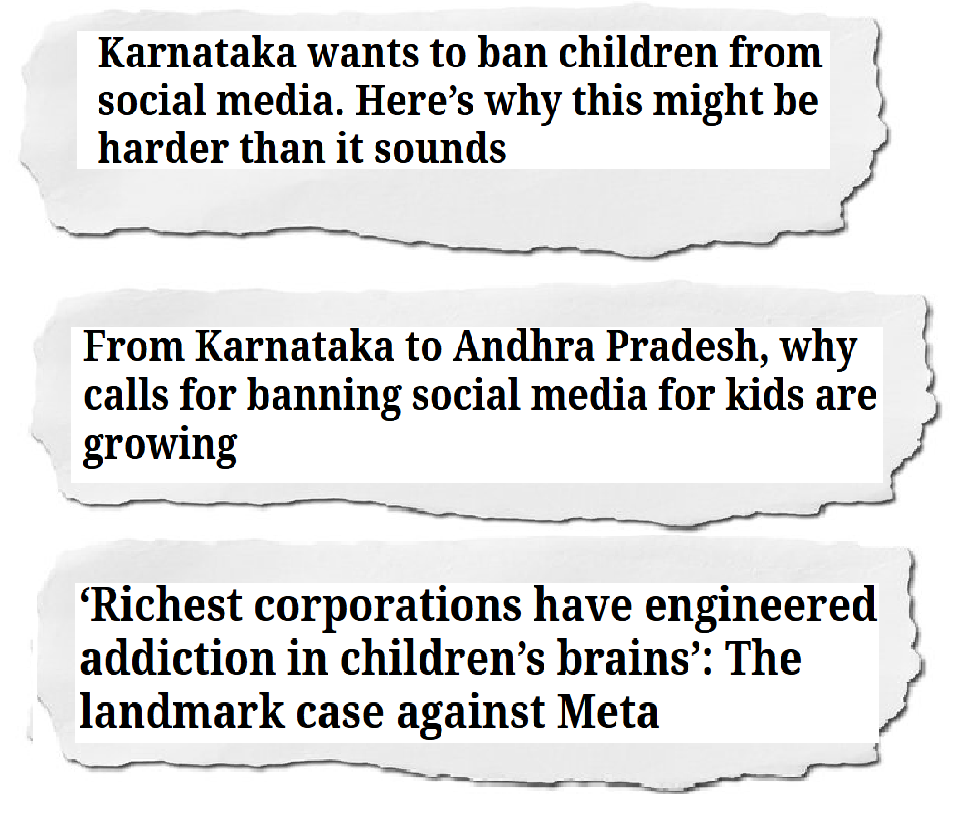
1. Karnataka wants to ban children from social media. Here’s why this might be harder than it sounds

This piece examines Karnataka’s proposal to restrict or ban children’s access to social media and explains why enforcing such a ban would be extremely difficult in practice.

Key points:

  • The intent is protective — to shield kids from addiction, harmful content, cyberbullying, etc.
  • Major challenges include:
    • Weak or absent age-verification systems on platforms.
    • Easy workarounds (VPNs, fake accounts, shared devices).
    • Technical difficulty in monitoring millions of users across apps and devices.
    • Legal hurdles: potential conflict with constitutional rights to information and expression for minors.
  • Experts argue that outright bans often drive usage underground and that education, parental tools, and better platform design are also needed.
  • Another issue is the debate between state control vs parental control. Some argue that parents should decide what is best for their children, while others believe that government intervention is necessary because many parents may not have the awareness or ability to regulate usage effectively.
  • Similar attempts abroad (e.g., UK’s Online Safety Act) face the same enforcement problems.

Conclusion: While well-intentioned, the ban is likely to be largely ineffective without major technological and legal reforms.

2. From Karnataka to Andhra Pradesh, why calls for banning social media for kids are growing

There is a rising state-level demands in India to restrict kids’ social media access.

Key proposals:

  • Karnataka: Announced in the state Budget — social media ban for children under 16 to prevent adverse effects of rising mobile usage (stated by CM Siddaramaiah).
  • Andhra Pradesh: Plans to introduce regulations within 90 days banning social media for those under 13.
  • No uniform central law yet, though the IT Ministry is in preliminary talks and India’s Economic Survey 2025-26 recommends age-based limits, content filters, and promoting simpler “education-only” devices.

Challenges highlighted:

  • State-level bans create inconsistency (different ages, enforcement issues).
  • Tech companies warn it could push kids to unregulated, less-safe platforms.
  • Digital rights groups (e.g., Internet Freedom Foundation) call blanket bans “disproportionate,” arguing they ignore root causes like poor platform design and could widen the gender digital divide (e.g., families keeping girls offline).

3. ‘Richest corporations have engineered addiction in children’s brains’: The landmark case against Meta

There is a ongoing high-profile US trial against Meta (Instagram/Facebook) in Los Angeles, focusing on scientific and design aspects of social media addiction in kids.

Main details:

  • First major trial in a wave of lawsuits by teens, parents, and school districts accusing Meta (and others like YouTube) of deliberately designing addictive features (endless scroll, “slot-machine” dopamine hits, beauty filters) that harm young users’ mental health — causing anxiety, depression, body dysmorphia, eating disorders, and self-harm.
  • Evidence includes internal Meta documents showing the company prioritized teen engagement, knew about under-13 users, and downplayed risks (parallels drawn to Big Tobacco lawsuits).
  • Mark Zuckerberg testified in February 2026, expressing some regret but defending the platforms as “valuable” and arguing age verification is hard.
  • Scientifically: Excessive use is described as “problematic/compulsive” rather than clinically “addicted” by the American Psychiatric Association, but the trial highlights how design exploits children’s developing brains.

Implications:

  • Could set precedents for thousands of similar cases and push for stricter regulations worldwide.
  • Ties directly into the Indian context — the same concerns (addiction, mental health) are driving Karnataka and Andhra Pradesh’s ban proposals.

It shows a clear trend States are responding to real harms of social media on children (backed by global evidence and the Meta trial), but enforcement faces huge practical, legal, and technical obstacles. An Union law (rather than patchy state bans) is widely seen as more effective, alongside better digital literacy, parental tools, and platform accountability. The conversation is still evolving, with no bans fully implemented in India yet.