Why in News?
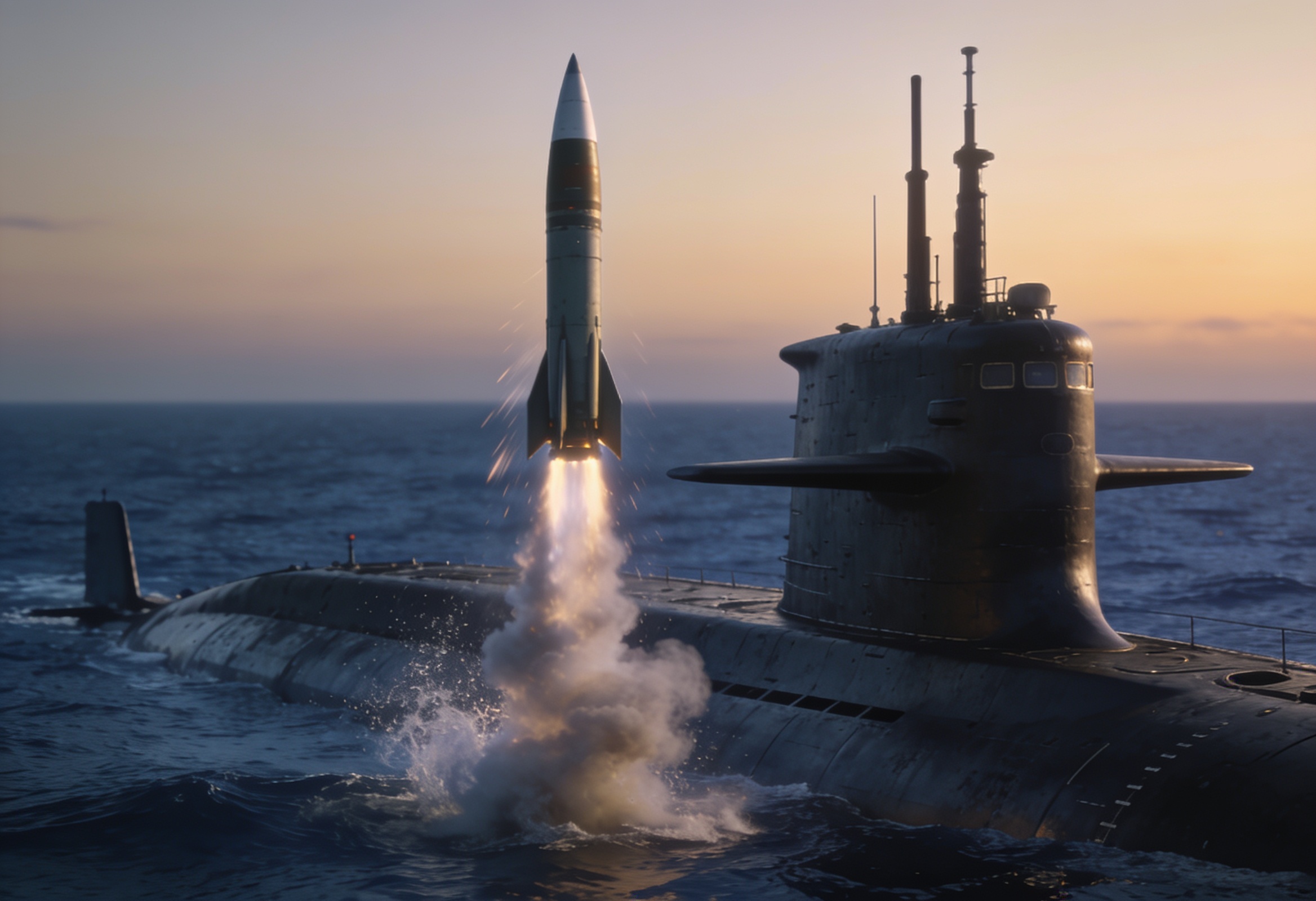
In late December 2025 India test-fired the indigenously developed K-4 submarine-launched ballistic missile (SLBM) from the nuclear-powered submarine INS Arighaat in the Bay of Bengal. The K-4 carries a nuclear warhead to a range of about 3,500 km, and the trial was reported as the first launch of the weapon from this newly commissioned boat.
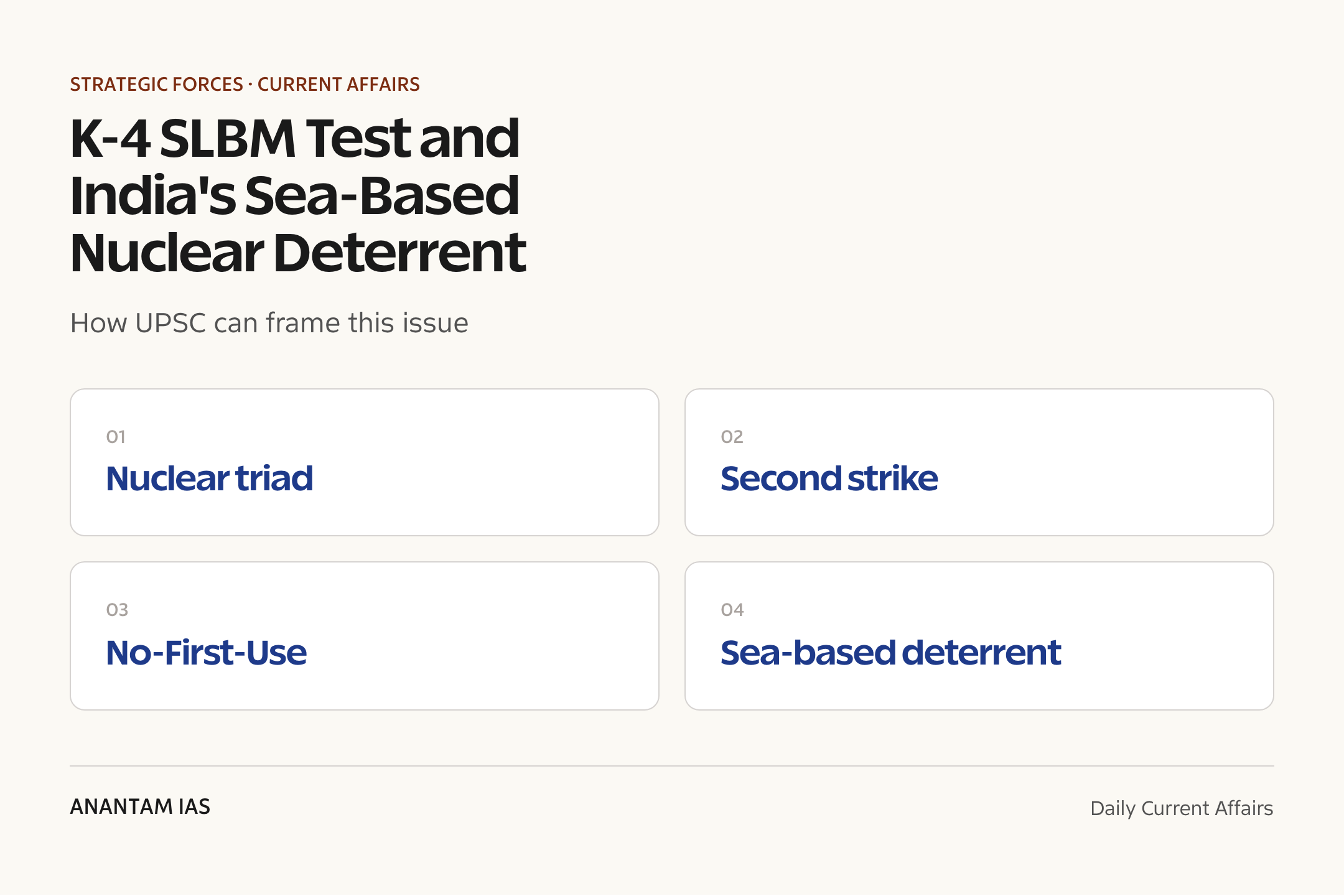
The test matters because the K-4 anchors the sea leg of India’s nuclear triad — the survivable second-strike platform that underpins the No-First-Use (NFU) doctrine and credible minimum deterrence.
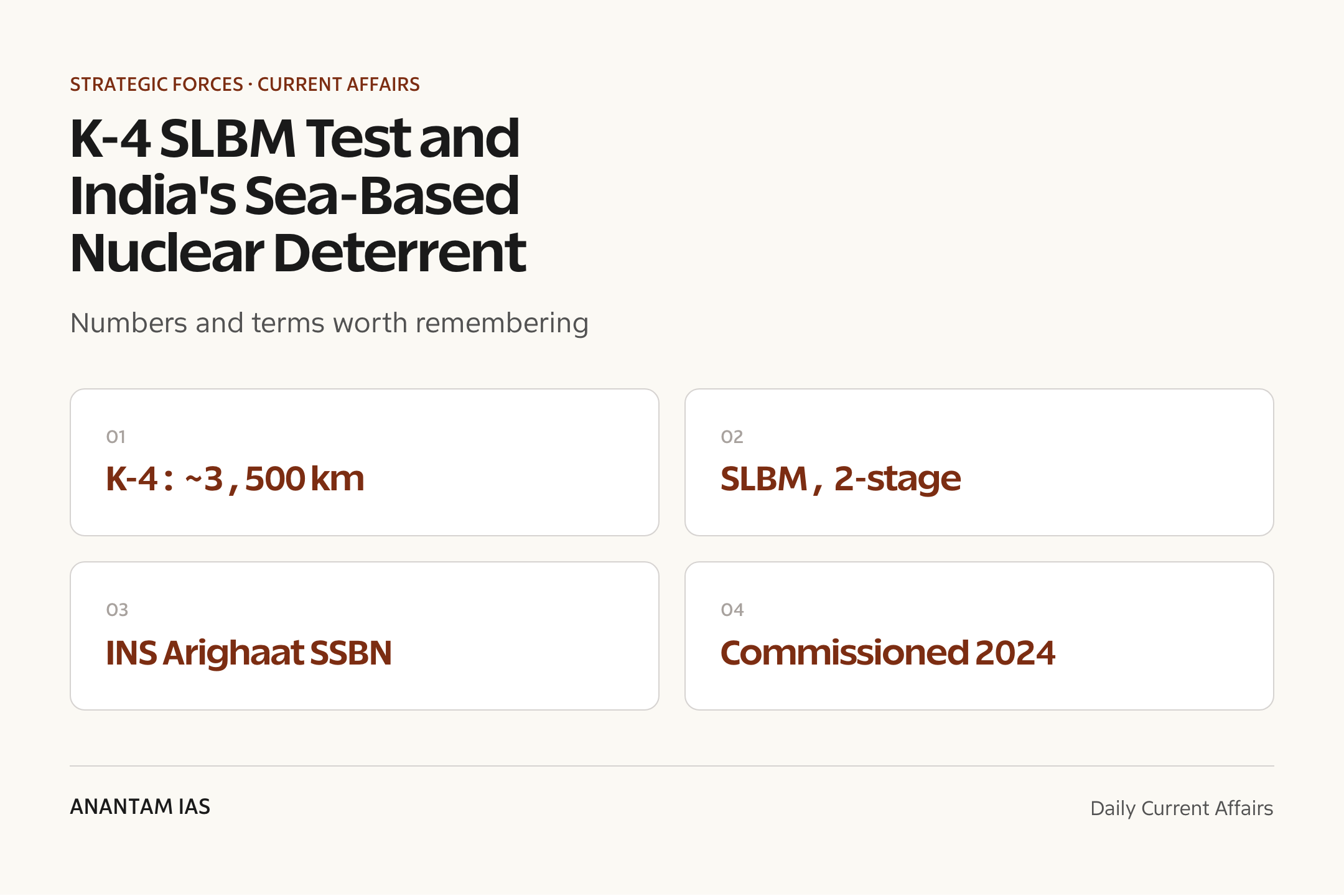
- Missile tested: the K-4, a solid-fuel, two-stage SLBM with a range of roughly 3,000–3,500 km, developed by the Defence Research and Development Organisation (DRDO).
- Launch platform: INS Arighaat, an Arihant-class nuclear ballistic-missile submarine (SSBN) commissioned on 29 August 2024 and operated by the Strategic Forces Command.
- Warhead capacity reported at about 2–2.5 tonnes; the missile design draws on the Agni-III family.
- As reported by the Times of India and noted by The Week, there was no formal Ministry of Defence statement on the launch — common for strategic, nuclear-capable systems.
The development matters in the context of:
- India holds nuclear weapons under a declared No-First-Use posture, which makes a survivable retaliatory capability — not a first strike — the doctrine’s centre of gravity.
- Submarines on patrol are the hardest leg of the triad to detect and destroy, so an SLBM with intercontinental reach extends deterrence credibility deep into the Indo-Pacific.
UPSC Relevance
Prelims Relevance
- K-4 SLBM: range ~3,500 km, solid-fuel, two-stage, DRDO-developed.
- K-15 (Sagarika): shorter-range SLBM, ~700–750 km, India’s first sea-launched ballistic missile.
- K-5 and K-6: longer-range SLBMs under development.
- INS Arihant: India’s first indigenous SSBN; INS Arighaat is the second boat of the class.
- INS Aridhaman: third Arihant-class SSBN expected to join the fleet.
- Strategic Forces Command (SFC): manages India’s nuclear arsenal under the Nuclear Command Authority.
- Nuclear triad: land (Agni missiles), air (aircraft-delivered bombs), sea (SLBMs on SSBNs).
- SSBN vs SSN: SSBN carries strategic ballistic missiles; SSN is a nuclear-powered attack submarine.
- No-First-Use (NFU) and credible minimum deterrence: pillars of India’s 2003 nuclear doctrine.
- Agni-V: land-based ICBM with 5,000+ km range, the longest-range Indian missile in service.
Mains Relevance
GS Paper 3
- Significance of the sea-based deterrent for India’s national security and assured second-strike capability.
- Role of indigenous DRDO programmes and self-reliance (Atmanirbhar Bharat) in strategic-weapons development.
GS Paper 2
- How a credible triad shapes India’s deterrence posture and stability in the Indo-Pacific maritime theatre.
Essay
- Deterrence, doctrine and restraint: does a stronger second-strike capability make a region safer or more fragile?
Background and Context
What is the nuclear triad?
A triad spreads nuclear weapons across three independent delivery platforms so that no single attack can disarm a state.
- Land leg: silo- and road-mobile ballistic missiles — India’s Agni series, including the 5,000+ km Agni-V.
- Air leg: gravity bombs and stand-off weapons carried by fighter aircraft.
- Sea leg: SLBMs fired from SSBNs patrolling silently at sea — the most survivable and hardest to pre-empt.
- The sea leg is what converts a deterrent from vulnerable to assured, because a hidden submarine can retaliate even after a first strike on land targets.
The K-4 missile
The K-4 is the workhorse SLBM that gives India’s SSBNs meaningful strategic reach.
- Range: about 3,000–3,500 km, a major jump over the earlier K-15 (Sagarika) at roughly 700–750 km.
- Propulsion: solid-fuel, two-stage design, reported to draw on the Agni-III lineage.
- Payload: capable of carrying a nuclear warhead of about 2–2.5 tonnes.
- Developed by the DRDO as part of the larger K-family of underwater-launched missiles.
- Longer-range successors — the K-5 and K-6 — are under development to extend reach further.
INS Arighaat and the SSBN fleet
India is steadily building a small but capable fleet of nuclear-missile submarines.
- INS Arihant: the lead boat, India’s first indigenously built SSBN, gave the country an operational sea-based deterrent.
- INS Arighaat: the second Arihant-class boat, commissioned on 29 August 2024, with design refinements over the lead vessel.
- INS Aridhaman: the third boat of the class, expected to be inducted, will deepen continuous-patrol capacity.
- The boats operate under the Strategic Forces Command, the tri-service body that handles delivery of nuclear weapons.
Second-strike capability and NFU
A survivable sea leg is the technical basis of India’s declared nuclear doctrine.
- India’s 2003 nuclear doctrine rests on No-First-Use and credible minimum deterrence.
- NFU only deters an adversary if retaliation after a first strike is certain — that certainty is what a hidden submarine provides.
- An SSBN on patrol can ride out a surprise attack on land-based forces and still deliver an assured second strike.
- Decisions to release weapons rest with the civilian-led Nuclear Command Authority, with the SFC as the executing arm.
Strategic and regional significance
The test signals maturing capability in a contested maritime neighbourhood.
- A ~3,500 km SLBM lets a patrolling boat hold distant targets at risk without venturing into vulnerable waters.
- It strengthens deterrence stability across the Indo-Pacific amid an expanding regional submarine and missile competition.
- Indigenous development reinforces strategic autonomy and reduces dependence on imported delivery systems.
- As a nuclear-capable system, such trials are typically conducted quietly, without the publicity that surrounds conventional-missile tests.
Way Forward
Deepen the SSBN fleet
- Induct additional Arihant-class boats, including INS Aridhaman, to sustain a credible continuous-at-sea deterrent.
- Invest in quieter propulsion, longer endurance and survivable command-and-control links for submerged boats.
Complete the missile ladder
- Operationalise longer-range SLBMs (K-5, K-6) so patrol boxes can stay well clear of adversary anti-submarine zones.
- Pair missiles with reliable re-entry and warhead systems while keeping arsenals to minimum deterrence levels.
Sustain indigenous R&D under the DRDO and Indian Navy, protect strict secrecy around strategic platforms, and keep doctrine, command structures and confidence-building measures aligned so capability growth supports — not erodes — regional stability.
Conclusion
The K-4 launch from INS Arighaat is less about a single missile and more about closing the gap between a declared doctrine and the hardware that makes it credible. A survivable sea leg turns India’s No-First-Use pledge from a statement of intent into an assured retaliatory capability.
For an exam, the durable takeaways are the structure of the nuclear triad, the role of SSBNs and the Strategic Forces Command, and why second-strike survivability sits at the heart of credible minimum deterrence.
UPSC Practice Questions
Prelims MCQ 1
With reference to India’s nuclear-capable missile systems, consider the following statements:
- The K-4 is a submarine-launched ballistic missile with a range of around 3,500 km.
- INS Arighaat is an Arihant-class nuclear-powered ballistic-missile submarine.
- The K-15 (Sagarika) has a longer range than the K-4.
How many of the above statements are correct?
(a) Only one (b) Only two (c) All three (d) None
Answer: (b) Only two
Explanation:
Statements 1 and 2 are correct. Statement 3 is wrong: the K-15 (~700–750 km) is far shorter-ranged than the K-4 (~3,500 km).
Prelims MCQ 2
Which of the following best describes India’s ‘nuclear triad’?
(a) Three types of nuclear warheads of differing yields (b) Three independent platforms — land, air and sea — for delivering nuclear weapons (c) A three-nation nuclear alliance in the Indo-Pacific (d) Three command levels in the Nuclear Command Authority
Answer: (b) Three independent platforms — land, air and sea — for delivering nuclear weapons
Explanation:
The triad means delivery by land-based missiles (Agni), aircraft, and sea-based SLBMs on SSBNs, ensuring a survivable second strike.
UPSC Mains Questions
- Examine how a survivable sea-based deterrent strengthens the credibility of India’s No-First-Use nuclear doctrine. Why is second-strike capability central to credible minimum deterrence? (250 words)
- Indigenous strategic-weapons programmes are as much about strategic autonomy as about firepower. Discuss with reference to India’s SSBN and submarine-launched ballistic missile capabilities. (250 words)
Sources: Army Recognition (citing Times of India) and The Week.
Frequently Asked Questions
What is the K-4 missile?
The K-4 is an indigenously developed, solid-fuel, two-stage submarine-launched ballistic missile (SLBM) with a range of about 3,500 km. Built by the DRDO, it can carry a nuclear warhead and is designed to be fired from India’s Arihant-class nuclear-powered submarines, giving the navy meaningful strategic reach from underwater.
What is INS Arighaat?
INS Arighaat is the second Arihant-class nuclear-powered ballistic-missile submarine (SSBN) in the Indian Navy, commissioned on 29 August 2024. It carries design refinements over the lead boat INS Arihant and operates under the Strategic Forces Command, forming the sea-based leg of India’s nuclear deterrent.
What is a nuclear triad?
A nuclear triad is the ability to deliver nuclear weapons by three independent platforms: land-based missiles, aircraft, and submarine-launched ballistic missiles. Spreading weapons across all three makes it nearly impossible for an adversary to destroy the entire arsenal in one strike, which is what makes a deterrent survivable and credible.
Why is second-strike capability important?
Second-strike capability means a country can still retaliate with nuclear weapons even after absorbing a first strike. Because submarines on patrol are hard to find and destroy, an SLBM-armed SSBN guarantees retaliation. This assurance is the technical basis of India’s No-First-Use doctrine and credible minimum deterrence.
What is India’s No-First-Use policy?
Under its 2003 nuclear doctrine, India pledges not to use nuclear weapons first, reserving them only for retaliation against a nuclear attack. The doctrine pairs No-First-Use with credible minimum deterrence, which requires just enough survivable capability to make retaliation certain, rather than a large first-strike arsenal.
How is the K-4 different from the K-15?
The K-15 (Sagarika) was India’s first SLBM, with a range of roughly 700–750 km. The K-4 is a far longer-range successor at about 3,500 km, letting a submarine strike distant targets while staying in safer waters. Longer-range variants, the K-5 and K-6, are under development.