Why in News?
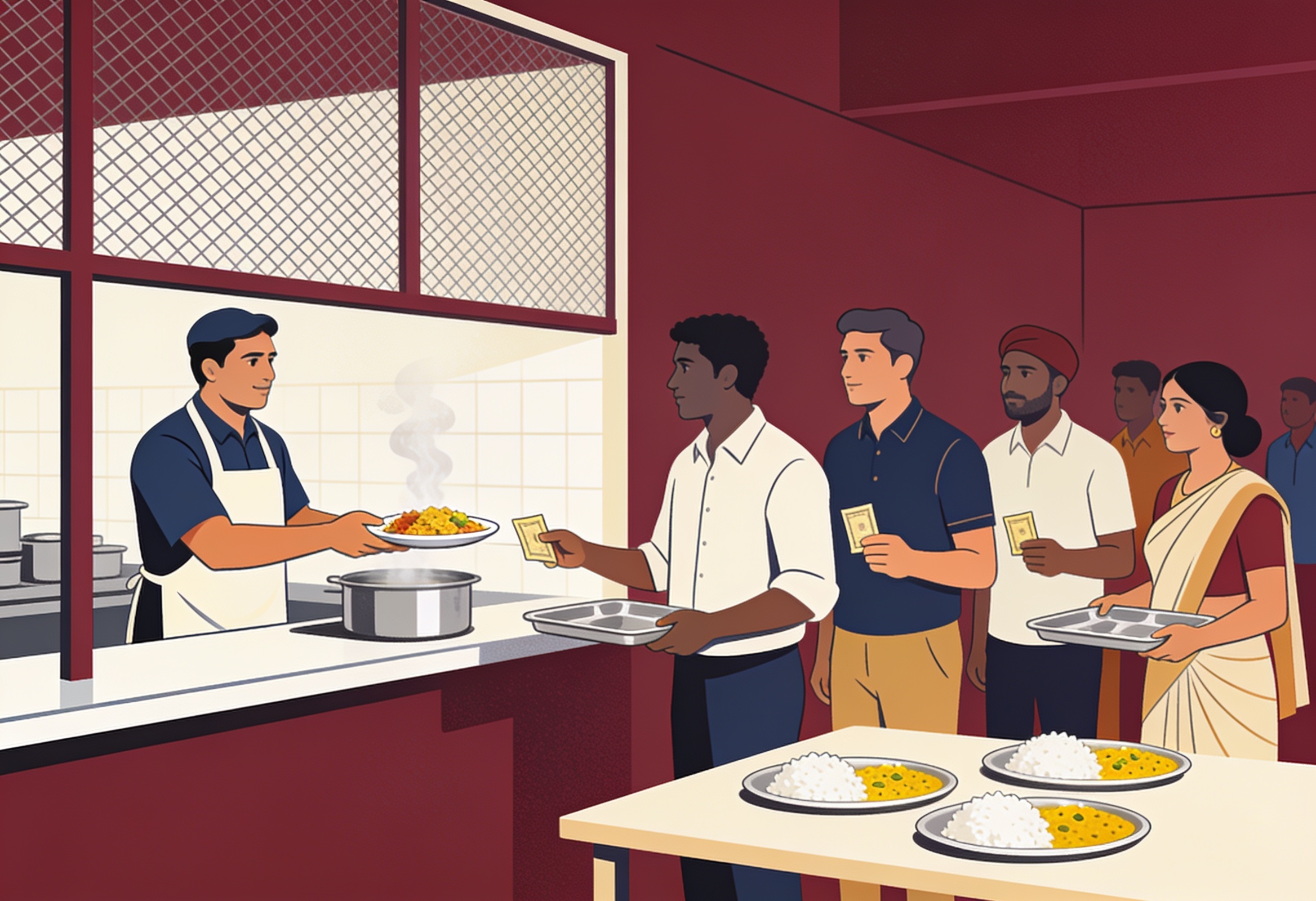
The Delhi government launched the Atal Canteen scheme on December 25, 2025, the birth anniversary of former Prime Minister Atal Bihari Vajpayee, to provide subsidised cooked meals to the city’s urban poor and daily-wage workers.
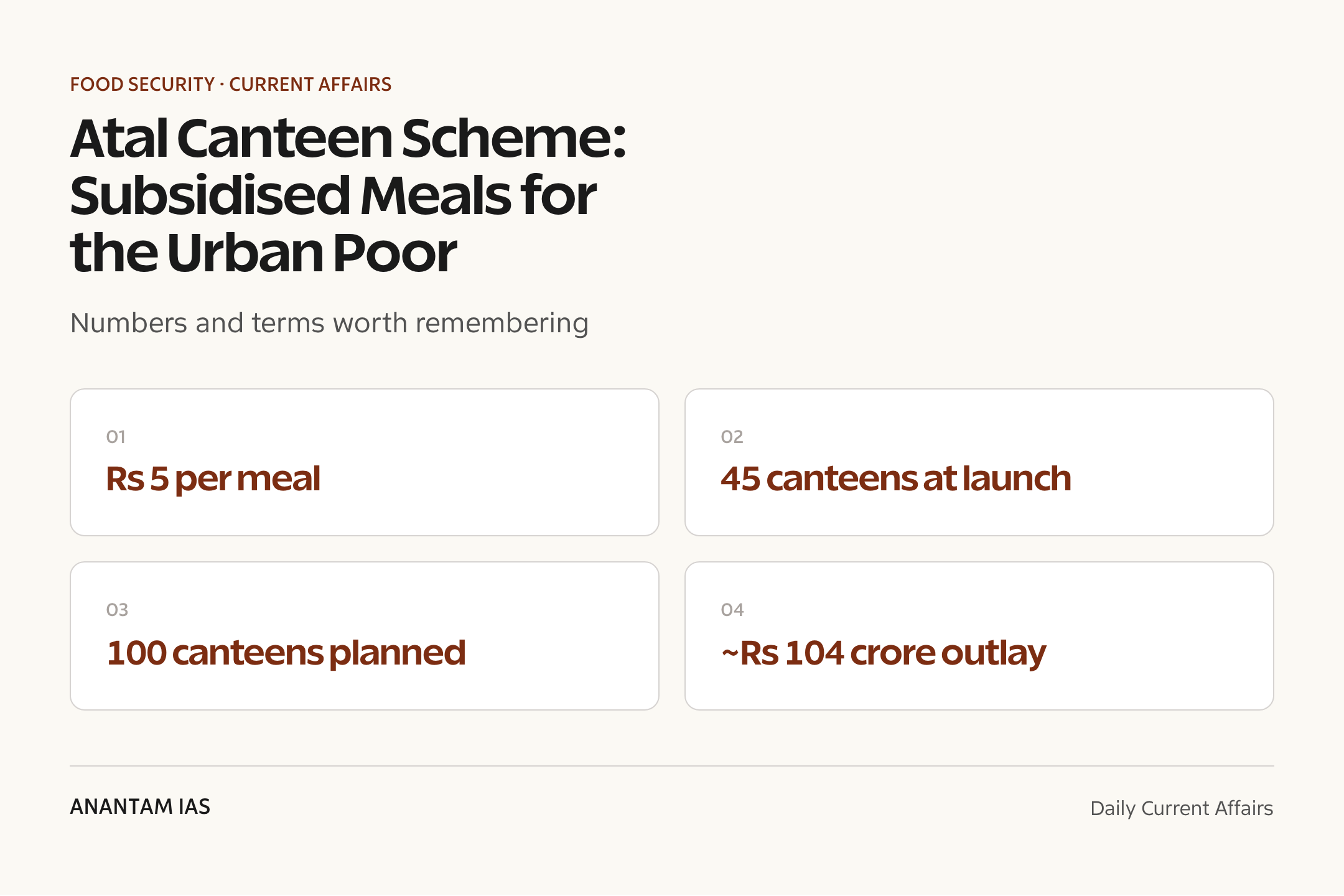
NewsOnAir (Prasar Bharati) reported that 45 canteens became operational on launch day, with the remaining canteens to open within a fortnight, taking the network towards a planned total of 100 canteens selling a meal for just Rs 5.
- Launched by Chief Minister Rekha Gupta on 25 December 2025, Atal Bihari Vajpayee’s birth anniversary.
- 45 canteens inaugurated on day one; 55 more targeted within roughly 15 days, towards 100 canteens overall.
- Each meal is priced at Rs 5, served as lunch and dinner to the needy and working people.
- Scheme outlay is around Rs 104 crore, managed by the Delhi Urban Shelter Improvement Board (DUSIB).
- Designed to serve roughly 1,000 people per canteen, scaling to about 1 lakh beneficiaries daily at full rollout.
The development matters in the context of:
- Sits in a lineage of state-run subsidised-meal schemes that treat affordable food as a welfare entitlement.
- Addresses urban food insecurity, a gap left by ration-based schemes that assume a fixed home and kitchen.
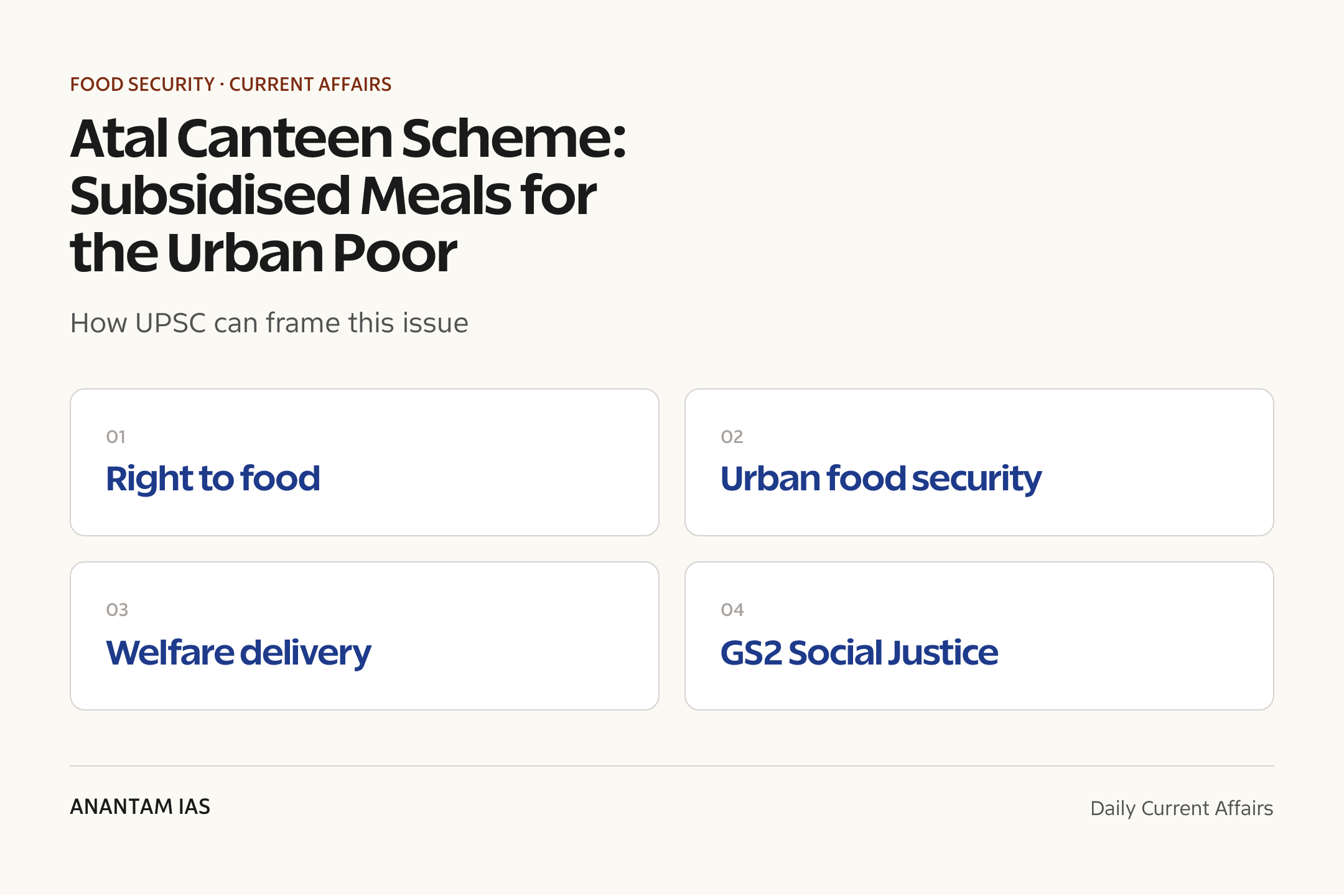
- Operationalises the spirit of the right to food, linked to Article 21 and the Directive Principles.
UPSC Relevance
Prelims Relevance
- Atal Canteen scheme — Delhi, launched 25 December 2025; Rs 5 meal.
- Implementing body: Delhi Urban Shelter Improvement Board (DUSIB).
- Outlay around Rs 104 crore; target of 100 canteens.
- Named after former PM Atal Bihari Vajpayee (birth anniversary, 25 December).
- Comparable schemes: Indira Canteen (Karnataka), Amma Unavagam (Tamil Nadu), Annapurna Rasoi (Rajasthan).
- Right to food derives from Article 21 read with DPSP Articles 39(a) and 47.
- National Food Security Act, 2013 — statutory backbone of subsidised food in India.
- JJ clusters — jhuggi-jhopri (slum) settlements that DUSIB administers in Delhi.
Mains Relevance
GS Paper 2
- Welfare schemes for vulnerable sections and the mechanisms for their implementation.
- Issues relating to development and management of social sector services like food security.
- Role of state governments and parastatal bodies (DUSIB) in last-mile welfare delivery.
GS Paper 3
- Public Distribution System, food security, and the limits of grain-based entitlements in cities.
- Subsidies, fiscal sustainability, and targeting in welfare programmes.
Essay
- Food is not charity but an entitlement: the welfare state and the right to live with dignity.
- Cities feed the nation but starve their own poor — the case for urban food security.
Background and Context
What the scheme provides
Atal Canteen offers a hot, sit-down meal at a token price to anyone unable to afford a market meal.
- A cooked meal at Rs 5, served as both lunch and dinner.
- Targeted at people from weak economic backgrounds and daily-wage workers across Delhi.
- Access through a token system for eligible persons at fixed hours.
- Each canteen is designed to feed about 1,000 people a day, reaching roughly 1 lakh at full scale.
Who runs it and what it costs
The scheme is anchored in an existing Delhi parastatal rather than a fresh bureaucracy.
- Implemented by the Delhi Urban Shelter Improvement Board (DUSIB), which already manages JJ clusters and night shelters.
- Reported outlay of about Rs 104 crore for the rollout.
- Phased launch: 45 canteens on 25 December 2025, with the balance to follow towards 100.
- Locating canteens near slums, markets, and labour hubs keeps the meal within walking distance of those who need it.
Why urban food insecurity is a distinct problem
Grain-based welfare assumes a settled home; the urban poor often have neither a stable address nor a kitchen.
- Migrant labourers and the homeless frequently lack a local ration card, leaving them outside the standard PDS net.
- Cooked-meal canteens bypass the household assumption, feeding the individual where they are.
- Rising rents and food prices squeeze the urban poor harder than headline poverty data suggest.
- A cheap, reliable meal frees scarce income for rent, health, and children’s schooling.
A lineage of subsidised-meal schemes
Atal Canteen joins a recognisable family of state-run community kitchens built over the past decade.
- Tamil Nadu’s Amma Unavagam (2013) pioneered the low-cost municipal canteen model in India.
- Karnataka’s Indira Canteen (2017) scaled the idea across Bengaluru and beyond.
- Rajasthan ran the Annapurna Rasoi, and several states experimented with similar kitchens.
- Each shares a common logic: dignified, no-stigma, pay-what-you-can-afford meals delivered through local bodies.
The constitutional anchor — right to food
Affordable food is not a discretionary handout; courts and the Constitution treat it as part of the right to life.
- The Supreme Court read the right to food into Article 21 in the long-running PUCL v. Union of India right-to-food litigation.
- Article 47 (DPSP) directs the state to raise the level of nutrition and standard of living.
- Article 39(a) directs that citizens have the right to an adequate means of livelihood.
- The National Food Security Act, 2013 converted much of this into a statutory entitlement; canteens extend it to those PDS misses.
Concerns and design questions
Community-kitchen schemes face recurring questions on quality, cost, and durability.
- Maintaining food quality and hygiene at a Rs 5 price point as volumes scale.
- Fiscal sustainability — recurring subsidy costs can outlast the political cycle that launched them.
- Risk of schemes shrinking or closing after a change of government, as seen with some predecessors.
- Ensuring genuine reach to the homeless and migrants, not just nearby residents who can already cook.
Way Forward
Build for permanence
- Tie funding to a stable line in the state budget rather than ad-hoc allocations.
- Embed clear hygiene and nutrition standards with regular independent audits.
Reach the truly excluded
- Site canteens deliberately near migrant labour hubs, shelters, and transit points.
- Avoid burdensome documentation so the homeless and undocumented migrants are not screened out.
Link the canteens to existing schemes — PDS, shelters, and skilling — so a cheap meal becomes an entry point to wider welfare rather than a stand-alone freebie.
Conclusion
The Atal Canteen scheme reframes a hot meal as a basic urban entitlement, extending the right-to-food idea to people the ration system was never built to reach.
Its lasting value will depend less on the Rs 5 headline than on quality, fiscal staying power, and whether it genuinely reaches the city’s most invisible workers.
UPSC Practice Questions
Prelims MCQ 1
With reference to the Atal Canteen scheme launched in December 2025, consider the following statements:
- It was launched by the Delhi government to provide subsidised cooked meals.
- It is implemented through the Delhi Urban Shelter Improvement Board (DUSIB).
- It is a Union government scheme administered by the Ministry of Consumer Affairs.
How many of the above statements are correct?
(a) Only one (b) Only two (c) All three (d) None
Answer: (b) Only two
Explanation:
Statements 1 and 2 are correct. The scheme is a Delhi government initiative run by DUSIB, not a Union scheme, so statement 3 is wrong.
Prelims MCQ 2
The constitutional and legal basis for affordable food entitlements in India is best reflected in which of the following?
(a) Article 21 read with Article 47 and the National Food Security Act, 2013 (b) Article 19 and the Essential Commodities Act, 1955 only (c) Article 32 and the Right to Education Act, 2009 (d) Article 14 and the Competition Act, 2002
Answer: (a) Article 21 read with Article 47 and the National Food Security Act, 2013
Explanation:
The right to food was read into the right to life (Article 21), is supported by DPSP Article 47, and was given statutory shape by the National Food Security Act, 2013.
UPSC Mains Questions
- Grain-based food security schemes are poorly suited to the realities of urban poverty. In this light, evaluate the role of state-run subsidised-meal canteens such as the Atal Canteen scheme in advancing the right to food.
- “A welfare scheme is only as good as its durability and reach.” Discuss the challenges of sustainability, quality, and targeting that confront community-kitchen programmes in Indian cities, suggesting measures to address them.
Sources: NewsOnAir, Prasar Bharati and Wikipedia.
Frequently Asked Questions
What is the Atal Canteen scheme?
It is a Delhi government welfare initiative launched on 25 December 2025 that provides cooked meals at Rs 5 to the urban poor, daily-wage workers, and the needy. It is run by the Delhi Urban Shelter Improvement Board (DUSIB) and aims to operate around 100 canteens across the city.
Why is the scheme named after Atal Bihari Vajpayee?
It was launched on 25 December 2025, the birth anniversary of former Prime Minister Atal Bihari Vajpayee, and named in his honour. Officials linked it to the vision that no one in the city should go to bed hungry.
How much does a meal cost and who can eat there?
A meal costs Rs 5 and is served as lunch and dinner. It is meant for people from weak economic backgrounds and daily-wage workers, who access the canteens through a token system at fixed hours.
Who runs the Atal Canteen scheme?
The scheme is implemented by the Delhi Urban Shelter Improvement Board (DUSIB), the parastatal body that already manages jhuggi-jhopri clusters and night shelters in Delhi. The reported outlay for the rollout is around Rs 104 crore.
How is it different from the public distribution system?
The PDS gives subsidised grain to households with ration cards, which assumes a fixed home and kitchen. Atal Canteen instead serves ready cooked meals to individuals, reaching migrants and homeless workers who often fall outside the ration net.
Which earlier schemes is it similar to?
It echoes Tamil Nadu’s Amma Unavagam, Karnataka’s Indira Canteen, and Rajasthan’s Annapurna Rasoi. All share the model of low-cost, no-stigma community kitchens delivered through state or local bodies to tackle urban food insecurity.
Tell Google you want more of this.
Add Anantam IAS as a preferred sourceOne tap, and this site shows up more often in your own Top Stories, AI Overviews and AI Mode. Remove it any time.