Opens in a new tab
Join Anantam IAS Channel on Telegram

Daily Digest · Thursday

29 January 2026 Current Affairs for UPSC

2 current affairs published on Thursday, 29 January 2026

29 January 2026 Current Affairs for UPSC — every Why-in-News article AnantamIAS published on Thursday, 29 January 2026, broken down with Why in News?, the exact GS paper it feeds, sub-topic mapping, MCQ-ready facts and a UPSC-style practice question. 2 articles in total, covering Polity, Economy, Environment, S&T, IR, Geography, History, Society and Internal Security — the same Why-in-News + GS-paper-mapping + practice-question format the Compass uses across every daily digest on the site.

Daily current affairs for UPSC is where new material enters your prep stream. Read this 29 January 2026 digest end-to-end in 25–35 minutes, attempt the practice question at the foot of each article (it's MCQ for some, 10/15-marker for others), then bookmark the entries that fall inside your active revision window. Everything stays cross-linked: tap any subject pill to jump to that subject's hub, or use the table of contents above to skip straight to a specific story.

Use this page three ways. Read sequentially for a one-sitting scan of everything that mattered on 29 January 2026. Download the 29 January 2026 PDF below for offline study or print revision. Or use the January 2026 Current Affairs compilation to see this day in the month's full context. For the previous day's reading, see 28 January 2026 Current Affairs; the next day's is 30 January 2026 Current Affairs.

Why we publish daily current affairs separately from the monthly compilation: daily is learning, monthly is revision. Use the daily page to add fresh material to your notes the day it breaks; come back to the January 2026 compilation 60 days before Prelims when the noise has settled and only the lasting takeaway is worth re-reading.

Solid Waste Management Rules 2026: A Reset for Urban Waste Governance

Open article →Download PDF

Why in News?

The Ministry of Environment, Forest and Climate Change (MoEFCC) has notified the Solid Waste Management Rules 2026 under the Environment (Protection) Act, 1986, replacing the decade-old SWM Rules 2016. The reset tightens segregation, expands Extended Producer Responsibility (EPR) and sets time-bound processing and scientific-landfill targets for urban local bodies (ULBs).

The new rules dovetail with the Swachh Bharat Mission-Urban 2.0 push on garbage-free cities and the government’s circular economy agenda, treating waste as a recoverable resource rather than a disposal problem.

  • Mandate source segregation into three streams — wet (biodegradable), dry (recyclable) and domestic hazardous/sanitary waste.
  • Extend EPR obligations onto producers, importers and brand-owners for packaging and harder-to-recycle waste streams.
  • Set time-bound targets for 100% scientific processing of fresh waste and remediation of legacy dumpsites via biomining and bio-capping.
  • Sharpen duties of bulk waste generators — bodies generating above the notified threshold must process wet waste on-site.
  • Align city sanitation with SBM-Urban 2.0 star-rating and the Garbage-Free City certification system.

The development matters in the context of:

  • India’s cities generate roughly 1.7 lakh tonnes of municipal solid waste a day, and a large share is still dumped unscientifically.
  • The SWM Rules 2016 were never fully enforced — segregation at source and landfill remediation lagged across most ULBs.
  • Mounting legacy waste at sites like Delhi’s Ghazipur and Bhalswa made dumpsite remediation a political and public-health priority.
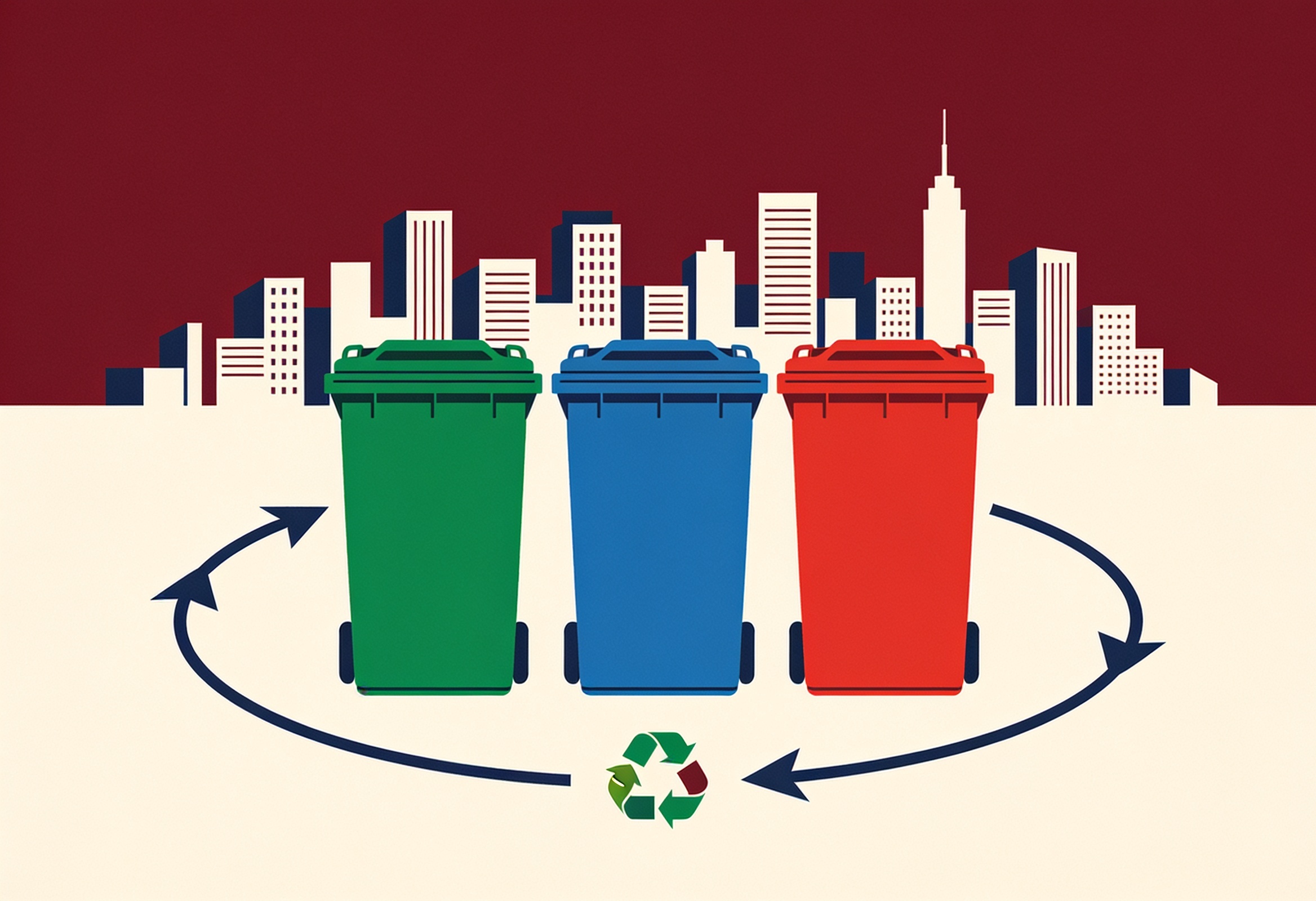
Flat editorial illustration of three colour-coded waste bins inside a recycling loop with a city skyline behind
Source segregation and the circular-economy idea behind the new urban waste rules Illustration: AI-generated (Freepik)
Solid Waste Management Rules 2026: A Reset for Urban Waste Governance — quick facts

UPSC Relevance

Prelims Relevance

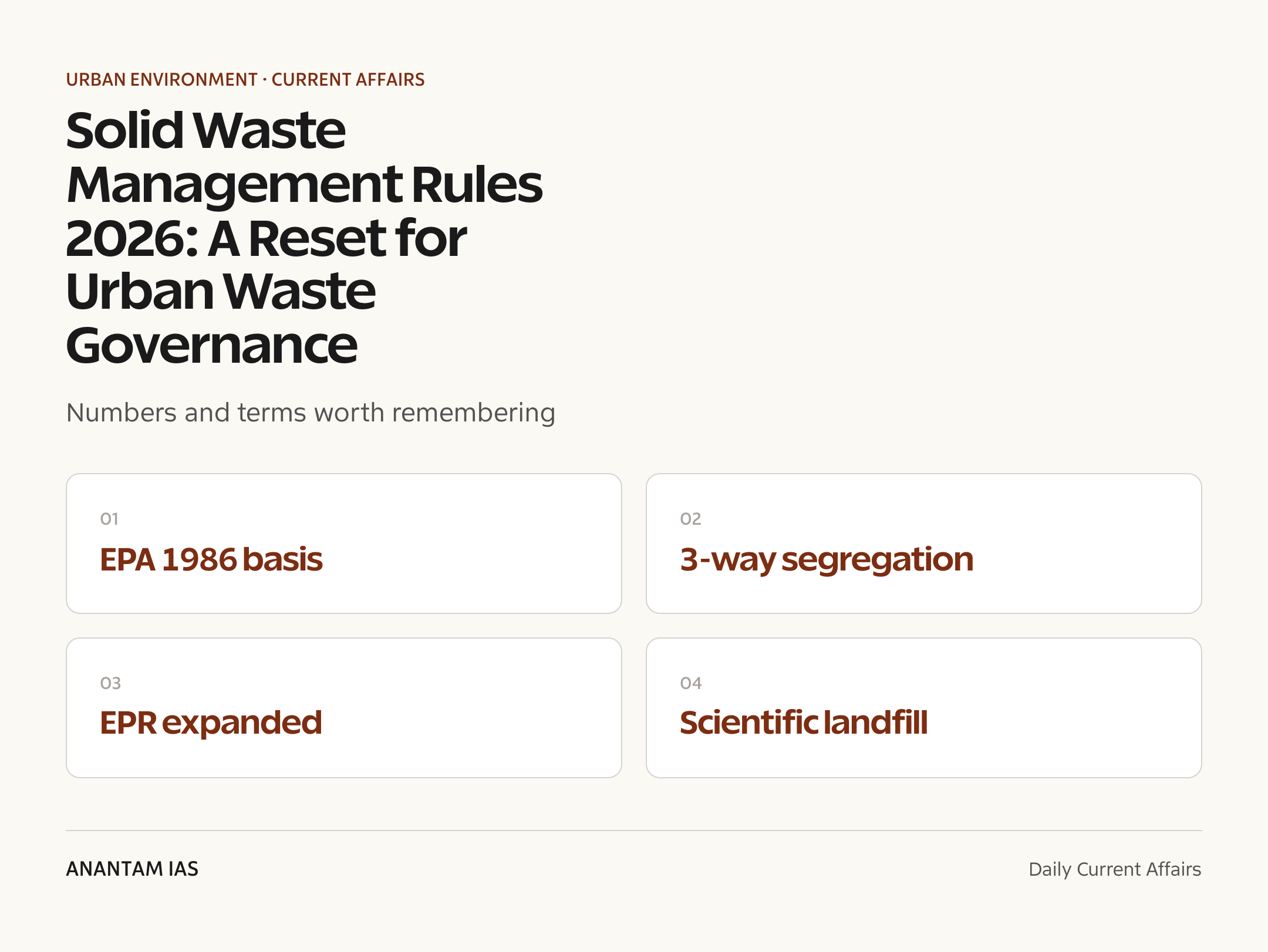
  • Solid Waste Management Rules 2026 notified under the Environment (Protection) Act, 1986 — a Central rule-making power.
  • SWM Rules 2016 superseded the Municipal Solid Wastes (Management and Handling) Rules, 2000.
  • Extended Producer Responsibility (EPR) — producer/brand-owner bears post-consumer waste responsibility.
  • Central Pollution Control Board (CPCB) — statutory body under the Water Act 1974, the apex monitoring authority.
  • Waste-to-energy (WtE) — incineration/RDF and biomethanation routes for non-recyclable residue.
  • Biomining and bio-capping — techniques used to remediate legacy waste dumpsites.
  • Swachh Bharat Mission-Urban 2.0 — aims at garbage-free cities; launched 2021.
  • 74th Constitutional Amendment Act, 1992 — sanitation/solid waste is a Twelfth Schedule function of urban local bodies.

Mains Relevance

GS Paper 3

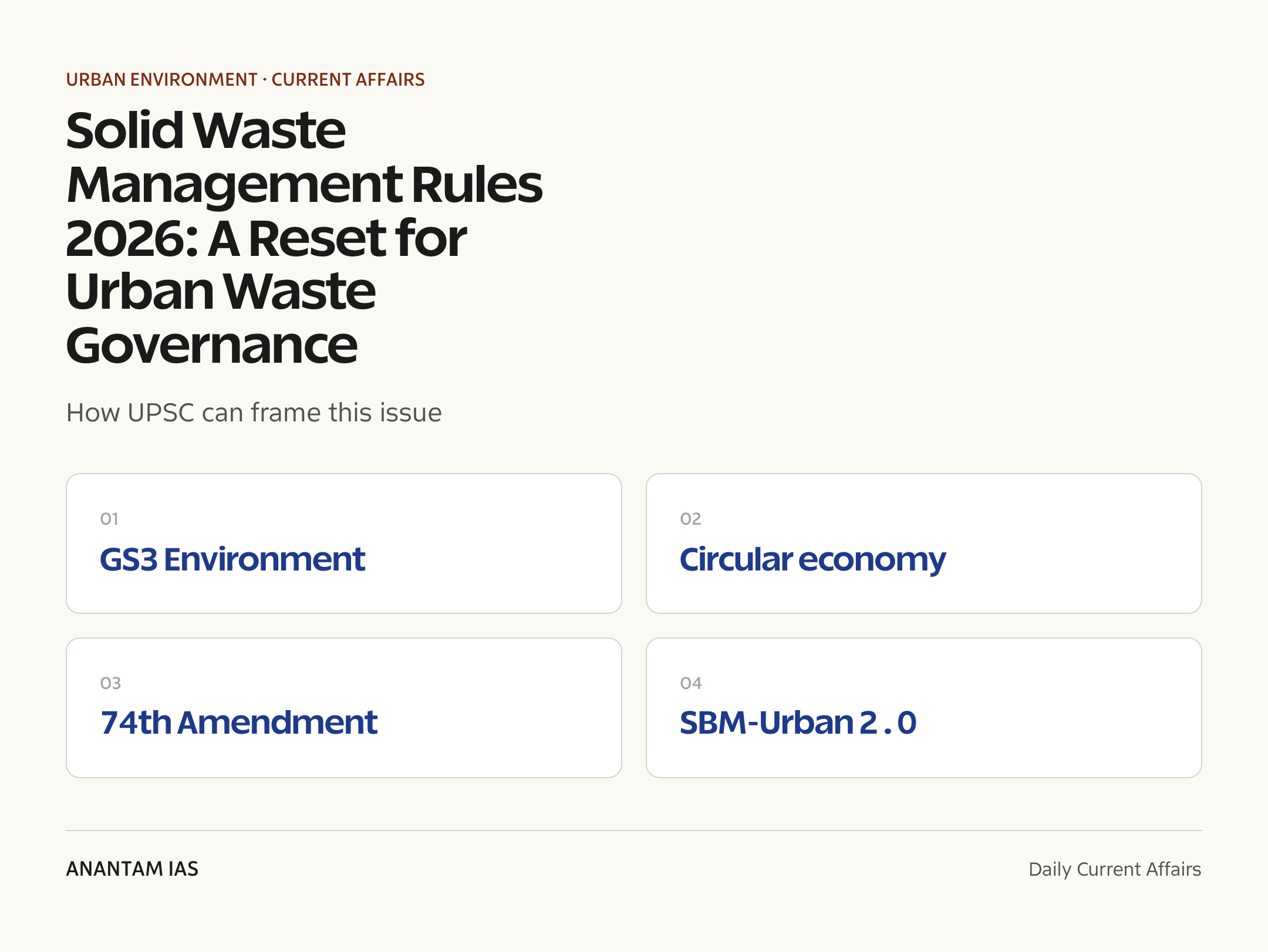
  • Examine how the SWM Rules 2026 advance a circular economy by treating waste as a resource.
  • Assess Extended Producer Responsibility as an instrument for managing packaging and plastic waste.

GS Paper 2

  • Evaluate the capacity of urban local bodies under the 74th Amendment to deliver time-bound waste targets.

Essay

  • Waste is not what we discard but what we have failed to value — the circular economy as a development idea.
  • Clean cities, the unfinished promise of urbanisation.

Background and Context

From 2016 to 2026: what the reset changes

The 2026 rules keep the architecture of the 2016 regime but close its biggest enforcement gaps.

  • Reaffirm and tighten source segregation into wet, dry and domestic hazardous/sanitary streams, with collection penalties for mixed waste.
  • Convert aspirational 2016 timelines into time-bound, monitorable targets for processing and dumpsite remediation.
  • Broaden EPR beyond plastics toward packaging, multi-layered and harder-to-recover materials.
  • Strengthen reporting and audit duties so CPCB and state boards can track ULB performance.
Solid Waste Management Rules 2026: A Reset for Urban Waste Governance — exam lens

Duties of generators and urban local bodies

The rules distribute clear obligations across households, bulk generators and the municipal machinery.

  • Households must hand over segregated waste; no co-mingling at the doorstep.
  • Bulk waste generators — large housing societies, hotels, hospitals, campuses above a notified threshold — must compost or process wet waste on-site.
  • Urban local bodies handle door-to-door collection, secondary transport, processing infrastructure and scientific landfilling.
  • Sanitation is a Twelfth Schedule subject under the 74th Amendment, so the rules effectively operationalise a constitutional municipal function.

EPR and the circular-economy logic

Extended Producer Responsibility shifts the cost of end-of-life waste onto those who put products on the market.

  • EPR makes producers, importers and brand-owners responsible for collecting back and recycling post-consumer packaging.
  • It feeds the circular economy goal of designing out waste and keeping materials in use.
  • Recovered dry waste re-enters manufacturing as recyclate, cutting demand for virgin material.
  • Better source segregation raises the quality and value of the recyclable stream.

Processing, waste-to-energy and scientific landfills

The rules push residue up the waste hierarchy and shrink the role of open dumping.

  • Wet waste is routed to composting and biomethanation; dry waste to material-recovery facilities.
  • Non-recyclable, high-calorific residue can go to waste-to-energy plants or be processed as refuse-derived fuel.
  • Only inert, non-processable residue should reach a scientific landfill — engineered with liners and leachate control.
  • CPCB sets standards and monitors emissions, leachate and processing compliance.

Legacy waste, dumpsites and remediation

Decades of unscientific dumping created mountains of legacy waste that the rules want cleared on a deadline.

  • Legacy waste at old dumpsites is to be remediated through biomining — excavating, screening and recovering material — and bio-capping.
  • Remediation reclaims valuable urban land and cuts methane and fire hazards.
  • Funding and execution are tied to Swachh Bharat Mission-Urban 2.0 support to states and ULBs.
  • Iconic sites such as Delhi’s Ghazipur and Bhalswa are the test cases for the new timelines.

Convergence with SBM-Urban 2.0 and the law

The rules sit inside a wider statutory and mission framework rather than standing alone.

  • Notified under the Environment (Protection) Act, 1986, giving them pan-India statutory force.
  • Operationally tied to SBM-Urban 2.0 outcomes — Garbage-Free City star ratings and the Swachh Survekshan survey.
  • Reinforce the role of state pollution control boards and CPCB in monitoring and enforcement.
  • Complement the separate Plastic Waste and E-Waste Management Rules within India’s waste-governance stack.

Way Forward

Make segregation stick

  • Pair penalties for mixed waste with reliable separate collection, so citizens trust that sorted waste stays sorted.
  • Run sustained behaviour-change and ward-level monitoring rather than one-off campaigns.

Fund and build ULB capacity

  • Strengthen municipal finances and technical staffing so urban local bodies can actually meet time-bound targets.
  • Use viability-gap funding and user charges to sustain processing plants beyond the grant period.

Close the loop on EPR

  • Build transparent, audited EPR registries so producer credits map to real recycling, not paper compliance.
  • Integrate the informal waste-picker economy with dignity, training and fair prices.

Conclusion

The Solid Waste Management Rules 2026 matter less for inventing new ideas than for converting the half-kept promises of 2016 into deadlines, duties and audited targets. Their real test is enforcement at the ward and dumpsite level, not the elegance of the notification.

If segregation, EPR and dumpsite remediation move together — and if cash-strapped urban local bodies get the money and people to deliver — the rules could turn India’s waste burden into a genuine circular economy opportunity. If not, they risk joining the long list of well-drafted environmental rules that the country never fully implemented.

UPSC Practice Questions

Prelims MCQ 1

With reference to the Solid Waste Management Rules 2026, consider the following statements:

  1. They are notified under the Environment (Protection) Act, 1986.
  2. They mandate segregation of waste at source into wet, dry and domestic hazardous streams.
  3. They abolish the principle of Extended Producer Responsibility introduced earlier.

How many of the above statements are correct?

(a) Only one (b) Only two (c) All three (d) None

Answer: (b) Only two

Explanation:

Statements 1 and 2 are correct — the rules are issued under the EPA 1986 and require three-way source segregation. Statement 3 is wrong: the rules expand, not abolish, Extended Producer Responsibility.

Prelims MCQ 2

In the context of municipal waste governance in India, the recovery of material from old dumpsites by excavating and screening accumulated legacy waste is best described as:

(a) Biomethanation (b) Biomining (c) Incineration (d) Leachate treatment

Answer: (b) Biomining

Explanation:

Biomining excavates and screens legacy waste to recover recyclables, soil and combustible fractions, reclaiming the dumpsite land. Biomethanation digests wet waste, while incineration burns residue for energy.

UPSC Mains Questions

  1. The Solid Waste Management Rules 2026 reframe municipal waste as a resource rather than a disposal problem. Examine how the rules advance a circular economy and the institutional bottlenecks that could hold them back.
  2. Extended Producer Responsibility shifts the burden of post-consumer waste onto producers. Critically evaluate its design and enforcement challenges in the Indian context.
  3. Sanitation and solid-waste management are constitutional functions of urban local bodies. Discuss why time-bound waste targets remain hard to deliver and suggest a way forward.

Sources: Ministry of Environment, Forest and Climate Change and Central Pollution Control Board.

Frequently Asked Questions

What are the Solid Waste Management Rules 2026?

They are central rules notified under the Environment (Protection) Act, 1986 that overhaul the 2016 framework for managing municipal solid waste. They tighten source segregation, expand Extended Producer Responsibility, and set time-bound targets for waste processing and scientific landfilling across India’s urban local bodies.

How do the 2026 rules differ from the SWM Rules 2016?

The 2016 rules introduced source segregation and EPR but were weakly enforced. The 2026 reset keeps that architecture while converting aspirational timelines into monitorable, time-bound targets, broadening EPR to more waste streams, and sharpening the duties of bulk generators and municipalities.

What is Extended Producer Responsibility in this context?

Extended Producer Responsibility, or EPR, makes producers, importers and brand-owners responsible for collecting back and recycling the post-consumer waste their products generate, especially packaging. It internalises the cost of waste and supports a circular economy by keeping materials in productive use.

What is the three-way segregation the rules require?

Households and generators must separate waste into three streams: wet or biodegradable waste for composting and biomethanation, dry recyclable waste for material recovery, and domestic hazardous and sanitary waste for safe handling. Mixed waste defeats downstream processing and attracts penalties.

How do the rules deal with legacy waste at old dumpsites?

They require remediation of legacy waste through biomining and bio-capping, where accumulated waste is excavated, screened and recovered, reclaiming land and cutting methane and fire risks. This work is tied to support under the Swachh Bharat Mission-Urban 2.0.

How are the rules linked to Swachh Bharat Mission-Urban 2.0?

The rules provide the statutory backbone for SBM-Urban 2.0’s garbage-free city goal. Compliance feeds into the Garbage-Free City star ratings and the Swachh Survekshan survey, while the mission channels funds and technical support to states and urban local bodies for processing and remediation.

The New Aadhaar App: Face Authentication, Consent and Digital Identity

Open article →Download PDF

Why in News?

The Unique Identification Authority of India (UIDAI) has rolled out a redesigned Aadhaar app that turns the 12-digit number into a fully digital, on-phone identity, replacing the practice of sharing printed copies of the Aadhaar letter for routine verification.

The headline feature is face authentication paired with a scannable QR code: a person can verify identity in seconds and share only the specific fields a checker needs, all gated by an explicit on-device consent step.

  • App enables QR-based offline verification — the verifier scans a code instead of photographing or photocopying the Aadhaar letter.
  • Face authentication on the phone confirms the holder is present, reducing reliance on fingerprint or OTP for in-person checks.
  • Selective disclosure lets a user share only name and photo (or only age band) rather than the full demographic record.
  • Aim, per UIDAI, is to cut physical-Aadhaar misuse and speed up offline KYC at hotels, airports, shops and counters.
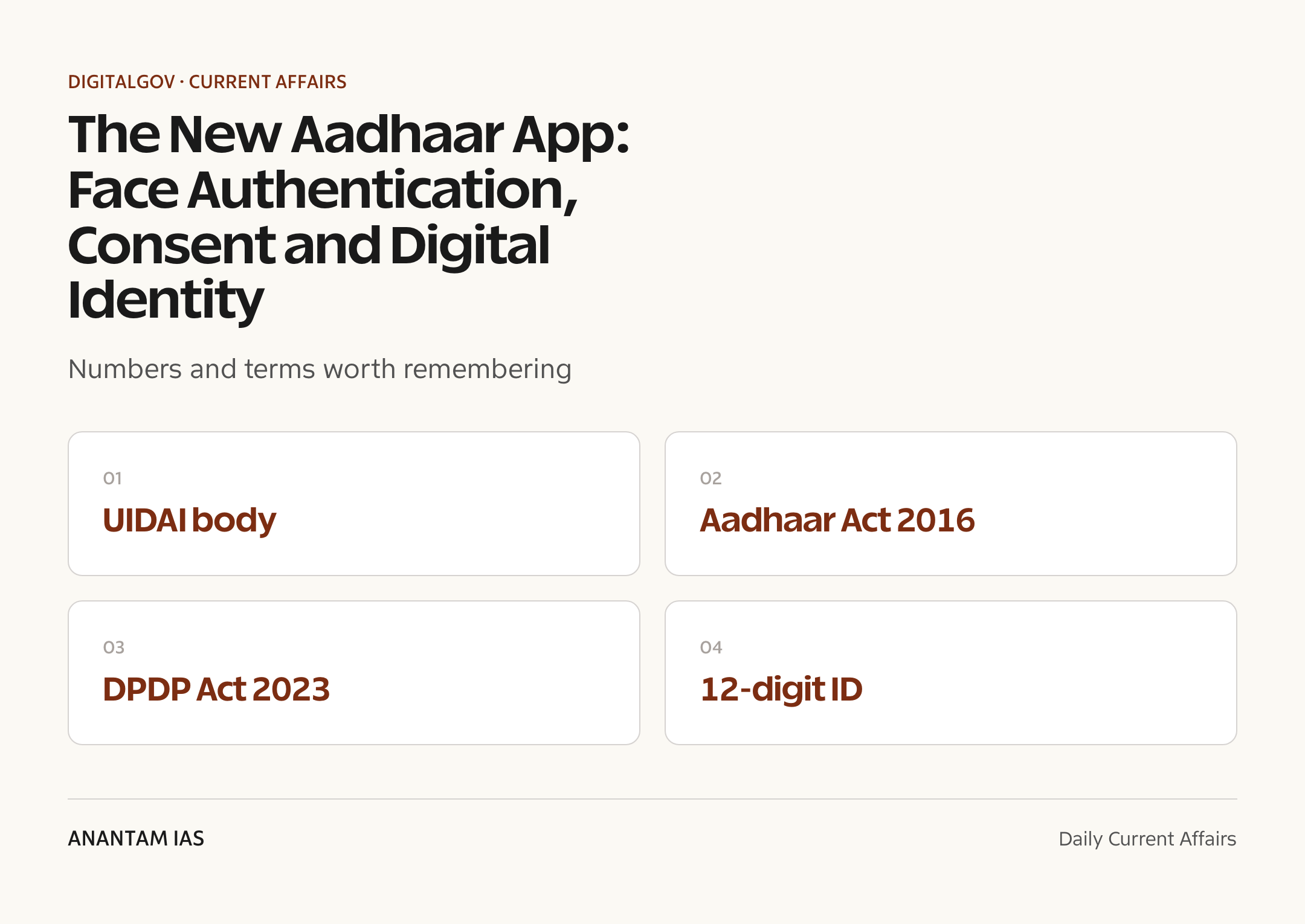
  • The redesign sits on top of the existing Aadhaar Act, 2016 framework and the Digital Personal Data Protection (DPDP) Act, 2023 obligations on consent and data minimisation.

The development matters in the context of:

  • Why this matters in the context of digital public infrastructure (DPI): Aadhaar is the identity layer of India’s JAM trinity and the new app re-engineers how that layer is presented and consented to.
  • Why this matters in the context of privacy: the Puttaswamy (2017–2018) jurisprudence set limits on Aadhaar use that any new feature must respect.
  • Why this matters in the context of data protection: consent architecture and selective disclosure are the operational test of the DPDP Act, 2023 principle of data minimisation.
Flat illustration of a smartphone showing a digital identity card with a face-scan ring, QR code, consent toggle and a protective shield.
Illustration of consent-driven, face-authenticated digital identity verification on a smartphone. Illustration: AI-generated (Freepik)
The New Aadhaar App: Face Authentication, Consent and Digital Identity — quick facts

UPSC Relevance

Prelims Relevance

  • UIDAI is a statutory body under the Aadhaar Act, 2016, attached to the Ministry of Electronics and Information Technology (MeitY).
  • Aadhaar is a 12-digit random number; it is proof of identity, not of citizenship.
  • Puttaswamy v. Union of India (2017) recognised the right to privacy as part of Article 21; the 2018 Aadhaar verdict upheld the Act with limits.
  • Section 7 of the Aadhaar Act allows Aadhaar for subsidies, benefits and services funded from the Consolidated Fund of India.
  • The 2018 verdict struck down Section 57, restricting Aadhaar use by private entities without a backing law.
  • DPDP Act, 2023 rests on consent, purpose limitation and the role of the Data Principal and Data Fiduciary.
  • JAM trinity = Jan Dhan accounts + Aadhaar + Mobile, the backbone of Direct Benefit Transfer (DBT).
  • Offline verification modes already include the QR code on the Aadhaar letter and masked Aadhaar; the app extends this on-device.
  • Face authentication is an additional UIDAI modality alongside fingerprint, iris and OTP.

Mains Relevance

GS Paper 2

  • Role of digital public infrastructure and identity in welfare delivery and governance reform.
  • Tension between state-led identity systems and the fundamental right to privacy after Puttaswamy.

GS Paper 3

  • Data protection, consent architecture and cyber-security implications of a phone-resident national ID.
  • Use of biometrics and face recognition in citizen-facing services: benefits and risks.

GS Paper 2

  • Citizens’ charters of accountability and transparency for bodies like UIDAI handling sensitive data.

Essay

  • Convenience versus consent: who owns my identity in a digital republic?
  • Technology as an enabler of inclusion and a vector of surveillance.

Background and Context

What changed in the new app

The redesign shifts Aadhaar from a paper letter to a consent-gated digital wallet on the phone.

  • Identity lives on the device; verification happens by QR scan rather than by handing over a photocopy.
  • Face authentication ties the live holder to the record, useful where fingerprint readers or network OTP are impractical.
  • Selective disclosure means a hotel or shop can receive only the fields it needs — say name and photo — not the full demographic set.
  • Every share is preceded by an explicit consent prompt, logging that the holder authorised that specific disclosure.
  • UIDAI frames the goal as cutting physical-Aadhaar misuse — forged copies, retained photocopies and casual data leakage at counters.
The New Aadhaar App: Face Authentication, Consent and Digital Identity — exam lens

The statutory backbone: Aadhaar Act and UIDAI

The app does not create new powers; it operates inside the existing 2016 statute.

  • The Aadhaar Act, 2016 gives UIDAI statutory status and governs enrolment, authentication and the protection of the Central Identities Data Repository (CIDR).
  • Section 7 anchors Aadhaar to subsidies and services drawn from the Consolidated Fund of India.
  • UIDAI functions under MeitY and is responsible for security of biometric and demographic data.
  • Authentication today already supports fingerprint, iris, OTP and face; the app makes the face mode citizen-facing and offline-friendly.

Privacy and the Puttaswamy limits

Any expansion of Aadhaar’s reach is read against the Supreme Court’s privacy jurisprudence.

  • Justice K.S. Puttaswamy v. Union of India (2017) held that the right to privacy is intrinsic to Article 21.
  • The 2018 Constitution-bench verdict upheld the Aadhaar Act but read it down — proportionality and a legitimate state aim are required.
  • The court struck down Section 57, barring private companies from demanding Aadhaar absent a specific law.
  • A consent-led, minimal-disclosure design is, in effect, the architecture Puttaswamy’s proportionality test invites.
  • Mission creep — quietly widening the fields verifiers can pull — remains the live constitutional risk.

Data protection under the DPDP Act, 2023

The new features map directly onto the obligations the data-protection law imposes.

  • The Digital Personal Data Protection Act, 2023 makes consent the default basis for processing personal data.
  • Principles of purpose limitation and data minimisation are exactly what selective disclosure operationalises.
  • The holder is a Data Principal; verifiers act as Data Fiduciaries accountable for what they collect and retain.
  • A verifier that scans a QR and keeps only the consented fields should, in principle, hold far less than one that photographs a full Aadhaar letter.
  • The Data Protection Board envisaged under the Act is the grievance and enforcement channel if disclosure rules are breached.

Aadhaar in the JAM trinity and DPI stack

Identity is one rail of India’s wider digital public infrastructure.

  • The JAM trinity — Jan Dhan, Aadhaar, Mobile — powers Direct Benefit Transfer and has cut leakage in welfare delivery, anchoring India’s digital public infrastructure.
  • Aadhaar is the identity layer that sits alongside payments (UPI) and data-sharing (Account Aggregator) in the DPI stack.
  • A cleaner, consent-driven verification flow strengthens trust in this stack as services digitise.
  • Offline modes matter for inclusion where connectivity is weak, so face-plus-QR can reach beyond OTP-dependent users.

Concerns and the criticism

Convenience invites its own risks that the design must answer.

  • Face recognition carries error and bias risks; a false match or mismatch can wrongly deny or grant access.
  • On-device identity raises device security and lost-phone questions that the app’s safeguards must cover.
  • A friction-free share button can normalise over-collection unless verifiers are audited for what they actually request.
  • Exclusion persists — those without smartphones, or with biometrics that fail to read, still need a non-digital fallback.
  • Centralised identity remains a high-value cyber-security target; breach impact scales with adoption.

Way Forward

Consent and minimisation by design

  • Default every share to the fewest fields a use-case needs, with clear logs the holder can review.
  • Audit Data Fiduciaries for over-collection and enforce purpose limitation under the DPDP Act.

Guardrails for biometrics

  • Publish face-authentication accuracy and bias metrics, and keep a robust non-biometric fallback to prevent exclusion.
  • Mandate a manual verification route so a failed face match never becomes a denial of service or benefit.

Operationalise the Data Protection Board quickly so citizens have a real grievance forum, and run public-awareness drives so users understand consent, selective disclosure and how to revoke a share.

Conclusion

The redesigned Aadhaar app is less a new power than a new presentation layer — it tries to make identity verification convenient while honouring the consent and minimisation logic that the DPDP Act, 2023 and the Puttaswamy judgments demand.

Whether it earns trust will turn on the details: transparent biometric accuracy, audited verifiers, a working grievance board and a fallback for those the technology leaves behind. Done well, it is a model for citizen-controlled digital identity; done carelessly, it risks the very mission creep the courts warned against.

UPSC Practice Questions

Prelims MCQ 1

With reference to the Aadhaar framework in India, consider the following statements:

  1. UIDAI is a statutory body established under the Aadhaar Act, 2016.
  2. Aadhaar is proof of Indian citizenship.
  3. The Supreme Court in the 2018 verdict struck down Section 57, which had allowed private entities to seek Aadhaar.

How many of the above statements are correct?

(a) Only one (b) Only two (c) All three (d) None

Answer: (b) Only two

Explanation:

Statements 1 and 3 are correct: UIDAI is statutory under the 2016 Act and the 2018 verdict struck down Section 57. Statement 2 is wrong — Aadhaar is proof of identity, not citizenship.

Prelims MCQ 2

The right to privacy was recognised as a fundamental right intrinsic to Article 21 in which case?

(a) Kesavananda Bharati v. State of Kerala (b) Justice K.S. Puttaswamy v. Union of India (2017) (c) Maneka Gandhi v. Union of India (d) Minerva Mills v. Union of India

Answer: (b) Justice K.S. Puttaswamy v. Union of India (2017)

Explanation:

The 2017 nine-judge Puttaswamy bench unanimously held that the right to privacy is intrinsic to the right to life and liberty under Article 21.

UPSC Mains Questions

  1. India’s new Aadhaar app introduces face authentication, consent-gated sharing and selective disclosure of identity data. Examine how these features address — and where they fall short of — the principles laid down in the Puttaswamy judgments and the DPDP Act, 2023. (250 words)
  2. Digital public infrastructure has transformed welfare delivery in India but also concentrated sensitive personal data. Critically evaluate the governance and data-protection safeguards needed for a phone-resident national identity system. (250 words)
  3. Discuss the trade-off between convenience and consent in state-led digital identity systems, with reference to the design of the redesigned Aadhaar app. (150 words)

Sources: UIDAI, Ministry of Electronics and Information Technology and Press Information Bureau.

Frequently Asked Questions

What is new in the redesigned Aadhaar app?

The app turns the 12-digit Aadhaar into a fully digital, on-phone identity. Its headline features are face authentication, a scannable QR code for offline verification, and selective disclosure — letting a person share only the specific fields a verifier needs, each behind an explicit consent prompt, instead of handing over a printed photocopy.

How does selective disclosure protect privacy?

Selective disclosure lets the holder reveal only what a given check requires — say name and photo, or just an age band — rather than the full demographic record. This operationalises the data-minimisation and purpose-limitation principles of the DPDP Act, 2023, so a hotel or shop ends up holding far less personal data than when it photographs an entire Aadhaar letter.

Is the new app legally backed?

Yes. It operates within the existing Aadhaar Act, 2016, which gives UIDAI its statutory status, and must comply with the consent and accountability obligations of the Digital Personal Data Protection Act, 2023. It adds no new statutory power; it changes how identity is presented and consented to.

How does this relate to the Puttaswamy judgment?

The 2017 Puttaswamy verdict held privacy to be a fundamental right under Article 21, and the 2018 verdict upheld Aadhaar with proportionality limits while striking down Section 57. A consent-led, minimal-disclosure design is broadly the architecture that the court’s proportionality test invites, though mission creep remains a risk to watch.

What are the main concerns with face authentication?

Face recognition can produce false matches or mismatches and may carry bias, risking wrongful denial or access. On-device identity also raises device-security and lost-phone questions, and there is a risk of normalising over-collection. A robust non-biometric fallback is essential so a failed face match never becomes a denial of a service or benefit.

Where does Aadhaar fit in the JAM trinity?

Aadhaar is the identity rail of the JAM trinity — Jan Dhan accounts, Aadhaar and Mobile — that underpins Direct Benefit Transfer and has reduced leakage in welfare delivery. In the wider digital public infrastructure stack it sits alongside UPI for payments and the Account Aggregator for data sharing, acting as the trusted identity layer.