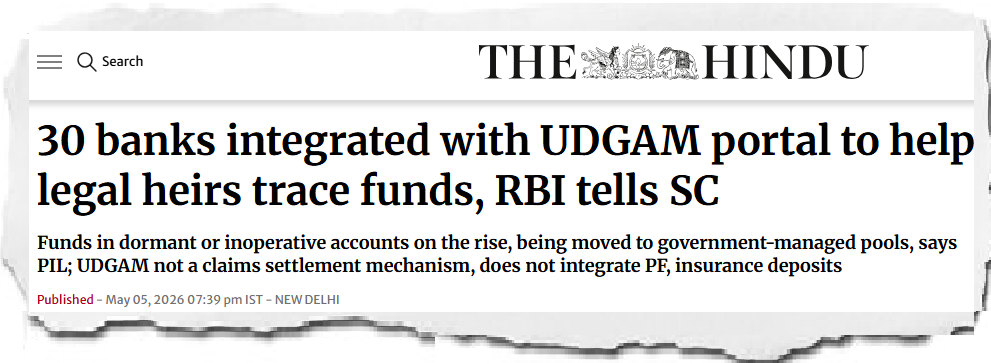
Why in News?
The Reserve Bank of India informed the Supreme Court of India that 30 banks have been integrated with the UDGAM portal to help legal heirs trace unclaimed deposits belonging to deceased account holders. The submission was made during hearings on a Public Interest Litigation (PIL) concerning rising unclaimed financial assets in banks and other institutions.
UPSC Relevance:
GS II:
Digital governance, citizen-centric administration, ease of living, access to justice, and financial inclusion.
GS III:
Banking reforms, financial sector regulation, digital public infrastructure, and data privacy concerns in centralized financial platforms.
Background
A Public Interest Litigation filed by journalist Sucheta Dalal highlighted the growing volume of dormant and unclaimed financial assets lying with banks, insurance companies, post offices, and investment institutions.
The petition argued that legal heirs often remain unaware of the existence of such accounts and face procedural difficulties while claiming them. It sought the creation of a unified digital mechanism enabling heirs to search and recover financial assets of deceased persons.
During the hearing, the RBI informed the Court about the operationalisation and expansion of the UDGAM portal.
What is the UDGAM Portal?
UDGAM stands for:
Unclaimed Deposits – Gateway to Access InforMation
It is a centralized web portal launched by the RBI in August 2023 to help individuals identify unclaimed deposits across multiple banks through a single platform.
The portal enables users to:
- Search for dormant or unclaimed bank deposits.
- Trace deposits belonging to deceased relatives.
- Identify the concerned bank holding such deposits.
- Initiate the process of claiming the funds from the respective bank.
The portal does not itself settle claims or transfer money. It only facilitates tracing and identification of deposits.
What are Unclaimed Deposits?
Unclaimed deposits refer to amounts lying in savings accounts, fixed deposits, recurring deposits, or other banking instruments that have remained inactive for a specified period without any customer operation.
Under RBI norms:
- A bank account becomes inoperative if there are no transactions for two years.
- Deposits remaining unclaimed for ten years are transferred to the Deposors’ Education and Awareness Fund (DEAF).
Common reasons for unclaimed deposits include:
- Death of account holder.
- Lack of nominee details.
- Migration of account holders.
- Forgotten accounts.
- Absence of communication with legal heirs.
Depositors’ Education and Awareness Fund (DEAF)
The DEAF was established by the RBI in 2014.
Features
| Aspect | Details |
| Managed by | RBI |
| Purpose | Hold unclaimed deposits transferred by banks |
| Source | Deposits inactive for 10 years |
| Use of funds | Depositor awareness and financial literacy initiatives |
| Ownership | Depositors/legal heirs retain claim rights permanently |
The PIL highlighted the rapid growth of the DEAF corpus.
| Year | DEAF Corpus |
| March 2020 | ₹33,114 crore |
| March 2021 | ₹39,264 crore |
This increase raised concerns regarding lack of awareness and procedural barriers in recovery of deposits.
RBI’s Submission Before the Supreme Court
The RBI informed the Court that:
- 30 banks have already been integrated with the portal.
- These banks account for nearly 90% of deposits lying in the DEAF.
- Around 20 lakh users have registered on the portal.
- Approximately 44 lakh searches had been conducted as of April 1, 2026.
The RBI also stated that several improvements have been introduced:
- User registration made optional.
- Search functionality expanded using address details.
- Relaxation of restrictions on number of searches and logins.
Constitutional and Legal Dimensions
The issue involves multiple constitutional and legal concerns.
1. Right to Property
Though no longer a Fundamental Right, Article 300A protects property rights and states that no person shall be deprived of property except by authority of law.
Unclaimed deposits legally continue to belong to depositors or their heirs.
2. Access to Justice
Lengthy documentation requirements such as:
- Succession certificates,
- Probate,
- Court orders,
often create barriers for ordinary citizens, especially poor families.
The petition argued that the refund process must become simple, affordable, and citizen-friendly.
3. Digital Governance and Financial Inclusion
The UDGAM portal reflects the broader move toward:
- Digital public infrastructure,
- Ease of access,
- Centralized governance systems,
- Financial inclusion.
It attempts to reduce information asymmetry between financial institutions and citizens.
Issues and Challenges
Fragmented Financial Information
Currently, different categories of assets remain scattered across institutions:
| Asset Type | Institution |
| Bank deposits | RBI and banks |
| Shares and dividends | IEPF, NSDL, CDSL |
| Insurance | Insurance companies |
| Provident fund | EPFO |
| Post office deposits | Department of Posts |
There is no single unified search platform.
Procedural Complexity
Banks and financial institutions frequently insist upon:
- Probate,
- Legal heir certificates,
- Succession certificates,
even in uncontested cases.
This increases litigation burden and delays.
Lack of Awareness
Many families are unaware that deceased relatives had:
- Bank accounts,
- Insurance policies,
- Investments,
- Deposits.
Poor financial documentation within households worsens the problem.
Data Privacy and Security
Creating integrated centralized financial databases raises concerns regarding:
- Data misuse,
- Cybersecurity,
- Unauthorized access,
- Privacy protection.
Investors’ Education and Protection Fund (IEPF)
The petition also highlighted growth in unclaimed investment-related funds.
The IEPF is managed by the Ministry of Corporate Affairs and contains:
- Unclaimed dividends,
- Matured debentures,
- Shares,
- Interest amounts.
| Year | IEPF Corpus |
| 1999 | ₹400 crore |
| 2020 | ₹4,100 crore |
This demonstrates the wider issue of unclaimed financial assets beyond banking.
Significance of the UDGAM Initiative
Strengthening Financial Inclusion
The portal helps ordinary citizens recover dormant wealth.
Reducing Information Asymmetry
A centralized platform reduces dependence on individual bank branches.
Enhancing Trust in Financial Institutions
Simplified recovery procedures improve public confidence in the banking system.
Promoting Digital Governance
The initiative aligns with India’s expanding digital governance architecture.
Supporting Ease of Living
Legal heirs, especially senior citizens and rural families, benefit from reduced procedural burden.
Way Forward
Creation of a Unified Financial Asset Registry
India may consider integrating:
- Banks,
- EPFO,
- Insurance companies,
- Post offices,
- Securities depositories,
- Mutual funds,
into a single interoperable national platform.
Simplification of Claim Procedures
For low-value uncontested claims:
- Self-declarations,
- Nominee verification,
- Aadhaar-based authentication,
should be sufficient without requiring court intervention.
Mandatory Nominee Updating
Financial institutions should periodically require customers to update nominee information.
Public Awareness Campaigns
Mass awareness campaigns should educate citizens regarding:
- Nomination,
- Joint accounts,
- Digital records,
- Estate planning.
Strong Data Protection Framework
Integration of financial databases must operate within a robust legal framework ensuring:
- Privacy,
- Cybersecurity,
- Consent-based access.
Time-bound Disposal Mechanism
Banks and institutions should be mandated to settle verified claims within a fixed timeframe.
Conclusion
The expansion of the UDGAM portal represents an important step toward improving access to unclaimed financial assets and strengthening citizen-centric financial governance. However, the issue extends beyond banking and reflects the broader challenge of fragmented financial systems and procedural barriers faced by legal heirs. A unified, transparent, and legally streamlined framework is essential to ensure that citizens are not deprived of their rightful assets due to institutional complexity or lack of awareness.
Prelims Practice Questions
1. With reference to the UDGAM portal, consider the following statements:
It has been launched by the Reserve Bank of India.
It directly settles claims relating to unclaimed deposits.
It enables users to search unclaimed deposits across multiple banks.
Which of the statements given above is/are correct?
(a) 1 and 2 only
(b) 1 and 3 only
(c) 2 and 3 only
(d) 1, 2 and 3
Answer:
(b) 1 and 3 only
2. The Depositors’ Education and Awareness Fund (DEAF) is associated with:
(a) SEBI
(b) Ministry of Finance
(c) Reserve Bank of India
(d) NABARD
Answer:
(c) Reserve Bank of India
Mains Practice Questions
1. Discuss the significance of the UDGAM portal in improving financial inclusion and citizen access to unclaimed financial assets in India.
2. Examine the legal, administrative, and technological challenges associated with recovery of unclaimed deposits and financial assets in India.
3. “Digital governance initiatives must balance ease of access with privacy and data security concerns.” Discuss in the context of centralized financial information platforms in India.
Tell Google you want more of this.
Add Anantam IAS as a preferred sourceOne tap, and this site shows up more often in your own Top Stories, AI Overviews and AI Mode. Remove it any time.