Why in News?
On 15 October 2026, NHAI announced independent checking of major bridge and critical highway-structure designs, with the policy taking effect from 1 December 2026.
- Coverage includes major river bridges with design discharge of at least 3,000 cubic metres per second, structures with individual effective spans of at least 40 metres, and other identified complex structures.
- Independent checking will be undertaken by empanelled IITs, government technical institutions and experienced firms with relevant bridge-engineering and hydraulic expertise.
- Applicability covers new EPC, HAM and BOT highway projects and projects where design verification or proof checking has not begun.
- Pre-construction scrutiny can identify design problems before they become embedded in a completed structure.
- River bridges require attention to the flowing river and supporting ground, alongside the strength of the bridge itself.
UPSC Relevance
Prelims Relevance
- NHAI: National Highways Authority of India.
- IRC: Indian Roads Congress; applicable codes form part of the checking framework.
- Hydrology: assessment of water availability and flood flows.
- Hydraulics: behaviour of flowing water through and around the bridge opening.
- Scour: erosion of river-bed material that can threaten foundation support.
Mains Relevance
GS Paper 3
- Infrastructure safety through independent design assurance.
- Flood-related risk and bridge-foundation resilience.
GS Paper 2
- Clear responsibilities between designers, independent reviewers and the approving authority.
Essay
- Public infrastructure quality depends on checking assumptions before accepting completed assets.
Background and Context
What Independent Checking Adds
A second technical examination tests the design before construction decisions become difficult to reverse.
- Design assurance means examining whether calculations, analysis and drawings satisfy applicable codes, specifications and contract requirements. A drawing can appear complete while still resting on an inadequate assumption about loads or site conditions.
- Independent expertise brings another technical team into the checking process. The announced panel includes public institutions and experienced technical firms; the policy does not reserve every assignment exclusively for an IIT.
- Scope extends beyond the visible bridge deck to the supporting analysis and, where applicable, water studies. A complete review must consider how these inputs work together rather than inspect isolated drawings.
- Early correction is the central purpose: identifying a design issue before it is built allows the contractor to revise it. The announcement is a quality-assurance measure, not evidence that all current bridges are unsafe.
- Project appraisal and design checking answer different questions. Integrated transport appraisal addresses broader planning decisions; this policy examines critical structures within NHAI projects against engineering and contractual requirements.
Why Water Studies Matter Alongside Structural Strength
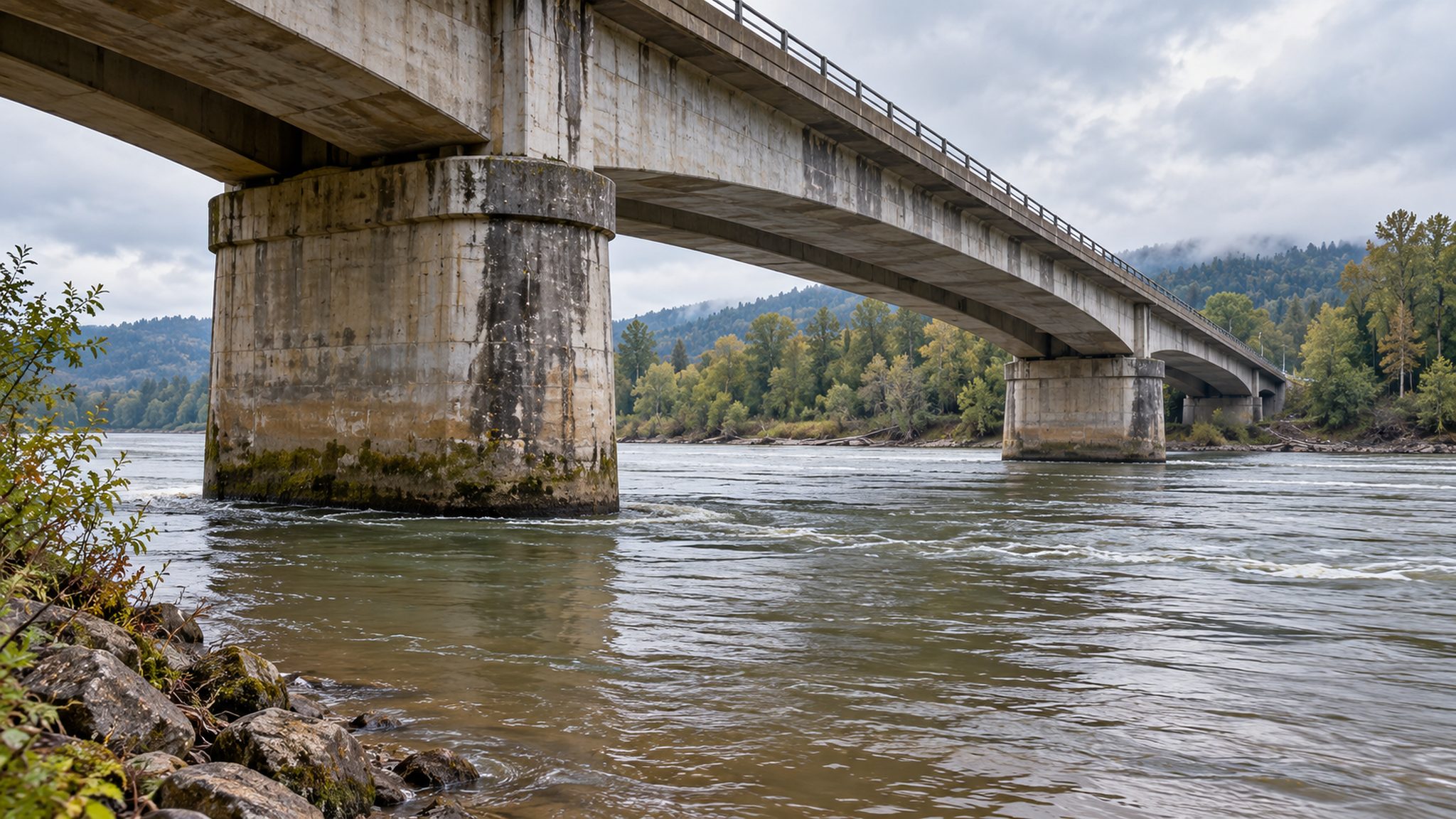
A river bridge must carry loads while allowing water to pass without undermining its supports.
- Structural calculations examine the bridge as a load-bearing system. Hydrological and hydraulic studies address the river conditions around it; passing one category of checks cannot establish that the other category is satisfactory.
- Design discharge is the flow used for design assessment, expressed as volume per unit time. It is not the speed of water or the amount of rainfall recorded across the surrounding catchment.
- Hydrological studies inform assessment of flows and floods. Hydraulic studies examine how that water passes through the bridge location, including flood levels and whether the available openings provide adequate passage.
- Scour removes river-bed material around foundations as water flows past. This can reduce the support available below a bridge even when damage is not immediately visible in its deck or road surface.
- Foundation safety must be assessed against river-bed erosion, not inferred from the apparent strength of the superstructure. The policy explicitly includes these water-related studies wherever applicable to the structure under examination.
Review Sequence and Limits of Coverage
The independent checker provides technical observations; the contractor and NHAI retain their distinct roles in the contractual process.
- Submission begins with the contractor or concessionaire presenting designs and drawings for contractual review or approval. Relevant institutions or firms are then selected from the empanelled list according to the project requirements.
- Verification produces observations and recommendations from the selected checker. The contractor or concessionaire considers these and makes necessary design changes; the review is intended to lead to corrections, not merely another certificate.
- NHAI review follows under the applicable contract. Independent verification is a technical input to that process, not a transfer of the authority’s final contractual review or approval role to an outside institution.
- Completed proof checking generally falls outside the new policy. Additional verification may still be undertaken for major bridges and complex or critical special structures; this is not blanket retrospective rechecking of every existing bridge.
- Implementation starts on the announced effective date, not the press-release date. The measure concerns design quality; unlike a road-access impact study, it does not measure wider social outcomes after construction.
Way Forward
Make Review Findings Traceable
- Record closure of each technical observation, linking the finding to the revised calculation or drawing and the contractual decision.
- Match expertise to the site: river crossings need relevant hydraulic and foundation competence alongside structural analysis.
- Preserve accountability by recording who designed, independently checked and reviewed each critical structure.
Conclusion
- Bridge safety requires a coherent design for the structure, flowing water and foundations; an independent review can expose weaknesses before construction fixes them into the asset.
- The exam distinction is between technical verification and contractual approval: the checker recommends, the contractor revises, and NHAI reviews or approves under the contract.
UPSC Practice Questions
Prelims MCQ 1
With reference to NHAI’s announced independent design-checking policy, consider the following statements:
- The policy takes effect from 1 December 2026.
- All projects with completed proof checking must automatically undergo fresh verification.
- Hydrological and hydraulic studies are included wherever applicable.
How many of the above statements are correct?
(a) Only one (b) Only two (c) All three (d) None
Answer: (b) Only two
Explanation:
Statements 1 and 3 are correct. Completed proof checking is generally excluded, although additional verification may be undertaken for major or critical structures.
Prelims MCQ 2
Which of the following best describes scour at a river bridge?
(a) Expansion of the bridge deck due to heat (b) Removal of river-bed material by flowing water (c) Accumulation of traffic load above the deck (d) Measurement of rainfall in the catchment
Answer: (b) Removal of river-bed material by flowing water
Explanation:
Scour is river-bed erosion that can threaten foundation support. It differs from structural loading and catchment rainfall measurement.
UPSC Mains Questions
- Explain why structural calculations alone cannot establish the safety of a major river bridge. Discuss the role of hydrological and hydraulic studies.
- How can independent design verification improve highway infrastructure quality without blurring contractual accountability?
Source: PIB, Ministry of Road Transport and Highways.
Frequently Asked Questions
When does the NHAI design-checking policy take effect?
The announced effective date is 1 December 2026. It covers new EPC, HAM and BOT projects and projects where design verification or proof checking has not commenced.
Does the policy order a fresh check of every existing bridge?
No. Projects with completed design verification or proof checking are generally excluded. Additional independent verification may still be undertaken for major bridges and complex or critical special structures.
How do hydraulic checks differ from structural checks?
Structural checks examine the load-bearing design. Hydraulic checks examine water movement, flood levels and passage through bridge openings. Foundation assessment must also account for erosion of the river bed.
Does the independent checker approve the final design?
The checker submits observations and recommendations. The contractor or concessionaire makes necessary changes, after which NHAI reviews or approves the design according to the applicable contractual provisions.
Tell Google you want more of this.
Add Anantam IAS as a preferred sourceOne tap, and this site shows up more often in your own Top Stories, AI Overviews and AI Mode. Remove it any time.