3 current affairs published on Tuesday, 30 September 2025
30 September 2025 Current Affairs for UPSC — every
Why-in-News article AnantamIAS published on Tuesday, 30 September 2025, broken down with
Why in News?, the exact GS paper it feeds, sub-topic mapping, MCQ-ready facts and a
UPSC-style practice question. 3 articles in total, covering Polity, Economy, Environment, S&T, IR, Geography, History, Society and Internal
Security — the same Why-in-News + GS-paper-mapping + practice-question format the Compass uses across
every daily digest on the site.
Daily current affairs for UPSC is where new material enters your prep stream. Read this
30 September 2025 digest end-to-end in 25–35 minutes, attempt the practice question
at the foot of each article (it's MCQ for some, 10/15-marker for others), then bookmark the entries
that fall inside your active revision window. Everything stays cross-linked: tap any subject pill to jump
to that subject's hub, or use the table of contents above to skip straight to a specific story.
Why we publish daily current affairs separately from the monthly compilation: daily is learning,
monthly is revision. Use the daily page to add fresh material to your notes the day it breaks;
come back to the September 2025 compilation 60 days before Prelims when the
noise has settled and only the lasting takeaway is worth re-reading.
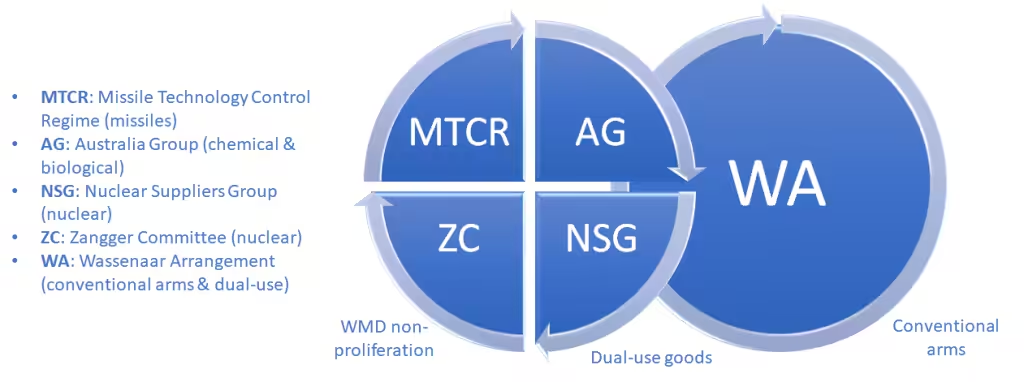
The Wassenaar Arrangement: the need to reform export control regimes.
UPSC Relevance:
International organizations and Agreements
UPSC PYQ:
Q. Recently, the USA decided to support India’s membership in multi-lateral export control regimes called the “Australia Group” and the “Wassenaar Arrangement”. What is the difference between them? (2011)
The Australia Group is an informal arrangement which aims to allow exporting countries to minimize the risk of assisting chemical and biological weapons proliferation, whereas the Wassenaar Arrangement is a formal group under the OECD holding identical objectives.
The Australia Group comprises predominantly of Asian, African and North American countries whereas the member countries of Wassenaar Arrangement are predominantly from the European Union and American Continents.
Which of the statements given above is/are correct?
(a) 1 only (b) 2 only (c) Both 1 and 2 (d) Neither 1 nor 2
About Wassenaar Arrangement:
The Wassenaar Arrangement has been established in order to contribute to regional and international security and stability, by promoting transparency and greater responsibility in transfers of conventional arms and dual-use goods and technologies.
Participating States seek, through their national policies, to ensure that transfers of these items do not contribute to the development or enhancement of military capabilities which undermine these goals, and are not diverted to support such capabilities.The aim is also to prevent the acquisition of these items by terrorists.
What is Dual Use: Ability of a good or technology to be used for multiple purposes usually peaceful and military.
The Participating States of the Wassenaar Arrangement are:
Argentina, Australia, Austria, Belgium, Bulgaria, Canada, Croatia, Czech Republic, Denmark, Estonia, Finland, France, Germany, Greece, Hungary, India, Ireland, Italy, Japan, Latvia, Lithuania, Luxembourg, Malta, Mexico, Netherlands, New Zealand, Norway, Poland, Portugal, Republic of Korea, Romania, Russian Federation, Slovakia, Slovenia, South Africa, Spain, Sweden, Switzerland, Türkiye, Ukraine, United Kingdom and United States.
The current Head of Secretariat is Ambassador György Molnár (Hungary).
Secretariat: Vienna, Austria.
India became a member of the Arrangement in 2017.
Wassenaar Arrangement Plenary:
The Wassenaar Arrangement Plenary is the decision-making body of the Arrangement. It is composed of representatives of all Participating States and normally meets once a year, usually in December.
The position of Plenary Chair is subject to annual rotation among Participating States. All Plenary decisions are taken by consensus.
The Plenary establishes subsidiary bodies for the preparation of recommendations for Plenary decisions and calls ad hoc meetings for consultations on issues related to the functioning of the Wassenaar Arrangement.
At present, the main Wassenaar Arrangement subsidiary bodies are:
the General Working Group (GWG) dealing with policy-related matters
Experts Group (EG) addressing issues related to the lists of controlled items.
Once a year, a Licensing and Enforcement Officers Meeting (LEOM) is held.
The Wassenaar Arrangement:
Uses export controls as a means to combat terrorism
Contributes to regional and international security and stability
Promotes transparency and greater responsibility in transfers of conventional arms and dual-use goods and technologies
Complements and reinforces the export control regimes for weapons of mass destruction and their delivery systems
Is not directed against any state or group of states
The founding document of the Wassenaar Arrangement is known as the “Initial Elements”. The Initial Elements were originally established in 1996 and set out the purposes and scope of the Arrangement.
Practice Question:
“Initial Element” are seen sometime in news related to which of the following?
The three-day Monetary Policy Committee (MPC) meeting has commenced at a time when recent cuts in Goods and Services Tax (GST) and direct taxes are expected to positively impact economic growth.
UPSC Relevance:
Monetary Policy and It’s Tools
UPSC PYQ:
With reference to Indian economy, consider the following: (2015)
Bank rate
Open market operations
Public debt
Public revenue
Which of the above is/are component/ components of Monetary Policy?
(a) 1 only (b) 2, 3 and 4 (c) 1 and 2 (d) 1, 3 and 4
About MPC:
Under the Reserve Bank of India, Act,1934 (RBI Act,1934) (as amended in 2016), RBI is entrusted with the responsibility of conducting monetary policy in India with the primary objective of maintaining price stability while keeping in mind the objective of growth.
In May 2016, the RBI Act, 1934 was amended to provide a statutory basis for the implementation of the flexible inflation targeting framework.(the Central Government retained the inflation target and the tolerance band for the next 5-year period – April 1, 2021 to March 31, 2026.)
RBI Act provides for the constitution of a six-member Monetary Policy Committee .
Failure to Maintain Inflation Target: The Central Government has notified the following as the factors that constitute failure to achieve the inflation target: (a) the average inflation is more than the upper tolerance level of the inflation target for any three consecutive quarters; or (b) the average inflation is less than the lower tolerance level for any three consecutive quarters.
India’s Index of Industrial Production (IIP) growth slowed to 4% in August 2025, compared to 4.3% in July (six-month high).
Key Reasons:
Manufacturing slowdown:
Manufacturing growth fell to 3.8% in August from 6% in July.
Positive turnaround in primary goods:
The primary goods sector grew at a seven-month high of 5.2%.
Drag from consumer sectors:
Consumer non-durables saw contraction of 6.3%, the worst in nine months.
UPSC CSE Relevance:
This article is relevant for GS Paper III (Indian Economy) as it highlights trends in industrial growth and sectoral performance under the Index of Industrial Production (IIP). It aids in understanding economic slowdowns, structural issues in key sectors like mining and electricity, and their implications on policy and planning.
UPSC CSE PYQ 2015:
In the ‘Index of Eight Core Industries’, which one of the following is given the highest weight?