UPSC CSE 2026 Essay Paper Discussion

Daily Digest · Wednesday

31 December 2025 Current Affairs for UPSC

2 current affairs published on Wednesday, 31 December 2025

31 December 2025 Current Affairs for UPSC — every Why-in-News article AnantamIAS published on Wednesday, 31 December 2025, broken down with Why in News?, the exact GS paper it feeds, sub-topic mapping, MCQ-ready facts and a UPSC-style practice question. 2 articles in total, covering Polity, Economy, Environment, S&T, IR, Geography, History, Society and Internal Security — the same Why-in-News + GS-paper-mapping + practice-question format the Compass uses across every daily digest on the site.

Daily current affairs for UPSC is where new material enters your prep stream. Read this 31 December 2025 digest end-to-end in 25–35 minutes, attempt the practice question at the foot of each article (it's MCQ for some, 10/15-marker for others), then bookmark the entries that fall inside your active revision window. Everything stays cross-linked: tap any subject pill to jump to that subject's hub, or use the table of contents above to skip straight to a specific story.

Use this page three ways. Read sequentially for a one-sitting scan of everything that mattered on 31 December 2025. Download the 31 December 2025 PDF below for offline study or print revision. Or use the December 2025 Current Affairs compilation to see this day in the month's full context. For the previous day's reading, see 30 December 2025 Current Affairs; the next day's is 1 January 2026 Current Affairs.

Why we publish daily current affairs separately from the monthly compilation: daily is learning, monthly is revision. Use the daily page to add fresh material to your notes the day it breaks; come back to the December 2025 compilation 60 days before Prelims when the noise has settled and only the lasting takeaway is worth re-reading.

Pralay and Pinaka: India’s Tactical Strike Capabilities

Open article →Download PDF

Why in News?

On 31 December 2025 the Defence Research and Development Organisation (DRDO) conducted user-evaluation trials of two Pralay short-range tactical ballistic missiles fired in rapid succession (a salvo launch) off the Odisha coast. Both missiles followed their intended trajectories and met all flight objectives, witnessed by Indian Army and Indian Air Force (IAF) officers along with industry representatives.

Days earlier, on 29 December 2025, the maiden flight of the indigenous Pinaka Long Range Guided Rocket (LRGR-120) reached its full 120-km range at the Integrated Test Range (ITR), Chandipur. Together, Pralay and Pinaka thicken India’s conventional battlefield-strike layer and are flagship examples of Atmanirbhar Bharat (self-reliance) in defence.

  • Systems tested: the Pralay quasi-ballistic surface-to-surface missile (two fired in salvo) and, two days prior, the Pinaka LRGR-120 guided rocket on its maiden flight.
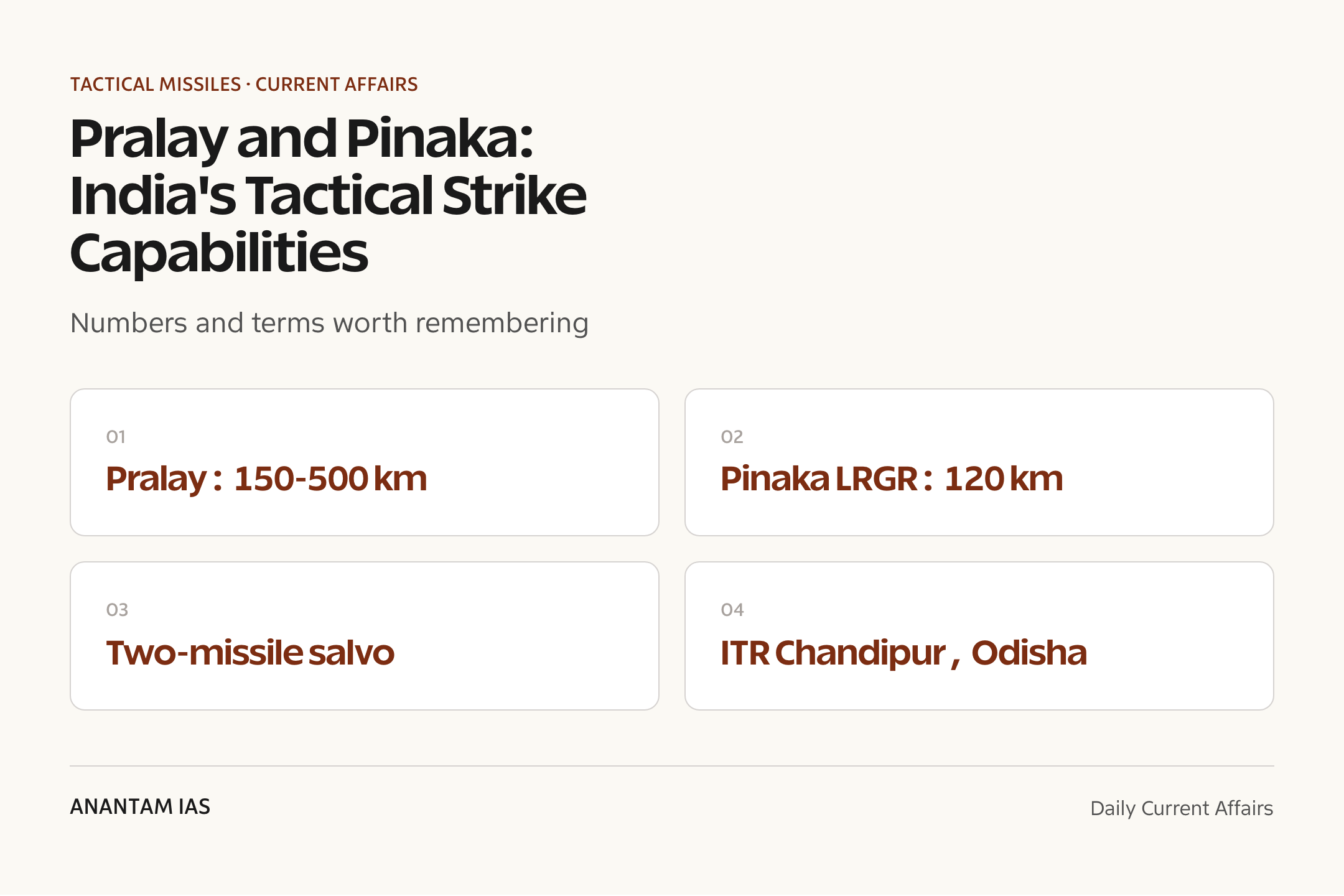
  • Pralay range: a short-range tactical band of 150–500 km, carrying a conventional warhead of roughly 500–1,000 kg.
  • Pinaka LRGR: the long-range guided rocket reached its full 120-km range and executed all planned in-flight manoeuvres with high accuracy.
  • Both Pralay missiles “followed their intended trajectories and successfully met all flight objectives”, per the official account.
  • Launch venues: Pralay off the Odisha coast; Pinaka LRGR from the ITR, Chandipur — India’s principal missile-test facilities.
  • The two events fell within a cluster of late-December trials that also included the Akash-NG SAM and the K-4 SLBM, signalling momentum in indigenous missile development.

The development matters in the context of:

  • Conventional war is increasingly decided by accurate, deep stand-off fires — short-range ballistic missiles and guided rockets that hit command posts, airfields and logistics without crossing a nuclear threshold.
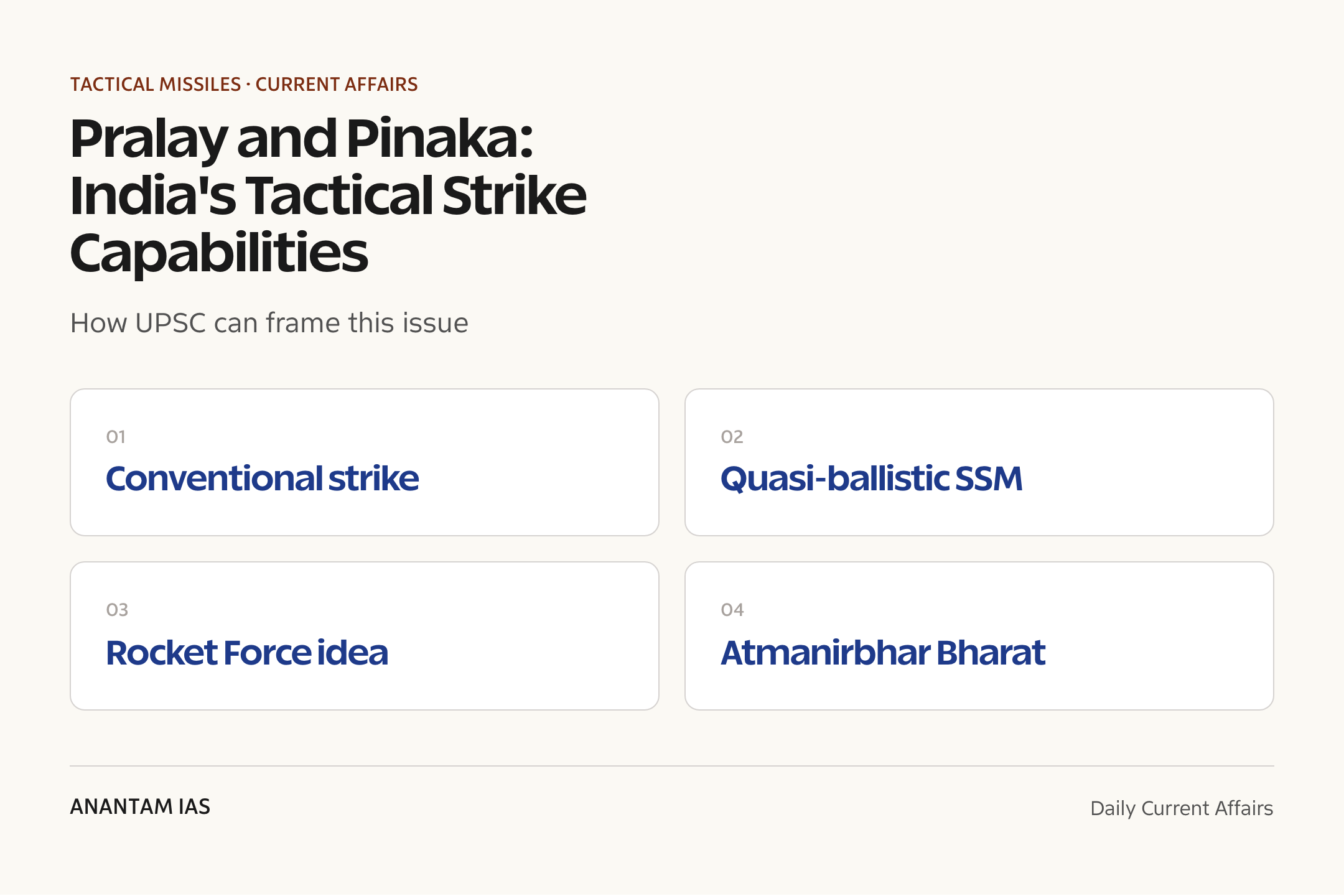
  • Pralay and Pinaka sit in this conventional tactical tier, giving commanders precise, scalable firepower below the strategic (nuclear) level and feeding the idea of a dedicated land-based missile or ‘Rocket Force’.
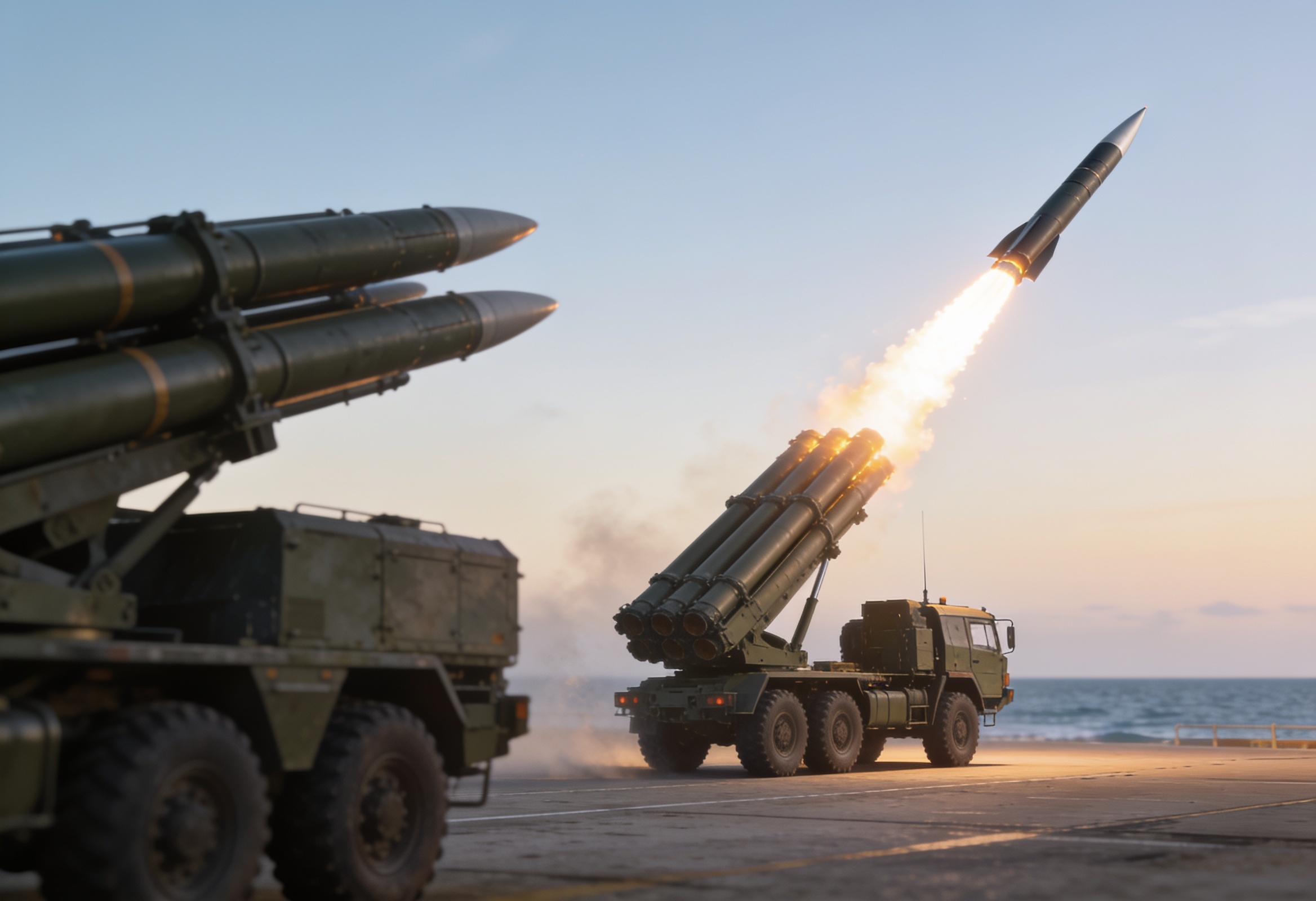
Illustration of a tactical surface-to-surface missile launching from a mobile launcher beside a multi-barrel rocket launcher at a coastal test range
A tactical missile lifting off from a mobile launcher alongside a multi-barrel rocket launcher, depicting modern conventional-strike systems. Illustration: AI-generated (Freepik)
Pralay and Pinaka: India's Tactical Strike Capabilities — quick facts

UPSC Relevance

Prelims Relevance

  • Pralay: indigenous quasi-ballistic, conventionally armed surface-to-surface missile; range 150–500 km; solid-propellant; mobile launcher; DRDO-developed.
  • Quasi-ballistic trajectory: a mostly ballistic flight with mid-course manoeuvring, making the missile harder to intercept than a pure ballistic path.
  • Pinaka: indigenous multi-barrel rocket launcher (MBRL) system developed by the Armament Research and Development Establishment (ARDE), Pune.
  • Pinaka variants: Mk-I (~38 km), Mk-II/Enhanced (~60 km), Guided Pinaka (~75–90 km) and the Long Range Guided Rocket (LRGR-120) reaching 120 km.
  • LRGR-120: long-range guided rocket variant of Pinaka; maiden full-range flight on 29 December 2025 at Chandipur.
  • Salvo launch: firing two or more missiles in quick succession to validate rapid, repeat-fire capability.
  • DRDO: lead developer of both systems; Pralay first flight-tested on 22 December 2021 from Dr APJ Abdul Kalam Island.
  • Integrated Test Range (ITR), Chandipur, Odisha: principal missile-test facility used for these trials.
  • Surface-to-surface vs surface-to-air: Pralay/Pinaka strike ground targets, unlike the same-week Akash-NG, which is an air-defence (surface-to-air) missile.
  • Atmanirbhar Bharat and positive indigenisation lists: the policy backdrop pushing home-grown conventional firepower.

Mains Relevance

GS Paper 3

  • Role of conventional tactical missiles and guided rockets in modern battlefield doctrine and deterrence below the nuclear threshold.
  • Contribution of indigenous DRDO programmes and Atmanirbhar Bharat to reducing import dependence in defence.

GS Paper 2

  • How indigenous conventional-strike capability shapes India’s strategic autonomy and posture along contested borders.

Essay

  • Self-reliance as security: can strategic autonomy exist without an indigenous defence industrial base?

Background and Context

What is the Pralay missile?

Pralay is an indigenous short-range tactical ballistic missile built for precise conventional strikes.

  • Type: a conventionally armed surface-to-surface missile that flies a quasi-ballistic trajectory — mostly ballistic but with mid-course manoeuvres to defeat interceptors.
  • Range: a tactical band of 150–500 km, bridging the gap below the strategic Agni/Prithvi family.
  • Warhead: a conventional payload of about 500–1,000 kg, able to carry different warhead types for varied targets.
  • Propulsion and mobility: a solid-propellant rocket motor and a mobile launcher for quick, dispersed deployment.
  • Lineage: first flight-tested on 22 December 2021 off Odisha; the December 2025 salvo was a user-evaluation step towards full induction.
Pralay and Pinaka: India's Tactical Strike Capabilities — exam lens

What is the Pinaka system?

Pinaka is India’s home-grown multi-barrel rocket launcher, a workhorse of area firepower.

  • System: a multi-barrel rocket launcher (MBRL) that fires a salvo of 12 rockets in under 44 seconds, saturating a target area.
  • Developer: the Armament Research and Development Establishment (ARDE) and High Energy Materials Research Laboratory (HEMRL), both DRDO labs in Pune.
  • Variants: Mk-I (~38 km), Mk-II/Enhanced (~60 km), Guided Pinaka (~75–90 km with GPS/INS guidance) and now the LRGR-120 at 120 km.
  • Combat record: used by the Indian Army since the Kargil War (1999), with steadily rising range and accuracy across generations.
  • Industry: produced with private partners such as Larsen & Toubro and Tata, deepening the domestic supply chain.

The December 2025 trials

The two tests, days apart, validated both rapid-fire and full-range performance.

  • Pralay: two missiles fired in salvo on 31 December 2025 off the Odisha coast; both met all flight objectives in a user-evaluation trial.
  • Pinaka LRGR-120: maiden flight on 29 December 2025 from ITR, Chandipur, reaching its full 120-km range with high-accuracy in-flight manoeuvres.
  • The salvo demonstrated the ability to launch repeat strikes quickly — important for overwhelming defences and engaging multiple targets.
  • Trials were observed by Army and IAF officers and industry, the standard gateway from development to induction.

Conventional tactical strike and the Rocket Force idea

Pralay and Pinaka populate the conventional tier that sits below nuclear weapons.

  • Below the nuclear threshold: conventionally armed missiles let India strike deep without invoking nuclear signalling, widening usable options in a conflict.
  • Target set: command posts, airfields, radars, logistics nodes and massed forces — high-value targets behind the line of contact.
  • Rocket Force concept: a proposed dedicated land-based missile arm to mass and coordinate such conventional firepower, an idea gaining traction in Indian strategic debate.
  • Guided rockets like Pinaka LRGR blur the line between artillery and missiles, delivering missile-like precision at lower cost per round.

Indigenous ecosystem and Atmanirbhar Bharat

Both systems are designed and largely built within India’s defence industrial base.

  • Developed by the DRDO, with Pralay led by its missile complex and Pinaka by ARDE and HEMRL.
  • Production draws in private firms such as Larsen & Toubro and Tata, building a wider home-grown supply chain.
  • Both fit the Atmanirbhar Bharat push and the Ministry of Defence’s positive indigenisation lists that bar imports of listed items.
  • Domestic content eases upgrades and life-cycle support and opens export potential without import-licence constraints.

Where they fit in India's missile family

Pralay and Pinaka occupy the conventional short-range and rocket-artillery tiers, distinct from strategic systems.

  • Strategic tier: the nuclear-capable Agni series and the K-4 submarine-launched ballistic missile, for long-range deterrence.
  • Conventional ballistic tier: Pralay (150–500 km), a precise, usable battlefield missile carrying conventional warheads.
  • Rocket-artillery tier: Pinaka (up to 120 km in the LRGR variant), saturating area targets within corps depth.
  • Cruise tier: systems such as BrahMos add a high-speed precision-strike option, completing a layered conventional toolkit.

Way Forward

Complete induction and build reserves

  • Move swiftly from user-evaluation trials to induction and series production of both Pralay and the Pinaka LRGR.
  • Hold adequate war reserves of missiles and rockets so the conventional-strike layer is credible in a sustained engagement.

Organise the conventional-fires force

  • Develop joint command-and-control so Army and IAF can task Pralay, Pinaka and BrahMos in a coordinated targeting cycle.
  • Evaluate a dedicated Rocket Force structure to mass and integrate land-based conventional missiles.

Sustain DRDO research on guidance, propulsion and seekers, deepen private-sector participation through indigenisation lists, and pursue exports so the Pralay and Pinaka programmes earn scale, feedback and revenue while cutting import dependence.

Conclusion

The Pralay salvo and the Pinaka LRGR’s full-range flight are less about two weapons than about a maturing conventional-strike layer that gives India precise, usable firepower below the nuclear threshold.

For an exam, the durable takeaways are the difference between conventional and strategic missiles, the meaning of a quasi-ballistic trajectory and the MBRL concept, the Rocket Force debate, and why an indigenous defence industrial base underpins both security and strategic autonomy.

UPSC Practice Questions

Prelims MCQ 1

With reference to the Pralay missile, consider the following statements:

  1. It is a conventionally armed, short-range surface-to-surface missile developed by the DRDO.
  2. It follows a quasi-ballistic trajectory and has a range in the 150–500 km band.
  3. It is a submarine-launched ballistic missile that replaces the K-4.

How many of the above statements are correct?

(a) Only one (b) Only two (c) All three (d) None

Answer: (b) Only two

Explanation:

Statements 1 and 2 are correct. Statement 3 is wrong: Pralay is a land-based, surface-to-surface tactical missile, not a submarine-launched ballistic missile, and is unrelated to the K-4.

Prelims MCQ 2

The Pinaka system, recently in the news, is best described as:

(a) An indigenous multi-barrel rocket launcher developed by the DRDO (b) A surface-to-air missile for high-altitude interception (c) A nuclear-capable submarine-launched ballistic missile (d) An imported anti-tank guided missile

Answer: (a) An indigenous multi-barrel rocket launcher developed by the DRDO

Explanation:

Pinaka is a home-grown multi-barrel rocket launcher (MBRL) developed chiefly by ARDE and HEMRL; its long-range guided rocket variant (LRGR) reached 120 km in December 2025.

UPSC Mains Questions

  1. Conventional tactical missiles and guided rockets are reshaping battlefield doctrine below the nuclear threshold. Examine the significance of indigenous systems like Pralay and Pinaka for India’s security. (250 words)
  2. Self-reliance in defence is as much about industrial capacity as about firepower. Discuss with reference to India’s conventional-strike missile development under Atmanirbhar Bharat. (250 words)

Sources: News On AIR (Prasar Bharati), Ministry of Defence and The Week.

Frequently Asked Questions

What is the Pralay missile?

Pralay is an indigenous, short-range tactical ballistic missile developed by the DRDO. It is conventionally armed, flies a quasi-ballistic trajectory with mid-course manoeuvres, and has a range of 150–500 km with a payload of roughly 500–1,000 kg. Solid-propellant and launched from a mobile launcher, it gives the armed forces precise battlefield strike below the nuclear level.

What happened in the December 2025 tests?

On 31 December 2025 the DRDO fired two Pralay missiles in salvo off the Odisha coast in user-evaluation trials; both met all flight objectives. Two days earlier, on 29 December 2025, the Pinaka Long Range Guided Rocket (LRGR-120) made its maiden flight from the Integrated Test Range at Chandipur, reaching its full 120-km range with high accuracy.

What is a quasi-ballistic trajectory?

A quasi-ballistic missile follows a mostly ballistic flight path but performs limited manoeuvres in mid-course, instead of a pure, predictable parabolic arc. This makes its track harder for air-defence systems to compute and intercept, while keeping the long range and high speed of a ballistic missile. Pralay uses such a trajectory for survivability.

What is the Pinaka system?

Pinaka is India’s indigenous multi-barrel rocket launcher (MBRL), developed mainly by the DRDO’s Armament Research and Development Establishment and High Energy Materials Research Laboratory in Pune. It can fire a salvo of 12 rockets in under 44 seconds and comes in several ranges, from about 38 km in the Mk-I to 120 km in the new long-range guided variant.

What is the Rocket Force concept?

The Rocket Force concept proposes a dedicated, land-based missile arm to mass and coordinate conventional strike systems such as Pralay, Pinaka and cruise missiles. The idea is to deliver precise, deep firepower below the nuclear threshold under unified command, improving how India plans and executes long-range conventional strikes in a conflict.

How do Pralay and Pinaka support self-reliance?

Both systems are designed and largely produced within India. The DRDO leads development, with private firms such as Larsen & Toubro and Tata in the supply chain. Home-grown conventional firepower reduces import dependence, fits the Atmanirbhar Bharat push and the Ministry of Defence’s positive indigenisation lists, eases upgrades and support, and opens export possibilities.

India’s Q2 FY26 GDP Grows 8.2%: A Six-Quarter High

Open article →Download PDF

Why in News?

On 28 November 2025, the National Statistics Office (NSO) under the Ministry of Statistics and Programme Implementation (MoSPI) released the quarterly GDP estimates for Q2 of FY 2025-26 (July-September 2025). The print became the headline growth number anchoring India’s fiscal and monetary debate through December.

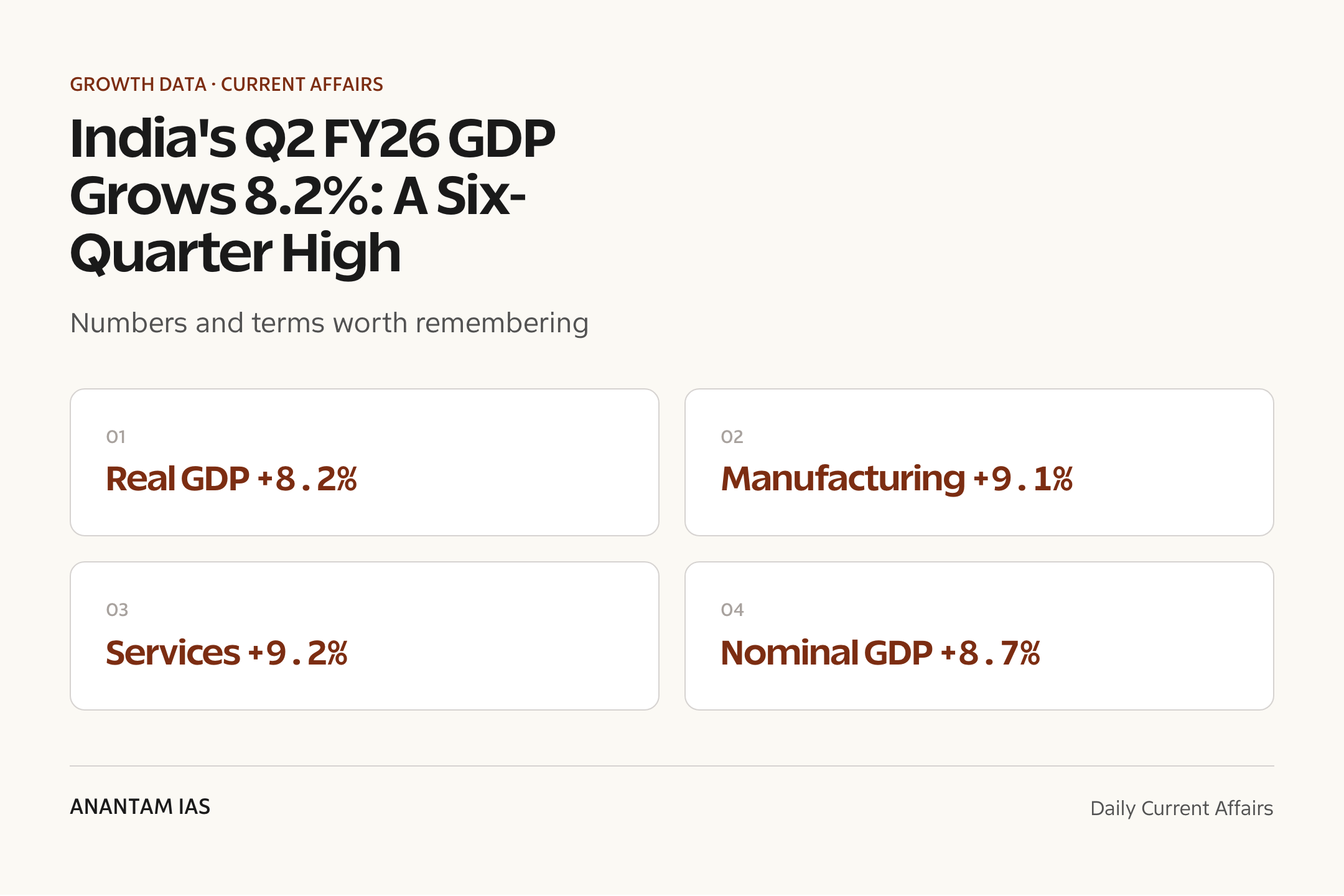
India’s real GDP grew 8.2% in Q2 FY26 against 5.6% in the same quarter a year earlier — a multi-quarter high that reinforced India’s standing as the world’s fastest-growing major economy, led by a buoyant manufacturing and services performance and resilient domestic demand.

  • Real GDP rose 8.2% in Q2 FY26, up sharply from 5.6% in Q2 FY25 (PIB).
  • Real GDP at constant (2011-12) prices was ₹48.63 lakh crore, against ₹44.94 lakh crore a year earlier.
  • Nominal GDP (current prices) grew 8.7% to ₹85.25 lakh crore.
  • Real GVA grew 8.1%; the Secondary (8.1%) and Tertiary (9.2%) sectors led the surge.
  • First-half (H1, April-September) real GDP growth stood at 8.0%, versus 6.1% in H1 FY25.
  • Business Standard reported the 8.2% reading as a six-quarter high, the strongest since Q4 FY24.

The development matters in the context of:

  • GDP data are the single most-watched signal for the RBI’s Monetary Policy Committee and the Union government’s fiscal stance ahead of the Budget cycle.
  • Robust prints temper the case for aggressive rate cuts while validating capex front-loading and consumption-support measures such as GST rationalisation.
Editorial illustration of a rising growth chart over an industrial and services skyline
Q2 FY26 growth was led by manufacturing and services activity Illustration: AI-generated (Freepik)
India's Q2 FY26 GDP Grows 8.2%: A Six-Quarter High — quick facts

UPSC Relevance

Prelims Relevance

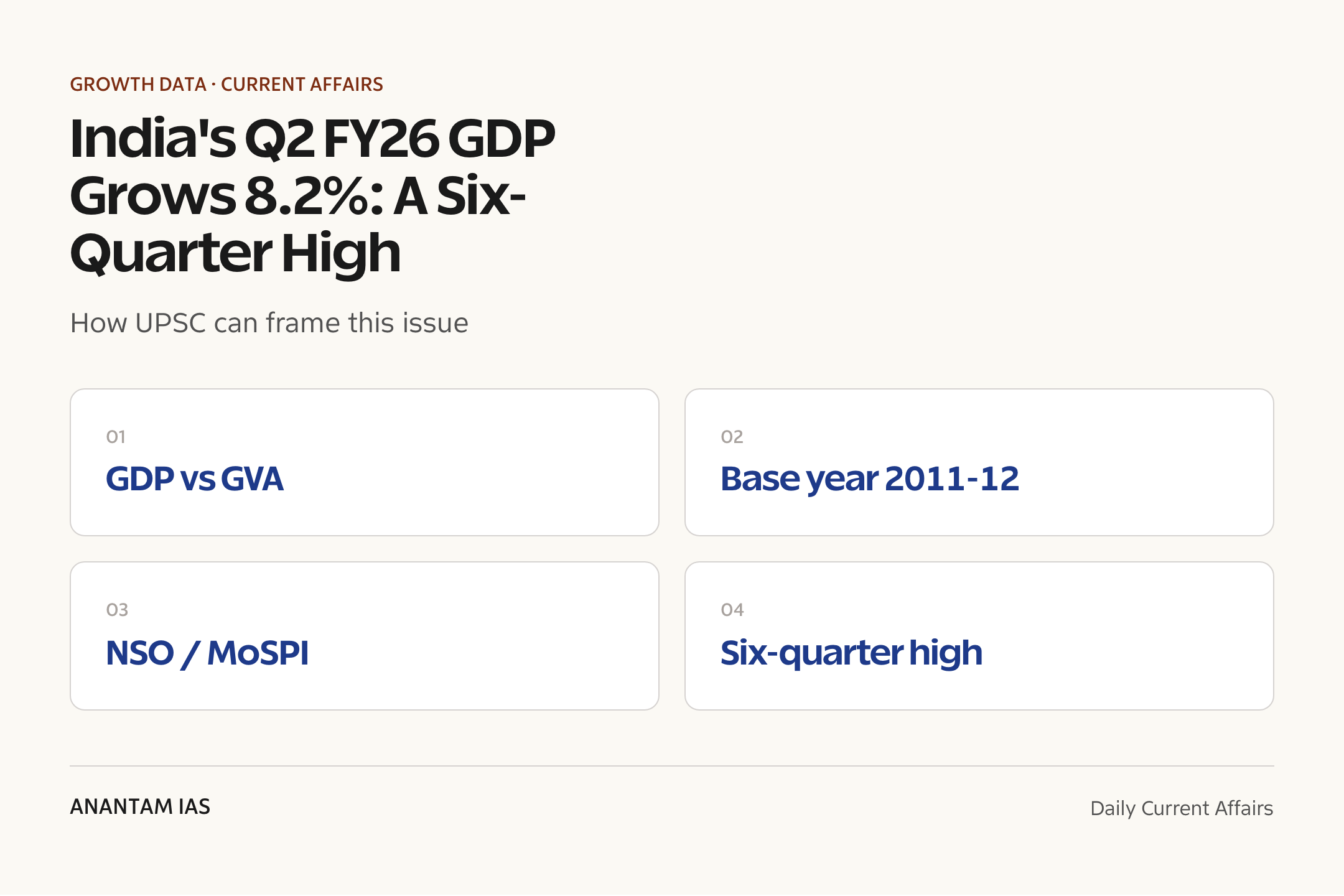
  • GDP measured at market prices; GVA measured at basic prices; GDP = GVA + product taxes − product subsidies.
  • Real (constant-price) vs nominal (current-price) GDP; current base year is 2011-12.
  • GDP estimates compiled by the NSO under MoSPI, using the System of National Accounts framework.
  • Benchmark-indicator method used for quarterly estimates.
  • Three broad sectors: Primary (agriculture, mining), Secondary (manufacturing, construction, utilities), Tertiary (services).
  • Expenditure-side components: PFCE, GFCE, GFCF, exports, imports, valuables, changes in stocks.
  • Q2 FY26 manufacturing growth 9.1%; construction 7.2%; agriculture and allied 3.5%.
  • MoSPI is revising the National Accounts base year from 2011-12 to 2022-23 (New Series).

Mains Relevance

GS Paper 3

  • Growth drivers and the durability of an investment-plus-consumption-led recovery in the Indian economy.
  • Role of national-income accounting and the choice of base year in measuring growth credibly.

GS Paper 2

  • Statutory and institutional architecture of official statistics (NSO, MoSPI) and the credibility of data governance.

Essay

  • Numbers tell only part of a nation’s growth story — measurement, distribution, and lived experience complete it.

Background and Context

What GDP and GVA actually measure

The headline number sits inside the System of National Accounts framework that India follows.

  • Gross Domestic Product (GDP) is the money value of all final goods and services produced within a country in a given period, measured at market prices.
  • Gross Value Added (GVA) measures output at basic prices — that is, value added before product taxes and after product subsidies.
  • The identity linking them: GDP = GVA + (taxes on products − subsidies on products).
  • Real GDP strips out price changes using a fixed base year (currently 2011-12), so it shows true volume growth; nominal GDP includes inflation.
  • India’s national accounts are compiled by the NSO within MoSPI, broadly aligned with the UN-recommended System of National Accounts (SNA).
India's Q2 FY26 GDP Grows 8.2%: A Six-Quarter High — exam lens

The Q2 FY26 headline numbers

PIB confirmed a broad-based acceleration across most aggregates.

  • Real GDP grew 8.2% (₹48.63 lakh crore) versus 5.6% (₹44.94 lakh crore) a year earlier.
  • Nominal GDP grew 8.7% to ₹85.25 lakh crore — the gap with real growth reflects the benign GDP deflator (low inflation).
  • Real GVA grew 8.1% to ₹44.77 lakh crore; nominal GVA grew 8.7%.
  • On the demand side, Private Final Consumption Expenditure (PFCE) grew 7.9%, up from 6.4% a year earlier — a sign of reviving household demand.
  • For H1 FY26 (April-September), real GDP grew 8.0% against 6.1% in H1 FY25.

Where the growth came from — sectors

Industry and services did the heavy lifting; agriculture moderated.

  • Secondary sector (manufacturing, construction, utilities) grew 8.1%, with Manufacturing at 9.1% and Construction at 7.2%.
  • Tertiary (services) sector grew 9.2%, led by Financial, Real Estate and Professional Services at 10.2%.
  • Agriculture and Allied activities grew a moderated 3.5%; Electricity, Gas and Water Supply utilities grew 4.4%.
  • The data were compiled using indicators such as listed-company results, IIP, rail and port traffic, bank credit, and GSTN supply data.

What lifted the print

Commentators tied the surge to a mix of policy and macro tailwinds; treat these as analyst framing, not NSO causation.

  • GST rationalisation — the rate restructuring rolled out in 2025 is widely credited with supporting consumption and the manufacturing-services momentum.
  • Capex front-loading by the Centre and states early in the year supported construction and investment demand.
  • Benign inflation kept the GDP deflator low, widening the gap between brisk real growth and nominal growth.
  • A favourable base, resilient services exports, and steady credit growth rounded out the drivers.

Why the number matters for policy

The GDP release is a primary input into both monetary and fiscal decisions.

  • It shapes the RBI Monetary Policy Committee’s read on the output gap and the room for rate action.
  • It informs the Union government’s fiscal arithmetic and revenue projections in the run-up to the Budget.
  • It is the denominator for headline ratios — the fiscal deficit, debt, and tax buoyancy are all expressed as a share of GDP.
  • A strong print reinforced India’s position as the fastest-growing major economy in global comparisons.

Caveats and the base-year revision

Quarterly estimates are provisional and the entire series is being rebased.

  • Quarterly GDP uses the benchmark-indicator method and is revised as fuller data arrive from source agencies.
  • MoSPI is shifting the National Accounts base year from 2011-12 to 2022-23, so these numbers will be revised under the New Series.
  • GDP captures market output but not distribution, informal-sector stress, or unpaid work — high aggregate growth need not mean broad-based gains.
  • The discrepancy term — the gap between the production and expenditure approaches — should be watched in any single-quarter reading.

Way Forward

Sustain the investment cycle

  • Keep public capex credible and crowd in private investment so growth does not lean only on government spending.
  • Deepen manufacturing momentum through stable trade and input-cost policy.

Broaden the base

  • Translate aggregate growth into jobs, rural demand, and MSME revival so gains are widely shared.
  • Watch agriculture, which moderated, and protect rural consumption.

Strengthen the statistics

  • Complete the base-year revision to 2022-23 transparently and improve informal-sector data coverage to keep estimates credible.

Conclusion

The 8.2% Q2 FY26 print is a genuinely strong reading — broad-based across manufacturing and services, backed by reviving private consumption, and consistent with India remaining the fastest-growing major economy.

For the UPSC aspirant the durable takeaway is not the single number but the machinery behind it: how GDP and GVA are defined, who compiles them, the base-year question, and why a headline figure must be read alongside distribution and the impending New Series revision.

UPSC Practice Questions

Prelims MCQ 1

With reference to the measurement of national income in India, consider the following statements:

  1. GDP at market prices equals GVA at basic prices plus product taxes minus product subsidies.
  2. Quarterly GDP estimates are released by the Reserve Bank of India.
  3. Real GDP is measured at constant prices of a chosen base year.

How many of the above statements are correct?

(a) Only one (b) Only two (c) All three (d) None

Answer: (b) Only two

Explanation:

Statements 1 and 3 are correct. Statement 2 is wrong — quarterly GDP estimates are released by the NSO under MoSPI, not the RBI.

Prelims MCQ 2

India’s real GDP growth in Q2 of FY 2025-26 (July-September 2025), as estimated by the NSO, was:

(a) 5.6% (b) 7.2% (c) 8.2% (d) 9.1%

Answer: (c) 8.2%

Explanation:

Real GDP grew 8.2% in Q2 FY26 against 5.6% in Q2 FY25. 9.1% was the manufacturing-sector growth rate; 7.2% was construction.

UPSC Mains Questions

  1. India’s Q2 FY26 GDP grew 8.2%, a multi-quarter high led by manufacturing and services. Examine the drivers of this acceleration and assess how durable an investment-and-consumption-led recovery is likely to be.
  2. A high aggregate GDP growth rate does not automatically translate into broad-based welfare. Critically discuss the limitations of GDP as a measure of economic progress and the reforms needed in India’s national-income accounting.

Sources: PIB, Ministry of Statistics and Programme Implementation and Business Standard.

Frequently Asked Questions

How much did India’s GDP grow in Q2 FY26?

India’s real GDP grew 8.2% in the second quarter of FY 2025-26 (July-September 2025), up from 5.6% a year earlier, according to NSO data released by PIB on 28 November 2025. In value terms, real GDP rose to ₹48.63 lakh crore at constant 2011-12 prices.

Who releases India’s GDP data?

GDP estimates are compiled and released by the National Statistics Office (NSO), part of the Ministry of Statistics and Programme Implementation (MoSPI). The estimates follow the UN-recommended System of National Accounts and are published quarterly, half-yearly, and annually.

What is the difference between GDP and GVA?

GVA (Gross Value Added) measures output at basic prices — the value added by producers before product taxes and after subsidies. GDP at market prices equals GVA plus product taxes minus product subsidies. GVA shows the supply-side or sectoral picture; GDP captures the whole economy at market value.

Which sectors drove the Q2 FY26 growth?

The surge was led by the secondary sector at 8.1% — with manufacturing at 9.1% and construction at 7.2% — and the tertiary (services) sector at 9.2%, paced by financial, real estate and professional services at 10.2%. Agriculture and allied activities grew a more moderate 3.5%.

Why is this GDP number called a six-quarter high?

Business Standard reported the 8.2% reading as the strongest growth in six quarters, meaning it exceeded every quarterly print since early 2024. The jump from 5.6% a year earlier reflected stronger industry and services output and reviving private consumption.

What is the base year used for India’s GDP?

India currently measures real GDP at constant 2011-12 prices. MoSPI is in the process of revising the National Accounts base year to 2022-23 (a New Series), so future estimates — and revisions of current figures — will be reported on the updated base.