Opens in a new tab
Join Anantam IAS Channel on Telegram

Daily Digest · Saturday

31 January 2026 Current Affairs for UPSC

2 current affairs published on Saturday, 31 January 2026

31 January 2026 Current Affairs for UPSC — every Why-in-News article AnantamIAS published on Saturday, 31 January 2026, broken down with Why in News?, the exact GS paper it feeds, sub-topic mapping, MCQ-ready facts and a UPSC-style practice question. 2 articles in total, covering Polity, Economy, Environment, S&T, IR, Geography, History, Society and Internal Security — the same Why-in-News + GS-paper-mapping + practice-question format the Compass uses across every daily digest on the site.

Daily current affairs for UPSC is where new material enters your prep stream. Read this 31 January 2026 digest end-to-end in 25–35 minutes, attempt the practice question at the foot of each article (it's MCQ for some, 10/15-marker for others), then bookmark the entries that fall inside your active revision window. Everything stays cross-linked: tap any subject pill to jump to that subject's hub, or use the table of contents above to skip straight to a specific story.

Use this page three ways. Read sequentially for a one-sitting scan of everything that mattered on 31 January 2026. Download the 31 January 2026 PDF below for offline study or print revision. Or use the January 2026 Current Affairs compilation to see this day in the month's full context. For the previous day's reading, see 30 January 2026 Current Affairs; the next day's is 1 February 2026 Current Affairs.

Why we publish daily current affairs separately from the monthly compilation: daily is learning, monthly is revision. Use the daily page to add fresh material to your notes the day it breaks; come back to the January 2026 compilation 60 days before Prelims when the noise has settled and only the lasting takeaway is worth re-reading.

India’s New CPI Series: Why the Base-Year Revision Matters

Open article →Download PDF

Why in News?

The Ministry of Statistics and Programme Implementation (MoSPI), through the National Statistical Office (NSO), has moved to roll out a revised Consumer Price Index (CPI) series, replacing the long-standing 2012 base year and re-weighting the consumption basket on fresher household-spending data.

The headline change is a lower weight for food in the basket, drawn from the Household Consumption Expenditure Survey (HCES) 2022-24, which alters how India’s official retail inflation, the RBI’s inflation-targeting anchor, is computed.

  • NSO revises the CPI base year from 2012 to a recent year, the routine periodic exercise to keep the index representative.
  • Basket weights are re-derived from the HCES 2022-24, the first large consumption survey released after a long gap.
  • The food and beverages weight, near 46% in the 2012 series, is set lower as spending shifts toward services and discretionary items.
  • Retail inflation is the flexible inflation-targeting anchor; the Monetary Policy Committee (MPC) reads CPI against the 4% (+/-2%) band.

The development matters in the context of:

  • A rebasing matters because an outdated basket overstates the role of items families no longer spend on, distorting the measured cost of living.
  • Because CPI drives monetary policy, dearness allowance and index-linked contracts, even a small re-weighting ripples across the economy.
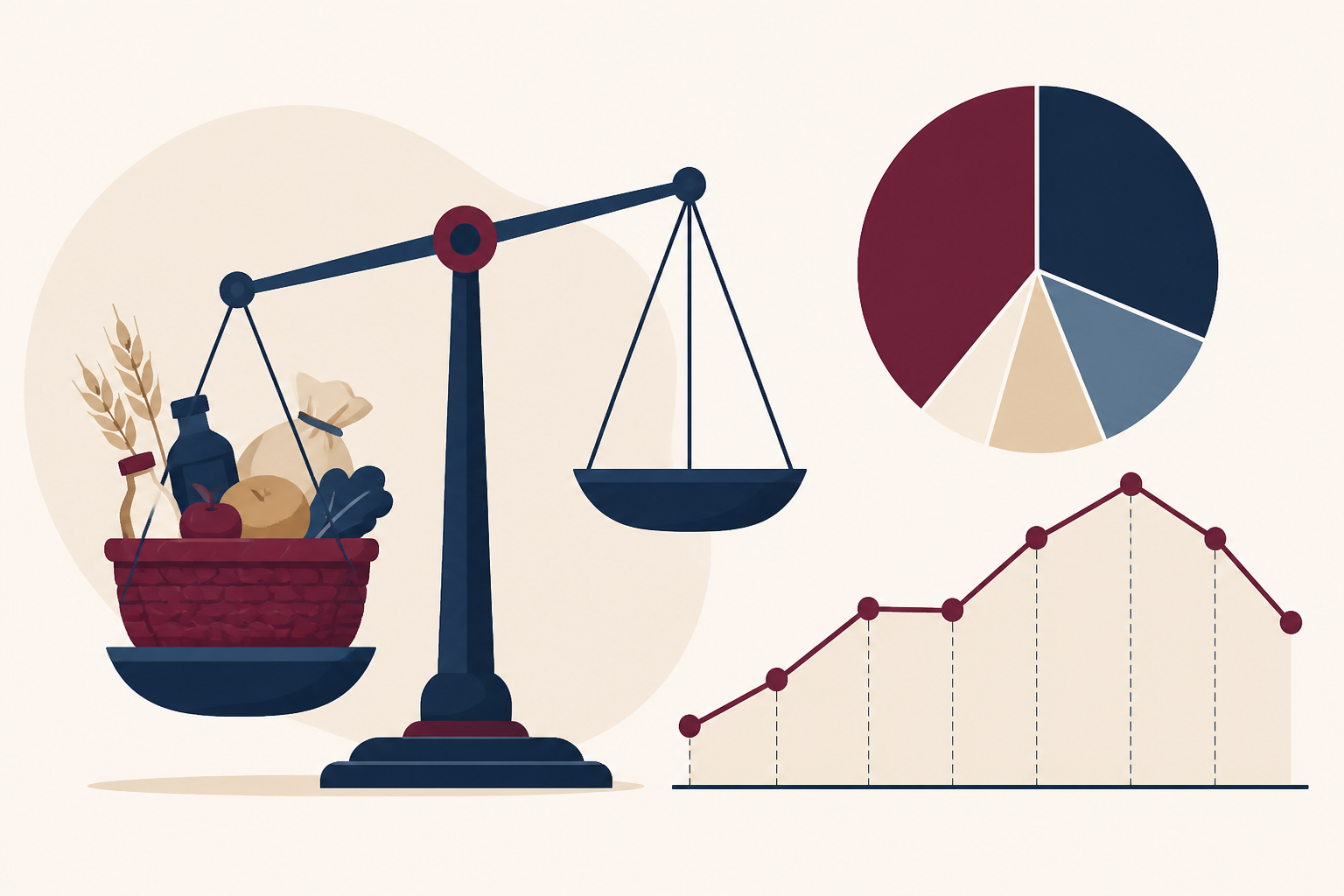
Illustration of a shopping basket on a balance scale beside a pie chart and a price-trend line graph, representing a revised price index basket.
A refreshed consumption basket being re-weighted and re-measured against changing prices. Illustration: AI-generated (Freepik)
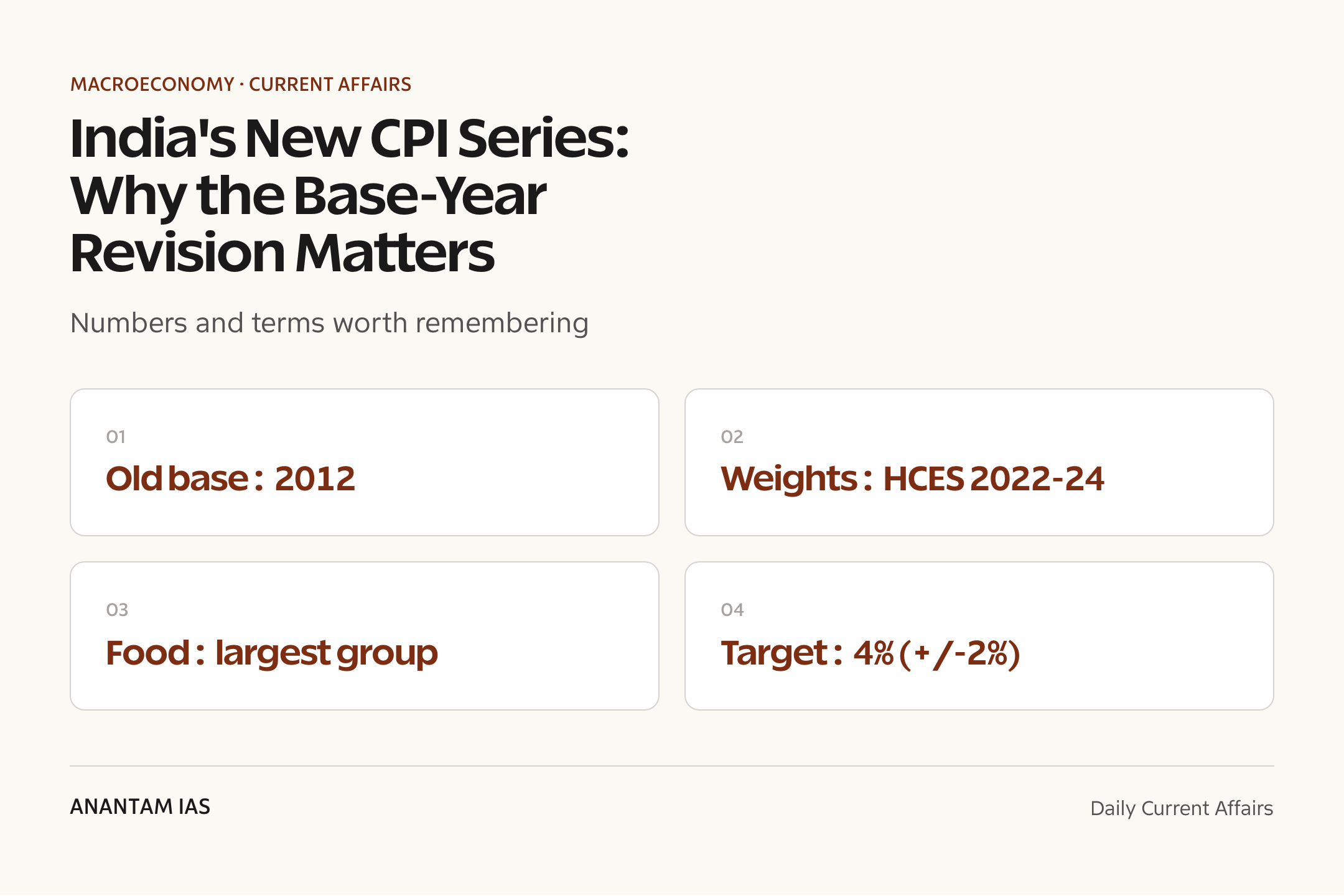
India's New CPI Series: Why the Base-Year Revision Matters — quick facts

UPSC Relevance

Prelims Relevance

  • CPI compiled by NSO/MoSPI; WPI compiled by the Office of the Economic Adviser, DPIIT
  • CPI base year being moved from 2012; weights from HCES
  • CPI-Combined (rural+urban) is the headline inflation measure used by the RBI
  • CFPI = Consumer Food Price Index; food and beverages is the single largest CPI group
  • Flexible Inflation Targeting adopted via the amended RBI Act, 1934; target 4% with a 2-6% band
  • MPC is a six-member committee chaired by the RBI Governor
  • Base effect: how a high or low year-ago index inflates or deflates current inflation
  • WPI excludes services; CPI captures the retail consumption basket including services

Mains Relevance

GS Paper 3

  • Why periodic rebasing of price indices is essential for credible inflation measurement and policy.
  • How a lower food weight changes headline-inflation dynamics and the RBI’s monetary-policy reaction.

GS Paper 2

  • Role of statistical institutions (MoSPI, NSO) and data quality in evidence-based governance.

Essay

  • Numbers we live by: how the statistics a state measures shape the choices it makes.

Background and Context

What the CPI is and who builds it

The Consumer Price Index tracks the average change in retail prices of a fixed basket of goods and services bought by households.

  • Compiled by the National Statistical Office (NSO) under MoSPI, released monthly; see our explainer on the Consumer Price Index in India.
  • CPI-Combined blends rural and urban indices and is the headline retail inflation figure cited in policy.
  • Distinct from the Wholesale Price Index (WPI), which tracks producer-level prices, excludes services and is maintained by the Office of the Economic Adviser.
  • Inflation is the year-on-year percentage change in the index, not the index level itself.
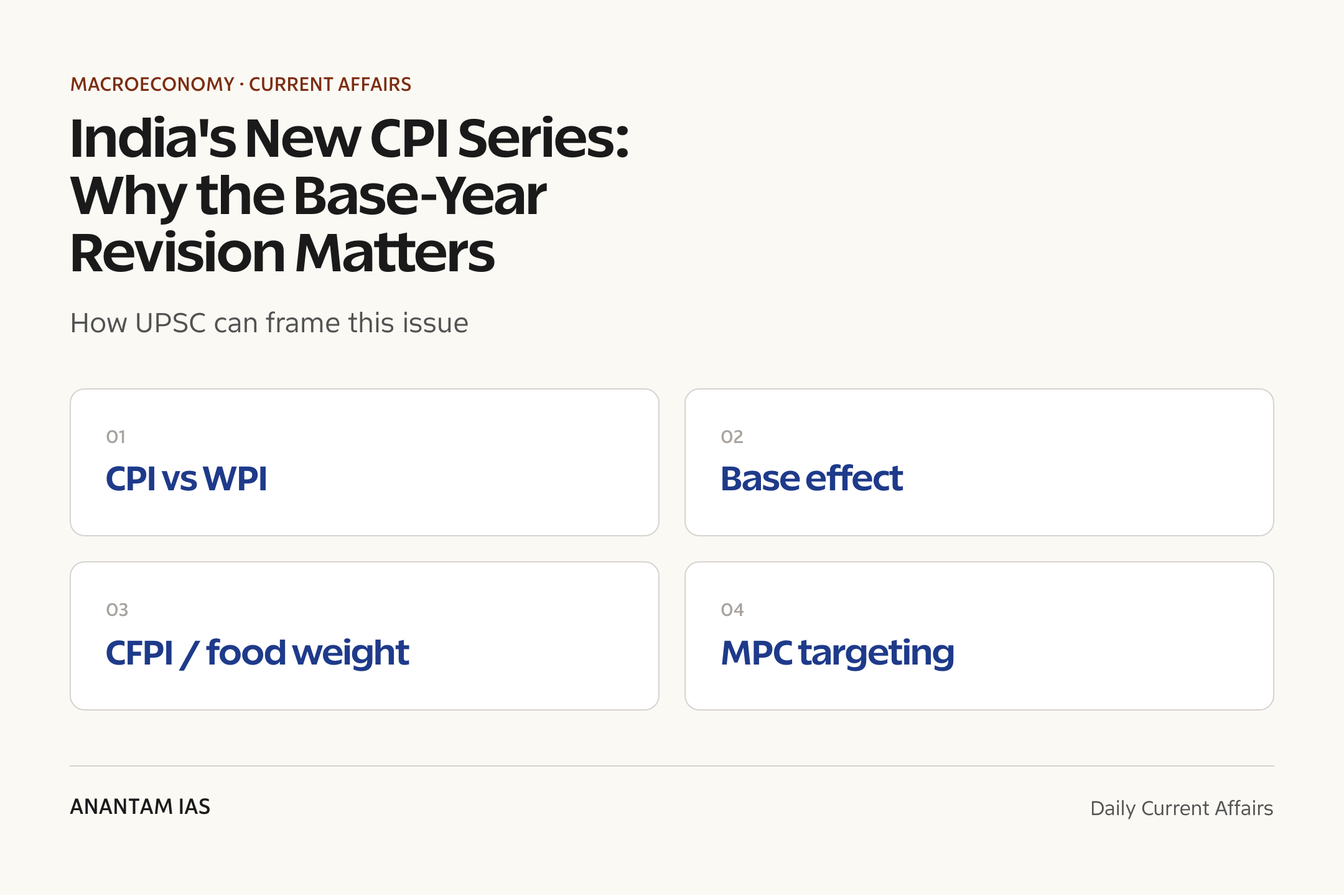
India's New CPI Series: Why the Base-Year Revision Matters — exam lens

Why a base year, and why revise it

Every index is anchored to a base year whose basket and weights represent typical household spending at that time.

  • The current series uses 2012 as the base; consumption patterns have shifted markedly since.
  • Over time families spend relatively less on food and more on transport, health, education and communication.
  • A stale basket misweights items, so the index drifts from the real cost of living, the classic case for rebasing.
  • Global statistical practice recommends rebasing roughly every five to ten years to keep an index representative.

The HCES 2022-24 reweighting

The new weights are derived from the Household Consumption Expenditure Survey, the survey that maps where the rupee actually goes.

  • The HCES 2022-24 is the first comprehensive consumption survey released after a long hiatus, giving fresh expenditure shares.
  • It records a falling share of spending on food, especially cereals, and a rising share on services and processed items.
  • These shares become the new CPI weights, so the basket reflects 2020s consumption rather than 2012 habits.
  • A lower food weight means food-price swings move headline inflation less than before.

Food weight, CFPI and the base effect

Food has long dominated India’s CPI, which is why a re-weighting here is consequential.

  • The Consumer Food Price Index (CFPI) isolates food inflation; food and beverages was the largest single group in the 2012 basket.
  • A reduced food weight dampens the sensitivity of headline CPI to volatile vegetable and pulse prices.
  • The base effect can also shift on rebasing: comparing prices against a different base year changes the arithmetic of measured inflation.
  • Lower food weight does not lower actual food prices; it changes how much those prices count in the aggregate.

Link to inflation targeting and the MPC

The CPI is not just a statistic; it is the legal anchor of India’s monetary policy.

  • Under the amended RBI Act, 1934, the government sets a flexible inflation-targeting goal of 4% CPI inflation within a 2-6% band.
  • The Monetary Policy Committee (MPC), chaired by the RBI Governor, sets the repo rate by reading CPI against that target.
  • A re-weighted CPI can print a different headline number for the same underlying prices, nudging how the MPC judges whether inflation is on target.
  • The RBI has flagged that it will study continuity between old and new series so policy signals stay comparable.

Wider stakes of the number

Because so much is indexed to CPI, the revision reaches well beyond the central bank.

  • Dearness allowance for government employees and pensioners is linked to CPI movements.
  • Wage settlements, rent escalations and many index-linked contracts reference retail inflation.
  • Real interest rates, real wages and poverty-line calculations all depend on a credible price index.
  • Better weights improve the accuracy of these downstream calculations across the economy.

Caveats and continuity concerns

A cleaner basket is welcome, but a series break creates analytical challenges.

  • A new base year breaks the continuous time series, complicating long-run comparisons of inflation.
  • Analysts watch for splicing and back-series so old and new numbers can be read together.
  • Transparency on methodology and weights is essential for the index to retain market and public trust.
  • Survey design and data quality from the HCES directly shape how representative the new basket is.

Way Forward

Methodological transparency

  • Publish the full revised weighting diagram and a clear back-series so users can splice old and new data.
  • Document the survey methodology behind the HCES shares to pre-empt credibility questions.

Policy continuity

  • Let the MPC communicate how the rebased series maps to the 4% target so rate signals stay clear.
  • Run old and new series in parallel for a transition window to ease interpretation.

Modernising the statistical machine

  • Move toward more frequent consumption surveys and faster price collection, including scanner and digital-transaction data.
  • Strengthen institutional independence and timeliness of the NSO to sustain data confidence.

Conclusion

Rebasing the CPI is routine statistical hygiene, but its timing and a lower food weight make this revision unusually consequential. The number that emerges feeds straight into the RBI’s inflation-targeting framework, so even small re-weightings shift how policy reads the economy.

The deeper lesson is that measurement is governance. A representative basket, built on a credible consumption survey and communicated transparently, lets the central bank, employers and households make sounder decisions about the real cost of living.

UPSC Practice Questions

Prelims MCQ 1

With reference to India’s Consumer Price Index (CPI), consider the following statements:

  1. The CPI is compiled by the National Statistical Office under MoSPI.
  2. The food and beverages group has been the largest single component of the CPI basket.
  3. CPI tracks only goods and excludes services from its basket.

How many of the above statements are correct?

(a) Only one (b) Only two (c) All three (d) None

Answer: (b) Only two

Explanation:

Statements 1 and 2 are correct: NSO/MoSPI compiles the CPI, and food and beverages is its largest group. Statement 3 is wrong, CPI covers services such as transport, health and education, unlike WPI which excludes services.

Prelims MCQ 2

The flexible inflation-targeting framework, under which the RBI aims for 4% CPI inflation within a band, derives its legal basis from which one of the following?

(a) The amended Reserve Bank of India Act, 1934 (b) The Banking Regulation Act, 1949 (c) The FRBM Act, 2003 (d) The Companies Act, 2013

Answer: (a) The amended Reserve Bank of India Act, 1934

Explanation:

The flexible inflation-targeting mandate and the 4% target with a 2-6% band were institutionalised through amendments to the RBI Act, 1934, which also created the Monetary Policy Committee.

UPSC Mains Questions

  1. Periodic rebasing of price indices is essential for credible inflation measurement. Examine how revising the CPI base year and re-weighting its basket on fresh consumption-survey data affects the accuracy of measured retail inflation in India.
  2. A lower food weight in the new CPI series changes the dynamics of headline inflation and the RBI’s monetary-policy response. Critically analyse the implications for India’s flexible inflation-targeting framework.
  3. Discuss the role of robust statistical institutions and timely consumption surveys in evidence-based economic governance, with reference to the CPI revision.

Sources: MoSPI, National Statistical Office (NSO) and Reserve Bank of India.

Frequently Asked Questions

What is the Consumer Price Index (CPI)?

The CPI measures the average change over time in the retail prices of a fixed basket of goods and services that households buy. Compiled monthly by the National Statistical Office under MoSPI, its year-on-year change is India’s headline retail inflation rate and the anchor for monetary policy.

Why is the CPI base year being revised?

Consumption patterns change over time, so a basket weighted to 2012 spending no longer reflects how households spend today. Rebasing refreshes the basket and weights using newer survey data, keeping the index representative of the actual cost of living and improving the accuracy of measured inflation.

What data is used to set the new CPI weights?

The new weights are derived from the Household Consumption Expenditure Survey (HCES) 2022-24, a large official survey of where households actually spend. It captures a falling share of spending on food and a rising share on services and discretionary items, which then become the index weights.

Why does a lower food weight matter?

Food was the largest group in the old CPI basket, so volatile vegetable and pulse prices moved headline inflation sharply. A lower food weight means food-price swings count for less in the aggregate, dampening their effect on headline CPI, though actual food prices themselves are unchanged.

How does the CPI affect RBI monetary policy?

Under the amended RBI Act, 1934, the RBI follows flexible inflation targeting, aiming for 4% CPI inflation within a 2-6% band. The Monetary Policy Committee reads the CPI against this target to set the repo rate, so a re-weighted index can shift how policy judges whether inflation is on track.

How is the CPI different from the WPI?

The CPI tracks retail prices paid by consumers and includes services such as transport, health and education. The Wholesale Price Index tracks producer or wholesale-level prices, excludes services, and is maintained by the Office of the Economic Adviser. The RBI targets CPI, not WPI.
Right to Menstrual Health: Toward a Constitutional Guarantee

Open article →Download PDF

Why in News?

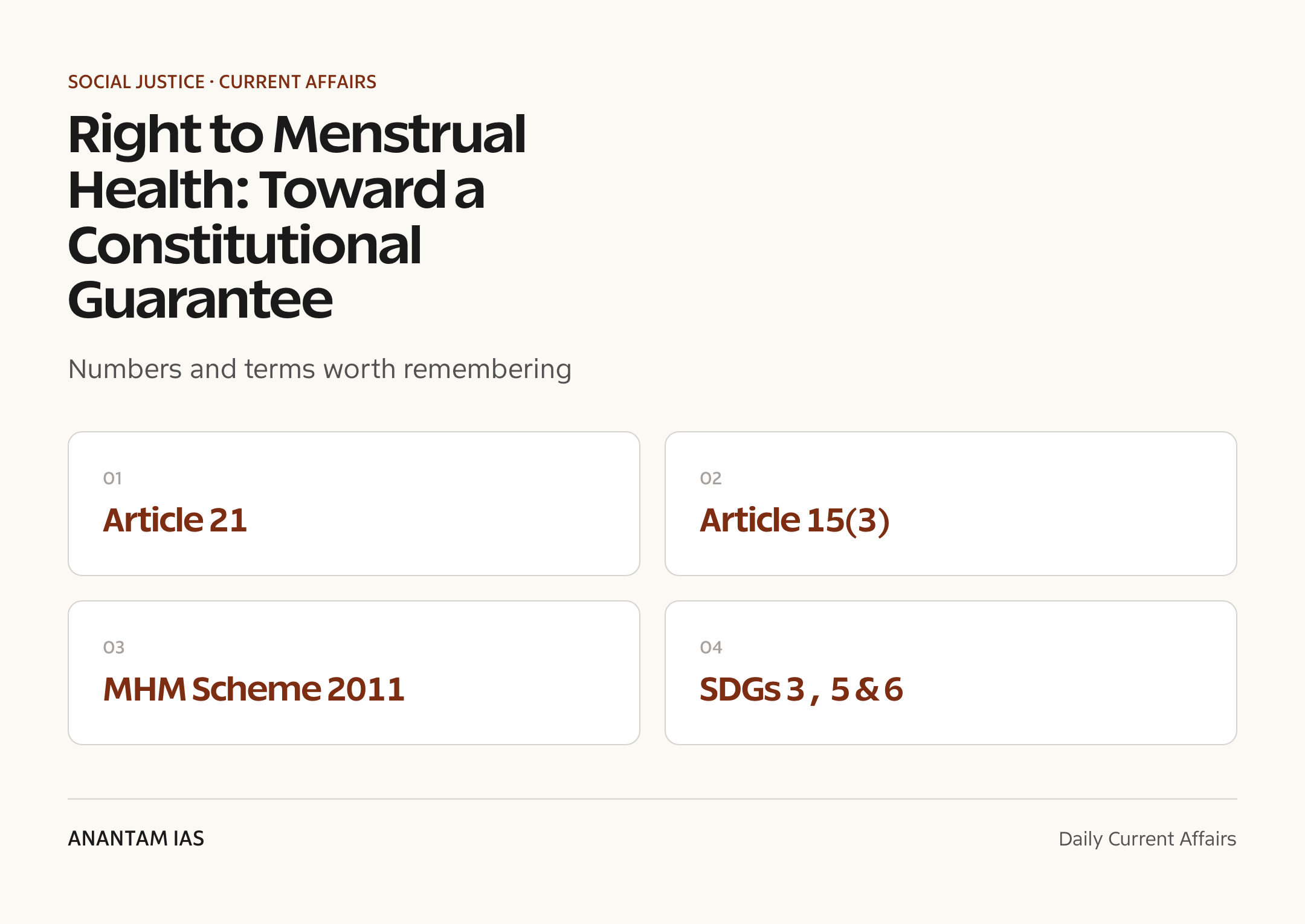
A growing line of judicial reasoning and policy debate has begun to frame menstrual health not as a private inconvenience but as a constitutional entitlement flowing from the Article 21 right to life, dignity and health, read with Article 15(3) which permits special provisions for women and children.

The Supreme Court of India directed the Union and the States to frame a uniform national menstrual-hygiene policy for school-going girls, covering access to products, disposal infrastructure and awareness, pushing the issue from welfare scheme to enforceable right.

  • The Court treated menstrual hygiene as part of the guarantees of health, dignity and education, not optional charity.
  • It sought a national policy on menstrual-hygiene management (MHM) for adolescent girls across government and aided schools.
  • Directions touched separate functional toilets, sanitary-pad access and safe disposal, linking the issue to school retention.
  • The debate widened to menstrual leave, free product access and de-stigmatisation in workplaces and public institutions.

The development matters in the context of:

  • This matters because roughly one in five adolescent girls is reported to drop out of school around menarche, tying menstruation to the right to education under Article 21A.
  • It sits at the intersection of reproductive health, gender equity and the directive-principles vision of a welfare state.
  • It also engages India’s commitments under the Sustainable Development Goals 3 (health), 5 (gender equality) and 6 (water and sanitation).
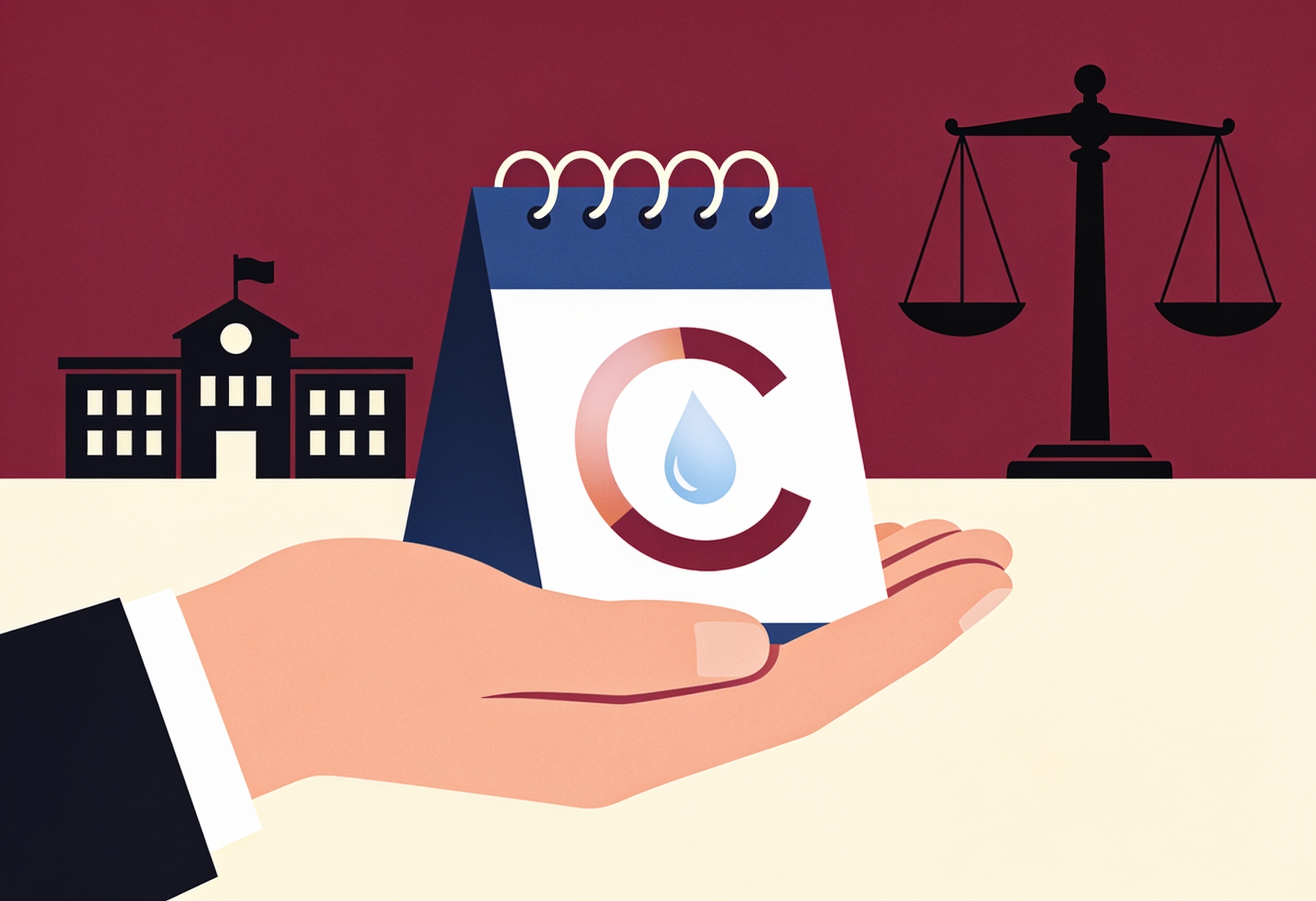
Illustration of a calendar with a highlighted monthly cycle, a water-drop motif and a protective hand, with a school and balance-scales silhouette behind.
Menstrual health reframed as a question of dignity, education and equal rights. Illustration: AI-generated (Freepik)
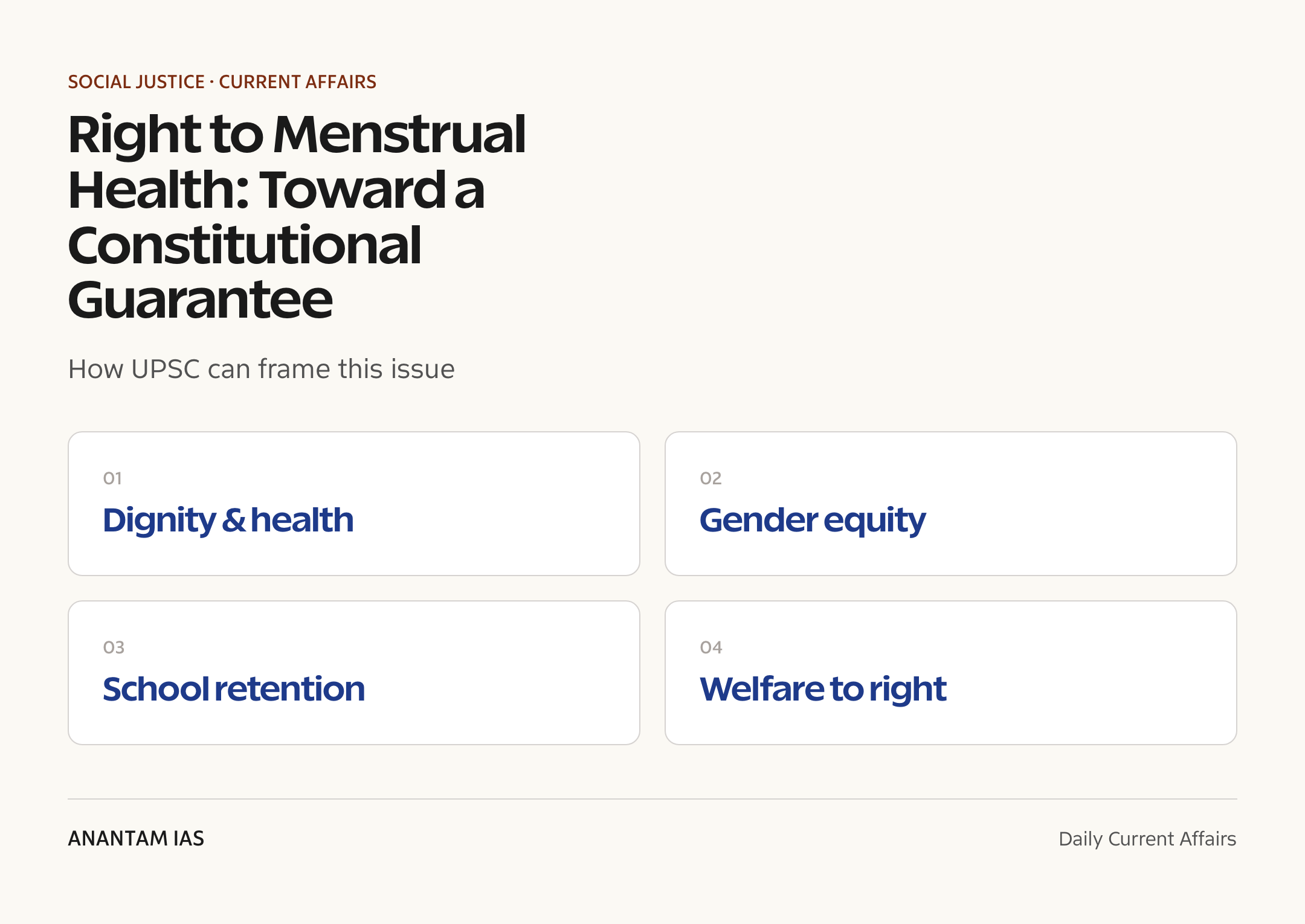
Right to Menstrual Health: Toward a Constitutional Guarantee — quick facts

UPSC Relevance

Prelims Relevance

  • Article 21 — right to life, expanded to include health and human dignity
  • Article 15(3) — special provisions for women and children
  • Article 21A and the link between menstruation and school dropout
  • Menstrual Hygiene Scheme (2011) under the National Health Mission
  • Swachh Bharat Mission and school sanitation / separate toilets
  • Pradhan Mantri Bhartiya Janaushadhi Pariyojana — low-cost ‘Suvidha’ sanitary pads
  • RMNCH+A framework and the adolescent-health programme RKSK
  • SDGs 3, 5 and 6 and their relevance to menstrual health
  • Difference between menstrual hygiene management and menstrual health (a wider WHO concept)

Mains Relevance

GS Paper 2

  • How the judiciary has read socio-economic entitlements like menstrual health into Article 21, and the limits of such judicial direction.
  • Welfare schemes versus rights: assessing the Menstrual Hygiene Scheme and product-access programmes against an enforceable-right standard.

GS Paper 1

  • Menstrual stigma as a marker of gender inequality and a barrier to women’s participation in education and the workforce.

Essay

  • Dignity is not a privilege: making the invisible needs of women a public concern.
  • A society is judged by how it treats its most ordinary biological realities.

Background and Context

The constitutional foundation

The case for a right to menstrual health is built on rights the Constitution already guarantees, not a new fundamental right.

  • Article 21 has been read by courts to include the right to life, the right to health and to live with human dignity (a line running from Francis Coralie Mullin onward).
  • Article 15(3) expressly allows the State to make special provisions for women and children, giving constitutional cover to targeted menstrual schemes.
  • Article 21A guarantees free and compulsory education up to 14; menstruation-linked dropout directly undercuts this promise.
  • Article 47, a Directive Principle, casts a duty on the State to raise nutrition and public health — the policy backbone for menstrual welfare.
Right to Menstrual Health: Toward a Constitutional Guarantee — exam lens

From scheme to right — the policy ladder

India already runs a stack of programmes; the shift is from discretionary welfare to a justiciable guarantee.

  • The Menstrual Hygiene Scheme (2011) under the National Health Mission subsidises sanitary napkins for rural adolescent girls through ASHA workers.
  • Swachh Bharat Mission built school toilets and pushed separate, functional toilets for girls as a retention measure.
  • Pradhan Mantri Bhartiya Janaushadhi Pariyojana sells ‘Suvidha’ pads at a low fixed price through Janaushadhi Kendras.
  • Adolescent care also flows through the RKSK programme and the wider RMNCH+A strategy under the Ministry of Health.

The gaps the right is meant to close

Access, disposal, affordability and stigma remain uneven, which is why courts treat the issue as unfinished.

  • Disposal infrastructure — incinerators and safe waste handling — lags far behind product distribution, raising health and environmental costs.
  • Affordability and continuity of supply varies; stock-outs in schools and kendras blunt the schemes’ reach.
  • Stigma and silence keep many girls from seeking facilities, so infrastructure alone does not guarantee use.
  • Data and standards differ across States, which is why the Court pressed for one national policy baseline.

The contested frontier — menstrual leave

Beyond schools, the debate has moved to the workplace, where opinion is genuinely divided.

  • Some States and employers have introduced menstrual leave, framing it as dignity and health support.
  • Critics warn it can become a pretext for workplace discrimination in hiring and pay, harming the very group it protects.
  • A middle view favours flexible leave and facilities over a separate mandatory category, keeping the choice with the worker.
  • Courts have so far been cautious about a blanket judicial mandate, treating leave as a policy question for the legislature.

Menstrual hygiene versus menstrual health

The vocabulary itself is shifting, and that shift carries the rights argument.

  • Menstrual hygiene management (MHM) focuses narrowly on products, water and disposal.
  • Menstrual health, as framed by the WHO, is broader — covering information, care, a supportive environment and freedom from coercion or stigma.
  • The wider framing maps neatly onto Article 21‘s dignity standard, strengthening the constitutional claim.
  • It also reframes the issue as one of autonomy and equality, not merely sanitation.

The global benchmark

India’s move sits within a recognisable international trend that examiners may ask you to compare.

  • Scotland became the first country to make period products legally free for all who need them.
  • Several countries have cut or removed the ‘tampon tax’, treating products as essentials, not luxuries.
  • The SDGs bind menstrual health to gender equality (5) and water-sanitation (6), giving India a reporting yardstick.
  • UN bodies increasingly classify menstrual health as a human-rights issue, mirroring India’s Article-21 reasoning.

Way Forward

Codify a national baseline

  • Frame the national menstrual-hygiene policy the Court sought, with enforceable minimum standards for schools and public institutions.
  • Tie disbursal to outcomes — functional toilets, stock continuity and disposal — not just product counts.

Close the disposal and supply gap

  • Invest in safe disposal (incinerators, biodegradable products) alongside distribution.
  • Strengthen Janaushadhi and NHM supply chains to end stock-outs in rural areas.

Treat stigma as policy, not afterthought

  • Embed menstrual health education for all genders in the school curriculum to break silence.
  • Approach menstrual leave through flexible, non-stigmatising design that protects against workplace discrimination.

Conclusion

Reading menstrual health into Article 21 reframes a routine biological reality as a question of dignity, equality and the right to education. It pushes the State from charitable distribution toward an enforceable guarantee, with the schools where girls drop out as the first test of intent.

The hard work now lies in execution — disposal, supply continuity, education and sensitively designed workplace policy. A right is only as real as the toilet that works and the silence that breaks; the constitutional promise will be measured there, not in the judgment alone.

UPSC Practice Questions

Prelims MCQ 1

With reference to the constitutional basis for menstrual health in India, consider the following statements:

  1. The right to health has been read by courts into the right to life under Article 21.
  2. Article 15(3) permits the State to make special provisions for women and children.
  3. The right to menstrual health is enumerated as a distinct fundamental right in Part III of the Constitution.

How many of the above statements are correct?

(a) Only one (b) Only two (c) All three (d) None

Answer: (b) Only two

Explanation:

Statements 1 and 2 are correct — courts have read health and dignity into Article 21, and Article 15(3) allows special provisions for women and children. Statement 3 is wrong: there is no separately enumerated fundamental right to menstrual health; the claim is derived from Article 21 read with 15(3).

Prelims MCQ 2

Under which scheme are low-cost ‘Suvidha’ sanitary napkins made available through dedicated outlets?

(a) Menstrual Hygiene Scheme (b) Swachh Bharat Mission (c) Pradhan Mantri Bhartiya Janaushadhi Pariyojana (d) Rashtriya Kishor Swasthya Karyakram

Answer: (c) Pradhan Mantri Bhartiya Janaushadhi Pariyojana

Explanation:

‘Suvidha’ biodegradable sanitary napkins are sold at a low fixed price through Janaushadhi Kendras under the PM Bhartiya Janaushadhi Pariyojana. The Menstrual Hygiene Scheme (2011) subsidises napkins for rural adolescent girls via the NHM but is a separate programme.

UPSC Mains Questions

  1. Indian courts have progressively read socio-economic entitlements into the right to life under Article 21. Examine this trend with reference to menstrual health, and discuss the limits of securing such rights through judicial direction. (250 words)
  2. “Menstrual health is a question of dignity and equality, not merely sanitation.” Critically evaluate India’s policy framework for menstrual health and suggest measures to make it a substantive guarantee. (250 words)
  3. Discuss whether mandatory menstrual leave advances or undermines gender equity in the workplace, and recommend a balanced policy approach. (150 words)

Sources: Supreme Court of India and Ministry of Health and Family Welfare.

Frequently Asked Questions

Is there a fundamental right to menstrual health in India?

There is no separately enumerated fundamental right to menstrual health. Courts derive it from the right to life under Article 21, which has been read to include health and human dignity, combined with Article 15(3) that allows special provisions for women and children. So it is a derived, judicially recognised entitlement rather than a distinct named right in Part III.

What did the Supreme Court direct on menstrual hygiene?

The Supreme Court asked the Union and the States to frame a uniform national menstrual-hygiene policy for school-going girls. The directions covered access to sanitary products, separate functional toilets and safe disposal infrastructure, treating these as part of the rights to health, dignity and education rather than as optional welfare measures.

Which schemes support menstrual hygiene in India?

Key programmes include the Menstrual Hygiene Scheme (2011) under the National Health Mission, which subsidises napkins for rural adolescent girls, the Swachh Bharat Mission for school sanitation and separate toilets, and the Pradhan Mantri Bhartiya Janaushadhi Pariyojana, which sells low-cost ‘Suvidha’ pads. Adolescent care also flows through the RKSK programme.

How does menstrual health link to school dropout?

Inadequate toilets, products and information lead many adolescent girls to miss classes or leave school around menarche. Because Article 21A guarantees free and compulsory education up to 14, this dropout connects menstrual health directly to the right to education, which is why courts and policymakers treat schools as the first place to act.

Why is menstrual leave a contested issue?

Supporters see paid menstrual leave as dignity and health support. Critics fear it may be used as a pretext to discriminate against women in hiring and pay, harming the group it aims to help. A middle path favours flexible leave and better facilities over a separate mandatory category, and courts have largely left it to the legislature as a policy choice.

How does this connect to the Sustainable Development Goals?

Menstrual health sits across three SDGs: Goal 3 on good health and well-being, Goal 5 on gender equality, and Goal 6 on clean water and sanitation. Framing menstruation as a health and equality issue, rather than just sanitation, aligns India’s domestic policy with its international reporting commitments under the 2030 Agenda.