Opens in a new tab
Join Anantam IAS Channel on Telegram

Daily Digest · Friday

5 June 2026 Current Affairs for UPSC

5 current affairs published on Friday, 5 June 2026

5 June 2026 Current Affairs for UPSC — every Why-in-News article AnantamIAS published on Friday, 5 June 2026, broken down with Why in News?, the exact GS paper it feeds, sub-topic mapping, MCQ-ready facts and a UPSC-style practice question. 5 articles in total, covering Polity, Economy, Environment, S&T, IR, Geography, History, Society and Internal Security — the same Why-in-News + GS-paper-mapping + practice-question format the Compass uses across every daily digest on the site.

Daily current affairs for UPSC is where new material enters your prep stream. Read this 5 June 2026 digest end-to-end in 25–35 minutes, attempt the practice question at the foot of each article (it's MCQ for some, 10/15-marker for others), then bookmark the entries that fall inside your active revision window. Everything stays cross-linked: tap any subject pill to jump to that subject's hub, or use the table of contents above to skip straight to a specific story.

Use this page three ways. Read sequentially for a one-sitting scan of everything that mattered on 5 June 2026. Download the 5 June 2026 PDF below for offline study or print revision. Or use the June 2026 Current Affairs compilation to see this day in the month's full context. For the previous day's reading, see 4 June 2026 Current Affairs; the next day's is 6 June 2026 Current Affairs.

Why we publish daily current affairs separately from the monthly compilation: daily is learning, monthly is revision. Use the daily page to add fresh material to your notes the day it breaks; come back to the June 2026 compilation 60 days before Prelims when the noise has settled and only the lasting takeaway is worth re-reading.

India-UK launch Critical Minerals Global Supply Chain Observatory

Open article →Download PDF

Why in News?

India and the United Kingdom have launched the India-UK Critical Minerals Global Supply Chain Observatory (GSCO) in New Delhi. The initiative seeks to strengthen monitoring, risk assessment and market intelligence related to global critical mineral supply chains.

UPSC Relevance: GS-2 International Relations: Bilateral, regional and global groupings GS-3 Economy: Energy Security 
Prelims: Critical minerals, Critical Minerals Global Supply Chain Observatory, National Critical Mineral Mission

Critical Minerals: 

  • Critical minerals are essential for electric vehicles, lithium-ion batteries, solar panels, wind turbines, semiconductors, telecommunications, defence systems and advanced manufacturing. However, their supply chains are often geographically concentrated, vulnerable to disruptions and exposed to geopolitical risks.
  • India’s clean energy transition, digital economy, defence modernisation and electric mobility push require stable access to minerals such as lithium, cobalt, nickel, graphite, rare earth elements, gallium and germanium. 

Therefore, critical minerals are becoming central to economic, energy, and national security.

What is the India-UK Critical Minerals Global Supply Chain Observatory?

  • The India-UK Critical Minerals Global Supply Chain Observatory is a joint initiative developed by TEXMiN at IIT (ISM) Dhanbad and the University of Cambridge
  • It will serve as a data-driven platform for monitoring global critical mineral supply chains.

Its key functions include:

  • Monitoring global supply chains: It will track production, processing, trade flows and supply concentration of critical minerals.
  • Identifying risks and disruptions: It will help detect supply shocks caused by geopolitical tensions, export controls, conflict, climate risks or market volatility.
  • Generating market intelligence: It will provide information useful for policymakers, industry and researchers.
  • Supporting evidence-based policymaking: It will strengthen India’s ability to make informed decisions on exploration, acquisition, processing, recycling and strategic reserves.

Link with India’s National Critical Mineral Mission:

  • The launch of the Observatory complements India’s National Critical Mineral Mission (NCMM). The mission seeks to create a robust framework for self-reliance in the critical mineral sector by securing supplies from both domestic and foreign sources.

The NCMM focuses on:

  • Expanding domestic exploration of critical minerals.
  • Auctioning critical mineral blocks.
  • Supporting overseas acquisition of mineral assets.
  • Strengthening mineral processing and recycling.
  • Creating Centres of Excellence and improving research capabilities.
  • Building resilient and diversified mineral value chains.

The Ministry of Mines has identified 30 critical minerals, while 24 minerals have been included in Part D of the First Schedule of the Mines and Minerals (Development and Regulation) Act, 1957, giving the Union government exclusive authority to auction mining leases and composite licences for these minerals.

Strategic Significance for India: 

  • Strengthening Supply Chain Resilience: India remains dependent on imports for several critical minerals and their processed forms. Global processing capacity, especially for rare earth elements and battery minerals, is concentrated in a few countries. The Observatory can help India identify vulnerabilities early and diversify supply sources.
  • Supporting Clean Energy Transition: Critical minerals are indispensable for renewable energy technologies. Lithium, nickel and cobalt are used in batteries; rare earth elements such as neodymium and dysprosium are used in permanent magnets for wind turbines and EV motors; silicon, tellurium, indium and gallium are used in solar technologies. A stable mineral supply is therefore essential for India’s climate commitments and net-zero transition.
  • Enhancing Strategic Autonomy: Critical minerals are increasingly being used as tools of economic statecraft. Export restrictions, resource nationalism and geopolitical conflicts can disrupt supply chains. India’s ability to track risks and build alternative partnerships will strengthen its strategic autonomy.
  • Enabling Advanced Manufacturing: Sectors such as semiconductors, electronics, aerospace, defence, telecommunications and battery manufacturing depend on assured mineral supplies. India’s ambitions under Make in India, the Production Linked Incentive schemes and the semiconductor mission require a secure mineral base.
  • Deepening India-UK Technology Partnership: The Observatory is aligned with the India-UK Technology Security Initiative, which covers critical and emerging technologies such as artificial intelligence, telecom, semiconductors, quantum technologies, biotechnology, advanced materials and critical minerals. It also supports the wider India-UK Vision 2035, which seeks to build a future-oriented partnership in trade, technology, climate, defence and security.

The India-UK Critical Minerals Global Supply Chain Observatory reflect that India-UK ties are moving beyond historical and cultural connections towards technology, supply chain resilience, clean energy, and strategic autonomy. 
India-UK MoU to set the Regional Maritime Security Centre of Excellence

Open article →Download PDF

Why in News? 

India and the United Kingdom have deepened their maritime security cooperation through a Memorandum of Understanding for setting up the Regional Maritime Security Centre of Excellence (RMSCE)

The announcement came as India’s External Affairs Minister and the UK’s Foreign Secretary held the first annual meeting in New Delhi to review progress under India-UK Vision 2035. The ministers reviewed cooperation under all five pillars of the Vision 2035 framework: Growth, Technology and Innovation, Defence and Security, Climate and Clean Energy, and Education.

UPSC Relevance: GS-2 International Relations: Bilateral Relations; GS-3 Internal Security: Maritime Security

Prelims: Regional Maritime Security Centre of Excellence
Mains: Maritime Security: Non-traditional security threats

Indian Ocean Region has become one of the most strategically important maritime spaces in the world. It connects the energy-rich Persian Gulf, the manufacturing centres of East Asia, the markets of Europe, and the developing economies of Africa and South Asia. A major share of global trade, energy flows, and container shipping passes through this region.

India’s long coastline, island territories, offshore assets, ports, fisheries, energy imports and sea lines of communication make maritime security central to its strategic thinking. The UK has growing Indo-Pacific interests and seeks to work with like-minded partners to support maritime stability, freedom of navigation and resilient supply chains.

What is the Regional Maritime Security Centre of Excellence?

  • The Regional Maritime Security Centre of Excellence is a proposed India-UK institutional platform aimed at strengthening maritime security capacity among Indian Ocean states. 
  • The centre will be established by King’s College London and India’s National Maritime Foundation.
  • It is expected to focus on research, training, policy dialogue, capacity-building and knowledge-sharing in the field of maritime security. 
  • Its emphasis will be on non-traditional maritime security threats, which are increasingly affecting smaller coastal and island states in the Indian Ocean.

What are Non-Traditional Maritime Security Threats?

Non-traditional maritime security threats are security challenges that do not arise from conventional naval warfare alone. They are often transnational, irregular, hybrid and difficult for individual states to manage alone.

These threats include:

  1. Piracy and armed robbery at sea.
  2. Illegal, unreported and unregulated fishing.
  3. Drug trafficking and arms smuggling.
  4. Human trafficking and irregular migration.
  5. Maritime terrorism.
  6. Cyber attacks on ports and shipping systems.
  7. Threats to undersea cables and offshore energy infrastructure.
  8. Marine pollution and illegal dumping.
  9. Climate-induced disasters affecting coastal and island states.
  10. Grey-zone activities and coercive maritime behaviour.

Why is the Centre Significant?

  • Enhancing Maritime Domain Awareness: Effective maritime security requires real-time awareness of activities at sea. The centre can support research and capacity-building on maritime domain awareness, including the tracking of suspicious vessels, dark shipping, illegal fishing fleets, trafficking networks and threats to critical infrastructure.
  • Addressing Hybrid and Grey-Zone Threats: The Indian Ocean is witnessing the rise of grey-zone tactics, where state and non-state actors use coercive actions below the threshold of open conflict. These may include maritime militia activity, coercive fishing fleets, cyber attacks, disinformation, and infrastructure pressure. The RMSCE can help develop common frameworks to understand and respond to such threats.
  • Strengthening capacity of Indian Ocean States: Many Indian Ocean states have limited naval, coast guard, surveillance and legal capacities. They often face challenges in monitoring their maritime zones, enforcing laws and responding to transnational threats. The RMSCE can help build training, research and operational awareness capacities among these states.
  • Supporting India’s Role as a Net Security Provider: India has increasingly projected itself as a net security provider in the Indian Ocean. Initiatives such as SAGAR, the Information Fusion Centre-Indian Ocean Region, coastal radar networks, defence training, humanitarian assistance and disaster relief missions already reflect this role. The RMSCE can add an intellectual and institutional layer to India’s maritime outreach.
  • Deepening India-UK Strategic Partnership: India-UK relations are moving beyond historical and cultural ties towards technology, defence, maritime security, trade and resilient supply chains. The RMSCE fits within the Defence and Security pillar of India-UK Vision 2035 and strengthens the strategic dimension of bilateral ties.
  • Protecting Critical Maritime Infrastructure: Ports, undersea cables, offshore energy platforms, shipping lanes, oil terminals and logistics hubs are critical to national economies. Recent global conflicts have shown that maritime infrastructure is highly vulnerable. The centre can contribute to risk assessment, policy planning and cooperative protection of critical maritime infrastructure.

Significance for the UK: 

  • The initiative also serves UK interests. The UK has growing economic, strategic and security interests in the Indo-Pacific. Its trade, energy security and global naval posture depend on stable maritime routes. Cooperation with India allows the UK to remain engaged in the Indian Ocean through a trusted democratic partner. 
  • The centre also aligns with the UK’s broader Indo-Pacific approach, which seeks cooperation with India on maritime security, defence technology, resilient supply chains and rules-based order.

Broader Geopolitical Context: 

The RMSCE must be understood against larger developments in the Indian Ocean and Indo-Pacific.

  • First, the Indian Ocean is witnessing increased strategic competition among major powers. China’s expanding naval presence, port investments and dual-use infrastructure have raised concerns among many regional actors
  • Second, conflicts in West Asia and disruptions in the Red Sea have shown how maritime chokepoints can become vulnerable to geopolitical shocks.
  • Third, non-traditional maritime threats have grown in scale due to climate stress, weak governance, illegal fishing, organised crime and technological vulnerabilities.
  • Fourth, smaller Indian Ocean states often lack the capacity to monitor vast exclusive economic zones. This creates space for criminal networks, illegal fishing vessels and external strategic influence.

In this environment, India-UK maritime cooperation can contribute to a more stable and rules-based maritime order. However, the centre’s real value will depend on its ability to deliver practical capacity-building, support smaller Indian Ocean states and address emerging non-traditional maritime threats. 

When El Niño becomes an Economic Crisis

Open article →Download PDF

Why in News?

Developing El Niño conditions in the equatorial Pacific has renewed concerns about India’s monsoon, agricultural output, food inflation, water security, and labour productivity.

The India Meteorological Department (IMD) has projected a below-normal southwest monsoon, forecasting seasonal rainfall at just 90% of the Long Period Average (LPA). 

UPSC Relevance: GS-1 Geography: Physical Geography; GS-3 Environment: Climate Change 

Prelims & Mains: ENSO, El Niño: Mechanism & Consequences

Understanding El Niño: 

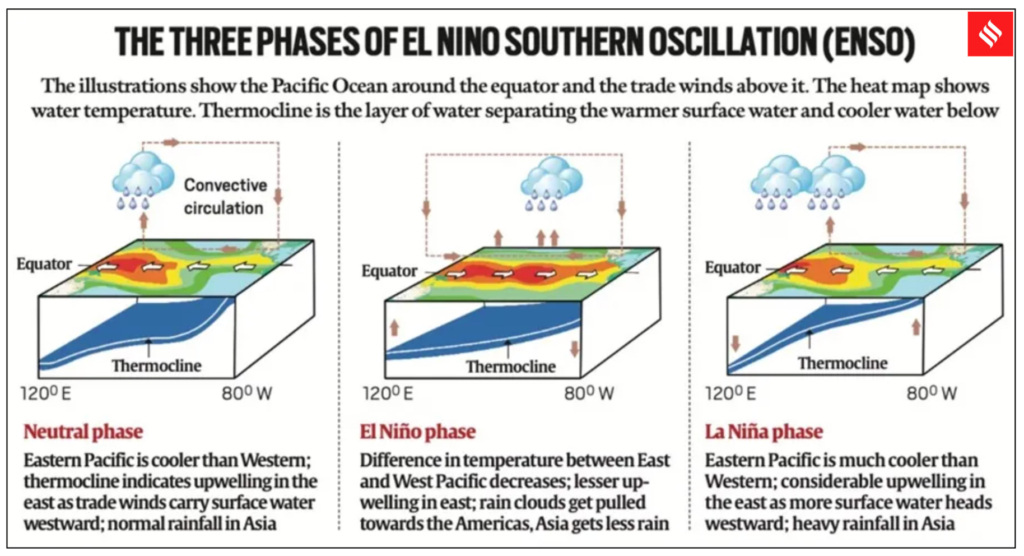
  • El Niño refers to the abnormal warming of sea surface temperatures in the central and eastern equatorial Pacific Ocean. This weakens the movement of moisture-bearing winds towards India and disrupts the southwest monsoon.
  • While every El Niño year does not necessarily result in drought, it increases the probability of rainfall deficiency, heat stress, delayed sowing, and agricultural uncertainty.
  • For India, this matters because the southwest monsoon remains central to the economy. It provides nearly 70% of the country’s annual rainfall, supports kharif agriculture, recharges reservoirs and aquifers, and sustains rural incomes. Therefore, a weak monsoon can transmit climate stress into the wider economy.

Climate Risk as Economic Risk:

Heat Stress and Labour Productivity:

  • Extreme heat reduces the ability of people to work safely and productively, especially in outdoor and physically demanding occupations. Heat stress reduces working hours, increases fatigue, raises health risks, and lowers daily income. 
  • Construction labourers, street vendors, delivery workers, sanitation workers, agricultural labourers, and gig workers face prolonged exposure to high temperatures.A large proportion of workers are in informal employment and do not have access to paid leave, cooling facilities, health insurance, or workplace protections.

Agriculture and Rural Incomes:

  • The southwest monsoon determines sowing decisions, soil moisture, reservoir levels, groundwater recharge, and crop yields. When rainfall is delayed or deficient, farmers face higher irrigation costs and greater uncertainty over crop selection.
  • Small and marginal farmers are the most vulnerable because they have limited savings, fragmented landholdings, weak bargaining power, and inadequate access to irrigation. A weak monsoon can reduce kharif output, increase dependence on groundwater, and deepen rural distress.
  • This also affects the non-farm rural economy. Lower farm incomes reduce demand for local goods and services, affecting small traders, transporters, rural artisans, and labourers.

Food Inflation and Household Budgets:

  • Climate shocks become visible to ordinary citizens through food prices. Vegetables, pulses, cereals, edible oils, and milk are highly sensitive to weather conditions, supply disruptions, and storage constraints.
  • If monsoon rainfall weakens, crop stress can push up food prices. This creates a difficult situation for policymakers because the same climate shock can weaken growth while raising inflation.

Water Scarcity and Urban Stress:

  • El Niño can also intensify water stress. Weak rainfall affects reservoirs, groundwater recharge, drinking water supplies, hydropower generation, and irrigation availability. Cities dependent on distant water sources may face shortages, while rural areas may experience deeper groundwater extraction.
  • Urban India is becoming more vulnerable because of concretisation, shrinking green cover, poor drainage, and the urban heat island effect. Poor households living in congested settlements face higher heat exposure, limited access to safe drinking water, and inadequate cooling.

Macroeconomic and Fiscal Pressures:

  • A weak monsoon can affect the macroeconomy through multiple routes. Agricultural growth may slow, rural consumption may weaken, food imports or export restrictions may become necessary, and inflation management may become more complicated.
  • The government may also face higher fiscal pressure through drought relief, food subsidies, irrigation support, crop insurance payouts, and public health expenditure. Therefore, El Niño is not a temporary weather disturbance; it can become a stress test for India’s economic resilience.

Why is India especially Vulnerable?

India’s vulnerability arises from the interaction of climate exposure and socio-economic inequality.

  • Nearly half of India’s net sown area still depends on rainfall, making agriculture sensitive to monsoon variation. 
  • A large share of India’s workforce is informal and lacks social security. 
  • Many Indian cities are poorly prepared for extreme heat. 
  • Groundwater extraction is already unsustainable in several regions. 
  • Food inflation has direct political and welfare implications because it affects every household.

This makes El Niño a development challenge rather than only a meteorological event.

Policy Measures Needed:

  • Climate-sensitive urban planning: Cities should increase tree cover, protect wetlands and water bodies, create shaded public spaces, promote cool roofs, improve ventilation in low-income housing, and reduce heat-trapping surfaces.
  • Heat Action Plans should move beyond advisories and include ward-level heat maps, drinking water points, public cooling shelters, emergency health services, and protection for outdoor workers. 
  • Worker Protection: Labour regulations must recognise heat as an occupational hazard. Work schedules should be adjusted during heatwaves, especially in construction, delivery, sanitation, mining, and agriculture. Employers should provide rest breaks, drinking water, shade, protective gear, and emergency medical support.
  • Social Protection for Gig workers and informal workers, including heat-linked wage compensation, health insurance, and access to public cooling infrastructure.
  • Climate-Smart Agriculture: Incorporating drought-tolerant crop varieties, micro-irrigation, crop diversification, better weather advisories, soil moisture conservation, and local water harvesting. Pulses, millets, and less water-intensive crops should be promoted in vulnerable regions.
  • Crop insurance must become faster, simpler, and more transparent. Farmers need timely payouts based on weather and satellite-based crop loss assessments.
  • Water management must shift from crisis response to long-term resilience. India needs aquifer mapping, groundwater budgeting, rainwater harvesting, wastewater reuse, tank restoration, watershed development, and demand-side water management.
  • Inflation Management: The government should strengthen buffer stocks, improve cold chains, reduce wastage, monitor price-sensitive commodities, and use a calibrated trade policy. Sudden export bans or import dependence should be avoided unless necessary, because they can create uncertainty for farmers and markets.
  • Early Warning and Data Systems: India should integrate IMD forecasts, satellite data, crop monitoring, reservoir levels, mandi prices, and health alerts into a real-time climate risk dashboard.

Challenges in Implementation:

India faces several constraints. 

  • Adaptation finance remains inadequate. 
  • Local governments often lack technical capacity. 
  • Heat Action Plans are uneven across cities. 
  • Groundwater governance is fragmented. 
  • Crop diversification is difficult because procurement incentives still favour rice and wheat in many regions. 

Informal workers are hard to reach through formal policy channels.

Therefore, adaptation must be decentralised, well-funded, and linked to livelihoods.

Way Forward:

India needs to treat El Niño as an economic early warning signal. The policy response should combine climate adaptation, social protection, inflation management, and water security.

A resilient India will require heat-resilient cities, climate-smart agriculture, protected workers, better groundwater governance, and stronger public health systems. The objective should not be only to survive a bad monsoon, but to reduce the economy’s dependence on climatic luck. 

Power of Mangroves over Seawalls

Open article →Download PDF

Why in News?

Coastal protection in India has traditionally relied on hard infrastructure such as seawalls, groynes, embankments and tetrapods. Ecosystem-based adaptation through mangroves, seagrasses, coral reefs and wetlands can provide a more sustainable and socially inclusive line of defence.  

Mangroves are not merely ecological assets but climate-resilience infrastructure that protects lives, livelihoods and coastal economies.

UPSC Relevance: GS-3 Environment and Biodiversity: Conservation; Disaster Management 

Mains: Mangroves, National Coastal Mission, Ecosystem-based Adaptation

What is Ecosystem-based Adaptation?

  • Ecosystem-based Adaptation refers to the use of biodiversity and ecosystem services to help people adapt to the adverse impacts of climate change. 
  • In coastal areas, it includes the protection and restoration of mangroves, coral reefs, seagrass meadows, dunes, salt marshes and wetlands.
  • Unlike conventional infrastructure, ecosystem-based adaptation provides multiple benefits. It reduces wave energy, stabilises shorelines, supports fisheries, improves water quality, stores carbon and creates livelihood opportunities for coastal communities.

Mangroves in India:

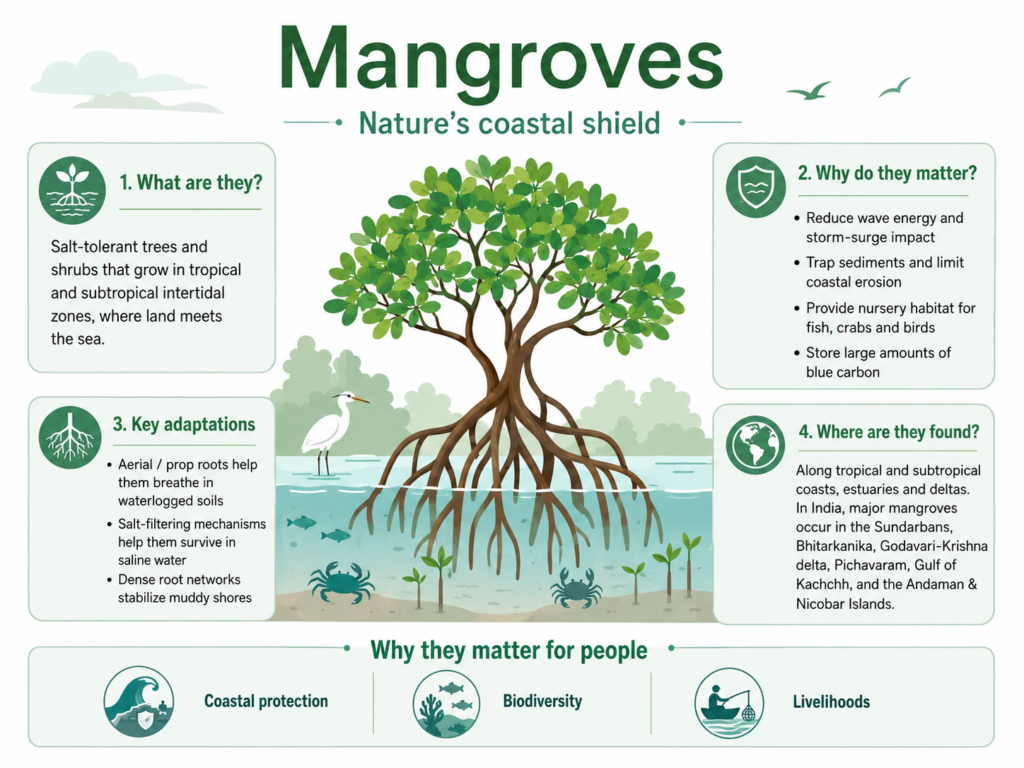
  • Mangroves are salt-tolerant plants, also known as halophytes, found in tropical and subtropical intertidal regions. Since they grow at the interface of land and sea, they are a classic example of an ecotone.
  • As per the India State of Forest Report 2023, India’s mangrove cover is about 4,991.68 sq. km, accounting for 0.15% of the country’s total geographical area. 
  • West Bengal has the largest mangrove cover, mainly due to the Sundarbans, followed by Gujarat and the Andaman and Nicobar Islands. 

Important mangrove regions in India include:

  • Sundarbans, West Bengal: The world’s largest mangrove ecosystem and a UNESCO World Heritage Site.
  • Bhitarkanika, Odisha: Important cyclone buffer and habitat for saltwater crocodiles.
  • Gulf of Kachchh, Gujarat: Important mangrove belt in an arid coastal zone.
  • Pichavaram and Muthupet, Tamil Nadu: Important estuarine mangrove ecosystems.
  • Andaman and Nicobar Islands: Rich island mangrove biodiversity.

Why Mangroves can be a better alternative to Seawalls?

  • Natural Protection against Cyclones and Storm Surges: Mangroves act as bio-shields. Their dense root systems, trunks and canopies reduce wave energy and slow down storm surges. During cyclones, mangrove belts can reduce wind speed, wave height and the force of tidal inundation. This is particularly important for low-lying deltaic regions such as the Sundarbans and Odisha coast.
  • Reduction of Coastal Erosion: Mangrove roots trap sediments and stabilise the shoreline. This reduces erosion and helps maintain coastal landforms. In contrast, seawalls may protect one stretch of coast while increasing erosion in adjacent areas by disturbing natural sediment movement.
  • Livelihood Security: Mangroves support fish breeding, crab farming, honey collection, fuelwood availability and eco-tourism. For fisherfolk and coastal communities, they are both protective infrastructure and an economic resource.
  • Biodiversity Conservation: Mangroves provide breeding and nursery grounds for fish, prawns, molluscs and crabs. They also support reptiles, birds and mammals, including the Royal Bengal Tiger in the Sundarbans and saltwater crocodiles in Bhitarkanika.
  • Carbon Sequestration: Mangroves are highly efficient blue carbon ecosystems. They store carbon in biomass as well as in waterlogged soils. Their conservation, therefore, contributes to both climate mitigation and adaptation.
  • Cost-effective Adaptation: Hard infrastructure requires large capital expenditure and continuous maintenance. Mangroves, once restored and protected, can regenerate naturally and provide long-term protection with lower maintenance costs. 

However, in dense urban areas, ports and critical infrastructure zones, engineered protection may still be required. The better approach is site-specific hybrid adaptation.

Limitations of Hard Coastal Infrastructure:

Seawalls, groynes and embankments have an important role in protecting densely populated and economically valuable assets. However, their limitations are increasingly visible.

  • They are expensive to build and maintain. 
  • They may create a false sense of security and encourage more construction in vulnerable coastal zones.
  • They can disrupt natural sediment flows and intensify erosion elsewhere. 
  • They often protect physical assets but do little for biodiversity, fisheries or livelihood resilience.

In states such as Kerala, excessive coastal armouring has often been criticised for shifting erosion rather than solving it. Therefore, hard infrastructure should be used selectively and in combination with ecological solutions.

India’s Policy Framework for Mangrove Conservation:

1. MISHTI Scheme (Mangrove Initiative for Shoreline Habitats and Tangible Incomes) was launched in 2023. It aims to restore and conserve mangroves over about 540 sq. km across 9 States and 3 Union Territories over five years. The scheme links mangrove restoration with shoreline protection, biodiversity conservation and livelihood generation.

2. National Coastal Mission supports conservation of coastal and marine ecosystems, including mangroves and coral reefs. It has also been extended for 2025-31 with a renewed focus on coastal resilience.

3. CRZ Notification, 2019: The Coastal Regulation Zone Notification classifies mangroves as ecologically sensitive areas. Where mangrove cover exceeds 1,000 sq. metres, a 50-metre buffer is also treated as CRZ-IA. This gives mangroves regulatory protection against destructive activities.

4. CAMPA and Green India Mission: Mangrove restoration can also be supported through Compensatory Afforestation Fund Management and Planning Authority resources and broader afforestation programmes.

5. International Commitments: India’s mangrove conservation efforts are linked with its commitments under the Paris Agreement, Convention on Biological Diversity, Sustainable Development Goals, Ramsar Convention and the Sendai Framework for Disaster Risk Reduction.

Why Classification of EbA Matters?

Recognising mangrove restoration as ecosystem-based adaptation is not merely a matter of terminology. It has direct policy consequences.

  • The classification helps measure adaptation outcomes. 
  • It allows India to report its adaptation efforts more effectively under global climate frameworks.
  • It can attract climate finance. 
  • It improves convergence between disaster management, biodiversity conservation, livelihoods and climate resilience. 
  • It helps policymakers compare the cost-effectiveness of ecological and engineered interventions.

As climate change intensifies coastal risks, India must reimagine coastal adaptation as a blend of engineering, ecology and community participation. By mainstreaming ecosystem-based adaptation into coastal planning, India can convert its natural capital into one of its most resilient and equitable lines of defence.  

Funding India’s Climate Future: A Trillion-Dollar Question

Open article →Download PDF

Why in News?

India needs large-scale, predictable, low-cost and credible climate finance to meet its Nationally Determined Contributions, build climate-resilient infrastructure, reduce emissions from hard-to-abate sectors and move towards its long-term goal of net-zero emissions by 2070.

UPSC Relevance: GS-3 Environment and Biodiversity: Climate Change, Mobilisation of Resources

Prelim & Mains: Climate Finance, Sovereign Green Bonds, Climate Finance Taxonomy, Blended Finance

India requires around $2.5 trillion between 2015 and 2030 to meet its Nationally Determined Contributions (NDC) targets. Over the longer term, the cost of achieving net-zero emissions by 2070 is estimated to be around $10.1 trillion

India already has several instruments such as green bonds, sovereign green bonds, blended finance, sustainability-linked debt, infrastructure investment trusts, green deposits and regulatory frameworks. 

The real gap lies in institutional capacity, credible classification, risk-sharing mechanisms and the ability to reduce the cost of green capital.

What is Climate Finance?

Climate finance refers to local, national or transnational financing that supports actions to address climate change. It includes both mitigation finance, which reduces greenhouse gas emissions, and adaptation finance, which helps societies adjust to climate impacts.

Key Forms of Climate Finance:

  • Green Bonds: Debt instruments used to finance environmentally beneficial projects.
  • Sovereign Green Bonds: Green bonds issued by the government. 
  • Blended Finance: Use of public or concessional capital to reduce risk for private investors. 
  • Climate Funds: Dedicated funds for climate mitigation and adaptation. E.g., Green Climate Fund
  • Carbon Markets: Market-based mechanism for emission reduction credits. E.g., Voluntary carbon credits, compliance markets.
  • Green Deposits: Deposits whose proceeds are allocated to green activities. 

Why India needs massive Climate Finance?

  • Meeting NDC Targets: India’s updated NDCs include:
    • Emissions Intensity: Reduce the emissions intensity of GDP by 47% below 2005 levels by 2035 (up from the 45% target set for 2030).
    • Renewable Energy Capacity: Achieve 60% of cumulative electric power installed capacity from non-fossil fuel-based resources by 2035 (up from the 50% target set for 2030).
    • Carbon Sinks: Create an additional carbon sink of 3.5 to 4.0 billion tonnes of CO₂ equivalent through forest and tree cover by 2035.

These goals require large investments in renewable energy, transmission infrastructure, battery storage, green hydrogen, electric mobility, afforestation and climate-resilient agriculture.

  • Achieving Net-Zero by 2070: India’s net-zero goal cannot be achieved through public expenditure alone. It requires long-term finance from banks, bond markets, development finance institutions, sovereign funds, pension funds and global climate funds.
  • Decarbonising Hard-to-Abate Sectors: Four sectors- Power, steel, cement and road transport account for a major share of India’s emissions. Decarbonising these sectors is difficult because the technologies required are capital-intensive. Green steel, green cement, carbon capture, battery storage, green hydrogen and grid modernisation need policy support before they become commercially viable at scale.
  • Financing Adaptation: India is highly vulnerable to heatwaves, floods, cyclones, droughts, glacier melt and sea-level rise. Adaptation finance is needed for resilient agriculture, urban drainage, coastal protection, climate-resilient housing, early warning systems and water security. Adaptation projects often do not generate clear commercial revenue, making them harder to finance.

The Climate Finance Gap:

  • India’s climate finance requirement is far larger than the finance currently available. According to estimates, India requires at least 2.5% of GDP annually as green finance until 2030. 
  • In four key emitting sectors (steel, cement, power and road transport), additional capital expenditure requirements are estimated at $467 billion between 2022 and 2030, or around $54 billion annually.
  • At the global level, developing countries require trillions of dollars for climate action. The developed world’s earlier promise to mobilise $100 billion annually was inadequate and delayed. 
  • At COP29 in Baku, the New Collective Quantified Goal set a target of $300 billion annually by 2035. Many developing countries, including India, criticised it as insufficient because it falls short of actual needs. 

Why is Climate Finance Taxonomy Crucial?

The Union Budget 2024-25 announced that India would develop a climate finance taxonomy. In 2025, the government released a draft framework. 

A taxonomy is crucial because it defines what counts as climate-aligned activity. Without it, green finance remains vulnerable to greenwashing, inconsistent reporting and weak investor confidence. It helps in:

  • Preventing Greenwashing: Investors can distinguish genuinely green projects from misleading claims.
  • Attracting Global Capital: International investors need clear standards for compliance and disclosure.
  • Improving Bank Lending: Banks can classify green loans more accurately.
  • Supporting Regulation: Regulators can design incentives for climate-aligned lending.
  • Enabling Carbon Markets: A taxonomy helps create credible measurement, reporting and verification systems.
  • Reducing Cost of Capital: Clarity reduces risk perception and can lower financing costs.

The Role of RBI in Climate Finance:

The RBI has a central role in directing the financial system towards climate resilience. 

Existing and Emerging Role: 

  • Climate Risk Disclosure: Banks and financial institutions need to disclose climate-related risks in governance, strategy, risk management and metrics.
  • Green Deposits Framework: This channels bank deposits towards eligible green activities.
  • Climate Risk Information System: Climate data can help banks assess physical and transition risks.
  • Regulatory Sandbox: Sustainable finance innovations can be tested in a controlled environment.
  • Priority Sector Lending Linkages: Climate adaptation and mitigation can be gradually integrated into priority lending frameworks.
  • Stress Testing: Banks need climate stress tests to assess risks from floods, droughts, heatwaves and transition shocks.

Why Blended Finance Matters?

  • Blended finance uses public or concessional funds to reduce risk for private investors. It is especially useful in sectors where commercial returns are uncertain or risks are high.
  • For example, a public first-loss guarantee can absorb initial losses and encourage private investors to invest in solar storage, offshore wind, green hydrogen, electric mobility, low-carbon steel, resilient agriculture or urban climate infrastructure.
  • Benefits of Blended Finance:
    • Reduces project risk.
    • Lowers the cost of capital.
    • Attracts private investors.
    • Makes new technologies bankable.
    • Useful for adaptation projects where revenue streams are weak.

Key Challenges in Financing India’s Climate Future:

  • High Cost of Capital: Green technologies such as battery storage, green hydrogen, carbon capture and offshore wind require large upfront investments. High borrowing costs make many projects commercially unattractive.
  • Weak Project Pipeline: Many climate projects remain at the concept stage because of poor project preparation, weak feasibility studies and limited technical capacity.
  • Lack of Clear Taxonomy: Without a finalised and legally backed taxonomy, investors face uncertainty over what qualifies as green or transition finance.
  • Greenwashing Risks: Mislabelled green projects can damage investor trust and weaken the credibility of India’s green finance market.
  • Limited Adaptation Finance: Most climate finance flows towards mitigation, especially renewable energy. Adaptation sectors such as water, agriculture, health, coastal resilience and urban drainage receive far less finance.
  • Low Municipal Capacity: Urban local bodies often lack creditworthiness, technical expertise and revenue streams to raise green debt.
  • Underdeveloped Bond Market: India’s corporate bond market is still relatively shallow. This limits the growth of long-term climate finance.

Way Forward:

  • Finalise India’s Climate Finance Taxonomy with clear sectoral thresholds, transition pathways, disclosure norms and verification standards. It should be compatible with India’s development priorities and avoid blindly copying Western taxonomies.
  • Build a dedicated State Climate Finance Facility to help States and municipalities prepare bankable projects, access concessional finance and issue green bonds. It can be capitalised by the Union government, NABARD, SIDBI, multilateral development banks and climate funds.
  • Expand Sovereign Green Bonds issuances and use them to finance public goods such as railways, grid infrastructure, climate-resilient irrigation, flood management and urban adaptation.
  • Banks should conduct climate stress tests to assess risks from floods, heatwaves, droughts, cyclones and transition shocks. Loan portfolios in climate-sensitive sectors should be evaluated more rigorously.
  • Coordination between the Ministry of Finance, RBI, SEBI, NABARD, SIDBI, State governments, municipalities and sectoral ministries. Fragmented regulation will slow down climate finance mobilisation.

Climate finance is linked to intergenerational justice. The current generation must finance a transition that protects future generations from irreversible climate harm.