Why in News?
Coastal protection in India has traditionally relied on hard infrastructure such as seawalls, groynes, embankments and tetrapods. Ecosystem-based adaptation through mangroves, seagrasses, coral reefs and wetlands can provide a more sustainable and socially inclusive line of defence.
Mangroves are not merely ecological assets but climate-resilience infrastructure that protects lives, livelihoods and coastal economies.
| UPSC Relevance: GS-3 Environment and Biodiversity: Conservation; Disaster Management Mains: Mangroves, National Coastal Mission, Ecosystem-based Adaptation |
What is Ecosystem-based Adaptation?
- Ecosystem-based Adaptation refers to the use of biodiversity and ecosystem services to help people adapt to the adverse impacts of climate change.
- In coastal areas, it includes the protection and restoration of mangroves, coral reefs, seagrass meadows, dunes, salt marshes and wetlands.
- Unlike conventional infrastructure, ecosystem-based adaptation provides multiple benefits. It reduces wave energy, stabilises shorelines, supports fisheries, improves water quality, stores carbon and creates livelihood opportunities for coastal communities.
Mangroves in India:
- Mangroves are salt-tolerant plants, also known as halophytes, found in tropical and subtropical intertidal regions. Since they grow at the interface of land and sea, they are a classic example of an ecotone.
- As per the India State of Forest Report 2023, India’s mangrove cover is about 4,991.68 sq. km, accounting for 0.15% of the country’s total geographical area.
- West Bengal has the largest mangrove cover, mainly due to the Sundarbans, followed by Gujarat and the Andaman and Nicobar Islands.
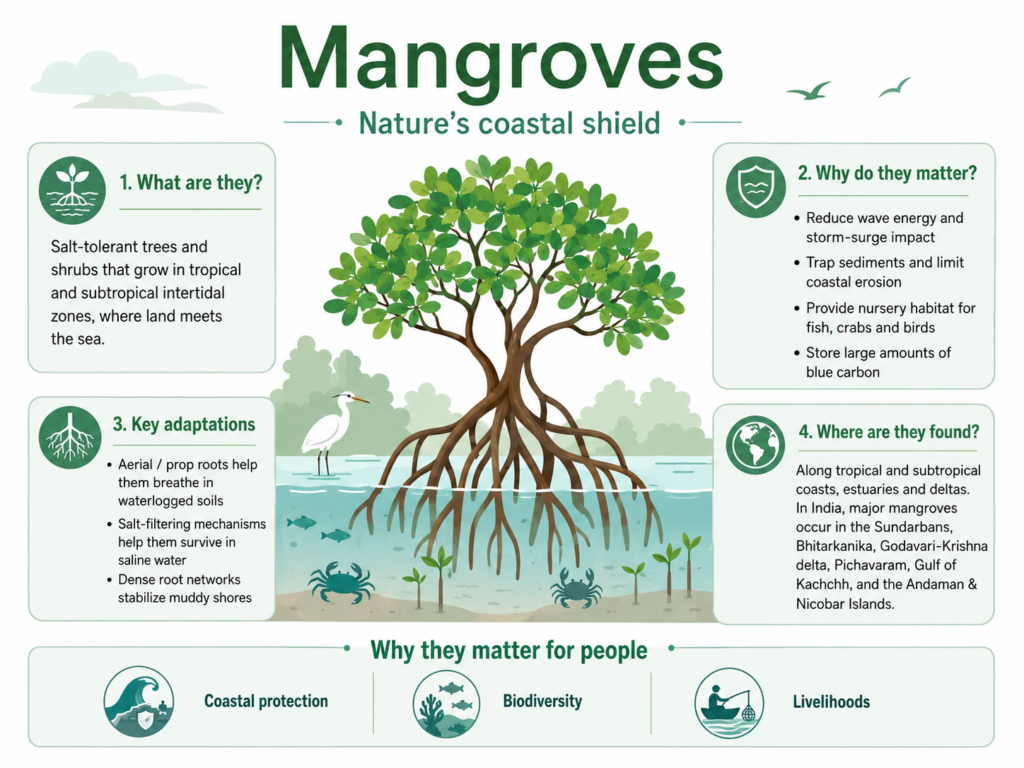
Important mangrove regions in India include:
- Sundarbans, West Bengal: The world’s largest mangrove ecosystem and a UNESCO World Heritage Site.
- Bhitarkanika, Odisha: Important cyclone buffer and habitat for saltwater crocodiles.
- Gulf of Kachchh, Gujarat: Important mangrove belt in an arid coastal zone.
- Pichavaram and Muthupet, Tamil Nadu: Important estuarine mangrove ecosystems.
- Andaman and Nicobar Islands: Rich island mangrove biodiversity.
Why Mangroves can be a better alternative to Seawalls?
- Natural Protection against Cyclones and Storm Surges: Mangroves act as bio-shields. Their dense root systems, trunks and canopies reduce wave energy and slow down storm surges. During cyclones, mangrove belts can reduce wind speed, wave height and the force of tidal inundation. This is particularly important for low-lying deltaic regions such as the Sundarbans and Odisha coast.
- Reduction of Coastal Erosion: Mangrove roots trap sediments and stabilise the shoreline. This reduces erosion and helps maintain coastal landforms. In contrast, seawalls may protect one stretch of coast while increasing erosion in adjacent areas by disturbing natural sediment movement.
- Livelihood Security: Mangroves support fish breeding, crab farming, honey collection, fuelwood availability and eco-tourism. For fisherfolk and coastal communities, they are both protective infrastructure and an economic resource.
- Biodiversity Conservation: Mangroves provide breeding and nursery grounds for fish, prawns, molluscs and crabs. They also support reptiles, birds and mammals, including the Royal Bengal Tiger in the Sundarbans and saltwater crocodiles in Bhitarkanika.
- Carbon Sequestration: Mangroves are highly efficient blue carbon ecosystems. They store carbon in biomass as well as in waterlogged soils. Their conservation, therefore, contributes to both climate mitigation and adaptation.
- Cost-effective Adaptation: Hard infrastructure requires large capital expenditure and continuous maintenance. Mangroves, once restored and protected, can regenerate naturally and provide long-term protection with lower maintenance costs.
However, in dense urban areas, ports and critical infrastructure zones, engineered protection may still be required. The better approach is site-specific hybrid adaptation.
Limitations of Hard Coastal Infrastructure:
Seawalls, groynes and embankments have an important role in protecting densely populated and economically valuable assets. However, their limitations are increasingly visible.
- They are expensive to build and maintain.
- They may create a false sense of security and encourage more construction in vulnerable coastal zones.
- They can disrupt natural sediment flows and intensify erosion elsewhere.
- They often protect physical assets but do little for biodiversity, fisheries or livelihood resilience.
In states such as Kerala, excessive coastal armouring has often been criticised for shifting erosion rather than solving it. Therefore, hard infrastructure should be used selectively and in combination with ecological solutions.
India’s Policy Framework for Mangrove Conservation:
1. MISHTI Scheme (Mangrove Initiative for Shoreline Habitats and Tangible Incomes) was launched in 2023. It aims to restore and conserve mangroves over about 540 sq. km across 9 States and 3 Union Territories over five years. The scheme links mangrove restoration with shoreline protection, biodiversity conservation and livelihood generation.
2. National Coastal Mission supports conservation of coastal and marine ecosystems, including mangroves and coral reefs. It has also been extended for 2025-31 with a renewed focus on coastal resilience.
3. CRZ Notification, 2019: The Coastal Regulation Zone Notification classifies mangroves as ecologically sensitive areas. Where mangrove cover exceeds 1,000 sq. metres, a 50-metre buffer is also treated as CRZ-IA. This gives mangroves regulatory protection against destructive activities.
4. CAMPA and Green India Mission: Mangrove restoration can also be supported through Compensatory Afforestation Fund Management and Planning Authority resources and broader afforestation programmes.
5. International Commitments: India’s mangrove conservation efforts are linked with its commitments under the Paris Agreement, Convention on Biological Diversity, Sustainable Development Goals, Ramsar Convention and the Sendai Framework for Disaster Risk Reduction.
Why Classification of EbA Matters?
Recognising mangrove restoration as ecosystem-based adaptation is not merely a matter of terminology. It has direct policy consequences.
- The classification helps measure adaptation outcomes.
- It allows India to report its adaptation efforts more effectively under global climate frameworks.
- It can attract climate finance.
- It improves convergence between disaster management, biodiversity conservation, livelihoods and climate resilience.
- It helps policymakers compare the cost-effectiveness of ecological and engineered interventions.
As climate change intensifies coastal risks, India must reimagine coastal adaptation as a blend of engineering, ecology and community participation. By mainstreaming ecosystem-based adaptation into coastal planning, India can convert its natural capital into one of its most resilient and equitable lines of defence.
Tell Google you want more of this.
Add Anantam IAS as a preferred sourceOne tap, and this site shows up more often in your own Top Stories, AI Overviews and AI Mode. Remove it any time.