Opens in a new tab
Join Anantam IAS Channel on Telegram

Daily Digest · Wednesday

7 January 2026 Current Affairs for UPSC

2 current affairs published on Wednesday, 7 January 2026

7 January 2026 Current Affairs for UPSC — every Why-in-News article AnantamIAS published on Wednesday, 7 January 2026, broken down with Why in News?, the exact GS paper it feeds, sub-topic mapping, MCQ-ready facts and a UPSC-style practice question. 2 articles in total, covering Polity, Economy, Environment, S&T, IR, Geography, History, Society and Internal Security — the same Why-in-News + GS-paper-mapping + practice-question format the Compass uses across every daily digest on the site.

Daily current affairs for UPSC is where new material enters your prep stream. Read this 7 January 2026 digest end-to-end in 25–35 minutes, attempt the practice question at the foot of each article (it's MCQ for some, 10/15-marker for others), then bookmark the entries that fall inside your active revision window. Everything stays cross-linked: tap any subject pill to jump to that subject's hub, or use the table of contents above to skip straight to a specific story.

Use this page three ways. Read sequentially for a one-sitting scan of everything that mattered on 7 January 2026. Download the 7 January 2026 PDF below for offline study or print revision. Or use the January 2026 Current Affairs compilation to see this day in the month's full context. For the previous day's reading, see 6 January 2026 Current Affairs; the next day's is 8 January 2026 Current Affairs.

Why we publish daily current affairs separately from the monthly compilation: daily is learning, monthly is revision. Use the daily page to add fresh material to your notes the day it breaks; come back to the January 2026 compilation 60 days before Prelims when the noise has settled and only the lasting takeaway is worth re-reading.

Bio-Bitumen from Farm Residue: Clean Green Highways and Stubble Management

Open article →Download PDF

India’s January 2026 bio-bitumen update connected two stubborn policy problems: road-building dependence on petroleum bitumen and the annual burning of crop residue. CSIR labs demonstrated bio-bitumen from rice straw through pyrolysis and showed its use in road construction trials.

For UPSC, this is a compact GS-III topic because it brings together science and technology, infrastructure, circular economy, pollution control, farmer income and import dependence. It is exactly the kind of applied innovation that can appear in both Prelims and Mains.

This article explains bio-bitumen as a policy instrument, not a laboratory curiosity, and maps how it can support cleaner roads and better residue management.

Quick Facts
Bio-Bitumen from Farm Residue: Clean Green Highways and Stubble Management quick facts
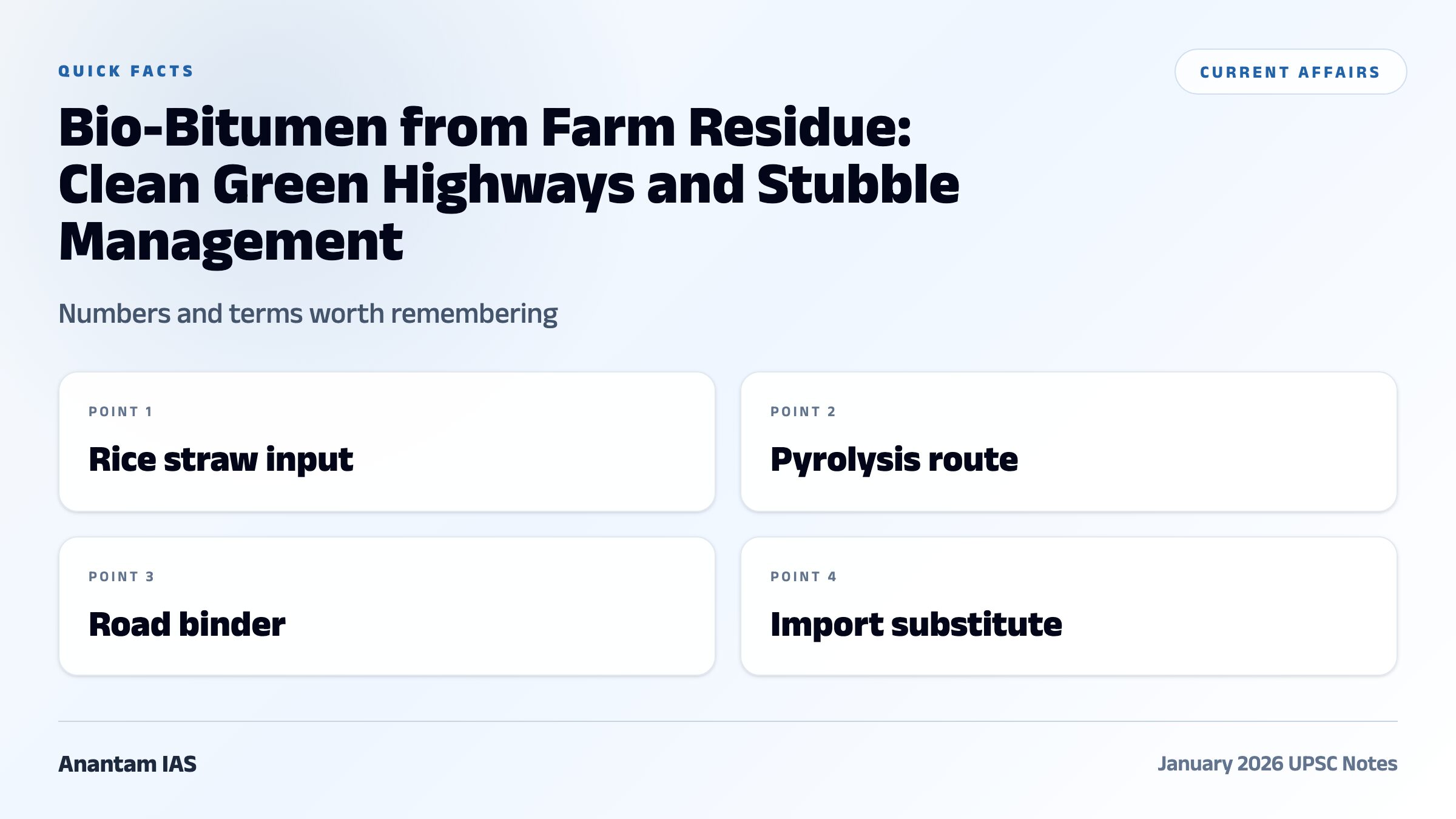
  • CSIR-CRRI and CSIR-IIP are central institutions in the bio-bitumen demonstration.
  • Rice straw can be converted into bio-oil through pyrolysis and processed into bio-bitumen.
  • Bio-bitumen can partially replace petroleum bitumen in road construction.
  • A demonstration road stretch was reported on NH-40 in Telangana.
  • India imports a large share of petroleum bitumen, creating an import-substitution opportunity.
  • Crop-residue burning is a major air-pollution source in northern India.
  • Official source: PIB, Ministry of Science and Technology.

What Just Happened

The official update highlighted India’s progress in producing bio-bitumen from agricultural residue and using it in road trials. The technology uses rice straw, a residue often burnt in fields, as a feedstock for a useful infrastructure material.

The policy significance is that a waste stream becomes a road-construction input. If scaled, the same farm residue that worsens winter air pollution could earn value in a supply chain linked to highways.

The topic also aligns with the Clean Green Highways idea: reduce fossil dependence in road materials, lower waste burning and improve the life-cycle profile of infrastructure.

Background and Historical Context

Bitumen is a petroleum-derived binder used in asphalt roads. India consumes large volumes of it for national highways, state highways and urban roads. Import dependence exposes the sector to crude-price volatility.

Rice straw burning is driven by tight sowing windows, low residue value, labour shortage and mechanised harvesting. Farmers often burn residue because removing it costs money and delays the next crop.

Bio-bitumen attempts to change the economics. If residue becomes a purchased input, farmers have a reason to collect and sell it. But that requires aggregation, transport, processing plants and assured demand from road agencies.

Key Features of Bio-Bitumen Technology
Bio-Bitumen from Farm Residue: Clean Green Highways and Stubble Management exam framework

The core policy architecture can be read through these features.

  • Feedstock: rice straw and other biomass residues can be used.
  • Process: pyrolysis converts biomass into bio-oil, which can be upgraded for bitumen blending.
  • Use case: partial replacement of petroleum bitumen in asphalt roads.
  • Institutional role: CSIR laboratories provide research, testing and standards support.
  • Environmental link: the technology can reduce open burning if procurement works.
  • Infrastructure link: highways can create steady demand for the material.

Why It Matters

This is a high-yield UPSC topic because it joins current news with durable syllabus themes.

  • It connects air-pollution control with farmer incentives, not only enforcement.
  • It gives GS-III content on circular economy, clean technology and infrastructure.
  • It shows import substitution without crude industrial protectionism.
  • It helps candidates write integrated answers on stubble burning beyond bans and fines.

Detailed Analysis: Environment Lens

The technology solves only half the problem. Producing bio-bitumen is important, but the policy challenge is feedstock logistics. Rice straw is bulky, seasonal and scattered across millions of farms.

Demand assurance is essential. Road agencies must create clear procurement standards and blending norms. Without predictable demand, farmers and processors will not invest in collection chains.

It is better as a portfolio tool. Bio-bitumen will not eliminate stubble burning alone. It should sit alongside in-situ residue management, biomass power, compressed biogas, pellets and soil-health practices.

Comparative Perspective
Bio-Bitumen from Farm Residue: Clean Green Highways and Stubble Management comparative and mains map

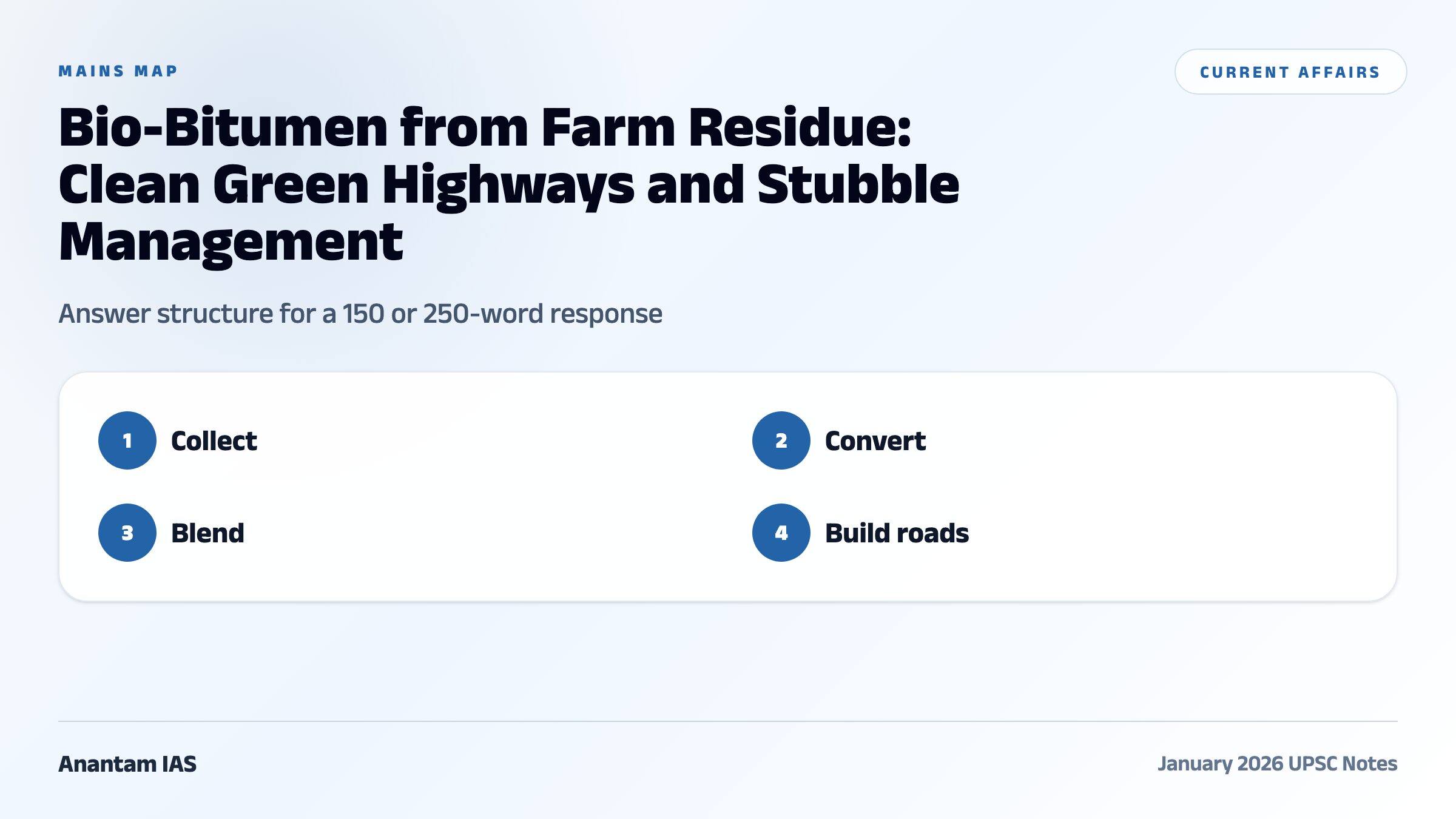
A comparison helps prevent the answer from becoming a one-dimensional news summary.

  • In-situ residue management: machines like Happy Seeder retain residue in fields but require farmer adoption.
  • Compressed biogas: converts residue into fuel but depends on plant economics and gas offtake.
  • Bio-bitumen: links residue to road construction and import substitution.
  • Ex-situ biomass power: uses residue for energy but faces collection and tariff challenges.

Challenges

The policy or institutional promise runs into recurring constraints.

  • Residue aggregation is expensive because rice straw is bulky.
  • Quality standards must prove road durability across climate zones.
  • Farmers need timely payments and local collection points.
  • Processing plants must be located close enough to feedstock sources.
  • Public procurement rules must allow innovative materials without compromising road safety.

Prelims Pointers

  • Bitumen is a petroleum-derived binder used in road construction.
  • Pyrolysis is thermal decomposition in limited or no oxygen.
  • CSIR-CRRI works on roads and transport infrastructure research.
  • CSIR-IIP works on petroleum and energy research.
  • Crop-residue burning contributes to particulate pollution.
  • Circular economy aims to convert waste streams into useful inputs.

Mains Questions

  1. Bio-bitumen can turn stubble from an air-pollution liability into an infrastructure input. Discuss the opportunities and constraints. (GS Paper III, 250 words)
  2. Why have enforcement-heavy approaches failed to solve crop-residue burning? Suggest incentive-based alternatives. (GS Paper III, 250 words)
  3. Evaluate the role of public procurement in scaling clean technologies. (GS Paper III, 150 words)
  4. Circular economy solutions require ecosystem design, not only innovation. Analyse with reference to bio-bitumen. (GS Paper III, 250 words)

Way Forward

India should begin with regional procurement corridors in high-residue districts, linking farmer-producer organisations, biomass aggregators, CSIR-tested processors and highway contractors.

Standards must be strict. A green road material that fails early will lose credibility quickly. Field performance across heat, rain and heavy traffic should guide blending limits.

Bio-bitumen is a promising bridge between clean technology and farmer income, but its success will be decided by logistics and procurement, not the press release.

The examiner is unlikely to reward a bare fact dump here. The better answer connects the January 2026 event to institutional design, implementation capacity and India’s long-term development priorities.

Frequently Asked Questions

What is bio-bitumen?

Bio-bitumen is a bitumen-like road binder produced partly from biomass such as rice straw, usually through thermochemical processing.

Why is bio-bitumen important for India?

It can reduce petroleum-bitumen dependence and create value for crop residue that is otherwise often burnt.

Which institutions are involved?

CSIR-CRRI and CSIR-IIP are key institutions mentioned in the official bio-bitumen update.

Can bio-bitumen end stubble burning?

No. It can help if scaled well, but it must be combined with other residue-management options.

What is pyrolysis?

Pyrolysis is heating biomass in limited or no oxygen to produce bio-oil, char and gases.

What is the main bottleneck?

The hard part is collecting, transporting and processing bulky residue at a cost that works for farmers and road agencies.
Rajasthan AI Impact Conference 2026: State-Level AI Governance and Skilling

Open article →Download PDF

Rajasthan hosted a Regional AI Impact Conference in January 2026 with a strong focus on skilling, youth participation and public-sector AI use. The event showed that AI policy is moving from national strategy documents into state-level implementation.

For UPSC, the state angle is important. AI governance will not be solved only in Delhi. Schools, police departments, health systems, agriculture extension, local language services and state data systems will decide how citizens actually experience AI.

This article uses the Rajasthan AI Impact Conference to explain state-level AI governance, skilling, public-service delivery and the federal dimension of India’s AI strategy.

Quick Facts

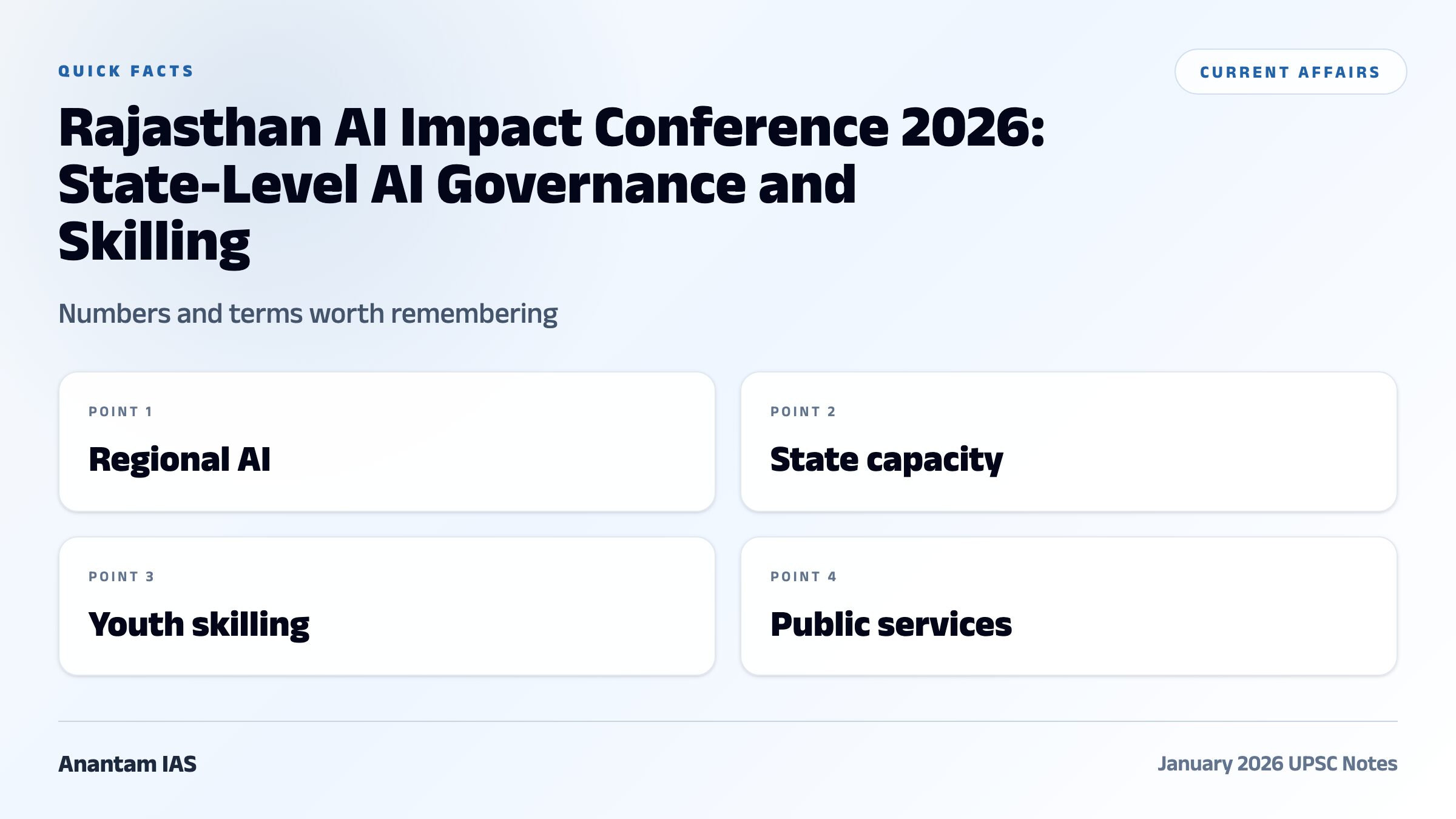
Rajasthan AI Impact Conference 2026: State-Level AI Governance and Skilling quick facts
  • The conference was held in Rajasthan in January 2026.
  • It was linked to the IndiaAI and AI-for-impact policy ecosystem.
  • Youth skilling and public-sector applications were central themes.
  • States can apply AI in health, education, agriculture, policing, tourism and grievance redress.
  • AI policy has federal implications because many service-delivery sectors are state-led.
  • Official source: PIB MeitY release dated 7 January 2026.
  • Official source: PIB, Ministry of Electronics and IT.

What Just Happened

The conference brought AI policy discussions to a state platform with emphasis on skilling and impact-oriented use cases.

The event reflects a broader policy shift: AI is no longer only about startups and models. It is about public administration, local capacity and citizen services.

For aspirants, this is a useful example when writing about cooperative federalism in technology governance.

Background and Historical Context

India’s AI policy ecosystem includes IndiaAI Mission, digital public infrastructure, sectoral datasets, skilling programs and state innovation missions.

States control or heavily influence health, police, schools, agriculture extension and local administration. These are precisely the areas where AI applications can affect citizens.

The risk is uneven adoption. A few states may build strong AI capacity while others remain dependent on vendors and poorly governed pilots.

Key Features of AI Governance

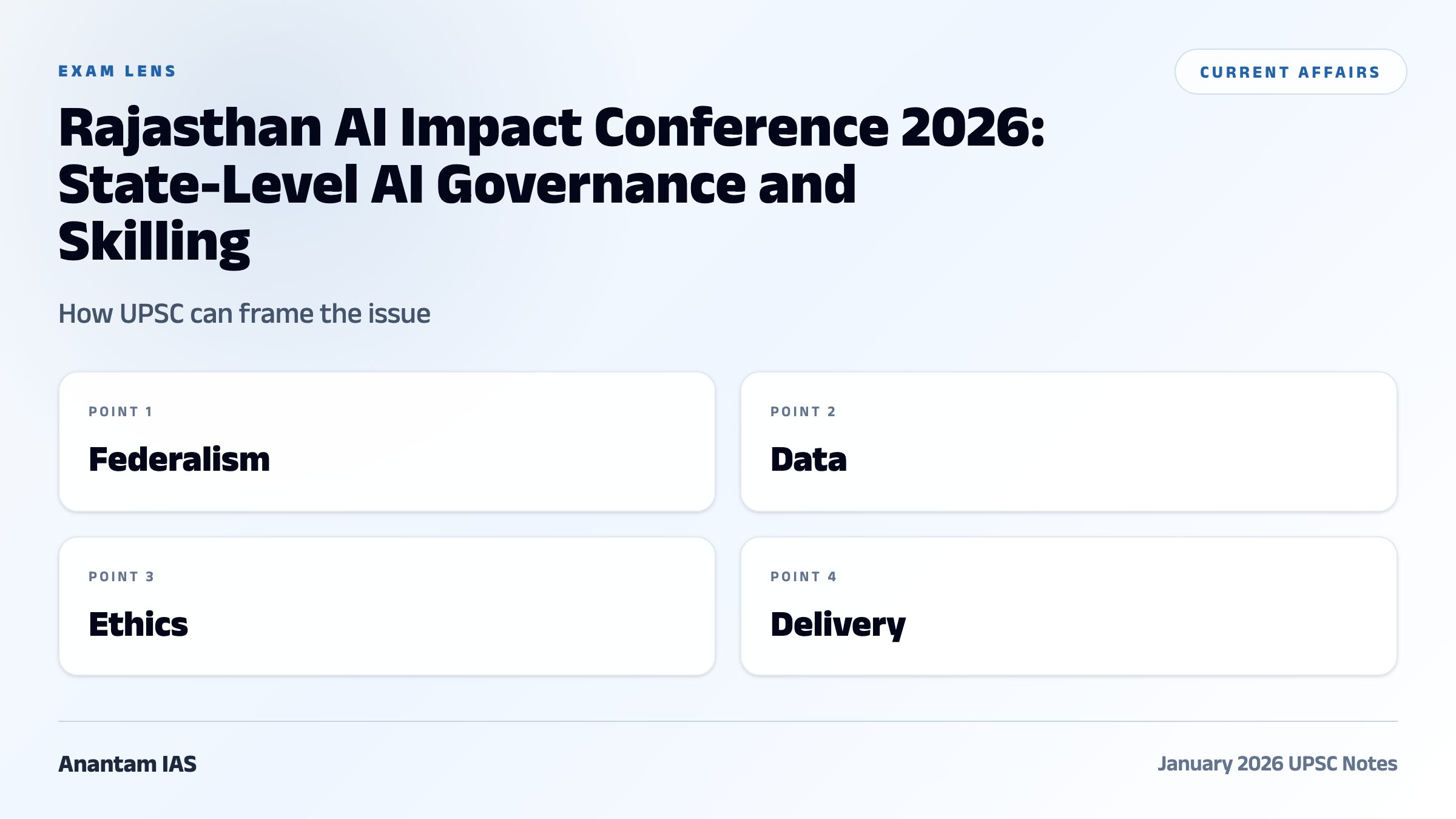
Rajasthan AI Impact Conference 2026: State-Level AI Governance and Skilling exam framework

The core policy architecture can be read through these features.

  • State platform: AI discussion moved into a regional implementation context.
  • Skilling: youth capability was positioned as a central requirement.
  • Public services: AI can support education, health, agriculture and grievance systems.
  • Federalism: states must adapt national AI frameworks to local realities.
  • Ethics: fairness, privacy and accountability are public-sector requirements.
  • Capacity building: officials need procurement and data-governance literacy.

Why It Matters

This is a high-yield UPSC topic because it joins current news with durable syllabus themes.

  • It connects a January 2026 event with durable UPSC syllabus themes.
  • It gives usable facts for Prelims and analytical hooks for Mains.
  • It helps students move from news recall to policy reasoning.
  • It can be linked with static concepts in polity, economy, governance, science, environment or society.

Detailed Analysis: AI Governance Lens

AI impact depends on administrative capacity. A good model deployed in a weak department can still fail.

States need procurement discipline. AI tools bought without audit, explainability and grievance mechanisms can create opaque governance.

Local-language AI is a governance multiplier. It can expand access to information and services if privacy and accuracy are protected.

Comparative Perspective

Rajasthan AI Impact Conference 2026: State-Level AI Governance and Skilling comparative and mains map

A comparison helps prevent the answer from becoming a one-dimensional news summary.

  • National AI missions: set compute, dataset and innovation priorities.
  • State AI missions: translate AI into sector-specific delivery.
  • Private AI tools: move fast but need regulation in public use.
  • Public DPI: can provide trusted rails for AI-enabled services.

Challenges

The policy or institutional promise runs into recurring constraints.

  • State data quality is uneven.
  • Public procurement may not understand AI risks.
  • Bias can harm welfare targeting or policing decisions.
  • Officials and teachers need training.
  • Citizens need grievance mechanisms when AI-assisted decisions go wrong.

Prelims Pointers

  • AI governance includes privacy, fairness, transparency, accountability and safety.
  • Many AI use cases in India depend on state subjects such as health, agriculture and police.
  • IndiaAI Mission is a national AI ecosystem initiative.
  • Digital public infrastructure can support AI applications through trusted data and identity layers.
  • Algorithmic bias means systematic unfairness in model outputs.
  • Explainability is important in high-stakes public decisions.

Mains Questions

  1. Why is state capacity central to responsible AI deployment in India? (GS Paper II/III, 250 words)
  2. Discuss the federal dimension of AI governance in India. (GS Paper II, 150 words)
  3. AI in public services can improve efficiency but also deepen exclusion. Analyse. (GS Paper III, 250 words)
  4. What safeguards should guide state governments when procuring AI systems? (GS Paper II, 250 words)

Way Forward

States should create AI procurement checklists, data-governance standards, model audits and citizen grievance channels before large-scale deployment.

AI skilling must include officials, teachers, local bodies and civil society, not just engineering students.

The balanced exam view is that AI can improve governance only when institutions remain accountable for decisions.

The examiner is unlikely to reward a bare fact dump here. The better answer connects the January 2026 event to institutional design, implementation capacity and India’s long-term development priorities.

Frequently Asked Questions

Why is a state AI conference important?

Because many AI use cases are implemented by state departments in education, health, agriculture and policing.

What is AI governance?

It is the framework for safe, fair, accountable and rights-respecting use of AI.

How does AI link to federalism?

States control many service-delivery sectors where AI will be deployed.

What is the main risk?

Opaque AI systems can produce biased or unchallengeable decisions.

Which GS papers are relevant?

GS-II governance and GS-III science and technology.

What should students remember?

AI policy requires both technology and administrative capacity.