Rajasthan hosted a Regional AI Impact Conference in January 2026 with a strong focus on skilling, youth participation and public-sector AI use. The event showed that AI policy is moving from national strategy documents into state-level implementation.
For UPSC, the state angle is important. AI governance will not be solved only in Delhi. Schools, police departments, health systems, agriculture extension, local language services and state data systems will decide how citizens actually experience AI.
This article uses the Rajasthan AI Impact Conference to explain state-level AI governance, skilling, public-service delivery and the federal dimension of India’s AI strategy.
Quick Facts
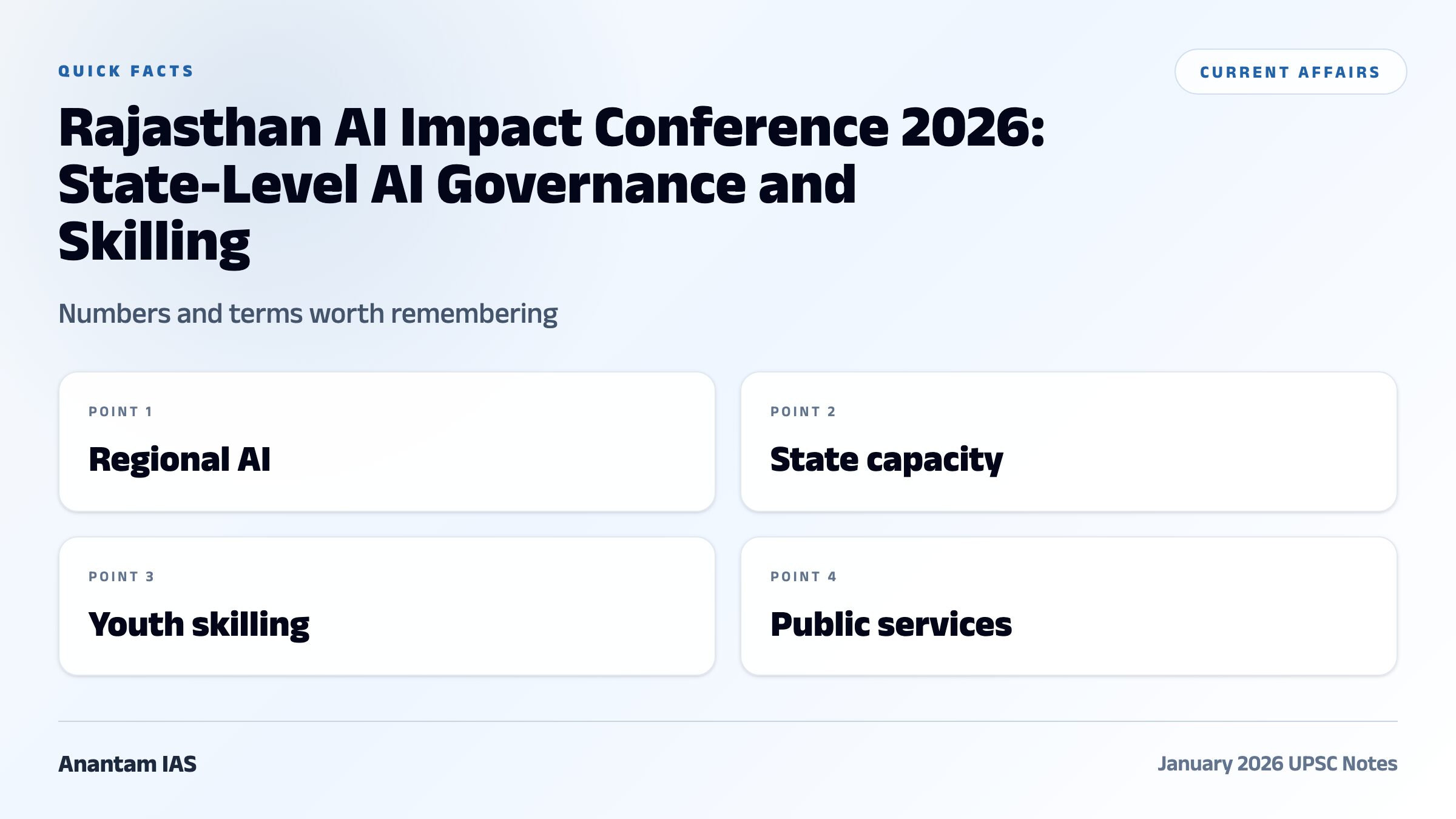
- The conference was held in Rajasthan in January 2026.
- It was linked to the IndiaAI and AI-for-impact policy ecosystem.
- Youth skilling and public-sector applications were central themes.
- States can apply AI in health, education, agriculture, policing, tourism and grievance redress.
- AI policy has federal implications because many service-delivery sectors are state-led.
- Official source: PIB MeitY release dated 7 January 2026.
- Official source: PIB, Ministry of Electronics and IT.
What Just Happened
The conference brought AI policy discussions to a state platform with emphasis on skilling and impact-oriented use cases.
The event reflects a broader policy shift: AI is no longer only about startups and models. It is about public administration, local capacity and citizen services.
For aspirants, this is a useful example when writing about cooperative federalism in technology governance.
Background and Historical Context
India’s AI policy ecosystem includes IndiaAI Mission, digital public infrastructure, sectoral datasets, skilling programs and state innovation missions.
States control or heavily influence health, police, schools, agriculture extension and local administration. These are precisely the areas where AI applications can affect citizens.
The risk is uneven adoption. A few states may build strong AI capacity while others remain dependent on vendors and poorly governed pilots.
Key Features of AI Governance
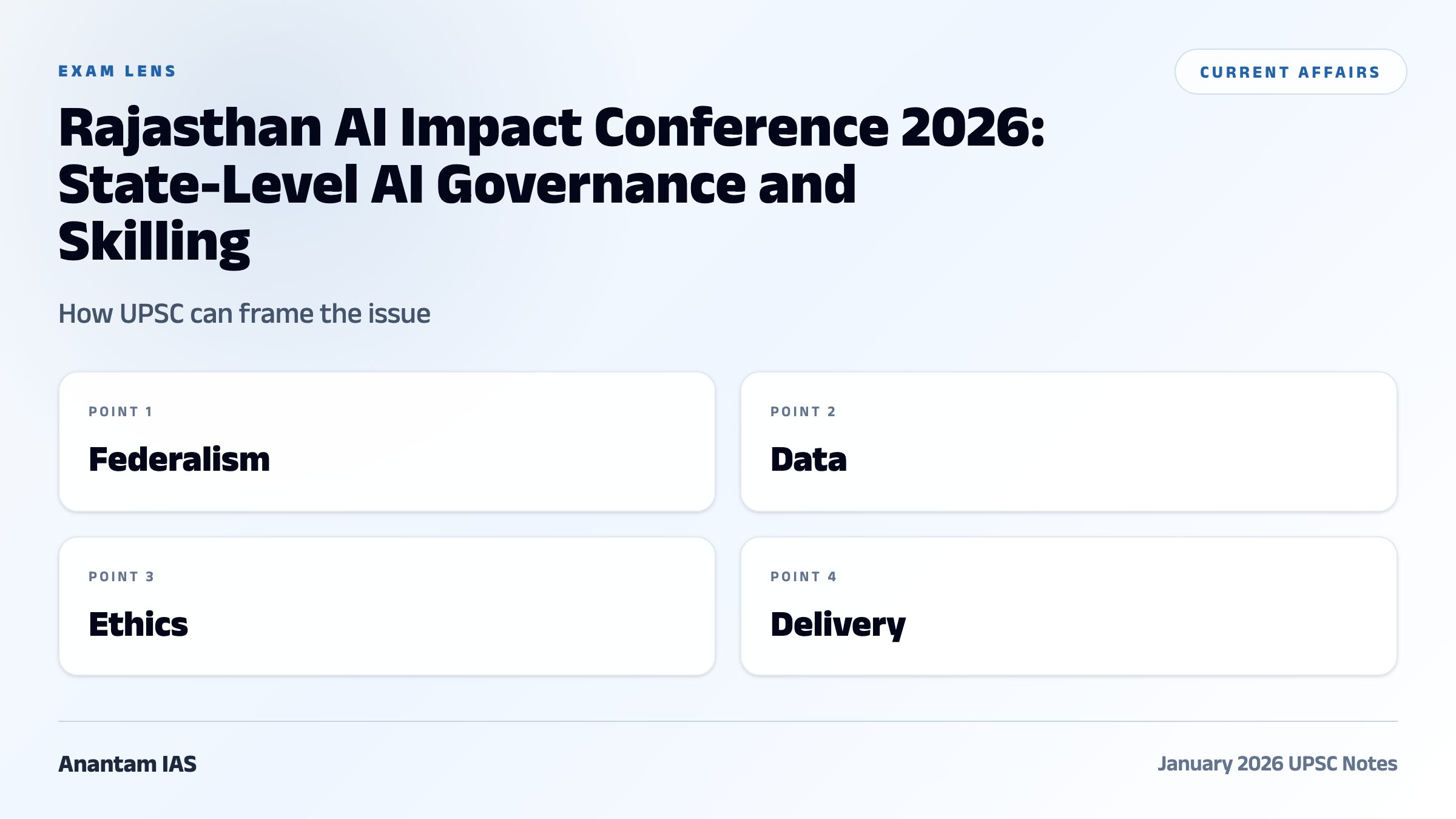
The core policy architecture can be read through these features.
- State platform: AI discussion moved into a regional implementation context.
- Skilling: youth capability was positioned as a central requirement.
- Public services: AI can support education, health, agriculture and grievance systems.
- Federalism: states must adapt national AI frameworks to local realities.
- Ethics: fairness, privacy and accountability are public-sector requirements.
- Capacity building: officials need procurement and data-governance literacy.
Why It Matters
This is a high-yield UPSC topic because it joins current news with durable syllabus themes.
- It connects a January 2026 event with durable UPSC syllabus themes.
- It gives usable facts for Prelims and analytical hooks for Mains.
- It helps students move from news recall to policy reasoning.
- It can be linked with static concepts in polity, economy, governance, science, environment or society.
Detailed Analysis: AI Governance Lens
AI impact depends on administrative capacity. A good model deployed in a weak department can still fail.
States need procurement discipline. AI tools bought without audit, explainability and grievance mechanisms can create opaque governance.
Local-language AI is a governance multiplier. It can expand access to information and services if privacy and accuracy are protected.
Comparative Perspective
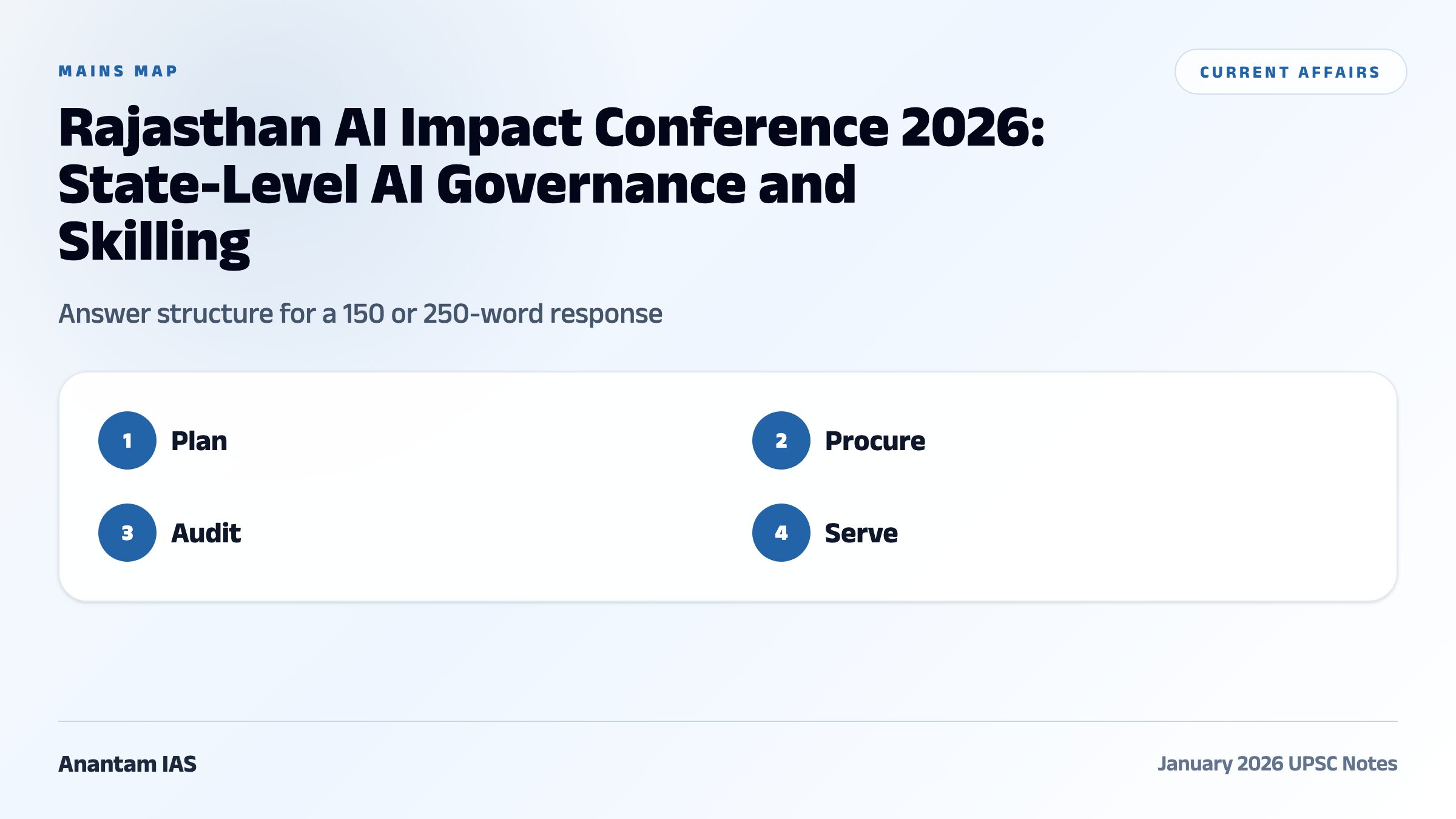
A comparison helps prevent the answer from becoming a one-dimensional news summary.
- National AI missions: set compute, dataset and innovation priorities.
- State AI missions: translate AI into sector-specific delivery.
- Private AI tools: move fast but need regulation in public use.
- Public DPI: can provide trusted rails for AI-enabled services.
Challenges
The policy or institutional promise runs into recurring constraints.
- State data quality is uneven.
- Public procurement may not understand AI risks.
- Bias can harm welfare targeting or policing decisions.
- Officials and teachers need training.
- Citizens need grievance mechanisms when AI-assisted decisions go wrong.
Prelims Pointers
- AI governance includes privacy, fairness, transparency, accountability and safety.
- Many AI use cases in India depend on state subjects such as health, agriculture and police.
- IndiaAI Mission is a national AI ecosystem initiative.
- Digital public infrastructure can support AI applications through trusted data and identity layers.
- Algorithmic bias means systematic unfairness in model outputs.
- Explainability is important in high-stakes public decisions.
Mains Questions
- Why is state capacity central to responsible AI deployment in India? (GS Paper II/III, 250 words)
- Discuss the federal dimension of AI governance in India. (GS Paper II, 150 words)
- AI in public services can improve efficiency but also deepen exclusion. Analyse. (GS Paper III, 250 words)
- What safeguards should guide state governments when procuring AI systems? (GS Paper II, 250 words)
Way Forward
States should create AI procurement checklists, data-governance standards, model audits and citizen grievance channels before large-scale deployment.
AI skilling must include officials, teachers, local bodies and civil society, not just engineering students.
The balanced exam view is that AI can improve governance only when institutions remain accountable for decisions.
The examiner is unlikely to reward a bare fact dump here. The better answer connects the January 2026 event to institutional design, implementation capacity and India’s long-term development priorities.
Frequently Asked Questions
Why is a state AI conference important?
Because many AI use cases are implemented by state departments in education, health, agriculture and policing.
What is AI governance?
It is the framework for safe, fair, accountable and rights-respecting use of AI.
How does AI link to federalism?
States control many service-delivery sectors where AI will be deployed.
What is the main risk?
Opaque AI systems can produce biased or unchallengeable decisions.
Which GS papers are relevant?
GS-II governance and GS-III science and technology.
What should students remember?
AI policy requires both technology and administrative capacity.
Tell Google you want more of this.
Add Anantam IAS as a preferred sourceOne tap, and this site shows up more often in your own Top Stories, AI Overviews and AI Mode. Remove it any time.