Why in News?
The Winter Session of Parliament is underway, scheduled from 1 to 19 December 2025, with both Houses taking up a dense legislative agenda spanning the economy, security and social policy. The pace of law-making has once again brought the question of legislative scrutiny to the fore.
A recurring concern is the limited referral of Bills to Department-related Standing Committees before they are passed. When Bills clear both Houses quickly with little committee examination, it revives a long-standing debate about the deliberative function of Parliament and the quality of the laws it produces.
- The session runs 1-19 December 2025, the third sitting period of the parliamentary year.
- Multiple Bills across finance, defence-related, social-sector and governance domains are listed for consideration.
- Commentators flagged that few of the Bills were sent to standing committees for detailed scrutiny.
- Department-related Standing Committees (DRSCs) were introduced in 1993 to give Parliament a year-round, expert review mechanism.
- The share of Bills referred to committees has fallen sharply across recent Lok Sabhas, a trend tracked by independent legislative researchers.
The development matters in the context of:
- Parliament holds three sessions a year by convention — Budget, Monsoon and Winter — though the Constitution only requires that no more than six months separate two sittings (Article 85).
- The quality of scrutiny, not just the number of Bills passed, is a core measure of legislative effectiveness.
UPSC Relevance
Prelims Relevance
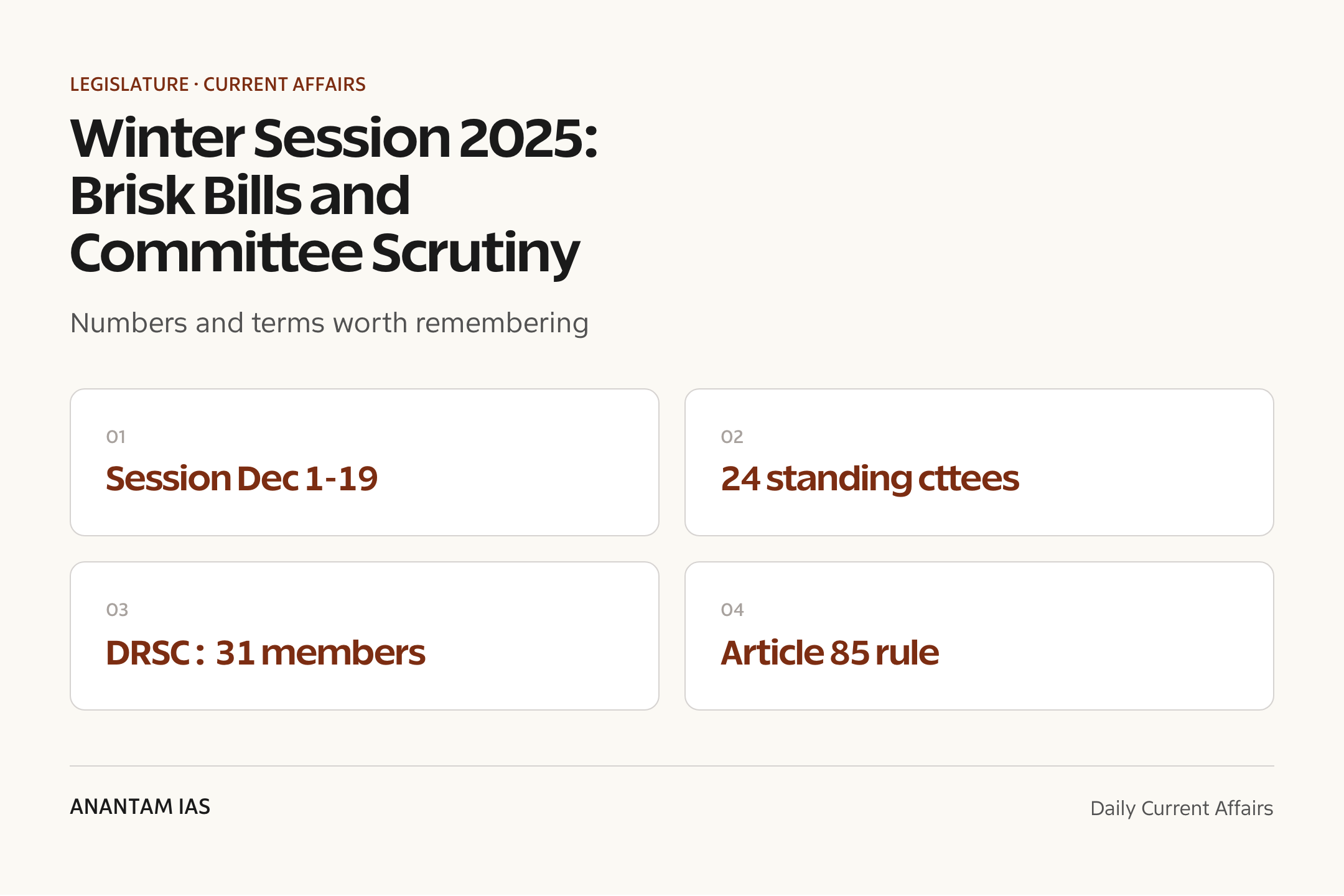
- Article 85: the President summons Parliament; the gap between two sessions cannot exceed six months.
- Department-related Standing Committees were set up in 1993; there are 24 such committees.
- A DRSC has 31 members — 21 from Lok Sabha and 10 from Rajya Sabha.
- Money Bills (Article 110) cannot be referred to a DRSC and are certified by the Speaker.
- Types of parliamentary committees: Standing and Ad hoc (including Select and Joint committees).
- Financial committees: Public Accounts Committee, Estimates Committee, Committee on Public Undertakings.
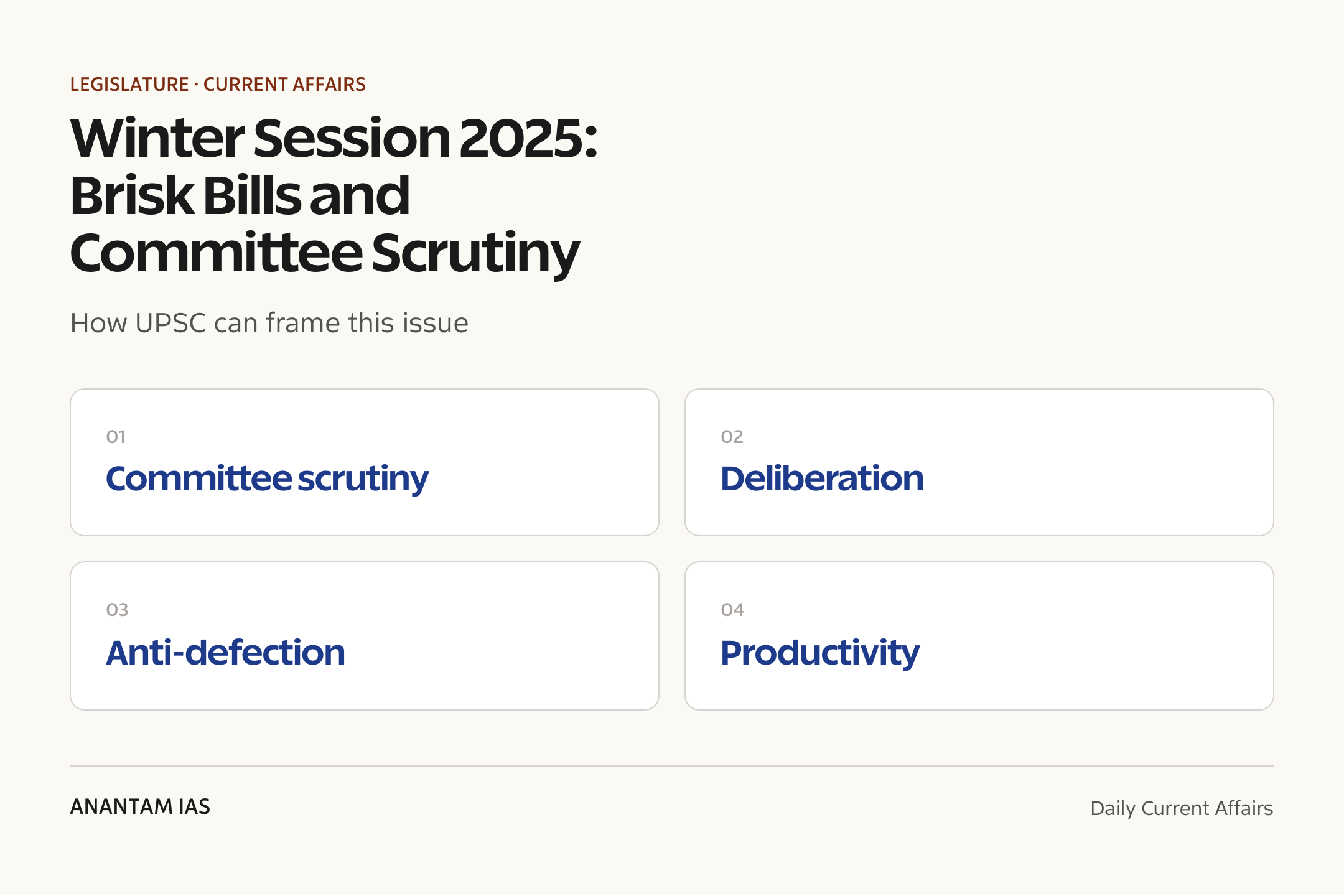
- Anti-defection is governed by the Tenth Schedule (52nd Amendment, 1985).
- Productivity of a House is measured against scheduled sitting hours.
Mains Relevance
GS Paper 2
- Declining referral of Bills to standing committees and its effect on the quality of legislation.
- Role of parliamentary committees as ‘mini-Parliaments’ in the scrutiny of laws, budgets and policy.
GS Paper 2 (Governance)
- Disruptions, guillotining and the erosion of the deliberative function of the legislature.
Essay
- A law passed in haste is scrutiny denied: deliberation as the soul of democracy.
Background and Context
How a parliamentary session works
Sessions are a matter of convention layered over a thin constitutional rule.
- Under Article 85, the President summons each House, and no more than six months may pass between two sittings.
- By convention Parliament meets in three sessions — Budget (Feb-May), Monsoon (Jul-Sep) and Winter (Nov-Dec).
- Government business — chiefly Bills and financial work — dominates the agenda, alongside questions and debates.
- A session ends with adjournment sine die, after which the presiding officer may prorogue the House.
What standing committees do
Committees are where the detailed, less partisan work of Parliament happens.
- Department-related Standing Committees (DRSCs), created in 1993, examine Bills, budgets (Demands for Grants) and the working of ministries.
- There are 24 DRSCs, each with 31 members (21 Lok Sabha + 10 Rajya Sabha), meeting through the year.
- They take expert and stakeholder evidence away from the floor’s adversarial glare, often described as ‘mini-Parliaments’.
- Their reports are recommendatory, but they materially improve the drafting and scrutiny of laws.
The scrutiny gap
Fewer Bills are now examined in committee before becoming law.
- The proportion of Bills referred to committees has declined steeply across the last several Lok Sabhas, per PRS Legislative Research.
- Bills passed with limited debate or sent straight for consideration risk drafting flaws and weaker accountability.
- Frequent disruptions and the use of guillotine (putting demands to vote without discussion) further compress scrutiny.
- High ‘productivity’ measured in Bills passed per hour can mask a thinning of deliberation.
Why scrutiny matters
The legislature’s value lies as much in deliberation as in voting.
- Detailed examination catches unintended consequences and constitutional infirmities before enactment.
- Committee work allows cross-party consensus-building insulated from floor theatre.
- It strengthens executive accountability, since ministries must justify proposals to members.
- Robust scrutiny reduces the burden later thrown on the judiciary to strike down poorly drafted laws.
Way Forward
Restore committee referral
- Adopt a norm of referring most Bills to DRSCs or Select Committees unless genuinely urgent.
- Give committees adequate time and research support to scrutinise complex legislation.
Protect deliberation
- Fix a minimum number of sitting days and curb avoidable disruptions and guillotining.
- Publish pre-legislative consultation drafts so the public can comment before Bills are introduced.
Strengthen the institution
- Empower committees to track implementation of laws they helped shape, closing the feedback loop.
Conclusion
The Winter Session’s busy legislative calendar is a reminder that Parliament’s worth is measured not only by how many Bills it passes but by how carefully it examines them.
For the UPSC aspirant the durable points are institutional: the constitutional basis of sessions under Article 85, the role and composition of standing committees since 1993, and why the falling rate of committee referral matters for the deliberative quality of Indian law-making.
UPSC Practice Questions
Prelims MCQ 1
With reference to Department-related Standing Committees (DRSCs) of the Indian Parliament, consider the following statements:
- They were first constituted in 1993.
- Each DRSC has more members from the Rajya Sabha than from the Lok Sabha.
- Their recommendations are binding on the government.
How many of the above statements are correct?
(a) Only one (b) Only two (c) All three (d) None
Answer: (a) Only one
Explanation:
Only statement 1 is correct. A DRSC has 31 members — 21 from Lok Sabha and 10 from Rajya Sabha, so more from the Lok Sabha (statement 2 wrong). Committee recommendations are recommendatory, not binding (statement 3 wrong).
Prelims MCQ 2
Under Article 85 of the Constitution, the maximum gap permitted between two sessions of Parliament is:
(a) Three months (b) Four months (c) Six months (d) One year
Answer: (c) Six months
Explanation:
Article 85 requires that six months shall not intervene between the last sitting of one session and the first sitting of the next. The three-session-a-year pattern is a convention, not a constitutional mandate.
UPSC Mains Questions
- ‘Parliament’s effectiveness lies in scrutiny, not just in the number of Bills passed.’ In light of the declining referral of Bills to standing committees, discuss the role of committees in strengthening legislative oversight in India.
- Examine how disruptions, guillotining and limited committee examination affect the deliberative function of the Indian Parliament, and suggest reforms to restore it.
Sources: PIB, Ministry of Parliamentary Affairs and PRS Legislative Research.
Frequently Asked Questions
When is the Winter Session of Parliament 2025 being held?
The Winter Session of Parliament 2025 is scheduled from 1 to 19 December 2025. It is the third sitting period of the parliamentary year, after the Budget and Monsoon sessions, and is taking up a range of Bills across economic, security and social-policy areas.
What are Department-related Standing Committees?
Department-related Standing Committees, introduced in 1993, are permanent panels that examine Bills, ministry budgets and policy across the year. There are 24 of them, each with 31 members — 21 from the Lok Sabha and 10 from the Rajya Sabha — and they are often called ‘mini-Parliaments’.
Why is referral of Bills to committees seen as important?
Committee scrutiny allows detailed, expert and relatively non-partisan examination of legislation away from the floor. It catches drafting flaws and unintended consequences, strengthens executive accountability, and improves the quality of laws before they are enacted.
What does Article 85 say about parliamentary sessions?
Article 85 empowers the President to summon Parliament and requires that no more than six months pass between the last sitting of one session and the first of the next. The convention of three sessions a year — Budget, Monsoon and Winter — operates within this rule.
What is the concern about legislative scrutiny in recent years?
The share of Bills referred to standing committees has fallen sharply across recent Lok Sabhas, and several laws have been passed with limited debate. Critics argue this weakens deliberation and accountability, even when measured ‘productivity’ looks high.
What is the difference between adjournment sine die and prorogation?
Adjournment sine die ends a sitting without fixing a date for the next, and is done by the presiding officer. Prorogation formally ends a session and is done by the President. Dissolution, by contrast, ends the life of the Lok Sabha itself.