
Why in news?
Artificial Intelligence in education has recently been in the news due to the expansion of the IndiaAI Mission and government initiatives aimed at integrating AI into school education, higher education, and workforce skilling to prepare India for the Fourth Industrial Revolution.
UPSC Relevance:
GS-II Social Justice, Education, Inclusion, GS-III Science & Technology
Introduction
Artificial Intelligence (AI) is rapidly transforming economies, labour markets, and governance systems across the world. In the context of education, AI has the potential to revolutionise how knowledge is delivered, accessed, and applied. For a country like India—home to one of the largest education systems in the world with over 1.5 billion learners across schools, universities, and skill institutions—AI represents both an opportunity and a necessity.
The emergence of the Fourth Industrial Revolution (4IR), driven by artificial intelligence, big data, robotics, and automation, is fundamentally altering labour markets. According to the World Economic Forum’s Future of Jobs Report, nearly 85 million jobs may be displaced globally due to automation, while 97 million new roles may emerge. This transition requires countries to rapidly upgrade their education and skilling systems.
Recognising this transformation, India has begun integrating AI into education through policy reforms such as the National Education Policy (NEP) 2020, the IndiaAI Mission, digital learning platforms, and large-scale skilling initiatives. The goal is not merely technological adoption but the creation of a future-ready workforce aligned with the vision of Viksit Bharat 2047.
How AI is Transforming India’s Education System?
Artificial intelligence is fundamentally reshaping the structure, delivery, and accessibility of education in India.
Personalised Learning and Adaptive Education
- Traditional education systems often follow a uniform approach that may not cater to diverse learning abilities. AI-powered adaptive learning platforms analyse students’ performance data and customise educational content according to individual needs.
- Such systems identify knowledge gaps, recommend personalised exercises, and adapt teaching methods based on learning patterns. This allows students to progress at their own pace and improves comprehension levels.
- AI-driven educational platforms used by institutions and EdTech companies provide real-time feedback and performance analytics, enabling both students and teachers to make informed learning decisions.
Teacher Augmentation and Efficiency
Artificial intelligence is not intended to replace teachers but to enhance their effectiveness.
AI tools assist teachers by:
- Automating administrative tasks such as attendance tracking and grading.
- Analysing classroom performance data.
- Identifying students who require additional academic support.
By reducing routine workload, teachers can focus more on mentoring, conceptual clarity, and higher-order learning.
Multilingual and Inclusive Education
- India’s linguistic diversity has historically created barriers in educational access. AI-based translation systems are now being used to translate textbooks and learning materials into multiple Indian languages.
- For instance, AI tools are being used to translate foundational school textbooks into 22 Indian languages, making education accessible to students studying in regional mediums.
- Similarly, AI-enabled tools such as text-to-speech systems assist visually impaired students, while specialised applications help detect learning disabilities like dyslexia or autism at early stages.
Thus, AI has the potential to make education more inclusive and accessible.
Expansion of Digital Learning Ecosystems
AI-driven digital platforms have significantly expanded access to quality education.
- Platforms such as SWAYAM offer massive open online courses (MOOCs) from premier institutions like IITs and IISc, enabling millions of students to access high-quality education regardless of their location.
- Similarly, the DIKSHA platform provides digital resources for teachers and students across the country.
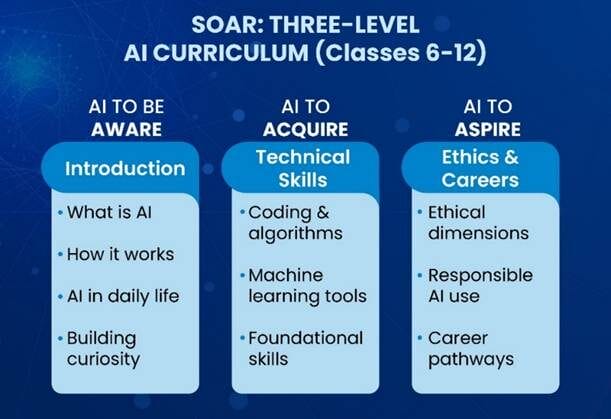
- SOAR Initiative: The Ministry of Skill Development and Entrepreneurship launched SOAR (Skilling for AI Readiness) to build AI awareness and skills for classes 6–12 students and educators. Program includes three 15-hour student modules and one 45-hour “AI for Educators” teacher module
These platforms allow India to scale educational delivery in a cost-effective manner, which is essential for a large population.
Government Policy Framework Driving AI in Education
India’s AI-driven education transformation is supported by several policy initiatives and institutional reforms.
(a) National Education Policy (NEP) 2020
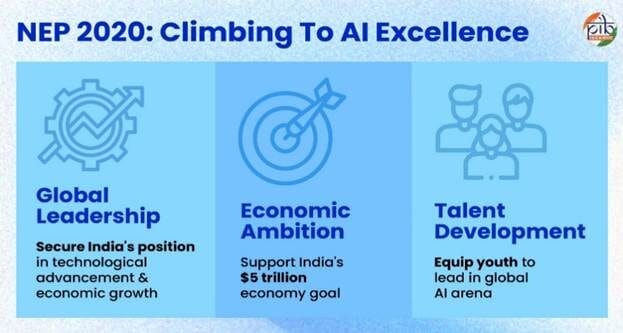
NEP 2020 represents India’s most significant education reform in over three decades. It emphasises the integration of emerging technologies such as artificial intelligence, coding, and data science into the education system.
Key provisions include:
- Introducing coding and computational thinking from Class VI.
- Promoting multidisciplinary education, allowing students to combine technology with social sciences and humanities.
- Expanding vocational education to bridge the gap between academic learning and industry requirements.
- Creating flexible higher education pathways through a four-year multidisciplinary undergraduate programme.
The policy aims to develop creativity, critical thinking, and problem-solving skills rather than rote learning.
(b) IndiaAI Mission
To strengthen India’s AI ecosystem, the government launched the IndiaAI Mission with an allocation of ₹10,371.92 crore over five years.
The mission focuses on:
- Building national AI compute infrastructure.
- Developing large datasets for AI training.
- Supporting AI startups and innovation ecosystems.
- Expanding AI education and skilling programs.
The initiative also emphasises the development of Safe and Trusted AI, ensuring responsible technological deployment.
(c) Integration of AI in School Education
India has begun introducing AI education at an early stage in schools.
The Central Board of Secondary Education has introduced AI as:
- A 15-hour skill module from Class VI
- An optional subject in Classes IX–XII
Such early exposure ensures that students develop familiarity with emerging technologies before entering higher education or the workforce.
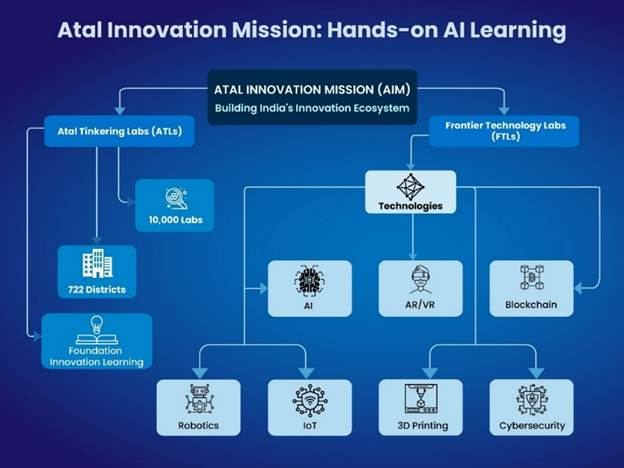
(d) AI in Higher Education
AI is increasingly being incorporated into university curricula.
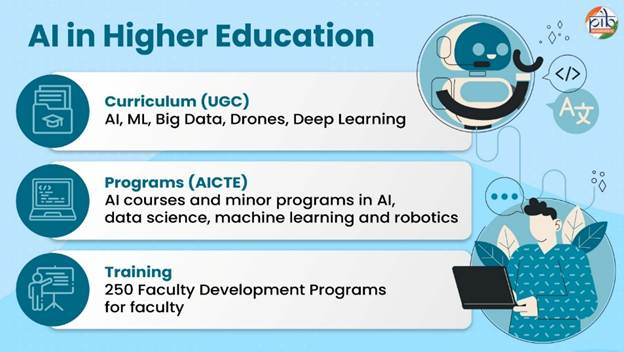
The University Grants Commission (UGC) has introduced courses related to artificial intelligence, machine learning, big data, and data analytics across higher education programs.
Additionally, institutions such as IITs and research universities are conducting advanced research on AI technologies.
This integration strengthens India’s innovation capacity and research output in emerging technologies.
Workforce Skilling and Capacity Building
India faces a significant skill gap in the field of artificial intelligence.
Industry estimates suggest that India will require over 12.5 lakh AI professionals by 2027, while the current workforce is approximately half that number.
To address this gap, the government has launched several skilling initiatives.
(a) FutureSkills PRIME
- FutureSkills PRIME is a joint initiative of the government and industry bodies aimed at building expertise in emerging technologies such as AI, cloud computing, and big data.
- Millions of learners have enrolled in these courses, making it one of the largest digital skilling programs in the region.
(b) Pradhan Mantri Kaushal Vikas Yojana (PMKVY 4.0)
- PMKVY 4.0 integrates training programs in artificial intelligence and emerging technologies.
- The program also includes initiatives to increase participation of women in technology sectors, addressing gender disparities in AI employment.
(c) YUVA AI Initiative
- The YUVA AI initiative aims to provide foundational AI knowledge to citizens across age groups, thereby expanding AI literacy beyond formal education institutions.
(d) Skill Development in Industrial Training Institutes
- Collaborations between government agencies and technology companies are introducing AI training modules in Industrial Training Institutes (ITIs), ensuring that technical and vocational students also benefit from AI education.
Democratisation of AI in Education
While AI offers transformative potential, its benefits must reach all sections of society.
Bridging Socio-Economic Inequalities
- Access to AI education often depends on economic resources. Private AI training programs can be expensive, making them inaccessible to many students.
- Government initiatives providing free online courses and digital learning resources aim to reduce this inequality.
Gender Inclusion
- Women represent a relatively small proportion of the AI workforce in India. Special programs targeting women and girls in technology aim to improve gender representation.
- Scholarships, training programs, and mentoring initiatives are being introduced to encourage female participation in STEM education.
Rural and Regional Inclusion
- AI talent and educational infrastructure are concentrated in major urban centres such as Bengaluru, Hyderabad, and Delhi.
- Government initiatives such as BharatNet aim to expand broadband connectivity to rural areas, enabling students from smaller towns and villages to access digital learning platforms.
- Common Service Centres in villages also function as digital education hubs.
Ethical and Governance Challenges of AI in Education
Despite its advantages, AI also raises several ethical concerns that require careful governance.
Data Privacy
- Digital learning platforms collect large amounts of personal data from students, including minors. Without strong data protection safeguards, such information could be misused.
- India’s Digital Personal Data Protection Act, 2023 provides a framework for protecting personal data, including additional safeguards for children.
Algorithmic Bias
- AI systems trained on biased data may reinforce social inequalities related to caste, gender, or socio-economic status.
- Ensuring fairness in algorithm design is therefore essential.
Surveillance Concerns
- AI-enabled monitoring tools used during online examinations or digital classrooms may lead to excessive surveillance and invasion of privacy.
- Balancing technological efficiency with individual rights is therefore important.
Teacher Deskilling
- Overreliance on automated tools may reduce teachers’ professional autonomy and decision-making authority.
- AI systems must therefore be designed to support rather than replace human judgment.
Governance Framework for Responsible AI in Education
To address these challenges, India must develop a robust governance framework.
Key elements include:
- Independent regulatory oversight for AI tools used in education.
- Mandatory audits of algorithms to detect bias.
- Strong data protection safeguards for student data.
- Transparent AI systems that provide explainable outcomes.
- Ethical training programs for educators and developers.
These measures would ensure that AI technologies operate within the framework of constitutional values such as equality, dignity, and justice.
India’s Potential as a Global AI Leader
India has significant structural advantages in becoming a major global player in artificial intelligence.
Strengths
- Large youth population and demographic dividend.
- Significant number of STEM graduates.
- Growing digital economy and startup ecosystem.
- Vast domestic data resources.
- Strong IT services industry.
These factors position India well to develop and deploy AI technologies.
What ae the Structural Challenges
However, several constraints limit India’s global AI competitiveness.
Limited R&D Investment
- India spends less than one percent of its GDP on research and development, significantly lower than many developed economies.
Compute Infrastructure Gap
- Advanced AI development requires high-performance computing infrastructure such as GPUs, where India currently lags behind major AI powers.
Brain Drain
- Many highly skilled AI researchers migrate abroad for better research opportunities and resources.
Digital Divide
- Significant disparities in internet access and digital infrastructure remain between urban and rural areas.
Strategic Opportunities for India
India can leverage several opportunities to strengthen its AI leadership.
These include:
- Developing AI solutions tailored for developing countries.
- Building language models for Indian languages.
- Strengthening public digital infrastructure.
- Expanding AI research funding.
- Encouraging global partnerships in semiconductor and AI technology.
By focusing on inclusive innovation, India can position itself as a leader in ethical and human-centric AI development.
Skilling in AI
To equip India’s workforce with AI and digital capabilities, the government has launched comprehensive skilling initiatives spanning students, industrial trainees, professionals, and government officials. These programs combine foundational AI literacy with advanced technical training
| Programme | Implementing Agency | Target/Scale | Key Features |
| Pradhan Mantri Kaushal Vikas Yojana (PMKVY) 4.0 | Ministry of Skill Development and Entrepreneurship (MSDE) | 36,584 trained in AI (as on June 30, 2025); 45% women | Short-Term Training (STT) and Recognition of Prior Learning (RPL); AI Career for Women Initiative launched in April 2025 (targeting 8,000 girls over 2 years) |
| SkillSaksham Program | MSDE + Microsoft (MoU Aug 2024) | 200 Industrial Training Institutes (ITIs); 10,000+ candidates targeted; 8,500+ already trained | 1,200 hours AI training + 400 hours Advanced AI in ~15 National Skill Training Institutes (NSTIs) under Craftsmen Training Scheme (CTS) |
| iGOT Karmayogi Bharat Platform | Mission Karmayogi | Government officials | Digital learning platform offering courses in AI, data analytics, and digital transformation |
| FutureSkills PRIME | Government + NASSCOM | 16.29 lakh+ enrolled/trained | 500+ courses, 2,000+ digital fluency pathways in AI, Big Data, Cloud Computing; aligned with National Occupational Standards (NOS) and National Skills Qualification Framework (NSQF) |
| YUVA AI For All | IndiaAI Mission | Target: 1 crore citizens | Free, self-paced foundational AI course (4–4.5 hours) for students, youth, professionals, parents, senior citizens |
Way Forward
To fully harness the benefits of AI in education, India must focus on several priorities.
- First, digital infrastructure such as broadband connectivity must be expanded to ensure equitable access to digital learning resources.
- Second, teacher training programs should be strengthened to build AI literacy among educators.
- Third, AI tools should be developed in multiple Indian languages to ensure broader accessibility.
- Fourth, collaboration between academia, industry, and government should be enhanced to align educational outcomes with labour market requirements.
- Finally, ethical governance mechanisms must be established to protect data privacy, prevent algorithmic discrimination, and ensure transparency in AI systems.
Conclusion
Artificial Intelligence represents one of the most transformative technological forces of the twenty-first century. For India, integrating AI into the education system is essential to prepare its youth for a rapidly changing global economy.
Through initiatives such as NEP 2020, the IndiaAI Mission, digital learning platforms, and large-scale skilling programs, India has begun laying the foundations for an AI-enabled education ecosystem.
However, the ultimate success of this transformation will depend on bridging the digital divide, strengthening research capabilities, ensuring ethical governance, and expanding access to all sections of society.
If implemented effectively, AI can become a powerful instrument not only for economic growth but also for social inclusion—helping India realise its aspiration of becoming a knowledge-driven and developed nation by 2047.

