Why in news?
India’s bid for a UNSC non-permanent seat for 2028-29 faces a contest from Tajikistan; UNGA voting is due in June 2027.
UPSC Relevance
Prelims: UN Charter provisions on the Security Council, election of non-permanent members, voting and veto, India’s UNSC terms.
Mains: GS2 – Important international institutions, their structure and mandate.
UN Security Council
- One of the six principal organs of the UN, with primary responsibility for maintaining international peace and security (Article 24).
- Legal basis: Chapter V of the UN Charter (Articles 23 to 32).
- Binding power: Under Article 25, members agree to accept and carry out the Council’s decisions. It is the only UN organ whose decisions are binding on all member states.
- Tools: Peaceful settlement of disputes (Chapter VI), sanctions and use of force (Chapter VII), peacekeeping missions, and referral of cases to the International Criminal Court.
Membership Structure
| Feature | Permanent Members (P5) | Non-permanent Members |
| Number | 5 – China, France, Russia, UK, USA | 10 |
| How chosen | Named in Article 23 of the Charter | Elected by the UN General Assembly |
| Term | Permanent | Two years; five elected every year |
| Re-election | Not applicable | Retiring member not eligible for immediate re-election |
| Veto power | Yes (on substantive matters) | No |
- Expansion in 1965: The Council originally had 11 members (6 non-permanent). An amendment adopted in 1963 came into force in 1965 and raised the strength to 15. This is the only time the Council has been expanded.
- Presidency: Rotates every month among all 15 members in English alphabetical order.
- Non-members: Any UN member whose interests are affected may take part in discussions without a vote (Article 31). A party to a dispute is also invited (Article 32).
How Non-permanent Members are Elected
- Criteria in the Charter (Article 23): Due regard to (i) contribution to international peace and security and to the other purposes of the UN, and (ii) equitable geographical distribution.
- Majority needed: Two-thirds of members present and voting in the UNGA, through secret ballot. If all 193 members vote, a candidate needs at least 129 votes. This applies even when a candidate is unopposed.
- Timing: Elections are held in June (shifted from October since 2016), and the new members take their seats on 1 January of the next year. This gives elected members more time to prepare.
- Repeated rounds: If no candidate gets two-thirds, voting continues in rounds. In 1979, Cuba and Colombia were deadlocked for over 150 rounds before Mexico was chosen as a compromise.
- Split terms: Sometimes two evenly matched candidates divide the two-year term, one year each. Italy and the Netherlands shared the 2017-18 term.
- Role of regional groups: Seats are informally allotted to regional groups. Each group tries to agree on a ‘clean slate’ (as many candidates as seats). When consensus breaks down, the contest moves to the full Assembly, and every vote counts.
Distribution of the 10 non-permanent seats
| Regional Group | Seats |
| African Group | 3 |
| Asia-Pacific Group (55 members) | 2 |
| Latin American and Caribbean Group (GRULAC) | 2 |
| Western European and Others Group (WEOG) | 2 |
| Eastern European Group | 1 |
India’s Eight Terms as a Non-permanent Member
| Term | Notes |
| 1950-51 | First term, soon after independence; Korean War on the Council’s agenda |
| 1967-68 | Second term |
| 1972-73 | Shortly after the 1971 war and the creation of Bangladesh |
| 1977-78 | Fourth term |
| 1984-85 | Fifth term |
| 1991-92 | End of the Cold War and the Gulf War period |
| 2011-12 | Won 187 of 191 votes after Kazakhstan withdrew in India’s favour; India chaired the Counter-Terrorism Committee |
| 2021-22 | Won 184 of 192 votes after Afghanistan stepped aside; Resolution 2593 on Afghanistan; chaired the Counter-Terrorism Committee in 2022 |
- Two defeats: India lost when it had to contest – in 1975 against Pakistan and in 1996 against Japan.
- Pattern: India has usually been the Asia-Pacific group’s consensus choice roughly once a decade, which made the elections almost a formality.
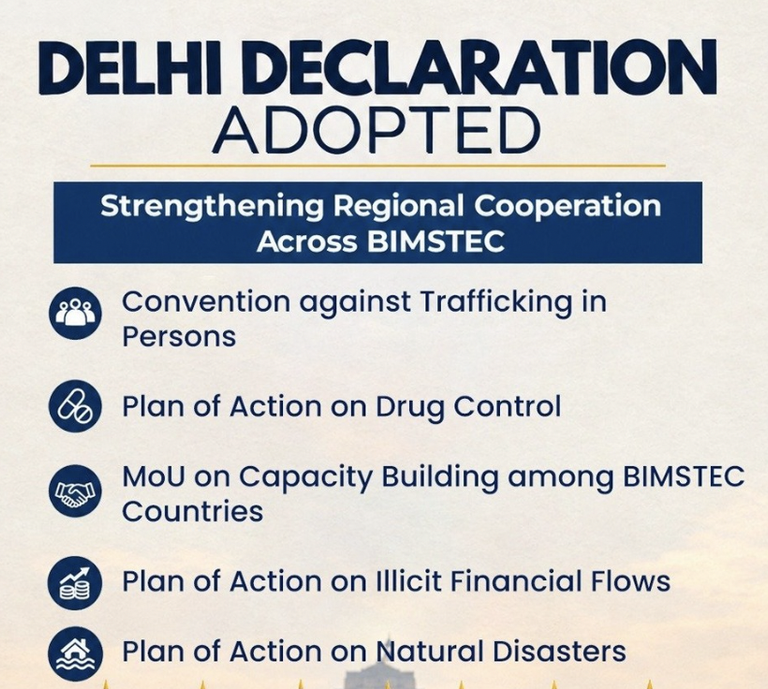
- 2021-22 highlights: PM Modi chaired an open debate on maritime security in August 2021, the first Indian PM to do so. During its December 2022 presidency, India focused on reformed multilateralism and counter-terrorism. The Delhi Declaration (2022) addressed misuse of new technologies by terrorists.
Practice MCQ
Q1. Consider the following statements regarding non-permanent members of the UN Security Council:
1. They are elected by the UN General Assembly by a two-thirds majority of members present and voting.
2. A retiring non-permanent member is eligible for immediate re-election.
3. Five non-permanent members are elected every year for a two-year term.
How many of the statements given above are correct?
(a) Only one (b) Only two (c) All three (d) None
Answer: (b). Statement 2 is incorrect. Article 23 bars immediate re-election of a retiring member.
Q2. Consider the following statements:
Statement I: The presidency of the UN Security Council rotates every month among its members in English alphabetical order.
Statement II: Under Article 27 of the UN Charter, decisions on procedural matters require the concurring votes of all permanent members.
Which one of the following is correct in respect of the above statements?
(a) Both Statement I and Statement II are correct and Statement II explains Statement I
(b) Both Statement I and Statement II are correct but Statement II does not explain Statement I
(c) Statement I is correct but Statement II is incorrect
(d) Statement I is incorrect but Statement II is correct
Answer: (c). Procedural matters need any 9 affirmative votes; the veto applies only to substantive matters.
Mains Practice Question
Q. “India has served eight terms as a non-permanent member of the UN Security Council, but its bid for 2028-29 is unlike its earlier ones.” Explain the process of electing non-permanent members and examine whether frequent non-permanent tenures help or hurt India’s claim to permanent membership. (15 Marks, 250 words)
Tell Google you want more of this.
Add Anantam IAS as a preferred sourceOne tap, and this site shows up more often in your own Top Stories, AI Overviews and AI Mode. Remove it any time.