Why in News?
Scientists analysing observations from India’s Aditya-L1 mission have identified small, short-lived brightenings in the Sun’s atmosphere several hours before the eruption of major solar flares. These events could improve the understanding and forecasting of hazardous space weather.
| UPSC Relevance: GS-3 Science and Technology: Astronomy and Space Technology Prelims: Aditya-L1, Solar flares, Coronal mass ejections, Geomagnetic storms |
Key Findings:
- Scientists detected numerous small pre-flare transient events in magnetically active regions of the Sun. These brightenings occurred hours before major flares and clustered near the locations where the flares subsequently erupted.
- Some events produced both ultraviolet and X-ray signatures, indicating small-scale releases of magnetic energy.
- Repeated energy releases may gradually disturb and weaken the stability of the magnetic field, eventually producing a major solar flare.
However, further observations are necessary to determine whether these events can serve as reliable predictors rather than merely being associated with flare-prone regions.
Role of Aditya-L1:
Aditya-L1 is India’s first dedicated solar observatory. It operates in a halo orbit around the Sun-Earth L1 point, about 1.5 million km from Earth, providing a nearly continuous view of the Sun. The study combined ultraviolet and X-ray observations from three Aditya-L1 payloads:
- Solar Ultraviolet Imaging Telescope (SUIT): Observes the Sun through 11 near-ultraviolet filters, covering layers from the upper photosphere to the chromosphere. These wavelengths are largely inaccessible from Earth because the atmosphere absorbs ultraviolet radiation.
- Solar Low Energy X-ray Spectrometer (SoLEXS): Measures low-energy X-ray emissions from solar activity.
- High Energy L1 Orbiting X-ray Spectrometer (HEL1OS): Studies high-energy X-rays produced during energetic events in the solar corona.
Their simultaneous observations help connect activity in the Sun’s lower atmosphere with magnetic-energy release in the corona.
What are Solar Flares?
- Solar flares are sudden explosions caused by the release of magnetic energy in the Sun’s atmosphere. They emit intense radiation across the electromagnetic spectrum, especially X-rays and ultraviolet radiation.
- Solar flares are often associated with (but do not always produce) coronal mass ejections (CMEs): large clouds of magnetised plasma expelled from the Sun.
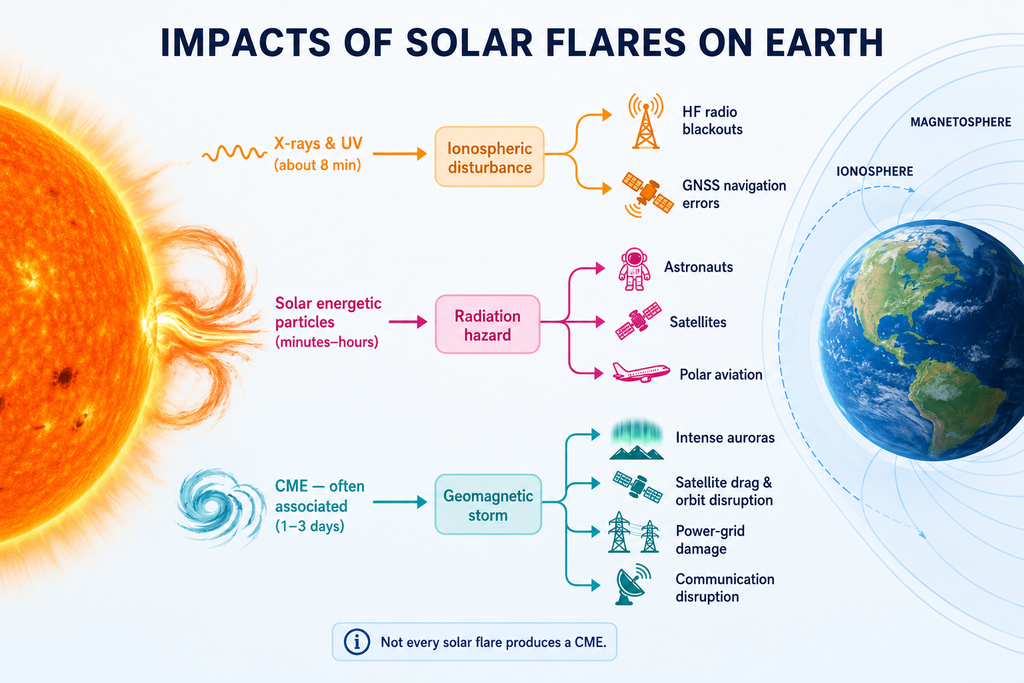
Impacts on Earth:
- Radio blackouts: X-rays and ultraviolet radiation disturb the ionosphere, affecting high-frequency communication on the Sun-facing side of Earth.
- Satellite disruption: Energetic particles may damage electronics, solar panels and sensors.
- Navigation errors: Ionospheric disturbances can degrade GPS and other GNSS signals.
- Geomagnetic storms: Earth-directed CMEs can disturb the magnetosphere and produce intense auroras.
- Power-grid damage: Geomagnetically induced currents may disrupt transformers and transmission networks.
- Radiation hazards: Solar energetic particles endanger astronauts and high-altitude polar flights.
- Orbital changes: Heating and expansion of the upper atmosphere increase drag on low-Earth-orbit satellites.
Reliable early warning can help satellite operators place spacecraft in safe mode, protect power grids, reroute polar flights and safeguard astronauts. The study therefore strengthens India’s capabilities in space-weather forecasting and protection of critical infrastructure.
UPSC PYQ 2022
Q. If a major solar storm (solar flare) reaches the Earth, which of the following are the possible effects on the Earth?
1. GPS and navigation systems could fail.
2. Tsunamis could occur at equatorial regions.
3. Power grids could be damaged.
4. Intense auroras could occur over much of the Earth.
5. Forest fires could take place over much of the planet.
6. Orbits of the satellites could be disturbed.
7. Shortwave radio communication of the aircraft flying over polar regions could be interrupted.
Select the correct answer using the code given below:
(a) 1, 2, 4 and 5 only
(b) 2, 3, 5, 6 and 7 only
(c) 1, 3, 4, 6 and 7 only
(d) 1, 2, 3, 4, 5, 6 and 7
Answer: (c) 1, 3, 4, 6 and 7 only
Tell Google you want more of this.
Add Anantam IAS as a preferred sourceOne tap, and this site shows up more often in your own Top Stories, AI Overviews and AI Mode. Remove it any time.