Why in News?
IIT Madras announced on October 22 that it would study small AI inference centres, according to a report published by The Hindu on October 23, 2026.
- The proposed feasibility study concerns distributed “pico centres” designed through frugal engineering for different groups of end users.
- The report identified agriculture, space, manufacturing, health and law as possible application areas; these references do not establish deployments in those sectors.
- Bodhan AI, an education-focused centre at IIT Madras, was described as examining frugal centres, with personalised tutoring offered as a possible use.
- The announcement establishes a research direction; it supplies no demonstrated performance benchmark, operational network or verified savings for the proposed centres.
- Public-service access depends on whether computing arrangements fit the task, local connectivity and available support, rather than on the size of a facility alone.
- Procurement decisions should distinguish an attractive architectural idea from evidence that a particular service works reliably for its intended users.
UPSC Relevance
Prelims Relevance
- Training: learning model parameters from data.
- Inference: applying an already trained model to new inputs.
- Latency: delay between a request and its response.
- Edge computing: processing near the source or user of data.
- Federated learning: distributed model training, distinct from distributed inference.
Mains Relevance
GS Paper 3
- Matching AI infrastructure to application workloads.
- Testing reliability and lifecycle support before procurement.
GS Paper 2
- Accountability when AI supports local public-service delivery.
Essay
- Appropriate technology begins with the problem that users need solved.
Background and Context
What a Small Inference Centre Would Do
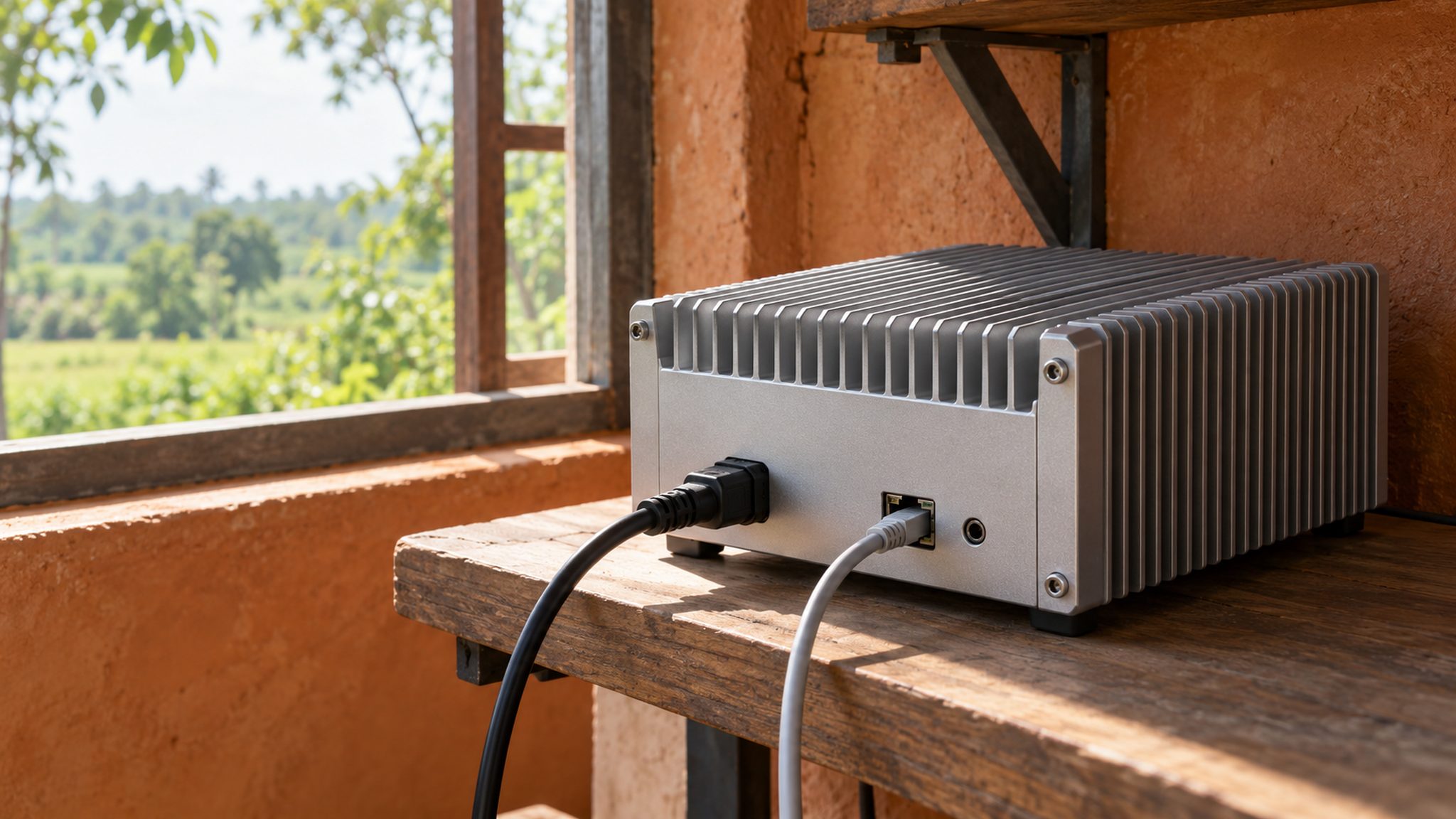
The central idea is to place suitable computing closer to users while choosing tasks that a small installation can realistically support.
- Inference applies a trained model to a fresh request, such as interpreting an input or generating a response; it does not mean teaching the model new parameters each time someone uses it.
- Training changes model parameters using data and an optimisation process, whereas inference uses the resulting parameters; this distinction explains why serving a specific application need not reproduce the original large training installation.
- A small node could serve a defined community or institution if its model and workload fit available computing resources; the announcement does not specify the hardware, supported model sizes or concurrent user capacity.
- Local execution concerns where processing happens, not a guarantee of complete offline operation; authentication, external information retrieval, software updates or other application dependencies may still require a functioning connection to a remote service.
- Distributed inference means that model execution occurs across multiple locations; it should not be confused with federated learning, where participants contribute to model training while retaining their underlying training data at separate locations.
Why the Workload Determines Feasibility
A credible study must connect the intended service to observed demand and acceptable performance before treating smaller installations as a practical alternative.
- Latency may improve when a request travels to a nearby machine, but the actual response also depends on processing time and queues; proximity alone cannot establish that the proposed service will be faster.
- Demand varies across places and hours, so testing should include busy periods rather than only isolated requests; a node that handles demonstrations may struggle when a classroom or institution uses it simultaneously.
- Model suitability matters alongside speed: a quick answer that misinterprets a local language or task is not an effective service; evaluation should assess output quality against the intended users and practical use cases.
- Connection failures should be tested explicitly by identifying which functions remain available and which stop; describing computing as local without examining these dependencies can create an unrealistic promise of uninterrupted access for users.
- Feasibility evidence should compare the proposed arrangement with an existing delivery option on the same task and demand conditions; neither smaller physical size nor a research announcement proves affordability or reliable performance in use.
Operating Many Nodes Creates Responsibilities
The proposal also raises an operational question: who keeps geographically dispersed installations dependable and accountable after their initial setup?
- Maintenance responsibility must identify who diagnoses faults, replaces failed components and restores service; distributing machines without distributing dependable technical support can leave users with equipment that exists but cannot perform its intended function.
- Security updates require a managed process across installations, including tracking software versions and restricting administrative access; placing data processing nearby does not automatically protect stored inputs or prevent misuse of the local system.
- Data handling should specify what is collected, retained and transmitted for each application; local processing may reduce some transfers, but privacy depends on these choices rather than on the physical location of hardware alone.
- Human review remains necessary where an incorrect output could affect health, legal understanding or educational decisions; the feasibility study should define the permitted task and the route for correcting harmful or misleading responses.
- Evidence status must remain clear: the reported work explores whether frugal centres are workable, while future claims of service improvement would require measured results; proposed applications are not proof of successful implementation across India.
Way Forward
Test a Defined Service Before Expansion
- Specify the task, expected users and acceptable response quality before selecting a computing arrangement; test representative requests rather than relying on a scripted demonstration.
- Publish pilot findings on availability, response delays, failures and support requirements, with clear distinctions between measured results and anticipated benefits.
- Assign an operator responsible for repairs, security updates and complaints, and establish a usable human fallback when the AI service cannot answer reliably.
Conclusion
- Right-sized AI starts with a defined service and tests whether its model, demand and operating arrangements fit; the IIT Madras announcement opens that inquiry without settling the practical case for widespread adoption.
- For an analytical answer, distinguish training from inference, local processing from guaranteed offline access, and a feasibility study from deployment; judge public value through reliable service rather than the novelty of a proposed computing architecture.
UPSC Practice Questions
Prelims MCQ 1
With reference to AI infrastructure, consider the following statements:
- Inference applies a trained model to new inputs.
- Local inference guarantees that every application function works without internet access.
- Distributed inference and federated learning describe the same process.
How many of the above statements are correct?
(a) Only one (b) Only two (c) All three (d) None
Answer: (a) Only one
Explanation:
Only statement 1 is correct. Local applications may retain network dependencies. Federated learning concerns distributed training, while distributed inference concerns executing trained models.
Prelims MCQ 2
Which approach best establishes the feasibility of a proposed small AI centre?
(a) Assuming all smaller centres cost less (b) Counting only the machines installed (c) Testing task quality, demand, reliability and support requirements (d) Treating a research announcement as proof of deployment
Answer: (c) Testing task quality, demand, reliability and support requirements
Explanation:
Feasibility depends on the particular service and its operating conditions, supported by measured results.
UPSC Mains Questions
- Explain the distinction between AI training and inference. How should this distinction inform the assessment of small computing centres for public services?
- Discuss the operational and accountability issues that must be addressed before expanding distributed AI inference facilities.
Source: The Hindu.
Frequently Asked Questions
What has IIT Madras announced?
IIT Madras announced a feasibility study of small, distributed AI inference centres. The report describes a research proposal and possible applications; it does not establish an operational nationwide network or proven savings.
How does inference differ from training?
Training adjusts model parameters using data. Inference applies the trained model to new inputs. A small installation serving a defined application may perform inference without undertaking the large training process that produced its model.
Can a local AI centre operate without internet?
Some functions may run locally, but offline availability depends on the application. Authentication, information retrieval, updates or other dependencies may need connectivity, so local execution alone does not guarantee complete offline operation.
Does distributed inference mean federated learning?
No. Distributed inference places execution of trained models at multiple locations. Federated learning is a training arrangement in which participants contribute to learning while their underlying training data remain distributed.
Tell Google you want more of this.
Add Anantam IAS as a preferred sourceOne tap, and this site shows up more often in your own Top Stories, AI Overviews and AI Mode. Remove it any time.