Why in News?
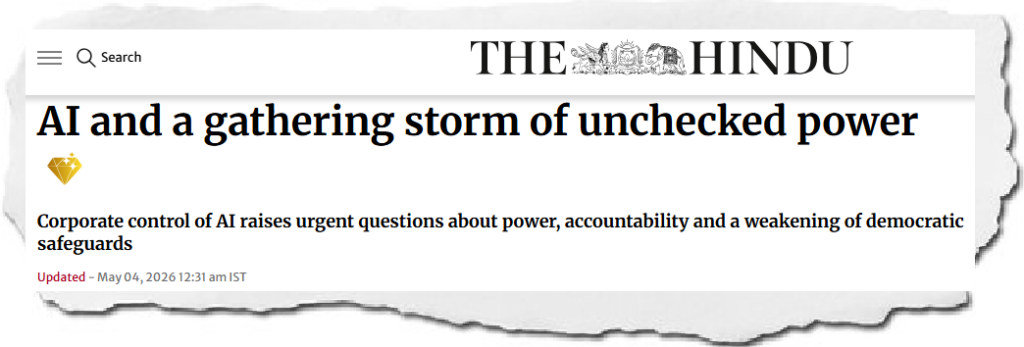
Recent debates over the role of Artificial Intelligence (AI) in warfare, surveillance, cybersecurity, and governance have intensified after reports linked AI-enabled defence systems to military operations in West Asia. Simultaneously, growing concerns about the absence of strong global regulation over AI technologies have triggered discussions on ethics, privacy, democratic accountability, and national security.
UPSC Relevance
GS-II: Governance, Privacy, Human Rights, Regulation of Technology
GS-III: Artificial Intelligence, Cybersecurity, Internal Security, Science and Technology,
The Expanding Influence of Artificial Intelligence
Artificial Intelligence has rapidly moved beyond being a technological tool and is now influencing:
- Warfare and defence systems
- Governance and surveillance
- Economic production and labour markets
- Social interaction and information ecosystems
- Creativity, media, and education
AI systems are increasingly shaping how societies function and how states exercise power. This has led to concerns that technological corporations may accumulate unprecedented influence over public life without adequate democratic oversight.
AI and the Militarisation of Technology
One of the most significant concerns today is the growing integration of AI into military decision-making.
Companies developing advanced AI systems increasingly argue that future geopolitical dominance will depend on software capabilities, autonomous systems, and data-driven warfare.
AI in Modern Warfare
AI technologies are now being used for:
- Target identification
- Drone operations
- Intelligence gathering
- Predictive military analysis
- Cyber warfare
This raises serious ethical concerns because:
- Human oversight may weaken.
- Automated systems can make life-and-death decisions.
- Civilian casualties may increase.
- Accountability becomes difficult to establish.
The use of AI in warfare also creates the danger of an arms race among technologically advanced nations.
The Rise of Surveillance Capitalism
Another major concern is the use of AI-powered surveillance systems by governments and private corporations.
Expanding Surveillance Systems
AI-based tools are increasingly used for:
- Facial recognition
- Behaviour prediction
- Social profiling
- Immigration enforcement
- Predictive policing
These systems rely on large-scale collection of personal data.
Critics argue that such technologies:
- Threaten privacy rights.
- Enable mass surveillance.
- Increase state control over citizens.
- Reinforce social and racial biases.
Predictive policing systems in several countries have already been criticised for disproportionately targeting marginalised communities.
Concerns Regarding Democratic Accountability
A central issue in AI governance is that many critical decisions are now being shaped by private technology corporations rather than democratically accountable institutions.
Concentration of Power
A few major technology companies control:
- Advanced AI models
- Computing infrastructure
- Massive datasets
- Digital communication platforms
This concentration of technological power raises concerns regarding:
- Monopoly control
- Influence over public discourse
- Manipulation of information ecosystems
- Weak public accountability
The growing dependence of governments on private technology firms further complicates regulatory oversight.
What are the Ethical Challenges in AI Development?
Many AI companies have introduced internal ethical frameworks and “AI constitutions” to guide model behaviour.
These frameworks generally aim to ensure that AI systems:
- Avoid harmful content
- Prevent cyber misuse
- Reduce violent or illegal outputs
- Operate within ethical boundaries
However, critics argue that:
- Self-regulation is insufficient.
- Ethical standards vary across corporations.
- Profit motives may override safety concerns.
- Private companies cannot replace public regulation.
The absence of legally enforceable global standards remains a major governance gap.
AI and Cybersecurity Risks
Advanced AI models are increasingly capable of:
- Writing malicious code
- Conducting sophisticated cyberattacks
- Identifying system vulnerabilities
- Automating hacking operations
This creates serious threats to:
- Financial systems
- Energy infrastructure
- Defence networks
- Public institutions
As AI capabilities improve, the possibility of autonomous cyber warfare becomes a growing concern.
What is the Impact on Employment and Economy?
AI-driven automation is expected to transform labour markets across sectors.
Potential Economic Effects
AI may:
- Increase productivity
- Improve efficiency
- Create new industries
However, it may also:
- Displace workers
- Increase income inequality
- Concentrate wealth among technology owners
- Reduce demand for routine labour
Sectors most vulnerable include:
- Manufacturing
- Customer support
- Transport
- Data processing
- Administrative work
The challenge for governments will be balancing innovation with social protection and workforce transition.
AI, Creativity and Intellectual Property
AI systems are trained using massive datasets containing:
- Books
- Articles
- Music
- Paintings
- Online content
This has triggered debates over:
- Copyright infringement
- Fair use
- Ownership of AI-generated content
- Compensation for original creators
Writers, artists, and creators increasingly fear that AI may undermine human creativity while benefiting corporations commercially.
What are Global Regulatory Responses?
Different countries and regions are attempting to regulate AI through varying approaches.
European Union
The European Union AI Act seeks to:
- Categorise AI systems by risk.
- Ban certain harmful applications.
- Introduce transparency obligations.
- Protect fundamental rights.
It is currently one of the world’s most comprehensive AI regulatory frameworks.
Brazil
Brazil has advocated stronger global AI governance focused on:
- Human rights
- Data protection
- Information integrity
- Protection of creative industries
Brazilian leadership has warned against unchecked concentration of technological power.
India’s Approach
India has so far adopted a relatively soft regulatory approach.
Its governance guidelines recognise concerns related to:
- Bias
- Privacy
- Misinformation
- Accountability
However, India has not yet enacted a comprehensive AI legislation.
India faces a complex balancing challenge:
- Encouraging innovation and digital growth
- Protecting citizens’ rights and democratic values
Key Challenges in AI Governance
Lack of Global Consensus
There is no universally accepted framework governing:
- AI ethics
- Autonomous weapons
- Data ownership
- Cross-border AI regulation
Rapid Pace of Technological Change
Technology is advancing faster than policymaking and institutional capacity.
Governments often struggle to:
- Understand emerging risks
- Develop technical expertise
- Implement timely regulations
National Security Competition
Major powers increasingly view AI as a strategic geopolitical asset.
This intensifies:
- Technological rivalry
- Defence competition
- Data nationalism
- Strategic secrecy
As a result, cooperation becomes more difficult.
Need for Responsible AI Governance
Effective AI governance requires:
- Democratic oversight
- Transparent algorithms
- Protection of privacy
- Ethical safeguards
- International cooperation
Regulation must ensure that technological innovation serves public welfare rather than concentrating power in a few corporations or states.
A balanced framework should promote:
- Innovation
- Human dignity
- Accountability
- Inclusion
- Constitutional values
Conclusion
Artificial Intelligence represents one of the most transformative developments of the 21st century. While it offers immense opportunities in healthcare, education, governance, and economic productivity, it also poses profound ethical, political, and security challenges.
The central issue is no longer whether AI will shape the future, but who will control it, how it will be governed, and whether democratic societies can ensure that technological progress remains aligned with human rights, accountability, and public welfare.
Unchecked technological power, especially when concentrated in a small number of corporations or states, risks deepening inequality, weakening privacy, and undermining democratic institutions. Therefore, robust and inclusive governance frameworks are becoming essential for ensuring that AI remains a tool for human advancement rather than domination.
Practice Questions
Prelims Practice Questions
1. With reference to Artificial Intelligence (AI), consider the following statements:
- Predictive policing systems use AI-based algorithms to identify potential criminal activity.
- The European Union AI Act seeks to regulate AI applications based on risk categories.
- AI systems can never exhibit algorithmic bias because they rely on data-driven decision-making.
Which of the statements given above are correct?
(a) 1 and 2 only
(b) 2 and 3 only
(c) 1 and 3 only
(d) 1, 2 and 3
Correct Answer:
(a) 1 and 2 only
2. Which of the following are major concerns associated with Artificial Intelligence?
- Mass surveillance
- Algorithmic bias
- Job displacement
- Cybersecurity threats
Select the correct answer using the code below:
(a) 1 and 2 only
(b) 2 and 3 only
(c) 1, 2, 3 and 4
(d) 1 and 4 only
Correct Answer:
(c) 1, 2, 3 and 4
3. The term “predictive policing” refers to:
(a) Forecasting weather-related disasters using AI
(b) Use of algorithms and data analytics to predict potential criminal activities
(c) AI-based military surveillance in border regions
(d) Predicting cyberattacks on financial institutions
Correct Answer:
(b) Use of algorithms and data analytics to predict potential criminal activities
Mains Practice Questions
- Discuss the ethical and governance challenges posed by the rapid expansion of Artificial Intelligence technologies.
2. “The concentration of AI capabilities in a few corporations poses risks to democracy and individual freedoms.” Examine.
3. Artificial Intelligence presents opportunities for economic growth as well as risks to employment, privacy, and national security. Critically analyse.
4. Why is global cooperation necessary for regulating Artificial Intelligence? Discuss the challenges in evolving a multilateral AI governance framework.
5. Examine the implications of AI-driven surveillance systems on civil liberties and democratic accountability.
Tell Google you want more of this.
Add Anantam IAS as a preferred sourceOne tap, and this site shows up more often in your own Top Stories, AI Overviews and AI Mode. Remove it any time.