Why in News?
On 21 July 2026, The Hindu reported Assam Chief Minister Himanta Biswa Sarma’s renewed emphasis on using Muga silk waste to produce high-value spun yarn. The immediate concern is a processing gap: the Chief Minister said about 40% of Muga cocoons currently go unused, leaving potentially valuable fibre outside the formal value chain.
The waste-to-yarn proposal is one component of Mission Senehjori, which had already been launched on 2 June 2026 by the Union Minister for Development of North Eastern Region and the Assam Chief Minister. The PIB launch release presents it as a three-year, cluster-based programme for the full Muga value chain, not as a newly announced standalone waste scheme.
- The programme proposes a dedicated Muga Spun Mill to turn reeling waste, pierced cocoons and other non-reelable material into marketable yarn.
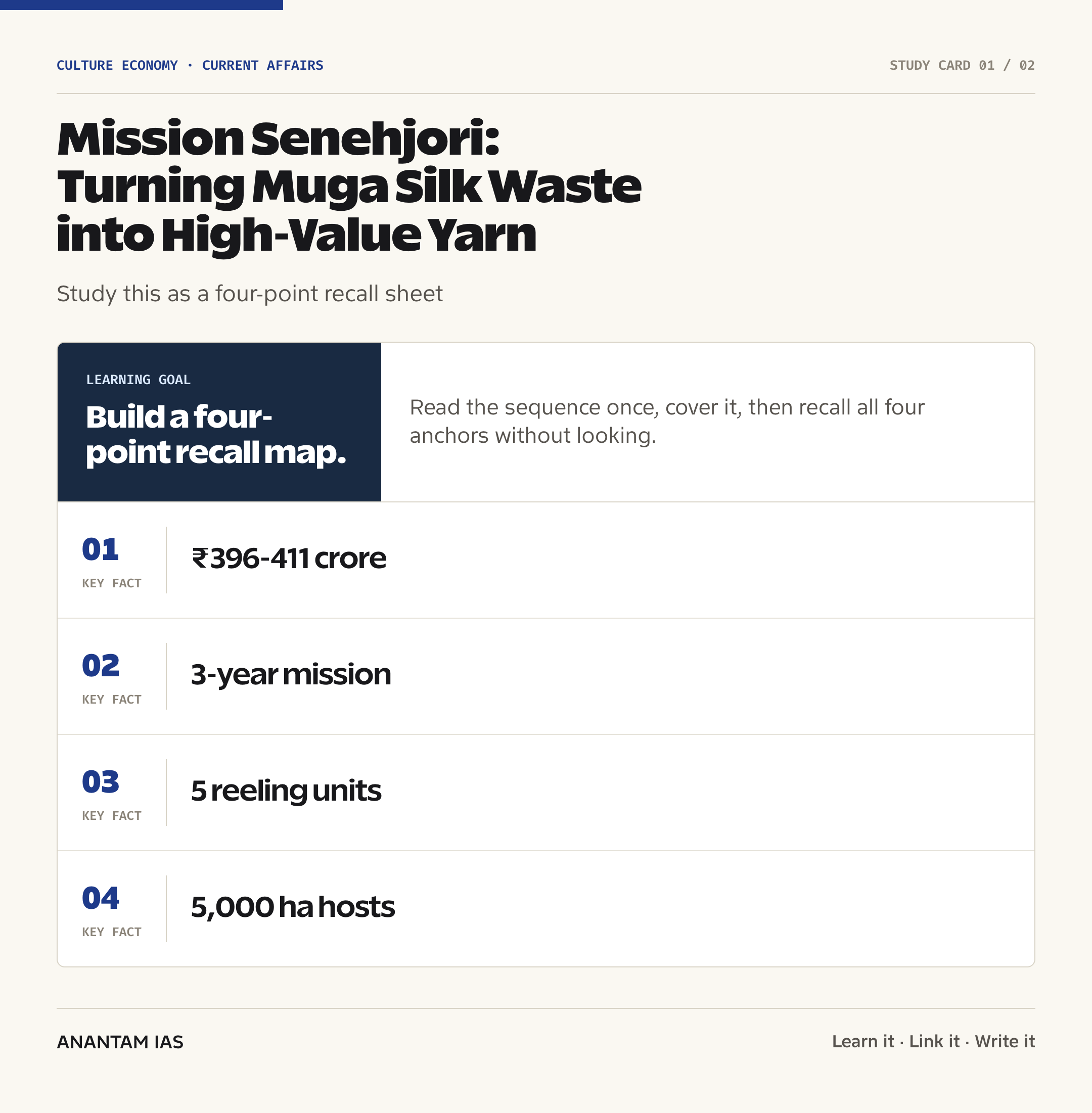
- The official mission envelope is an estimated ₹396-411 crore over three years, including ₹136-151 crore from MDoNER.
- The mission is anchored by MDoNER in convergence with the Government of Assam, the Central Silk Board, the Ministry of Textiles and other central organisations.
- Its design also covers host plants, seed security, reeling, weaving, producer organisations, GI authentication, traceability, exports and silk tourism.
- Income growth, job creation and reduced waste are expected benefits; they shouldn’t be read as outcomes already achieved.
The development matters in the context of:
- The issue matters in the context of converting a heritage fibre into a circular production system without diluting its place-based identity.
- It tests whether public investment can shift value towards rearers, reelers and weavers, rather than only expanding premium retail markets.
- It links cultural economy, rural livelihoods, biological resources and modern traceability within one cluster policy.
UPSC Relevance
Prelims Relevance
- Muga silk is produced by the semi-domesticated, multivoltine silkworm Antheraea assamensis.
- Its principal host plants are Som and Soalu; the worms are reared outdoors on trees.
- Muga is classed with Vanya silks, alongside Tasar and Eri; India produces Mulberry, Tasar, Eri and Muga natural silks.
- The Central Silk Board describes Muga’s defining feature as its natural golden-yellow sheen.
- The Central Silk Board is a statutory body under the Ministry of Textiles, while Mission Senehjori is anchored by MDoNER through convergence.
- Muga Silk of Assam, GI application number 55, was registered on 20 July 2006; its separate logo registration followed in 2012.
- A Geographical Indication identifies goods whose quality, reputation or other characteristic is essentially attributable to geographical origin.
- Spun silk yarn is made from discontinuous fibres such as reeling waste, unlike reeled raw silk drawn as continuous filament from suitable cocoons.
- The mission’s clusters include Jorhat, Sivasagar, Lakhimpur, Dhemaji, Dibrugarh, Tinsukia, Majuli and Sualkuchi.
Mains Relevance
GS Paper 1
- Muga as a living element of Assamese textile heritage, expressed in sarees, mekhela-chadars and local weaving traditions.
- The role of GI protection, cultural tourism and design innovation in conserving a craft while adapting it to contemporary markets.
GS Paper 3
- Agro-based rural industry, producer collectivisation, common infrastructure and value-chain development in the Northeast.
- Waste valorisation as a practical form of the circular economy, with quality, energy, effluent and market safeguards.
- Climate-sensitive host-plant ecology, seed security and the distribution of gains among 2.6 lakh rearer and weaver families cited by PIB.
Essay
- Heritage survives best when communities can earn from conserving it.
- Waste is often a design and infrastructure failure, not a material without value.
- Traceability can connect local identity with ethical global markets.
Background and Context
Muga silk: biological and cultural foundations
Muga is a place-linked fibre whose value begins with a specific silkworm-host plant ecology and continues through Assam’s reeling and weaving knowledge.
- The Central Silk Board identifies the silkworm as Antheraea assamensis, a semi-domesticated and multivoltine species that can produce several crops in a year.
- The larvae feed mainly on aromatic leaves of Som and Soalu; outdoor rearing makes crop performance closely dependent on host-plant health, weather, pests and disease.
- Its filament has a characteristic golden-yellow colour. This natural sheen, rather than dye alone, is central to Muga’s premium identity.
- Traditional products include sarees, mekhela-chadars, chadars and dress material. Sualkuchi is an important reeling and weaving cluster, while cultivation extends across several Upper Assam districts.
- CSB’s distribution note says production is concentrated in Assam but also occurs in adjoining northeastern areas and Cooch Bihar. Claims that the biological culture exists nowhere outside Assam should be avoided.
- The mission launch release estimated Assam’s share at 90% of world Muga production. A separate CSB overview says more than 95% without a current denominator, so 90% is best treated as the launch estimate, not a timeless constant.
- For the wider sectoral setting, see sericulture in India.
Why silk waste can become yarn
Reeling and spinning are different processing routes, which is why material unsuitable for continuous filament can still have commercial value.
- Reeled silk is obtained by unwinding a continuous filament from a suitable cocoon; uniform, intact cocoons are preferred for this route.
- Spun silk uses shorter discontinuous fibres after waste is sorted, opened, cleaned, carded or combed, and spun with twist into yarn.
- The Assam Directorate of Sericulture states that roughly half of the silk in each cocoon can be reeled and the remainder becomes silk waste or noil that can be processed further.
- This technical statement isn’t identical to the Chief Minister’s reported estimate that 40% of cocoons go unused. One concerns fibre recovery within a cocoon; the other concerns cocoons left outside adequate processing.
- Potential feedstock includes pierced cocoons, flimsy cocoons and reeling waste. Traditional practice already produces forms of spun Muga yarn, so the policy is scaling and standardising an existing principle rather than inventing waste use from scratch.
- A mill can improve volume, count consistency and market access, but the output shouldn’t be passed off as premium reeled Muga. Fibre composition and production method need truthful labelling.
- This is a textile example of the circular economy: retain material value, reduce discard and create a second product stream.
Mission design and institutional architecture
Mission Senehjori is designed as a convergent cluster programme spanning biological inputs, production infrastructure and market institutions.
- The PIB release says the mission is anchored by MDoNER in convergence with the Government of Assam, Central Silk Board, Ministry of Textiles and other central ministries and organisations.
- The phrase matters: it isn’t presented as a scheme implemented by the Central Silk Board alone, nor solely as an Assam Directorate of Sericulture project.
- The estimated investment is ₹396-411 crore over three years, of which MDoNER is expected to contribute ₹136-151 crore. The range signals a programme envelope, not a final audited expenditure.
- The cluster approach covers production centres named by the launch release: Jorhat, Sivasagar, Lakhimpur, Dhemaji, Dibrugarh, Tinsukia, Majuli and Sualkuchi.
- Upstream measures cover Som-Soalu regeneration and seed security; midstream measures cover reeling, spinning, common facilities and weaving; downstream measures cover authentication, branding, exports and tourism.
- Producer organisation is built around proposed Farmer Interest Groups and Farmer Producer Organisations, intended to aggregate demand, supply and bargaining power.
- A unified Senehjori brand and digital traceability are meant to connect origin claims with buyer confidence, but governance rules for brand use will determine credibility.
Planned infrastructure and 2028 targets
The official launch release sets measurable outputs for 2028, all of which remain targets until completion and use are independently verified.
- Set up five modernised Muga reeling units and one Muga Spun Mill; the mill is the mission component most directly linked to waste-to-yarn conversion.
- Create 30 FPOs and more than 1,180 Farmer Interest Groups to organise dispersed producers and improve aggregation.
- Regenerate 5,000 hectares of Som and Soalu host plants, tying industrial expansion to the ecological base of silkworm rearing.
- Authenticate more than 80% of traded Muga silk through GI-linked systems, which would need reliable testing, authorised users and enforcement against imitation.
- Create digital traceability mechanisms for more than 8,000 households; enrolment is only an input unless records remain accurate and producers can access the system.
- Expand annual Muga silk exports to more than 2,000 kilograms. Export growth is a target, not proof of demand, premium prices or higher household income.
- Develop a Muga Silk Trail, Silk Tourism Park and annual Muga Utsav to connect production with Assam’s cultural economy.
- These outputs should be tracked separately: a facility can be built yet underused, an FPO can be registered yet inactive, and a traceability ID can exist without credible chain-of-custody data.
GI protection, authentication and market trust
A premium Muga strategy needs legal origin protection and physical product verification to work together.
- IP India’s registry records Muga Silk of Assam as GI application number 55, registered on 20 July 2006 in the handicraft category.
- The separate Muga Silk of Assam logo, application number 384, was registered in 2012. A logo can aid consumer recognition but doesn’t replace authorised-user and origin checks.
- The public registry entry for application 55 displayed validity through 19 July 2026 when checked for this note. Since GI protection is renewable, the registry’s current renewal status should be confirmed before making a categorical post-date claim.
- The official mission release calls Muga India’s first GI-tagged silk, but IP India records Kancheepuram Silk with a 2 June 2005 certificate, earlier than Muga’s 2006 registration. The safer exam fact is Muga’s exact registry date and application number.
- GI authentication should establish geographical origin and compliance with the registered specification; it isn’t simply a marketing sticker available to any silk trader.
- Digital traceability can record movements from rearer to yarn and fabric, while laboratory or field authentication supports the material claim. Neither tool can substitute for inspected source data.
- Read the legal concept separately in Geographical Indications explained.
Likely gains are conditional, not automatic
The mission has a plausible development logic, but its social and environmental benefits depend on who owns assets, who bears costs and who captures the premium.
- Waste recovery can add a second revenue stream for pierced cocoons and short fibre that fetch little value, provided procurement prices are transparent.
- Local spinning can create work in sorting, cleaning, carding, spinning, testing and product development; the number and quality of jobs remain to be measured.
- FPOs and aggregation centres may reduce transaction costs and improve bargaining, but weak management or buyer dependence can reproduce the same imbalance at a larger scale.
- Common facilities can widen access to machinery that individual reelers can’t afford. User fees, downtime, maintenance and distance will decide whether small producers benefit.
- Product diversification can make Muga more accessible through textured yarn and blends, but poor disclosure could weaken the premium attached to authentic reeled Muga.
- Resource efficiency can reduce discard, yet spinning still has water, chemical, energy and effluent footprints. Circularity needs cleaner processing, not waste conversion alone.
- Silk tourism can increase craft visibility and direct sales; community consent, cultural accuracy and revenue sharing are needed to prevent heritage from becoming only a visitor spectacle.
Implementation risks and policy tests
The strongest evaluation question is whether the mission can preserve fibre integrity and producer agency while building scale.
- Feedstock mapping must distinguish unreelable cocoons, reeling waste, noil and usable continuous filament; inflated waste estimates can produce oversized plants.
- Host-plant restoration should use suitable local germplasm and survival audits, not plantation counts alone, because Muga rearing depends on leaf quality and seasonal resilience.
- Seed security and disease management require coordination with Central Silk Board research and seed institutions, backed by local extension rather than one-time training.
- Spun-yarn standards should declare fibre content, count, twist, strength and origin. Blended or waste-derived yarn must not be sold as pure reeled silk.
- Procurement rules should publish the price paid for each waste grade so that rearers and reelers share in value addition instead of supplying cheap residue to a central mill.
- The mission needs a public dashboard separating sanctions, expenditure, completed assets, operating capacity and household income change.
- Baseline and end-line studies should report participation and gains by gender, social group, district and value-chain role; an aggregate export figure can’t show distributive impact.
Way Forward
Build from verified material flows
- Conduct district-wise audits of cocoon output, reelable share and waste grades before fixing mill capacity.
- Use traceable procurement lots so finished spun yarn can be linked back to clusters and producer groups.
- Report recovery rates and rejected material instead of presenting all collected waste as saleable yarn.
Put producers into commercial governance
- Give FPOs and reeler groups representation in pricing, facility management and brand decisions.
- Publish grade-wise floor or reference prices and make payment records auditable.
- Pair machinery with working capital, repair support, design advice and assured quality testing.
Protect both GI and product truth
- Confirm and publicly update the GI renewal status, authorised-user base and enforcement protocol.
- Use separate labels for reeled Muga, spun Muga and blends, with fibre composition visible to buyers.
- Connect QR records to verifiable chain-of-custody data, not just promotional pages.
Make processing genuinely circular
- Set benchmarks for water, energy, chemicals and effluent per kilogram of spun yarn.
- Recover more fibre without diverting healthy seed cocoons or lowering reeling quality.
- Plan safe handling of residues that remain after cleaning, degumming and spinning.
Measure outcomes, not announcements
- Track facility use, household earnings, jobs, women’s control over income and price realisation against a baseline.
- Disclose progress against every 2028 target, with district and institution responsible.
- Commission independent technical, financial and social audits before scaling beyond the initial clusters.
Conclusion
Mission Senehjori treats Assam’s Muga silk as both heritage and a production system. Its waste-to-yarn component is credible because reeling naturally leaves short fibre and unusable cocoons that can be spun, but the mission’s larger promise depends on host plants, seed, institutions, authentication and market access moving together.
The policy test isn’t whether a mill is announced. It is whether verified waste becomes honestly labelled yarn, whether producers receive a fair share of the added value, and whether Assam’s ecological and cultural foundations remain stronger after commercial expansion.
UPSC Practice Questions
Prelims MCQ 1
With reference to Muga silk, consider the following statements:
- It is produced by Antheraea assamensis.
- Som and Soalu are important host plants for its silkworm.
- Spun Muga yarn must be made only from a continuous filament reeled from intact cocoons.
How many of the above statements are correct?
(a) Only one (b) Only two (c) All three (d) None
Answer: (b) Only two
Explanation:
Statements 1 and 2 are correct. Spun silk uses discontinuous fibres, including suitable reeling waste and non-reelable cocoon material; continuous filament produces reeled raw silk.
Prelims MCQ 2
Which institution anchors Mission Senehjori according to the official launch release?
(a) Ministry of Development of North Eastern Region (b) Ministry of Environment, Forest and Climate Change (c) Khadi and Village Industries Commission (d) North Eastern Council alone
Answer: (a) Ministry of Development of North Eastern Region
Explanation:
MDoNER anchors the mission in convergence with the Government of Assam, Central Silk Board, Ministry of Textiles and other central ministries and organisations.
UPSC Mains Questions
- Mission Senehjori frames Muga silk waste as an economic resource, but infrastructure alone can’t guarantee inclusive value addition. Examine the mission’s cluster design and suggest safeguards for producer incomes, ecological sustainability, product authenticity and accountable delivery.
- Geographical Indications can protect a cultural product’s origin, while traceability can protect trust across its value chain. Discuss this distinction with reference to Assam’s Muga silk and the challenges of scaling it for premium domestic and export markets.
Sources: PIB, Ministry of Development of North Eastern Region and The Hindu.
Frequently Asked Questions
What is Mission Senehjori?
Mission Senehjori is a three-year, cluster-based programme for Assam’s Muga silk value chain. MDoNER anchors it with the Government of Assam, Central Silk Board, Ministry of Textiles and other organisations. It covers host plants, seed, reeling, spinning, producer groups, GI authentication, traceability, branding, exports and cultural tourism.
Why is Muga silk waste valuable?
Not all cocoon fibre can be drawn as a continuous reeled filament. Pierced or flimsy cocoons, reeling waste and short fibres can be cleaned, carded or combed and spun into yarn. This creates a distinct product stream, but it should be labelled as spun Muga rather than represented as premium reeled raw silk.
Is 40% of Muga silk currently wasted?
The 40% figure is a reported estimate attributed to Assam’s Chief Minister for cocoons going unused because of inadequate processing. Assam’s technical sericulture page separately says roughly half the silk in each cocoon may remain after reeling as waste or noil. The two figures measure different stages and shouldn’t be merged.
Who implements Mission Senehjori?
The official launch release says MDoNER anchors the mission in convergence with the Government of Assam, Central Silk Board, Ministry of Textiles and other central ministries or organisations. It doesn’t assign the entire mission to one silk agency. Delivery will require coordinated state, central, technical and producer-level institutions.
What are the mission’s main 2028 targets?
Targets include five modernised reeling units, a Muga Spun Mill, 30 FPOs, over 1,180 Farmer Interest Groups, regeneration of 5,000 hectares of Som and Soalu, GI-linked authentication of over 80% of traded silk, traceability for more than 8,000 households and exports above 2,000 kilograms annually.
Does Muga silk have a GI registration?
IP India records Muga Silk of Assam under application 55, registered on 20 July 2006, with a separate logo registered in 2012. The public entry displayed validity through 19 July 2026 when this note was checked, so the latest renewal or registry update should be confirmed for claims after that date.
Tell Google you want more of this.
Add Anantam IAS as a preferred sourceOne tap, and this site shows up more often in your own Top Stories, AI Overviews and AI Mode. Remove it any time.