Why in news?
A proposed Adani-linked bauxite mine in Odisha’s Balda hills threatens one of the last habitats of the endangered Jeypore ground gecko.
UPSC Relevance
Prelims – Jeypore ground gecko, species endemic to the Eastern Ghats, Bonda and Paroja tribes, PVTGs.
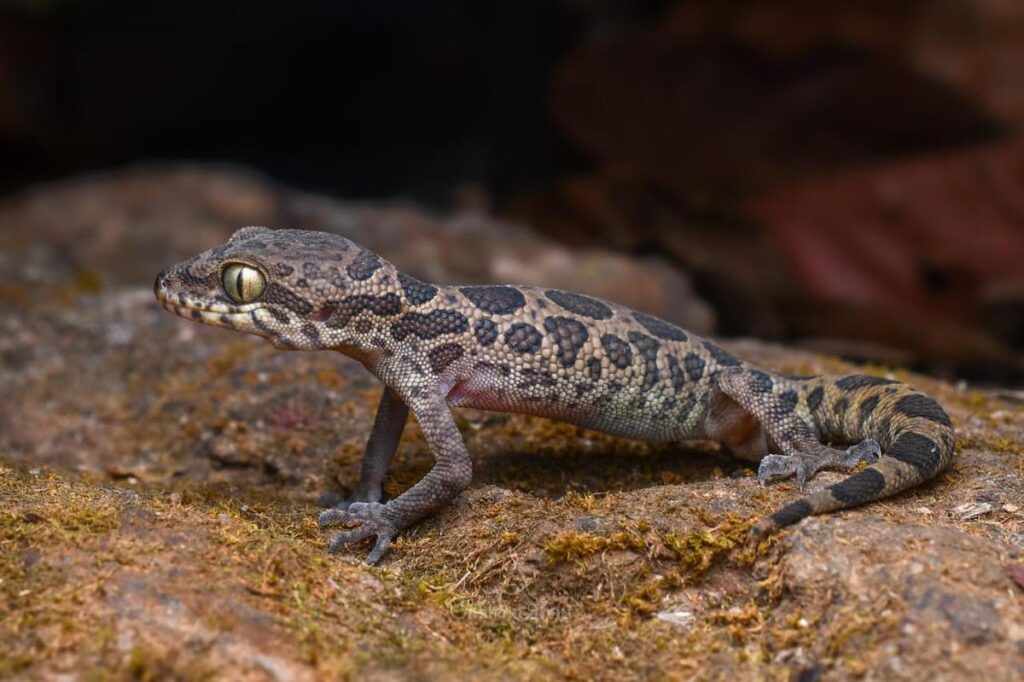
Jeypore Ground Gecko
- Scientific name – Geckoella jeyporensis.
- Discovery – First described in 1878 by British naturalist Richard Henry Beddome from Potangi, near Jeypore in Koraput district, Odisha.
- Lost and found – It was presumed extinct for about 130 years. It was rediscovered in 2010 in Koraput by herpetologists.
- Distribution – Endemic to the Eastern Ghats of southern Odisha and northern Andhra Pradesh. It is range-restricted and found only in high-elevation forests between 900 and 1,400 metres.
- Habitat – Lives on the forest floor, in crevices of boulders and under leaf litter. It is a ground gecko, which means it lives on the ground rather than climbing walls or trees.
- Appearance – Small, about 3.6 inches (around 9 cm) long, with a comparatively large head and a yellow-orange body covered in dark blotches.
- Behaviour – Nocturnal (active at night). Its habits, behaviour and life cycle are still largely unknown to scientists.
- Evolutionary value – It split from its closest relatives over 20 million years ago, making it an evolutionarily distinct lineage.
- Conservation status – Described as Endangered, with a very small known population.
- Threats – Bauxite mining (its original habitat at Potangi has already been lost to NALCO mining), coffee plantations, hydel projects and general forest loss.
The Balda hills mining proposal
- The project – An opencast bauxite mine by Kalinga Alumina Ltd, an Adani group subsidiary, covering 147 hectares of forest in the Balda hills within the Nageswari reserve forest.
- Tribal opposition – Bonda and Paroja (Porja) communities, whose ancestral land this is, have protested for two years, filed a complaint in February 2026, and stopped a drone survey of the area.
- Forest rights – Communities have applied for forest rights over the hill under the Forest Rights Act, 2006, but these have not been recognised.
- Bonda tribe – One of Odisha’s Particularly Vulnerable Tribal Groups (PVTGs), known for their distinct culture and isolation in the hills of Malkangiri-Koraput region.
Practice MCQ
Q1. Consider the following statements about the Jeypore ground gecko:
1. It is endemic to the high-elevation forests of the Eastern Ghats.
2. It is a diurnal, tree-dwelling species.
3. It was rediscovered in Odisha’s Koraput district after being presumed extinct for over a century.
How many of the statements given above are correct?
(a) Only one (b) Only two (c) All three (d) None
Answer: (b). Statement 2 is incorrect. The gecko is nocturnal and lives on the ground among boulders and leaf litter.
Q2. Consider the following pairs:
| Species | Region where it is endemic |
|---|---|
| 1. Jeypore ground gecko | Eastern Ghats |
| 2. Indian golden gecko | Eastern Ghats |
| 3. Lion-tailed macaque | Western Ghats |
| 4. Jerdon’s courser | Western Ghats |
How many of the pairs given above are correctly matched?
(a) Only one (b) Only two (c) Only three (d) All four
Answer: (c). Pair 4 is incorrect. Jerdon’s courser is found in the Eastern Ghats of Andhra Pradesh (Sri Lankamalleswara Wildlife Sanctuary).
Tell Google you want more of this.
Add Anantam IAS as a preferred sourceOne tap, and this site shows up more often in your own Top Stories, AI Overviews and AI Mode. Remove it any time.