Why in News?
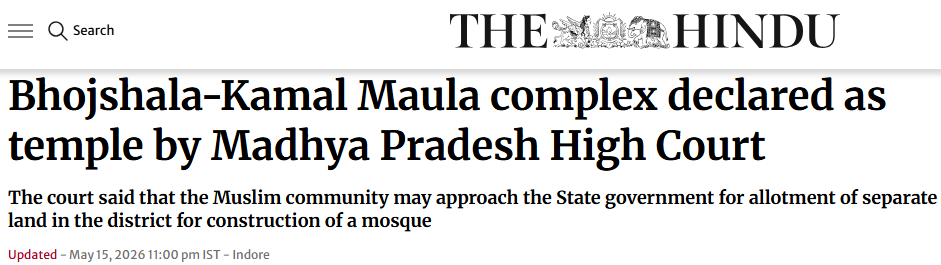
The Madhya Pradesh High Court has declared the disputed Bhojshala-Kamal Maula complex in Dhar as a temple dedicated to goddess Vagdevi (Saraswati), while dismissing the claims of the Muslim community over the site. The court also quashed the 2003 ASI arrangement permitting Friday prayers and relied upon principles evolved in the Ayodhya Ram Janmabhoomi-Babri Masjid Verdict.
UPSC Relevance
Prelims: ASI, Ancient Monuments and Archaeological Sites and Remains Act 1958, Article 25, Article 26, protected monuments, carbon dating, palaeography
Mains:
GS Paper 1 – Indian heritage and culture, conservation of heritage sites
GS Paper 2 – secularism, religious rights, judiciary, constitutional morality, governance of religious institutions;
Essay – religion and constitutionalism, heritage and identity
Background and Context
The Bhojshala-Kamal Maula complex located in Dhar district of Madhya Pradesh has been a site of religious and historical contestation for decades.
The dispute primarily concerns:
- The religious character of the structure
- Rights of worship
- Ownership and management of the monument
The site has historically been claimed by:
- Hindus, who regard it as a temple dedicated to goddess Saraswati
- Muslims, who consider it the Kamal Maula mosque
- Certain Jain groups, who also raised claims recently
The complex is a protected monument under the Archaeological Survey of India (ASI).
For years, a shared arrangement existed under a 2003 ASI order:
- Hindus performed puja on Tuesdays and Basant Panchami
- Muslims offered namaz on Fridays
The High Court judgment has now fundamentally altered this arrangement.
Historical Significance of Bhojshala
Connection with Raja Bhoja
The Bhojshala is associated with Raja Bhoja, the famous 11th-century ruler of the Paramara dynasty.
Raja Bhoja is remembered for:
- Patronage of Sanskrit learning
- Temple construction
- Contributions to literature and architecture
The term “Bhojshala” is often interpreted as:
A centre of learning established under Raja Bhoja.
Association with Goddess Saraswati
Hindu groups believe that the site originally housed:
- A temple of goddess Saraswati (Vagdevi)
- A centre for Sanskrit education
Historical references mention the existence of:
- Sculptures
- Pillars with Sanskrit inscriptions
- Temple-style architecture
The idol of goddess Saraswati associated with the site was reportedly taken to the United Kingdom during colonial times and is presently housed in a museum in London.
Archaeological and Architectural Importance
The monument contains:
- Pillared halls
- Carved stone structures
- Sanskrit inscriptions
- Islamic architectural additions
This reflects layers of historical transformation over centuries.
The site is considered architecturally significant because it displays:
- Medieval temple architecture
- Reused structural elements
- Syncretic historical layers
Legal and Constitutional Dimensions
Ancient Monuments and Archaeological Sites and Remains Act, 1958
The court held that the site is a protected monument under the Ancient Monuments and Archaeological Sites and Remains Act 1958.
The Act provides for:
- Protection of ancient monuments
- Preservation of archaeological heritage
- Regulation of religious access where applicable
The ASI is empowered to:
- Maintain protected monuments
- Regulate public access
- Ensure conservation
Article 25 and Religious Freedom
Article 25 guarantees:
- Freedom of conscience
- Freedom to profess, practice and propagate religion
However, these rights are subject to:
- Public order
- Morality
- Health
The dispute involved balancing competing religious claims over the same site.
Article 26 and Religious Denominations
Article 26 grants religious denominations the right to manage their own affairs in matters of religion.
The case raised questions regarding:
- Whether the site retained temple character
- Rights of communities over protected monuments
- State regulation of religious spaces
Key Findings of the High Court
Declaration of Religious Character
The High Court declared that:
- The religious character of the disputed structure is that of a Bhojshala temple dedicated to goddess Saraswati
The court therefore permitted Hindu worship at the site.
Quashing of 2003 ASI Arrangement
The court struck down the 2003 ASI order that allowed:
- Friday namaz by Muslims
- Limited Hindu worship access
The judgment effectively ended the earlier shared-use arrangement.
Reliance on Ayodhya Principles
The court stated that it drew guidance from principles evolved in the Ayodhya judgment.
The Ayodhya verdict had emphasised:
- Historical evidence
- Archaeological findings
- Longstanding patterns of worship
- Balancing constitutional rights
Directions Regarding Saraswati Idol
The court directed the Union government to make efforts to:
- Bring back the Saraswati idol from London
- Re-establish it at Bhojshala
This touches upon broader debates regarding:
- Repatriation of cultural artefacts
- Colonial-era removal of heritage objects
Role of Archaeological Survey of India (ASI)
Court-Ordered Scientific Survey
The dispute involved a scientific survey conducted by the Archaeological Survey of India.
The survey reportedly used:
- Carbon dating
- Palaeography
- XRF spot analysis
- Compositional testing
Scientific Evidence and Heritage Litigation
The court accepted the ASI findings as:
- Fair
- Scientific
- Impartial
The judgment noted that:
- Videography was conducted
- Representatives from all parties were present during the survey
This reflects the increasing use of scientific archaeology in heritage and religious disputes.
Repatriation of Cultural Artefacts
Saraswati Idol Issue
The judgment’s direction regarding the Saraswati idol raises the larger issue of repatriation of cultural heritage objects.
India has increasingly sought the return of:
- Sculptures
- Antiquities
- Temple idols
- Artefacts taken during colonial rule
Recent years have seen successful repatriation efforts involving:
- United States
- Australia
- United Kingdom
International Conventions
India is a signatory to:
UNESCO Convention 1970
The convention seeks to:
- Prevent illicit trade in cultural property
- Facilitate return of stolen artefacts
Broader Constitutional and Social Issues
Heritage and Religious Identity
The dispute reflects how historical monuments can become sites of:
- Identity politics
- Religious mobilisation
- Competing historical narratives
Such disputes often involve tensions between:
- Archaeological interpretation
- Faith-based claims
- Constitutional secularism
Judiciary and Religious Disputes
Courts increasingly play a central role in resolving:
- Temple-mosque disputes
- Religious access issues
- Heritage claims
This raises debates regarding:
- Judicial capacity in interpreting history
- Role of evidence in faith disputes
- Limits of judicial intervention
Shared Heritage and Pluralism
India’s medieval heritage often reflects:
- Multiple historical layers
- Syncretic traditions
- Adaptive reuse of structures
Managing such sites requires balancing:
- Religious sensitivities
- Constitutional rights
- Conservation needs
Challenges and Concerns
Potential Social Tensions
Religious site disputes can trigger:
- Communal polarisation
- Public unrest
- Political mobilisation
Balancing Faith and Archaeology
Courts must navigate the difficult relationship between:
- Historical evidence
- Archaeological interpretation
- Faith-based belief systems
Preservation versus Religious Use
Increased religious activity at protected monuments may create challenges for:
- Conservation
- Visitor regulation
- Structural preservation
Judicialisation of Historical Disputes
There are concerns that more historical disputes may increasingly move into courts, potentially affecting social harmony.
Management of Protected Monuments
Balancing:
- ASI conservation responsibilities
- Religious access
- Tourism
- Security
remains administratively complex.
Way Forward
Strengthening Scientific Heritage Conservation
Archaeological investigations should remain:
- Transparent
- Evidence-based
- Professionally supervised
to preserve public trust.
Promoting Dialogue and Reconciliation
Community dialogue mechanisms can help reduce tensions surrounding disputed heritage sites.
Balanced Heritage Management
Protected monuments with religious significance require integrated management frameworks balancing:
- Conservation
- Worship rights
- Public access
Repatriation of Cultural Heritage
India should continue diplomatic and legal efforts for:
- Return of stolen antiquities
- Recovery of temple idols
- Protection of heritage assets abroad
Preserving Constitutional Secularism
State institutions must ensure that:
- Religious freedom
- Rule of law
- Equality before law
remain protected while addressing historical disputes.
Strengthening ASI Capacity
The ASI requires:
- Better funding
- Modern scientific tools
- Conservation experts
- Improved site management systems
Conclusion
The Bhojshala-Kamal Maula judgment marks another significant development in the intersection of faith, history, archaeology and constitutional law in India. The case demonstrates how historical monuments continue to shape contemporary debates on identity, heritage and religious rights.
While the judgment resolves one legal dispute, it also raises broader questions regarding management of shared heritage spaces, the role of scientific evidence in religious claims, and the challenge of preserving constitutional harmony in a diverse society. Going forward, India’s approach must balance historical justice, conservation priorities and social cohesion within the framework of constitutional values.
UPSC Practice Questions
- Consider the following statements regarding the Ancient Monuments and Archaeological Sites and Remains Act, 1958:
I. It provides for protection and preservation of ancient monuments in India.
II. The Archaeological Survey of India is responsible for implementing the Act.
III. All protected monuments under the Act are prohibited from religious use.
Which of the statements given above are correct?
(a) I and II only
(b) II and III only
(c) I and III only
(d) I, II and III
Correct Answer: (a) I and II only
Explanation:
Statements I and II are correct because the AMASR Act provides for conservation of protected monuments and is administered by the ASI.
Statement III is incorrect because certain protected monuments continue to permit regulated religious practices.
- With reference to the Archaeological Survey of India (ASI), consider the following statements:
I. It functions under the Ministry of Culture.
II. It is responsible for conservation of centrally protected monuments.
III. It was established after independence.
Which of the statements given above are correct?
(a) I and II only
(b) II and III only
(c) I and III only
(d) I, II and III
Correct Answer: (a) I and II only
Explanation:
Statements I and II are correct. The ASI functions under the Ministry of Culture and manages centrally protected monuments.
Statement III is incorrect because ASI was established in 1861 during British rule.
Mains Questions:
- Examine the role of archaeology, scientific evidence and constitutional principles in resolving heritage-related disputes in India.
- Discuss the constitutional and heritage-related issues involved in disputes concerning religious claims over historical monuments in India.
Tell Google you want more of this.
Add Anantam IAS as a preferred sourceOne tap, and this site shows up more often in your own Top Stories, AI Overviews and AI Mode. Remove it any time.