Why in News?
On 27 October 2026, the Culture Ministry disclosed an India–Bibliothèque nationale de France manuscript cooperation agreement signed in Paris the previous day, covering conservation, digitisation and research access.
- The MoU connects the Ministry of Culture, through Gyan Bharatam, the National Archives of India and the National Library, Kolkata, with France’s national library.
- The partners will work to identify and digitise Indic-origin manuscripts held by BnF, alongside exchanges involving conservation, cataloguing standards and text-recognition tools.
- The envisaged repository provides structured, permission-based access. The agreement does not establish that every manuscript is already digitised or publicly available.
- Identification and access are different stages of heritage work. The earlier Gyan Bharatam manuscript survey concerns locating collections; this agreement adds institutional cooperation on preservation and research use.
- Digital copies can help researchers study materials held in different institutions, while physical originals still require conservation and decisions about permitted use.
UPSC Relevance
Prelims Relevance
- BnF: Bibliothèque nationale de France, the National Library of France.
- Conservation: care of the physical manuscript and its material condition.
- Digitisation: creation of a digital representation of a physical source.
- OCR and HTR: optical character recognition and handwritten text recognition, used to derive text from images.
- Permission-based access: access governed by specified conditions rather than an assumption of unrestricted reuse.
Mains Relevance
GS Paper 1
- Cultural heritage: preserving documentary sources while supporting research and interpretation.
GS Paper 2
- Cultural diplomacy: cooperation between institutions holding collections relevant to shared historical study.
GS Paper 3
- Technology governance: combining digital access with quality checks and clear permissions.
Background and Context
What the Cooperation Framework Covers
The agreement links institutions that can contribute different kinds of expertise to the care and study of manuscript collections.
- The India–BnF MoU establishes a framework for identifying and digitising Indic-origin manuscripts held by the French institution. Its announcement describes planned cooperation; it does not report completion of every collection or a finished public archive.
- Gyan Bharatam provides the Indian mission context, with the National Archives of India and National Library, Kolkata, among the participating institutions. Their involvement connects manuscript work with expertise in documentary preservation, collections and research services.
- The framework covers digitisation, repository cross-sharing and technology exchange, together with conservation and research. These activities solve related problems, but progress on one does not establish that the others have been completed for a collection.
- Institutional exchanges are also envisaged, including workshops, research initiatives and exchanges of scholars and experts. Their potential value lies in sharing methods and skills; the release does not provide evidence of completed training outcomes.
- The cooperation complements research capacity for classical languages. A collection becomes more useful when people can identify its script, interpret its context and assess its contents, alongside the technical work of producing digital copies.
Why Conservation, Scanning and Transcription Differ
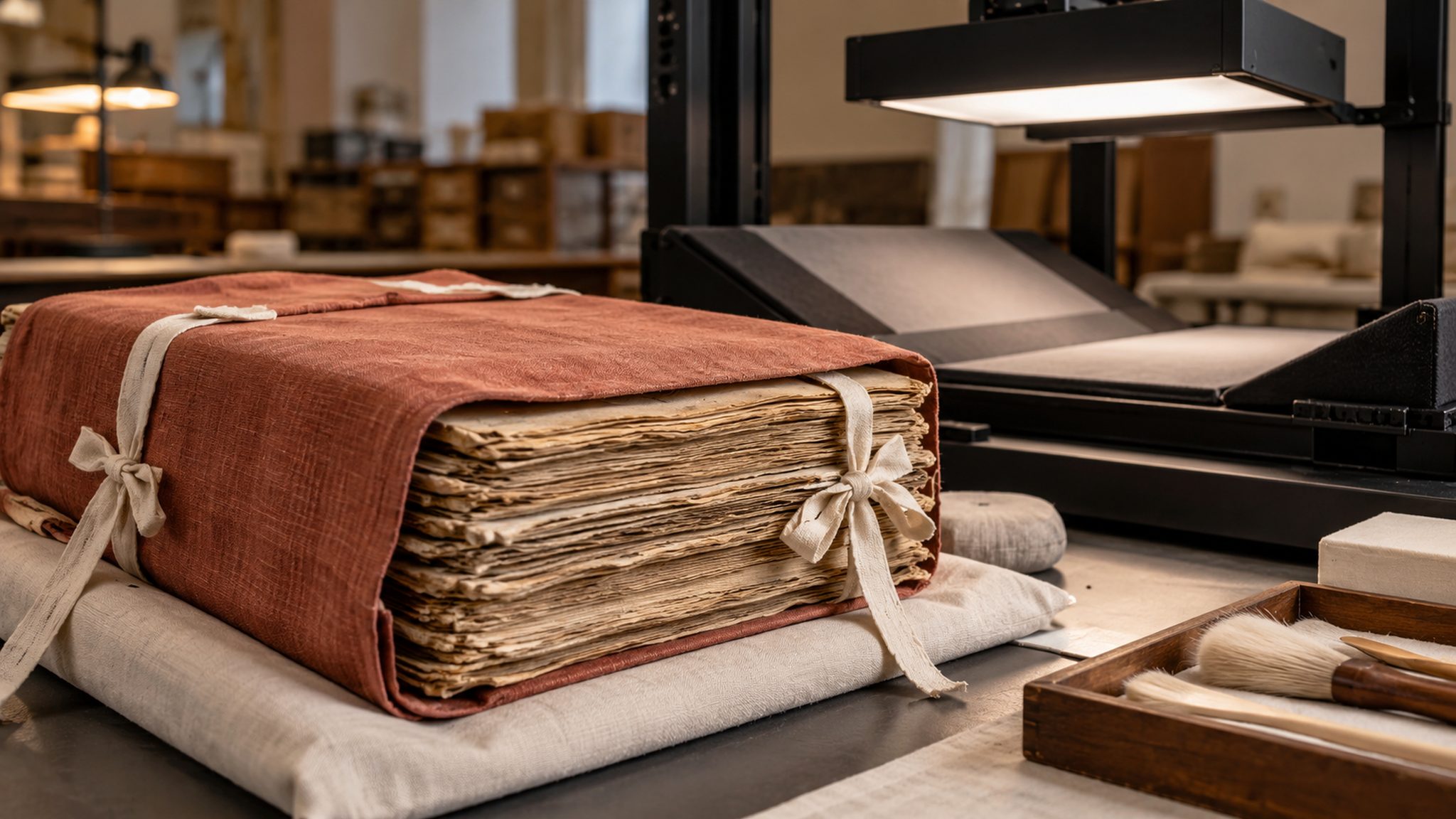
A manuscript is a physical object, a visual source and a record of language; each aspect needs a different kind of care.
- Physical conservation addresses the condition of the original material. Producing a scan does not repair damaged folios or remove the need for careful storage and handling, even when researchers can consult a digital copy instead.
- Digitisation creates an image-based representation that can be viewed away from the original. Its usefulness depends on faithful capture and checks for missing or unclear material; counting files alone does not establish a usable collection.
- Cataloguing connects an item with descriptive information that helps researchers find and understand it. A clear catalogue record distinguishes one work or copy from another and provides context that an isolated page image cannot supply.
- OCR and HTR address the separate task of deriving machine-readable text from images. Printed characters and handwritten forms present different recognition challenges; a readable photograph does not automatically produce an accurate searchable transcription of its contents.
- Human verification remains important where scripts, handwriting, damage or page shape complicate recognition. A practical workflow should let researchers compare the transcription with the source image, rather than treating software output as an unquestionable reading.
What Digital Access Does and Does Not Establish
Access arrangements determine how a digital collection can be consulted and reused, independently of where the physical manuscript is held.
- The ministry describes the National Digital Repository as envisaging structured, permission-based access. That wording matters: participation in the framework does not by itself promise unrestricted downloading, republication or commercial reuse of every digitised item.
- Digital sharing and physical restitution are different outcomes. Making a copy available for research does not transfer the original object to another institution or settle ownership questions; the announced MoU should not be read that way.
- Provenance and attribution help users trace a digital item to the institution and source from which it came. Maintaining that connection supports scholarly checking and prevents an image separated from its record becoming difficult to interpret.
- Common descriptive standards can make records from different institutions easier to connect. Technology exchange is useful when it improves consistent description and retrieval, rather than simply placing disconnected files on another storage system without adequate context.
- Access quality requires continuing care after scanning: usable records, dependable files and clear permission information. These are implementation priorities suggested by the cooperation framework, not results already demonstrated by the signing ceremony or ministry announcement.
Way Forward
Make Each Digital Item Usable and Traceable
- Check capture and description together, so a digital file retains the information needed to identify the source and understand what it contains.
- Keep transcriptions reviewable against source images and record corrections, especially where recognition tools encounter damaged material or difficult handwriting.
- Explain access conditions clearly and retain institutional attribution, helping researchers distinguish permission to consult a source from permission to reproduce it.
Conclusion
- Manuscript cooperation works through connected but distinct tasks: caring for originals, creating reliable copies and enabling informed research access. The India–BnF framework brings these tasks together without establishing that all collections are already accessible.
- For an answer on heritage governance, assess the quality of preservation, description and permitted use alongside the number of digital files. Technology supports scholarship when the source remains identifiable and its interpretation can be checked.
UPSC Practice Questions
Prelims MCQ 1
With reference to manuscript preservation and digital access, consider the following statements:
- Digitisation removes the need to conserve the physical original.
- A digital image and a verified machine-readable transcription are different outputs.
- Permission to consult a digital item automatically allows every form of republication.
How many of the above statements are correct?
(a) Only one (b) Only two (c) All three (d) None
Answer: (a) Only one
Explanation:
Only statement 2 is correct. Scanning does not replace physical conservation, and access conditions must be checked before assuming permission for reuse.
Prelims MCQ 2
Which practice best helps a researcher check the accuracy of a manuscript transcription?
(a) Removing the source institution from the catalogue record (b) Comparing the transcription with the corresponding source image (c) Treating every software-generated word as authoritative (d) Counting the number of files stored in the repository
Answer: (b) Comparing the transcription with the corresponding source image
Explanation:
Comparison with the source image makes the transcription reviewable. File counts and uncritical reliance on software do not establish textual accuracy.
UPSC Mains Questions
- Explain why digitisation alone is insufficient for preserving manuscript heritage. Discuss the roles of conservation, cataloguing and verified transcription.
- How can international manuscript cooperation expand research access while respecting institutional responsibilities and conditions on reuse?
Source: PIB, Ministry of Culture.
Frequently Asked Questions
What did India and BnF agree to cooperate on?
The MoU covers conservation, digitisation, repository cross-sharing, technology exchange and research concerning manuscript heritage. It was signed on 26 October and publicly described by the Ministry of Culture on 27 October 2026.
Does digitising a manuscript preserve the physical original?
A digital copy can support research access, but scanning does not repair the original or replace its conservation needs. Physical care and creation of a usable digital representation remain separate tasks.
Why are OCR and HTR outputs checked by people?
Recognition tools can struggle with handwriting, historical scripts, damage and page shape. Comparing their output with the source image helps identify errors before a transcription is treated as reliable evidence.
Does the MoU mean every manuscript is freely available online?
No. The announcement envisages structured, permission-based access and future cooperation. It does not establish immediate availability of every collection or an unrestricted licence to download, republish or commercially reuse all digitised materials.
Does digital sharing mean physical restitution?
No. Sharing a digital representation for research does not itself transfer the physical manuscript or resolve ownership questions. The announced cooperation framework should be distinguished from any separate agreement concerning the return of objects.
Tell Google you want more of this.
Add Anantam IAS as a preferred sourceOne tap, and this site shows up more often in your own Top Stories, AI Overviews and AI Mode. Remove it any time.