Why in News?
On 19 October 2026, WHO released a training manual for programme managers to strengthen breast cancer care through early detection, timely diagnosis and comprehensive management.
- The training manual translates the existing Global Breast Cancer Initiative implementation framework into practical approaches adapted to national, subnational and facility settings.
- Its modules cover prevention, detection, diagnosis and management, alongside health products, multidisciplinary teams and patient navigation.
- WHO highlights diagnosing at least 60% of new breast cancers at early stages; this is a stage-at-diagnosis objective, not population screening coverage.
- Detecting a possible problem creates a need for diagnostic confirmation and care; a referral without an accessible receiving service leaves that need unresolved.
- The governance issue is continuity across services: programme managers must connect community contact, diagnostic facilities and treatment teams.
UPSC Relevance
Prelims Relevance
- WHO Global Breast Cancer Initiative and its three operational pillars.
- Early diagnosis in symptomatic people versus screening in asymptomatic groups.
- Patient navigation across detection, diagnosis and treatment.
- Multidisciplinary care and coordinated referral systems.
Mains Relevance
GS Paper 2
- Health-service delivery: accountable referrals and continuity of cancer care.
- Social justice: practical barriers between recognition of illness and access to treatment.
Essay
- A health system succeeds when patients can complete the journey through care.
Background and Context
What the Training Manual Changes
The new publication addresses implementation capacity: helping programme managers organize existing recommendations into a workable care system suited to local resources.
- The Global Breast Cancer Initiative was established in 2021; this manual is a technical product supporting its existing framework, rather than the launch of another initiative or discovery of a new treatment.
- Its three operational pillars connect health promotion and early detection, timely diagnosis, and comprehensive management. Treating these as separate campaigns would miss the dependence of each stage on the services that follow.
- The programme-manager focus matters because clinical knowledge alone cannot arrange referral responsibilities, available diagnostic services and coordinated treatment. The manual supports capacity across administrative levels rather than prescribing an identical institutional model everywhere.
- Context-specific adaptation means translating guidance into arrangements that facilities can actually deliver. WHO reports work with partners to adapt training materials, which should not be mistaken for evidence of completed improvements in patient outcomes.
- The early-stage objective concerns the stage when newly diagnosed cancers are identified. It does not mean screening that proportion of the population, and earlier diagnosis cannot guarantee cure for every individual patient.
How Navigation Connects Referral, Diagnosis and Treatment
Patient navigation provides continuing support through the care pathway, especially where a person must move between facilities, professionals or administrative steps.
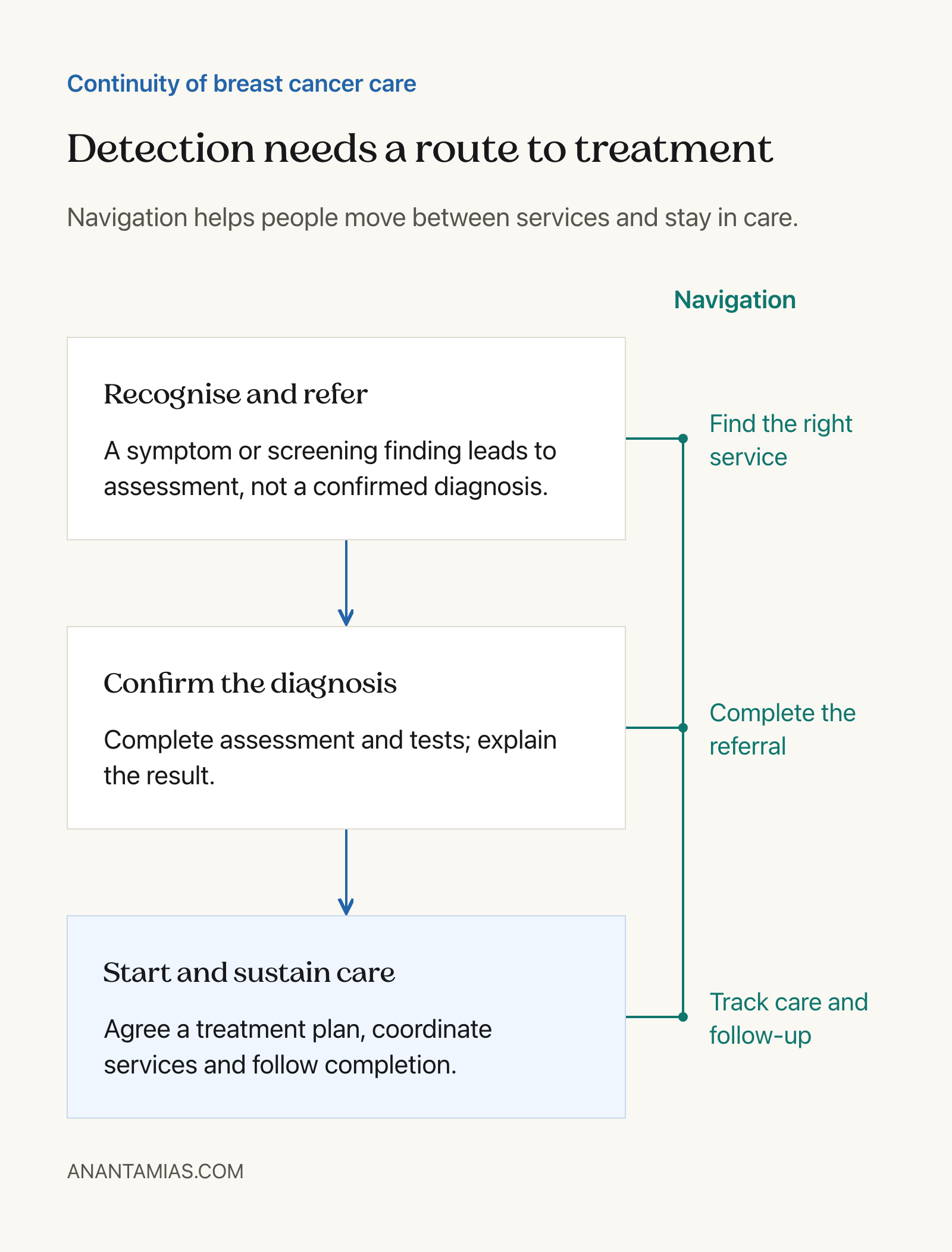
- Recognition and referral begin the pathway when a possible problem prompts contact with care. The important handoff is to a service able to assess the concern, rather than merely issue another direction to travel.
- Diagnostic confirmation separates suspicion from an established diagnosis. Programme design must connect assessment and necessary investigations with communication of results, so patients understand the next step rather than being left between disconnected appointments.
- Treatment access is a further handoff after diagnosis. A functioning pathway connects the patient with the appropriate management team; documenting a diagnosis alone does not establish that comprehensive care has started or continued.
- Patient navigation helps people move through this complex system, including practical coordination and communication. It complements clinical services rather than replacing professional assessment, diagnostic capacity or the resources required to deliver treatment safely.
- Multidisciplinary team-based care coordinates professionals involved in management. For programme managers, the operational question is who takes responsibility at each transition and how the next service receives the information needed to continue care.
Early Diagnosis Is Different From Screening
Both approaches can support earlier detection, but they start with different groups and require reliable diagnostic and treatment services after an initial concern.
- Early diagnosis focuses on people with symptoms or signs suggestive of disease. Its system-level tasks include enabling timely presentation, appropriate assessment and access to care, rather than waiting for illness to become advanced.
- Screening examines apparently healthy, asymptomatic people for possible disease. An abnormal screening result requires further assessment; the initial test does not itself establish a confirmed cancer diagnosis or determine the complete treatment pathway.
- The distinction changes programme planning: symptom-responsive services and organized screening are not interchangeable. Expanding initial detection without arrangements for subsequent diagnosis and management can leave patients unable to complete the intended route into care.
- Access barriers can persist after the first contact, making navigation relevant across stages. A useful administrative review asks where people lose contact with services, rather than assuming that attendance at an initial appointment means successful treatment.
- The manual should inform health-system design, not be converted into a universal screening-age or test recommendation. Clinical decisions depend on relevant guidance and individual circumstances; this publication does not establish one procedure for every person.
Way Forward
Make Each Handoff Accountable
- Map referral destinations and responsibilities before expanding detection activity; identify which facilities can complete assessment and provide management.
- Build navigation and communication into routine service delivery, with clear arrangements for appointments, results and onward referrals.
- Review delays and interrupted care across the pathway so programme improvements address the transition that is failing.
Conclusion
- The manual’s policy value lies in turning an existing framework into connected service delivery. Earlier recognition becomes useful when diagnostic confirmation and appropriate management remain accessible throughout the patient’s journey.
- For a governance answer, distinguish the availability of a service from the ability to move between services. Navigation and multidisciplinary coordination address that organizational gap, while clinical capacity and treatment resources remain essential.
UPSC Practice Questions
Prelims MCQ 1
With reference to breast cancer care, consider the following statements:
- Early diagnosis addresses people with symptoms or signs suggestive of disease.
- Screening generally addresses asymptomatic people.
- An abnormal screening result necessarily establishes a confirmed cancer diagnosis.
How many of the above statements are correct?
(a) Only one (b) Only two (c) All three (d) None
Answer: (b) Only two
Explanation:
The first two statements are correct. An abnormal screening result requires further assessment and does not by itself confirm cancer.
Prelims MCQ 2
Which best describes patient navigation in breast cancer care?
(a) Replacing diagnostic services with public education (b) Restricting support to the first screening appointment (c) Helping patients move through detection, diagnosis and treatment services (d) Guaranteeing cure after an early-stage diagnosis
Answer: (c) Helping patients move through detection, diagnosis and treatment services
Explanation:
Navigation supports continuity across a complex care pathway. It does not replace clinical services or guarantee outcomes.
UPSC Mains Questions
- Explain why improving early detection of breast cancer requires coordinated diagnostic and treatment services. Discuss the role of patient navigation.
- Distinguish early diagnosis from screening. How can programme managers reduce interruptions in the pathway from first contact to comprehensive cancer care?
Sources: World Health Organization and WHO Global Breast Cancer Initiative.
Frequently Asked Questions
What is new in WHO’s breast cancer announcement?
WHO released a training manual for programme managers on 19 October 2026. It translates an existing implementation framework into practical approaches for strengthening breast cancer programmes and coordinating care.
What is patient navigation?
Patient navigation provides support to help people move through complex cancer services. It connects stages such as recognition, diagnostic assessment and treatment, while complementing rather than replacing clinical care.
How does early diagnosis differ from screening?
Early diagnosis focuses on people with symptoms or signs, while screening examines asymptomatic groups. Both require appropriate follow-up; an initial suspicion or abnormal screening result is not itself a confirmed diagnosis.
Does early detection guarantee a cure?
No. Earlier diagnosis can improve opportunities for effective treatment, but individual outcomes depend on multiple clinical and care-related factors. The WHO objective is not a guarantee of cure for every patient.
Tell Google you want more of this.
Add Anantam IAS as a preferred sourceOne tap, and this site shows up more often in your own Top Stories, AI Overviews and AI Mode. Remove it any time.