Why in News?
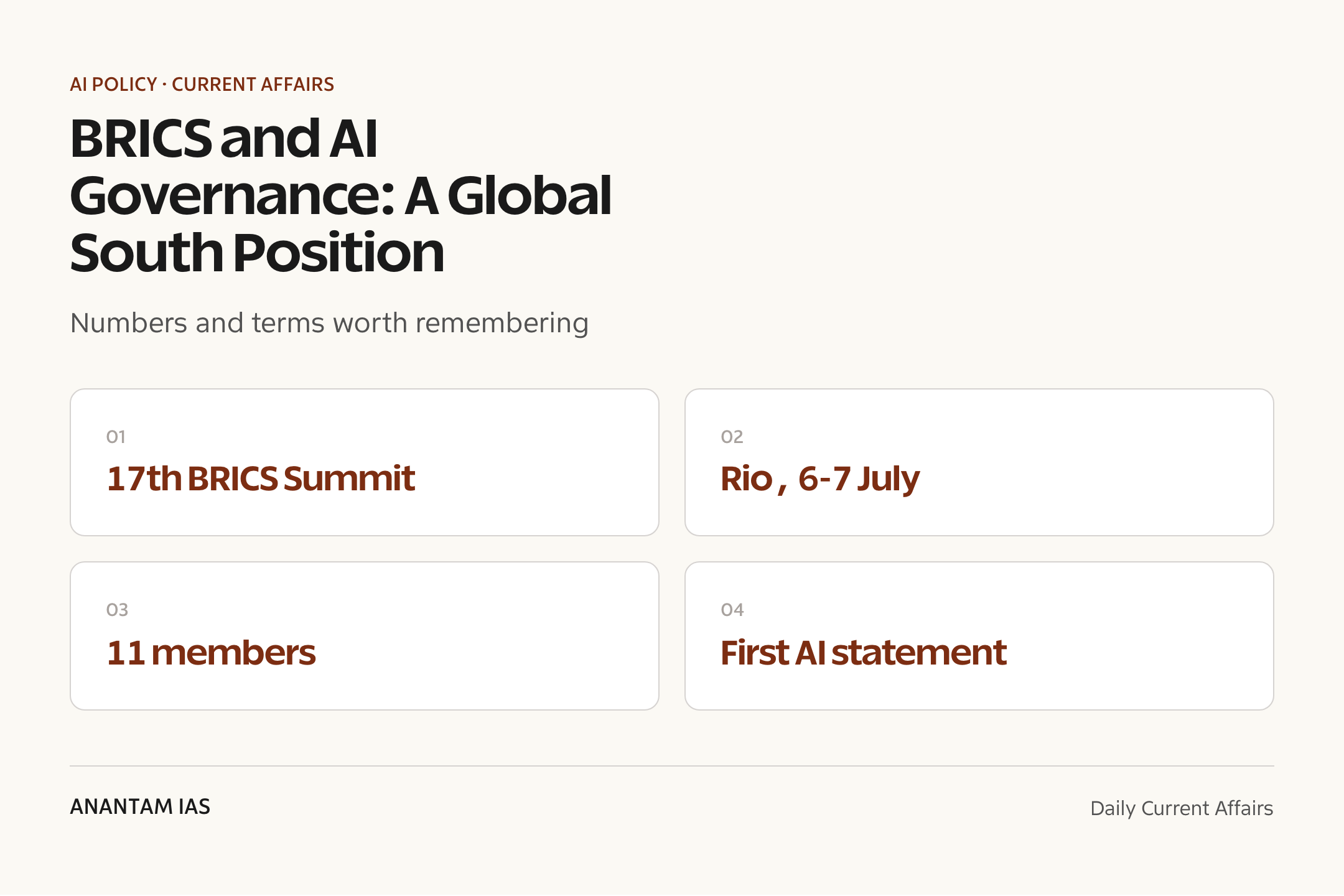
At the 17th BRICS Summit in Rio de Janeiro on 6-7 July 2025, the grouping adopted its first dedicated, standalone Leaders’ Statement on the Global Governance of Artificial Intelligence – a developing-country position on how AI should be regulated, distributed and shared. PIB confirmed that Prime Minister Narendra Modi addressed the session on Strengthening Multilateralism and Artificial Intelligence and pressed the case for responsible AI.
The statement frames AI governance through a Global South lens: it foregrounds data sovereignty, equitable access to compute and technology, and a UN-centred, consensus-based rule-making process – positioning BRICS as a counterweight to the largely Western-led frameworks of the OECD and G7.
- First time BRICS issued a high-level, standalone declaration on AI – adopted 6 July 2025.
- Summit theme: Strengthening Global South Cooperation for a More Inclusive and Sustainable Governance.
- BRICS is now an 11-member bloc (5 founders plus Egypt, Ethiopia, Iran, Saudi Arabia, UAE and Indonesia).
- PM Modi offered four ideas, including a Science and Research repository for the Global South and a call for responsible AI that balances governance with innovation.
- Leaders also adopted the wider Rio de Janeiro Declaration covering UNSC reform and multilateralism.
The development matters in the context of:
- Matters because most foundational AI – models, chips, data centres – sits with a handful of advanced economies and large firms, leaving developing nations as rule-takers.
- Sharpens the global debate on digital sovereignty and the technology divide ahead of UN-level AI processes.
UPSC Relevance
Prelims Relevance
- BRICS: founded 2009 (Russia summit); South Africa added 2010; expanded from 2024-25.
- Current full members (11): Brazil, Russia, India, China, South Africa + Egypt, Ethiopia, Iran, Saudi Arabia, UAE, Indonesia (joined Jan 2025).
- 17th BRICS Summit host: Brazil; venue Rio de Janeiro; dates 6-7 July 2025.
- Outcome documents: Rio de Janeiro Declaration + standalone Statement on Global Governance of AI.
- New Development Bank (NDB): BRICS bank, HQ Shanghai, first president K.V. Kamath.
- Data sovereignty: a state’s right to govern data generated within its borders.
- Western AI fora to contrast: OECD AI Principles (2019), G7 Hiroshima AI Process (2023).
- UN AI process: Global Digital Compact and the UN High-Level Advisory Body on AI.
Mains Relevance
GS Paper 3
- Responsible AI and the governance-versus-innovation balance for a developing economy.
- Critical minerals, compute and chip access as inputs to technological sovereignty.
GS Paper 2
- BRICS as a plurilateral platform and the reform of global governance institutions.
- India’s Global South leadership and the demand for equitable technology transfer.
Essay
- Who writes the rules of intelligence: technology, power and the Global South.
- Sovereignty in the age of data and algorithms.
Background and Context
What the AI statement actually says
The statement reads as a Global South charter for AI – rights of states first, shared access second.
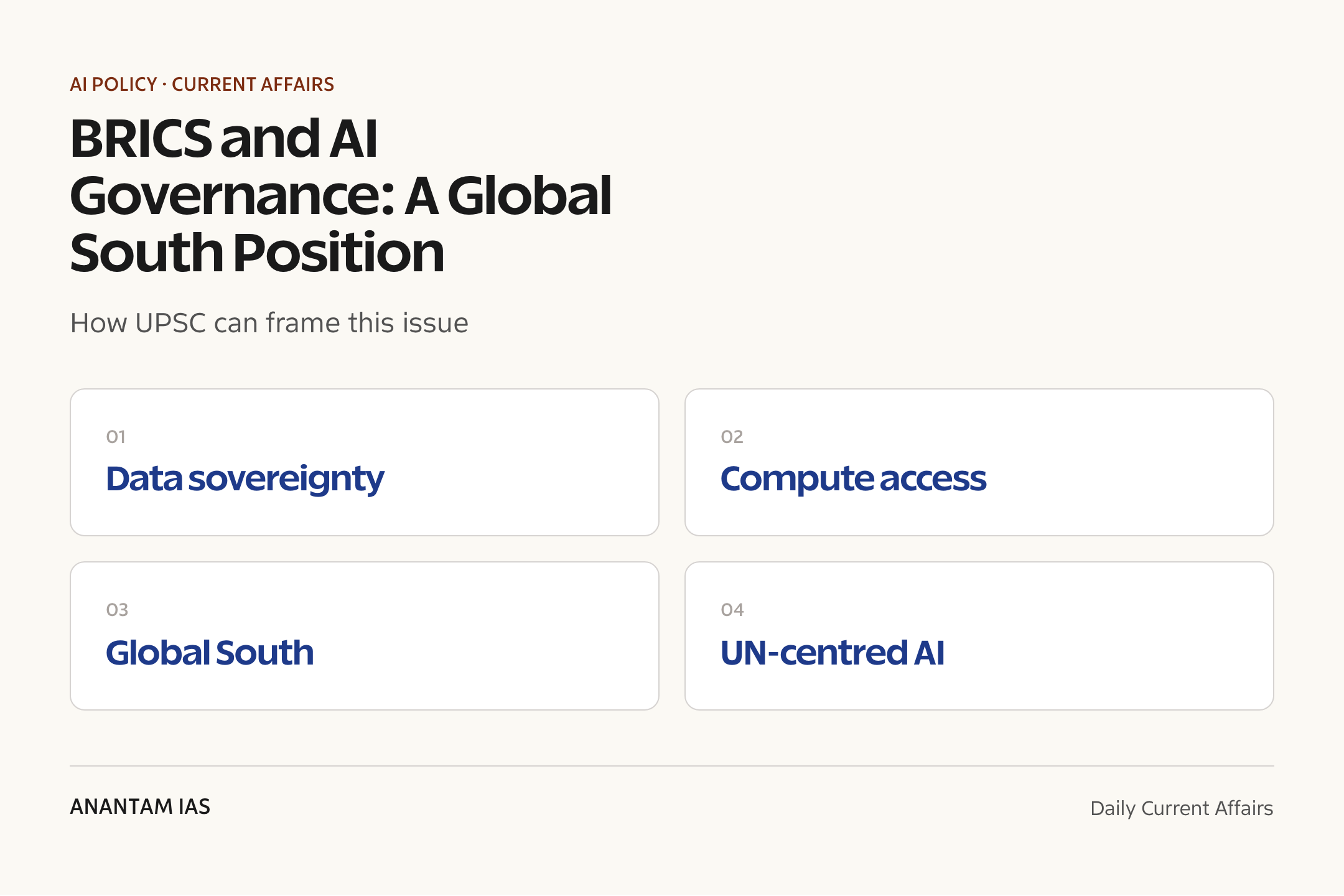
- Affirms each country’s right to develop, regulate and control its own digital future – the core of data sovereignty.
- Calls for removal of barriers to AI knowledge and hardware faced by lower-income nations.
- Warns against monopolistic concentration and backs open-source collaboration and interoperable standards.
- Wants AI to serve sustainable and inclusive development, with safeguards for information integrity and safe, reliable use.
- Places the United Nations at the centre of multilateral AI cooperation rather than narrow plurilateral clubs.
Why BRICS frames itself as a counterweight
The grouping positions its statement against frameworks it sees as set by a few rich economies.
- Western-led benchmarks – the OECD AI Principles and the G7 Hiroshima AI Process – emerged without much Global South voice.
- BRICS argues fragmented governance risks entrenching asymmetries and undermining legitimacy.
- It rejects bloc politics and pushes consensus-based standards over rules dominated by advanced economies and multinationals.
- The pitch: rule-making that is inclusive and grounded in sovereign laws, with the UN at its core.
The compute and technology divide
Behind the principles sits a hard material gap in who controls AI’s inputs.
- Foundational compute (advanced chips, data centres) is concentrated in a few states and firms.
- BRICS links AI access to technology transfer, capacity building and training local talent.
- PM Modi flagged securing critical minerals supply chains – the raw inputs to chips and clean tech.
- He proposed a BRICS Science and Research repository to benefit Global South countries.
- Statement balances intellectual property protection with broader public interest and worker safeguards.
India's position at Rio
India anchored the AI debate to responsibility, development and reform.
- PM Modi argued for responsible AI – addressing governance concerns while equally promoting innovation.
- He reaffirmed India’s commitment to enhancing the voice of the Global South.
- He linked AI access to climate finance and technology support for developing countries.
- India will host the BRICS chairmanship next, giving it agenda-setting space on AI follow-up.
- Domestic anchor: the IndiaAI Mission and a stated preference for safe, inclusive AI.
BRICS in 2025 – the bigger frame
The AI statement sits inside a broader push to reshape global governance.
- Bloc has grown to 11 members, representing over 40% of world population and a large share of global GDP.
- The Rio de Janeiro Declaration demanded urgent reform of the UN Security Council, IMF, World Bank and WTO.
- Leaders condemned the Pahalgam terror attack of April 2025 and called for zero tolerance on terrorism.
- BRICS positions diversity and multipolarity as strengths in shaping a multipolar world.
The catch – principles without enforcement
Ambition outruns institutional muscle, and that is the main critique.
- The statement is non-binding – it sets a position, not enforceable rules.
- BRICS members differ sharply on data rules, surveillance and free expression, complicating a single stance.
- Without shared compute capacity, calls for equitable access risk staying aspirational.
- Real influence depends on translating the text into UN-level outcomes such as the Global Digital Compact.
Way Forward
Build, don't just declare
- Stand up the proposed Science and Research repository and pool compute so access is real, not rhetorical.
- Invest in domestic chip, data-centre and talent capacity to reduce dependency.
Anchor to the UN
- Channel the BRICS position into the Global Digital Compact and UN AI mechanisms for legitimacy.
- Pursue interoperable, consensus-based standards that the wider Global South can adopt.
India should use its upcoming BRICS chairmanship to convert the statement into concrete deliverables – capacity-building, open datasets in Indian languages, and a credible responsible-AI track that other developing economies can plug into.
Conclusion
The Rio statement is the clearest sign yet that the Global South wants a seat at the table where AI rules are written, not just a copy of rules made elsewhere. Its language on data sovereignty, equitable compute access and UN-centred governance reframes AI as a development and equity question, not only a safety one.
The test now is execution. A declaration becomes a position only when it produces shared infrastructure and UN-level outcomes. For India, the chairmanship is the moment to turn a Global South charter into working mechanisms.
UPSC Practice Questions
Prelims MCQ 1
With reference to the 17th BRICS Summit (2025), consider the following statements:
- It was hosted by Brazil in Rio de Janeiro.
- It adopted a standalone Leaders’ Statement on the Global Governance of Artificial Intelligence.
- Indonesia participated as a full member of BRICS.
How many of the above statements are correct?
(a) Only one (b) Only two (c) All three (d) None
Answer: (c) All three
Explanation:
The summit was held in Rio de Janeiro, Brazil (6-7 July 2025), adopted a first-ever standalone statement on AI governance, and Indonesia attended as a full member, having joined in January 2025.
Prelims MCQ 2
Which of the following best describes the central thrust of the BRICS Statement on Global Governance of AI (2025)?
(a) Banning open-source AI models to protect intellectual property (b) Data sovereignty and equitable access to AI technology, with the UN at the core (c) Creating a BRICS-only AI regulator to replace the OECD (d) Mandatory licensing of all AI systems by the New Development Bank
Answer: (b) Data sovereignty and equitable access to AI technology, with the UN at the core
Explanation:
The statement emphasises sovereign control over data, removal of barriers to AI access for lower-income nations, and UN-centred multilateral cooperation. It does not ban open-source AI or set up a replacement regulator.
UPSC Mains Questions
- The 2025 BRICS Statement on AI governance reframes artificial intelligence as a development and equity issue for the Global South. Examine its key principles and assess whether BRICS can credibly serve as a counterweight to Western-led AI frameworks. (250 words)
- Data sovereignty and equitable access to compute are emerging as central concerns in global AI governance. Discuss India’s stake in these debates and the steps needed to translate declaratory positions into capability. (250 words)
Sources: PIB, Prime Minister's Office and Vivekananda International Foundation.
Frequently Asked Questions
What is the BRICS AI governance statement?
It is a standalone Leaders’ Statement on the Global Governance of Artificial Intelligence adopted at the 17th BRICS Summit in Rio de Janeiro on 6 July 2025. It sets out a Global South position emphasising data sovereignty, equitable access to AI technology and compute, and a UN-centred, consensus-based approach to rule-making.
Why is it called a Global South position?
Because it foregrounds the concerns of developing countries: the right of states to control their own data and digital future, removal of barriers to AI knowledge and hardware, technology transfer, and capacity building. It pushes back against AI rules shaped mainly by a few advanced economies and large firms.
How does it differ from OECD and G7 AI frameworks?
The OECD AI Principles and the G7 Hiroshima AI Process were largely set by advanced economies with limited Global South voice. The BRICS statement rejects bloc politics, favours consensus-based standards, and places the United Nations – rather than narrow plurilateral clubs – at the centre of AI cooperation.
What is data sovereignty?
Data sovereignty is the principle that a country has the right to govern, regulate and control data generated within its borders under its own laws. In the BRICS statement it underpins the call for states to develop and control their own digital future and avoid dependency on foreign-controlled information flows.
What did India propose at the summit?
Prime Minister Narendra Modi argued for responsible AI that balances governance with innovation. He proposed a BRICS Science and Research repository for the Global South, called for secure critical-minerals supply chains, and reaffirmed support for enhancing the voice of developing countries.
Is the BRICS AI statement legally binding?
No. It is a political declaration that sets out a shared position rather than enforceable rules. Its real impact depends on whether members build shared capacity such as compute and research pools and whether the position feeds into UN processes like the Global Digital Compact.
Tell Google you want more of this.
Add Anantam IAS as a preferred sourceOne tap, and this site shows up more often in your own Top Stories, AI Overviews and AI Mode. Remove it any time.