Why in News?
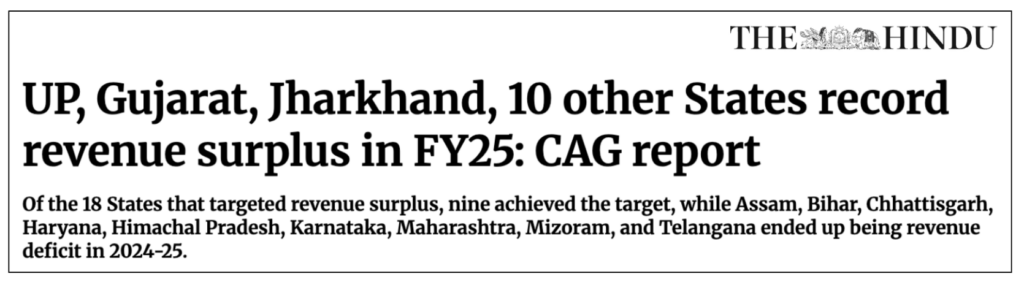
A report compiled by the Comptroller and Auditor General of India (CAG) on State finances has found that several States closed FY25 (2024-25) with a revenue surplus rather than a deficit, signalling a partial recovery in the quality of State budgets after the pandemic years.
As reported by The Hindu, 13 States recorded a revenue surplus in FY25, with Uttar Pradesh, Gujarat and Jharkhand among those that earned more on the revenue account than they spent.
- A revenue surplus means a State’s revenue receipts exceed its revenue expenditure — current spending is fully met without borrowing.
- 13 States were in revenue surplus in FY25, per the CAG compilation cited by The Hindu.
- Uttar Pradesh, Gujarat and Jharkhand are named among the surplus States.
- A surplus on the revenue account frees up borrowed funds for capital outlay (asset creation) instead of routine consumption.
- The picture comes from the CAG’s audit and compilation role under Articles 148-151 of the Constitution.
The development matters in the context of:
- Revenue-account health is the single best signal of whether a State is borrowing to build assets or just to pay salaries — the core of fiscal sustainability.
- State finances matter as much as the Union’s: States together spend more than the Centre on health, education, agriculture and police.
UPSC Relevance
Prelims Relevance
- Revenue deficit = revenue expenditure minus revenue receipts
- Fiscal deficit = total expenditure minus total receipts (excluding borrowings); equals the year’s borrowing
- Primary deficit = fiscal deficit minus interest payments
- Effective revenue deficit = revenue deficit minus grants for the creation of capital assets
- CAG appointed by the President under Article 148; reports under Articles 149-151
- CAG reports laid before State Legislatures via the Governor (Article 151(2))
- FRBM Act, 2003 (Union) and State FRBM/FRL laws cap deficits and debt
- Committed expenditure = salaries + pensions + interest payments
- States’ own-tax revenue vs central transfers (devolution + grants)
- Finance Commission (Article 280) recommends tax devolution and grants-in-aid
- GST and the 101st Constitutional Amendment; GST Council (Article 279A)
Mains Relevance
GS Paper 3
- Fiscal sustainability of States: revenue deficit vs capital outlay, and why the composition of spending matters more than the headline deficit.
- Off-budget borrowing, committed expenditure and the freebies debate as threats to State fiscal space.
GS Paper 2
- The CAG’s constitutional role and its place in ensuring legislative control over the public purse.
- Fiscal federalism: vertical and horizontal imbalances and the Finance Commission’s balancing role.
Essay
- Accountability of the public exchequer is the quiet foundation of democracy.
- A budget reveals a government’s real priorities more honestly than any manifesto.
Background and Context
The three deficits — read the budget correctly
A single ‘deficit’ number hides what a government is actually doing with borrowed money.
- Revenue deficit: revenue expenditure exceeds revenue receipts. It means a government is borrowing to fund day-to-day running costs — a warning sign, since the borrowing creates no assets.
- Fiscal deficit: total expenditure minus total receipts excluding borrowings. It equals the amount the government must borrow in the year and is the headline indicator of fiscal pressure.
- Primary deficit: fiscal deficit minus interest payments. It strips out the cost of past borrowing to show the fresh imbalance created this year.
- Effective revenue deficit: revenue deficit minus grants given for creating capital assets — a refinement that treats some transfers as quasi-capital.
- A revenue surplus is the healthy mirror image — revenue receipts cover all current spending, so every rupee borrowed can go to capital works.
FRBM and State fiscal-responsibility laws
Deficit ceilings are not just convention — they are statutory.
- The FRBM Act, 2003, binds the Union to a glide-path on fiscal and revenue deficits and on debt.
- Every State has its own Fiscal Responsibility Legislation (FRL) capping the fiscal deficit (commonly around 3% of GSDP) and the debt-to-GSDP ratio.
- Borrowing limits for States are set under Article 293, which requires Union consent when a State is indebted to the Centre.
- The Finance Commission recommends the deficit and debt path States should follow, and net borrowing ceilings are tied to FRL compliance.
- Crossing the cap typically forces corrective steps; the audit by the CAG is how breaches and creative accounting come to light.
The CAG’s constitutional role (Articles 148-151)
The CAG is the auditor of the entire public purse — Union and States alike.
- The CAG is appointed by the President under Article 148, with security of tenure and salary charged on the Consolidated Fund.
- Article 149 defines the duties and powers; the CAG audits all receipts and expenditure of the Union and the States.
- Article 150 lets the President, on the CAG’s advice, prescribe the form of Union and State accounts.
- Article 151 requires CAG reports to be laid before Parliament and, for States, before the State Legislature through the Governor.
- State Finance Audit Reports feed the Public Accounts Committee, the legislative arm that scrutinises how money was actually spent.
Where State money comes from
A State’s fiscal health depends heavily on how much it raises for itself versus how much it receives.
- Own-tax revenue: State GST, stamp duty and registration, State excise (liquor), motor-vehicle tax and electricity duty — the part a State controls.
- Own non-tax revenue: royalties (especially mining, which lifts mineral-rich States like Jharkhand), interest, dividends and user charges.
- Tax devolution: a State’s share of the divisible central pool, recommended by the Finance Commission under Article 280.
- Grants-in-aid: Finance Commission grants plus centrally sponsored scheme transfers — important for weaker States.
- GST shifted many State taxes into a shared pool decided by the GST Council; compensation for revenue loss has since lapsed, tightening State finances.
Spending quality — committed expenditure vs capital outlay
What a State spends on is the real test the CAG reports help answer.
- Committed expenditure — salaries, pensions and interest payments — is largely unavoidable and crowds out development spending when it grows too large.
- Capital outlay builds assets — roads, irrigation, schools, hospitals — and is the spending that supports future growth.
- A revenue surplus is valuable precisely because it lets a State direct its entire borrowing toward capital outlay rather than current consumption.
- Rising pension burdens and the debate over the Old Pension Scheme are key pressures the CAG flags for many States.
- High subsidy and transfer outgo (power, water, direct benefits) can swing a State from surplus to revenue deficit quickly.
Off-budget borrowing and the transparency problem
The headline numbers can flatter a budget when borrowing is hidden.
- Off-budget borrowing routes loans through State public-sector undertakings or special vehicles so they don’t show in the State’s own deficit.
- The CAG has repeatedly flagged such borrowing, which understates the true fiscal and debt position.
- Guarantees extended by States create contingent liabilities — risks that fall on the budget if the entity defaults.
- The Union has tightened rules so that off-budget borrowing is increasingly counted within a State’s net borrowing ceiling.
- Transparency in accounts is why the CAG’s independent audit matters — it converts political budget claims into verified numbers.
Way Forward
Protect the revenue account
- Treat a revenue surplus, not just a low fiscal deficit, as the headline target, so borrowing funds assets, not consumption.
- Contain committed expenditure growth — salaries, pensions and interest — to preserve space for capital outlay.
Raise and broaden one’s own revenue
- Improve State GST compliance and rationalise stamp duty, excise and property-related levies to lift own-tax revenue.
- Use mineral and resource royalties prudently, recognising they are finite and volatile.
Strengthen transparency
- End off-budget borrowing and bring guarantees and contingent liabilities fully onto the books.
- Act on CAG observations through an active Public Accounts Committee and timely tabling of audit reports.
Conclusion
A revenue surplus in 13 States is a modest but real signal that some State budgets are healing — borrowing more for building than for spending. But the surplus tells only part of the story; the composition of revenue and the honesty of the accounts matter just as much.
The CAG’s audit turns budget rhetoric into verified fact, and its constitutional independence is what makes State finances accountable to legislatures and citizens. For India’s fiscal federalism, the durable lesson is to defend the revenue account, raise its own revenue and bring all borrowing into the open.
UPSC Practice Questions
Prelims MCQ 1
With reference to the deficits in government finance, consider the following statements:
- Revenue deficit arises when revenue expenditure exceeds revenue receipts.
- Fiscal deficit equals total expenditure minus total receipts excluding borrowings.
- Primary deficit is the fiscal deficit minus interest payments.
How many of the above statements are correct?
(a) Only one (b) Only two (c) All three (d) None
Answer: (c) All three
Explanation:
All three definitions are correct. Fiscal deficit indicates the borrowing requirement; primary deficit strips out interest on past debt; a revenue deficit signals borrowing for current spending.
Prelims MCQ 2
Which one of the following best describes the constitutional position of the Comptroller and Auditor General of India?
(a) Appointed by the Prime Minister and removable by a simple majority
(b) Appointed by the President; duties and powers governed by Article 149; reports laid before Parliament and State Legislatures
(c) An officer of the Finance Ministry who frames the Union Budget
(d) Appointed by and answerable to the GST Council
Answer: (b) Appointed by the President; duties and powers governed by Article 149; reports laid before Parliament and State Legislatures
Explanation:
The CAG is appointed by the President under Article 148, with duties under Article 149; reports are laid before Parliament and the State Legislatures under Article 151.
UPSC Mains Questions
- Distinguish between revenue deficit, fiscal deficit and primary deficit. Why is the quality of expenditure financed by borrowing a better measure of a State’s fiscal health than the headline fiscal deficit alone? (250 words)
- Examine the role of the Comptroller and Auditor General in ensuring fiscal accountability of States. How does off-budget borrowing undermine the transparency of State finances? (250 words)
- Indian fiscal federalism balances State autonomy against fiscal discipline. Discuss the instruments — FRBM/FRL laws, the Finance Commission and Article 293 borrowing limits — that shape State finances. (250 words)
Sources: Comptroller and Auditor General of India (CAG) and The Hindu.
Frequently Asked Questions
What is a revenue surplus?
A revenue surplus occurs when a government’s revenue receipts (taxes, devolution, grants, non-tax income) exceed its revenue expenditure (salaries, pensions, interest, subsidies). It means current spending is fully met without borrowing, so any borrowed funds can be channelled into capital assets like roads and schools rather than routine consumption.
How is fiscal deficit different from revenue deficit?
Fiscal deficit is total expenditure minus total receipts excluding borrowings, so it equals the amount a government must borrow in a year. Revenue deficit is the shortfall only on the revenue (current) account. A government can run a fiscal deficit yet still have a revenue surplus if its borrowing funds capital outlay rather than day-to-day expenses.
What is the CAG’s role in auditing State finances?
The CAG is appointed by the President under Article 148 and audits all receipts and expenditure of both the Union and the States under Article 149. Its reports on State finances are laid before each State Legislature through the Governor under Article 151 and are examined by the Public Accounts Committee, making the executive accountable for how public money is spent.
What is committed expenditure?
Committed expenditure refers to spending a State cannot easily cut in the short run — mainly salaries, pensions and interest payments. When committed expenditure grows large, it crowds out development and capital spending. Controlling it is essential to keep a State’s revenue account in surplus and preserve room for asset creation.
What is off-budget borrowing and why does it matter?
Off-budget borrowing is debt raised through State public-sector undertakings or special vehicles so it does not appear in the State’s own deficit figures. It flatters the headline numbers while raising the true debt burden. The CAG repeatedly flags it, and rules now increasingly count such borrowing within a State’s net borrowing ceiling.
How do States earn their revenue?
States rely on own-tax revenue (State GST, stamp duty, State excise on liquor, motor-vehicle tax), own non-tax revenue (royalties, interest, user charges), tax devolution from the central pool recommended by the Finance Commission under Article 280, and grants-in-aid. The balance between self-raised revenue and central transfers shapes a State’s fiscal autonomy and health.
Tell Google you want more of this.
Add Anantam IAS as a preferred sourceOne tap, and this site shows up more often in your own Top Stories, AI Overviews and AI Mode. Remove it any time.