Why in News?
The Hindu reports that the Census 2027 population-enumeration schedule went live on 17 August 2026 in Ladakh and snow-bound Himalayan areas, and now asks for both parents’ religion and village-level place of birth.
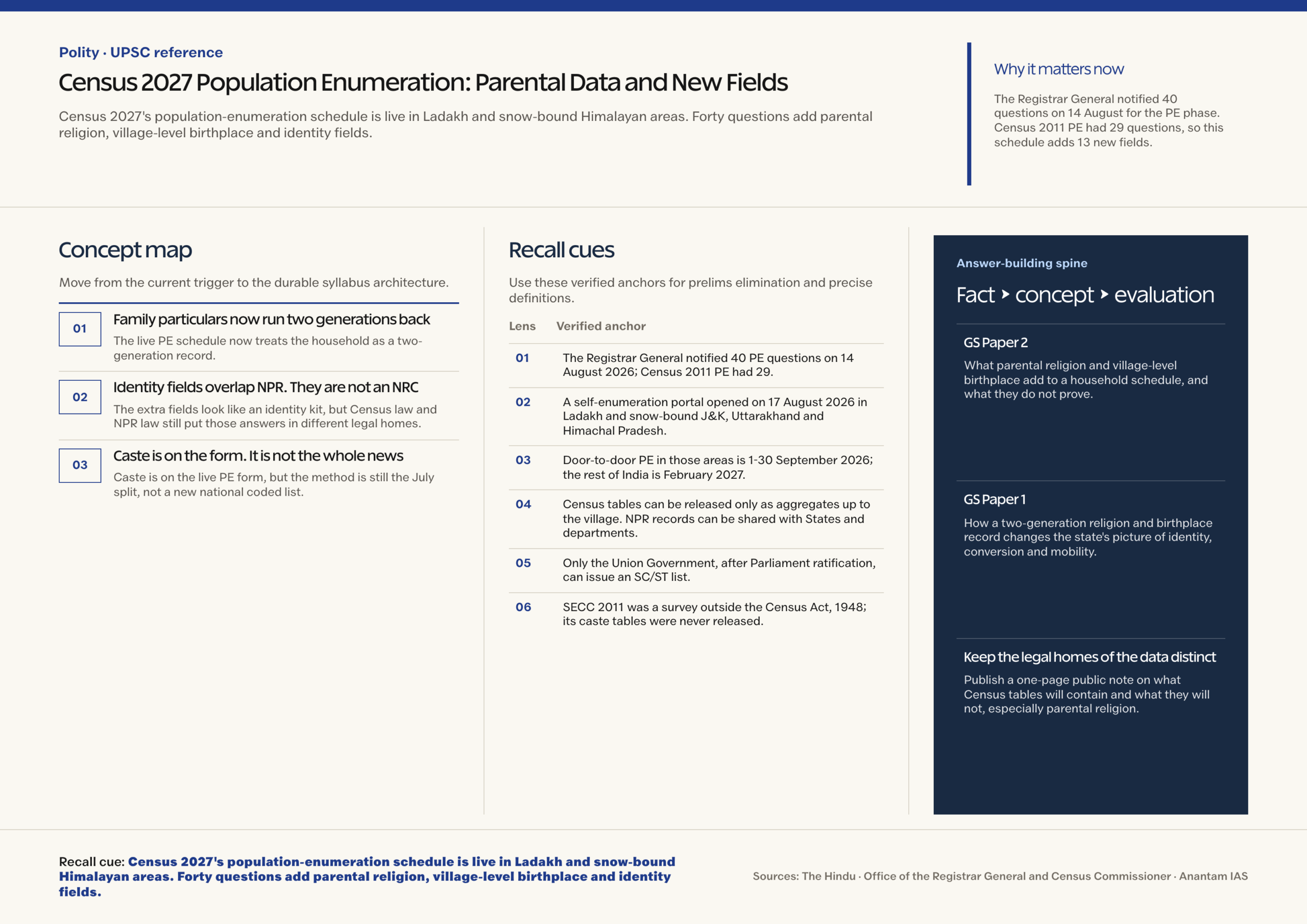
- The Registrar General notified 40 questions on 14 August for the PE phase. Census 2011 PE had 29 questions, so this schedule adds 13 new fields.
- Under Family Particulars, the form records religion, date of birth and place of birth up to the village for both father and mother, with an option if born outside India.
- A self-enumeration portal opened on 17 August in Ladakh and snow-bound J&K, Uttarakhand and Himachal. Door-to-door there is 1-30 September; the rest of India is February 2027.
- Other first-time items sit as one class of identity and digital fields: spouse’s name, nationality, digital literacy, permanent address, vaccination place, bank accounts, and IDs if available.
- Caste is marked mandatory. SC/ST pick a drop-down; others type a name. Options include Does not want to declare Caste and No Caste.
- Parental religion and village-level birthplace turn the form into a family-history record, not only a snapshot of who lives in the house now.
- Several new fields overlap the 2019 NPR rehearsal. NPR is a resident database. Overlap is not an NRC, and the two instruments must stay distinct.
- Caste enumeration is Independent India’s first beyond SC and ST, but the live news is the wider PE schedule, not a replay of the July method fight.
UPSC Relevance
Prelims Relevance
- The Registrar General notified 40 PE questions on 14 August 2026; Census 2011 PE had 29.
- A self-enumeration portal opened on 17 August 2026 in Ladakh and snow-bound J&K, Uttarakhand and Himachal Pradesh.
- Door-to-door PE in those areas is 1-30 September 2026; the rest of India is February 2027.
- Census tables can be released only as aggregates up to the village. NPR records can be shared with States and departments.
- Only the Union Government, after Parliament ratification, can issue an SC/ST list.
- SECC 2011 was a survey outside the Census Act, 1948; its caste tables were never released.
Mains Relevance
GS Paper 2
- What parental religion and village-level birthplace add to a household schedule, and what they do not prove.
- Why Census aggregates and an NPR resident file are different instruments even when some questions overlap.
GS Paper 1
- How a two-generation religion and birthplace record changes the state’s picture of identity, conversion and mobility.
Essay
- What a state asks about parents, it is preparing to see as a lineage, not only a household.
Background and Context
Family particulars now run two generations back
The live PE schedule now treats the household as a two-generation record, not only a list of people present on the count day in that house.
- Under Family Particulars, the form seeks religion, date of birth and place of birth up to the village for both father and mother, not only for the person being enumerated.
- If a parent was born outside India, that fact can be recorded as such. The field is a migration and origin hook. It is not, by itself, a citizenship or NRC question.
- Six religions appear as listed options: Hindu, Christian, Sikh, Buddhist, Muslim and Jain. Anyone else can record other religion in a separate column on the same family head.
- Asking the parents’ religion as well as the person’s lets later tables show conversion, inter-faith households and inherited identity, but only if those tables are actually published.
- Village-level parental birthplace is finer than a state-of-origin box. It can map one-generation mobility between villages and districts, which a usual-residence question on the same person cannot show by itself.
Identity fields overlap NPR. They are not an NRC
The extra fields look like an identity kit, but Census law and NPR law still put those answers in different legal homes, not one register.
- First-time PE items form one class of identity and digital access: spouse’s name, nationality, digital literacy, permanent address, COVID-19 vaccination place, number of bank accounts, and IDs if available.
- Some of those fields, including parental particulars and ID numbers if available, mirror the 2019 NPR rehearsal. Overlap of questions is still not proof that this Census is an NRC.
- NPR was first prepared in 2011 and updated in 2015. It already holds a family-wise database of 119 crore residents. A planned update with the first phase of houselisting was deferred.
- Census output can be released only as aggregates up to the village. NPR records can be shared with States and departments. That legal difference, not the shared questions, is the exam point.
- The NPR update sat on the back burner amid NRC fears. Keep the instruments apart in every answer: a Census schedule that asks similar questions is still not a citizenship register.
Caste is on the form. It is not the whole news
Caste is on the live PE form, but the method is still the July split, not a new national coded list.
- Question 10(C) reads: if the person is not SC/ST in this State/UT, enter the caste name. Those caste fields are marked mandatory. This is the live PE schedule, not a July rehearsal sheet.
- This is Independent India’s first caste count beyond SC and ST. SC and ST pick a drop-down; others type. Options include Does not want to declare Caste and No Caste.
- Only the Union Government can issue an SC/ST list after Parliament ratifies it. That is why the drop-down is State/UT-specific, not a free national menu of every caste.
- One comparison: SECC 2011, a survey outside the Census Act, 1948, returned over 46 lakh caste names; the 1931 Census listed 4,147. SECC caste tables were never released.
- The July rehearsal already tested this split. See our note on the Census 2027 caste open-column test. Today’s news is that the same design now sits on a notified PE schedule.
Way Forward
Keep the legal homes of the data distinct
- Publish a one-page public note on what Census tables will contain and what they will not, especially parental religion, birthplace and ID fields.
- Train enumerators that IDs are recorded if available, so a missing Aadhaar, passport or voter card is not treated as a failed count.
- Issue caste coding and synonym rules before the February 2027 national PE, or the open field will splinter names the way SECC did.
- Keep NPR and Census on separate legal tracks in every official briefing, so overlap of questions is not read as a citizenship drive.
Conclusion
- The PE schedule is now live in snow-bound India, ahead of the rest of the country. The new fields that matter are parental religion and village-level birthplace, plus a class of identity and digital items.
- In an answer, name the 14 August Gazette, the 17 August portal, the September snow-bound calendar, and the Census-versus-NPR release rule before any politics.
- Caste is on the form, but it is one field among 40. Do not treat the schedule as an NRC, and do not rebuild the July method debate.
UPSC Practice Questions
Prelims MCQ 1
With reference to the Census 2027 population-enumeration schedule, consider the following statements:
- The Registrar General notified a 40-question PE schedule on 14 August 2026.
- Self-enumeration opened on 17 August 2026 in Ladakh and specified snow-bound areas.
- Door-to-door PE in those snow-bound areas is scheduled for February 2027.
How many of the above statements are correct?
(a) Only one (b) Only two (c) All three (d) None
Answer: (b) Only two
Explanation:
Statements 1 and 2 are correct. Door-to-door PE in Ladakh and the snow-bound areas is 1-30 September 2026. February 2027 is the rest of India, so statement 3 is wrong.
Prelims MCQ 2
Which one of the following correctly distinguishes Census data from the National Population Register?
(a) Both can be released only as village-level aggregates (b) Census tables are released as aggregates up to the village; NPR records can be shared with States and departments (c) NPR is conducted under the Census Act, 1948, while the Census is not (d) The Census records only houses; NPR records only individuals
Answer: (b) Census tables are released as aggregates up to the village; NPR records can be shared with States and departments
Explanation:
Census output is statistical and aggregate. NPR is a family-wise resident database that can be shared with States and departments. Shared questions do not make them the same instrument.
UPSC Mains Questions
- The Census 2027 PE schedule asks for religion and village-level birthplace of both parents. What does this change about the state’s picture of the household? (150 words)
- Overlap between Census 2027 questions and the 2019 NPR rehearsal has revived NRC fears. Distinguish the two instruments and explain why the legal home of the data matters. (250 words)
Sources: The Hindu and Office of the Registrar General and Census Commissioner, India.
Frequently Asked Questions
What is new in the Census 2027 PE schedule?
The notified PE form has 40 questions against 29 in 2011. The live change is family particulars: religion, date of birth and village-level birthplace of both parents, plus a class of identity and digital fields.
Where has the PE schedule gone live first?
On 17 August 2026, through a self-enumeration portal in Ladakh and snow-bound parts of Jammu and Kashmir, Uttarakhand and Himachal Pradesh. Door-to-door visits there run from 1 to 30 September 2026.
Does this Census create an NRC?
No. Some new questions overlap the 2019 NPR rehearsal, and NPR was deferred amid NRC fears. Census tables are village-level aggregates. NPR is a shareable resident database. Shared questions are not a citizenship register.
How is caste being recorded on the live form?
SC and ST respondents pick from a State/UT drop-down. Others type a caste name. Options include Does not want to declare Caste and No Caste. Fields are mandatory. Only the Union, after Parliament, can notify SC/ST lists.
When is PE in the rest of India?
February 2027. The snow-bound calendar is earlier so Himalayan areas can be counted before winter closes the field. The 40 questions were notified on 14 August 2026.
Tell Google you want more of this.
Add Anantam IAS as a preferred sourceOne tap, and this site shows up more often in your own Top Stories, AI Overviews and AI Mode. Remove it any time.