Why in News?
The Government of India has officially notified the Central Armed Police Forces (General Administration) Act, 2026. The Act establishes a uniform legal framework for recruitment and service conditions across major CAPFs – CRPF, BSF, CISF, ITBP and SSB.
| UPSC Relevance: GS-3 Internal Security: Security forces and agencies. Prelims & Mains: Central Armed Police Forces: Components, role & associated challenges. |
About Central Armed Police Forces:
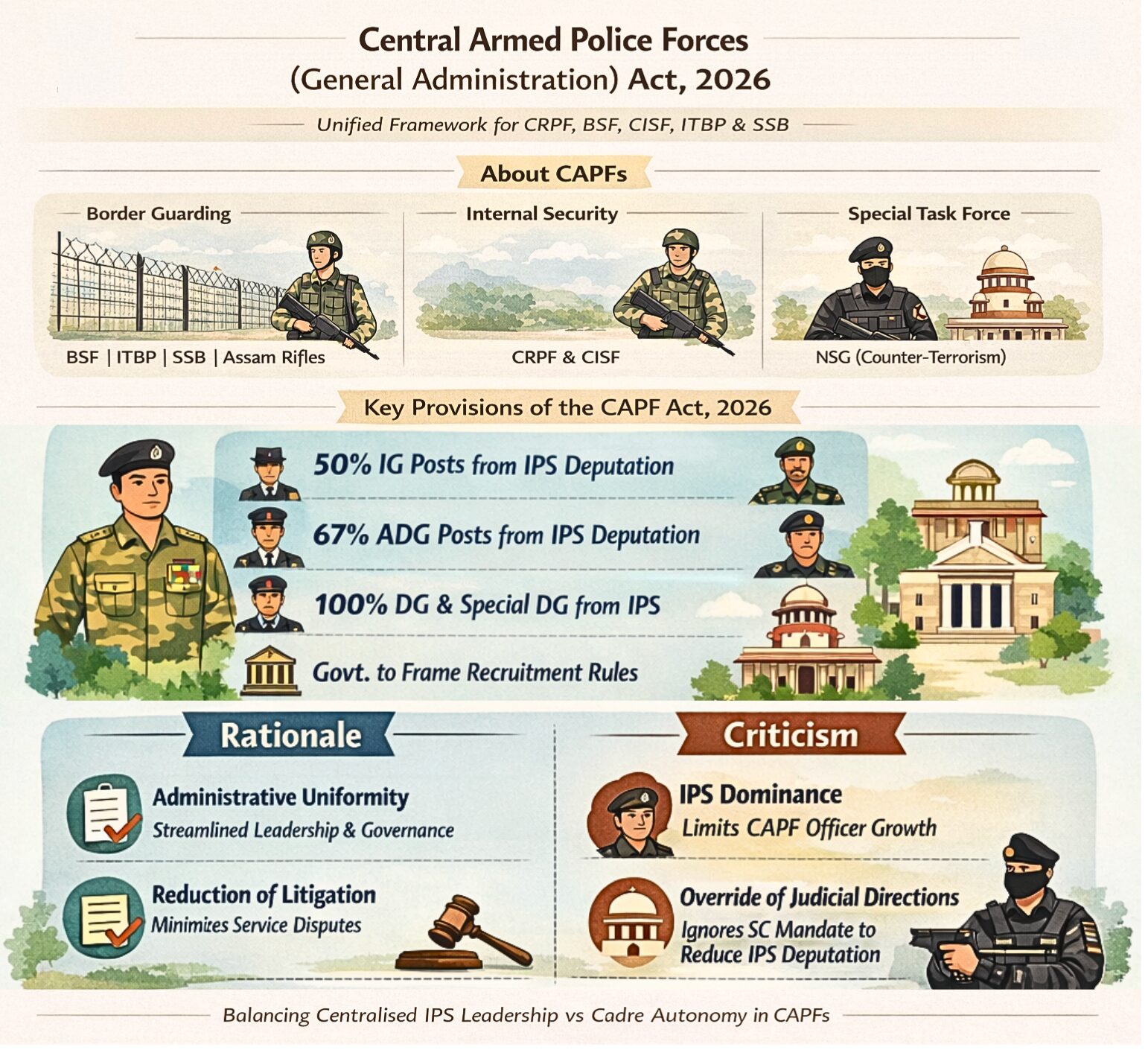
- Central Armed Police Forces (CAPF) are seven primary security forces responsible for border guarding, internal security, and counter-insurgency. It is under the administrative control of the Ministry of Home Affairs (MHA).
- Core Components and Functions:
- Border Guarding: Border Security Force (BSF), Indo-Tibetan Border Police (ITBP), Sashastra Seema Bal (SSB), and Assam Rifles.
- Internal Security:
- The Central Reserve Police Force (CRPF) handles internal security and counter-insurgency.
- The Central Industrial Security Force (CISF) protects critical infrastructure.
- Special Task Force: National Security Guard (NSG) acts as a specialised counter-terrorism unit.
Central Armed Police Forces (General Administration) Act, 2026:
- Aim: To establish a comprehensive and uniform system governing the recruitment and service conditions of Group A General Duty officers and other personnel across major CAPFs – CRPF, BSF, CISF, ITBP and SSB.
- Major Provisions of the CAPF Act:
- The Act provides a clear legal framework for Indian Police Service (IPS) officers in senior positions in CAPF. These officers are typically appointed on deputation to head CAPFs.
- 50% of the posts will be filled through deputation from the IPS in the rank of Inspector General (IG).
- A minimum of 67% of the posts will be filled through deputation from the IPS in the rank of Additional Director General (ADG).
- 100% of posts at the Special DG and Director General (DG) ranks.
- The Act empowers the Central Government to frame rules governing recruitment and service conditions, overriding any conflicting laws.
- The Act provides a clear legal framework for Indian Police Service (IPS) officers in senior positions in CAPF. These officers are typically appointed on deputation to head CAPFs.
In recent years, due to the absence of an umbrella law, regulatory provisions have evolved in a fragmented manner. This has resulted in several litigations on service-related matters, leading to some functional and administrative difficulties.
Rationale of the CAPF Act:
- Administrative Uniformity: Creates a common governance structure and removes fragmentation across different CAPFs. The Act streamlines leadership hierarchy, cadre and strengthens centralised control and uniform leadership.
- Reduction of Litigation: Aims to reduce service disputes and ambiguity in promotions, postings and cadre management.
Criticism of the CAPF Act:
- IPS dominance and impact on CAPF morale: The 2026 Act faces criticism from retired personnel for codifying high percentages of IPS officers in top positions (up to 100% for ADG/DG ranks) and limiting the career progression and morale of CAPF cadre officers. Weakens recognition of CAPF officers as an independent cadre.
- Override of Judicial Directions: In 2025, the Supreme Court of India directed the government to gradually reduce the deputation of IPS officers to CAPFs. It aimed to promote internal cadre officers to top positions, and to place emphasis on fair career progression and autonomy for CAPF personnel. The new Act overrides these directions by reinforcing IPS dominance.
The Act represents a major structural reform in internal security governance and is expected to improve administrative efficiency and coordination. However, it exposes a deep institutional conflict between centralised leadership (IPS model) vs Cadre-based autonomy (CAPF officers). The long-term success will depend on balancing efficiency with fairness.
UPSC PYQ 2023
Q. With reference to Home Guards, consider the following statements:
1. Home Guards are raised under the Home Guards Act and Rules of the Central Government.
2. The role of the Home Guards is to serve as an auxiliary force to the police in the maintenance of internal security.
3. To prevent infiltration on the international border/coastal areas, the Border Wing Home Guards Battalions have been raised in some States.
How many of the above statements are correct?
(a) Only one
(b) Only two
(c) All three
(d) None
Answer: (b) (Statement 1 is incorrect)
Tell Google you want more of this.
Add Anantam IAS as a preferred sourceOne tap, and this site shows up more often in your own Top Stories, AI Overviews and AI Mode. Remove it any time.