Context:
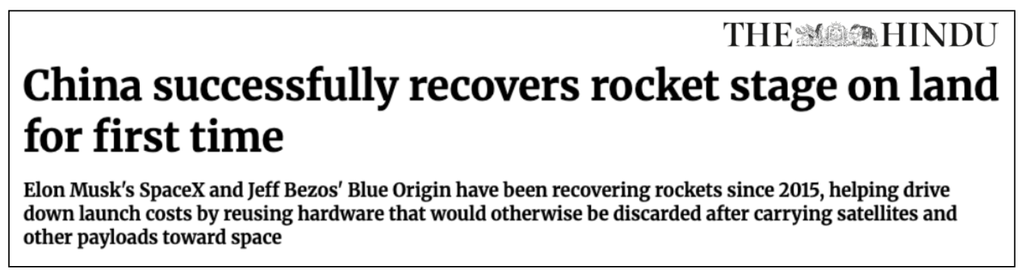
Recently, China has demonstrated a major step towards reusable orbital launch vehicles by successfully recovering the first stage of LandSpace’s Zhuque-3 Y2 rocket on land after an orbital mission. The methane-liquid oxygen rocket performed a controlled vertical landing about 390 km downrange from the launch site.
The development highlights the growing global shift from expendable rockets towards reusable space transportation systems and the increasing role of China’s private space sector.
| UPSC Relevance: GS-3 Science and Technology; Space Technology Prelims & Mains: Rocket Reusability (Concept, Advantages & Challenges); Major attempts towards Rocket Reusability. |
What is Rocket Reusability?
Most orbital rockets consist of multiple stages:
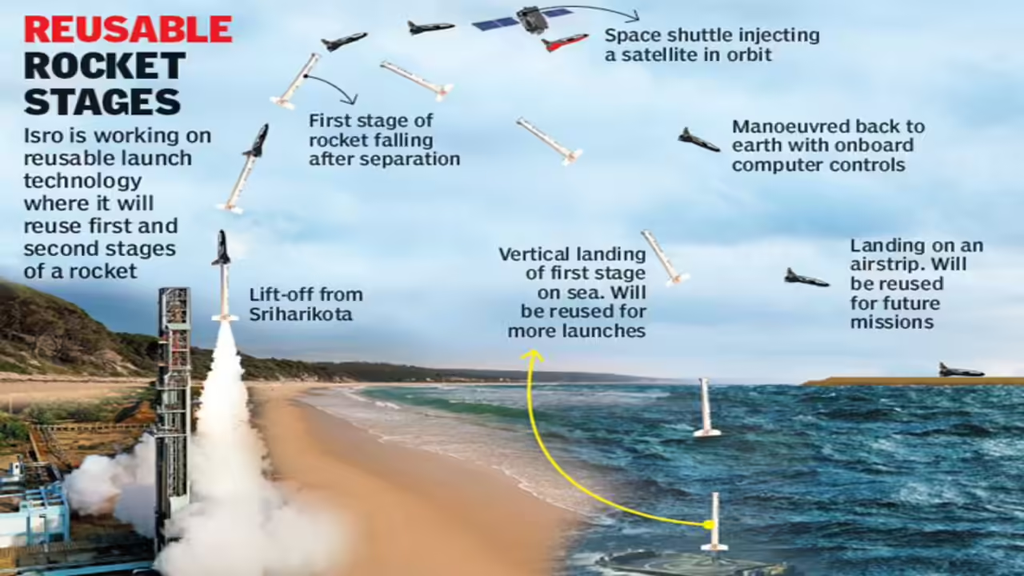
- The first stage provides the major thrust required to overcome gravity and atmospheric resistance/drag before separating from the upper stage. After fuel exhaustion, it separates from the upper stage, which continues towards orbit.
- In conventional expendable rockets, the first stage falls into the ocean or a designated impact zone.
- A reusable launch vehicle instead attempts to:
- Launch → Stage separation → Controlled descent → Recovery → Inspection/refurbishment → Reflight
Importantly, successful recovery does not by itself establish operational reusability. The recovered stage must undergo refurbishment and demonstrate reliable subsequent flights.
Types of Reusability:
- Partial reusability: Only some components, generally the first stage/boosters, are recovered. SpaceX’s Falcon 9 follows this model.
- Full reusability: Both the first stage and upper spacecraft/stage are designed for repeated recovery and flight. SpaceX’s Starship is pursuing this model, although achieving rapid, routine full reusability remains technically challenging.
Why is Reusability Important?
- Lower recurring costs: Expensive engines and structural components can be used multiple times.
- Higher launch cadence: Reduces dependence on manufacturing an entirely new rocket for every mission.
- Responsive space access: Enables faster replacement or deployment of satellites.
- Commercialisation: Lower launch costs can expand satellite constellations, space-based services and other commercial applications.
- Strategic capability: Frequent and responsive launches can strengthen capabilities in communications, Earth observation and national security.
- Deep-space potential: Reusable heavy-lift systems could reduce the cost of sustained lunar and eventually Martian operations.
However, reusability is not synonymous with cheap launches. Economic gains depend on high flight frequency, low refurbishment costs and reliable turnaround.
Why Methane-Based Rockets?
Zhuque-3 uses LOX-methane propulsion, an increasingly important technology for next-generation reusable rockets.
Methane is attractive because it offers:
- relatively clean combustion, reducing engine-soot-related refurbishment challenges;
- good performance for reusable systems; and
- potential relevance to future Mars missions, since methane can theoretically be produced from Martian resources.
Associated Challenges:
- Recovery systems require additional fuel, landing hardware and guidance systems, potentially reducing payload capacity.
- Repeated flights impose thermal, structural and engine stresses.
- Inspection and refurbishment can offset some of the economic benefits.
- High utilisation is necessary to achieve significant cost reductions.
- Requires sophisticated tracking, telemetry, landing and ground infrastructure.
- Frequent launches raise concerns regarding atmospheric emissions, noise and sonic booms.
- Full reusability is considerably more difficult than first-stage recovery because the upper stage must survive orbital velocity and atmospheric re-entry.
India’s Reusable-Launch Programme:
India is developing reusable-launch technologies through ISRO and the emerging private space sector.
- RLV Technology Demonstrator (Pushpak): ISRO’s winged vehicle has tested hypersonic re-entry and autonomous runway landing. Three landing experiments (LEX-01, LEX-02 and LEX-03) were successfully completed by 2024. ISRO is now working towards an Orbital Re-entry Experiment, in which Pushpak would return from orbit and land on a runway.
- Next Generation Launch Vehicle (NGLV): Approved in 2024, NGLV is envisaged as a heavier launch system (carrying up to 30 tonnes to Low-Earth Orbit, using relatively cleaner LOX-methane propulsion) with a reusable first stage. It is intended to support India’s growing commercial launch requirements, the Bharatiya Antariksh Station and future deep-space ambitions.
- Vertical landing technology: ISRO is also developing technologies for vertical take-off and vertical landing (VTVL), which could eventually enable booster recovery.
India’s space reforms are enabling private companies to participate in launch-vehicle development, potentially accelerating innovation in reusable systems.
Rocket reusability represents a shift from a “disposable rocket” model to a “space transportation” model. The real breakthrough in reusable launch vehicles is not merely bringing a rocket back to Earth, but making its recovery, refurbishment and rapid reflight sufficiently reliable and economical to transform space launch.
Tell Google you want more of this.
Add Anantam IAS as a preferred sourceOne tap, and this site shows up more often in your own Top Stories, AI Overviews and AI Mode. Remove it any time.