Why in News?
On 12 October 2026, the science ministry reported CeNS research showing how a methylene spacer alters peptide self-assembly and the resulting material’s optical behaviour.
- Researchers at the Centre for Nano and Soft Matter Sciences, Bengaluru, introduced a methylene spacer between a peptide and a fluorescent pyrene unit.
- The change affected molecular packing, supramolecular chirality, fluorescence lifetime behaviour and nanoscale organisation while retaining the fundamental peptide framework.
- The work appeared in Polymer Chemistry; the official report identifies possible applications rather than announcing a commercial material or clinical product.
- For materials design, what molecules contain and how they organise are separate questions; the arrangement can change the properties that a device would use.
- The practical challenge is controlling self-assembly to obtain desired structures, rather than merely observing that molecules form an ordered arrangement.
UPSC Relevance
Prelims Relevance
- Peptides and amino-acid chains
- Methylene spacer and molecular geometry
- Supramolecular self-assembly
- Chirality and mirror images
- Fluorescence lifetime
Mains Relevance
GS Paper 3
- Linking molecular design to functional nanomaterials
- Distinguishing laboratory findings from validated biomedical applications
Essay
- Small changes can produce large effects when relationships within a system change.
Background and Context
What Is Peptide Self-Assembly?
Peptide self-assembly concerns the organisation of molecules into a larger structure, so understanding the building block is only the first step.
- A peptide is a chain of amino-acid residues connected through peptide bonds. A single amino acid is a building block; it should not be described as an entire peptide chain.
- In self-assembly, molecular components spontaneously form an organised structure through molecular recognition. The resulting arrangement belongs to a collection of molecules, rather than being the structure of one isolated molecule.
- The term supramolecular directs attention beyond an individual molecule to the organisation of multiple molecules. For this study, the important question is how peptide-based units arrange themselves at the nanoscale.
- The studied system links a peptide with a fluorescent pyrene unit. The researchers changed their connection, allowing them to examine how relative orientation affects assembly without replacing the fundamental peptide framework.
- Self-assembly describes organisation, not biological reproduction. Molecules arranging themselves into an ordered material do not, on that basis, constitute a living system or demonstrate the ability to produce biological offspring.
How Does a Small Spacer Change Properties?
The central relationship runs from molecular geometry to collective packing and then to observable material properties.
- A methylene spacer, written as –CH₂–, was inserted between the peptide and pyrene components. This small chemical modification changed their relative orientation, creating a different geometry for molecular organisation.
- Changed geometry led to different packing: the way neighbouring molecules arrange themselves. The finding shows why retaining a peptide framework does not guarantee that the resulting material retains identical properties.
- Chirality means that a structure cannot be superimposed on its mirror image. In supramolecular chirality, the relevant handedness concerns the organised assembly, extending the discussion beyond the geometry of an individual molecule.
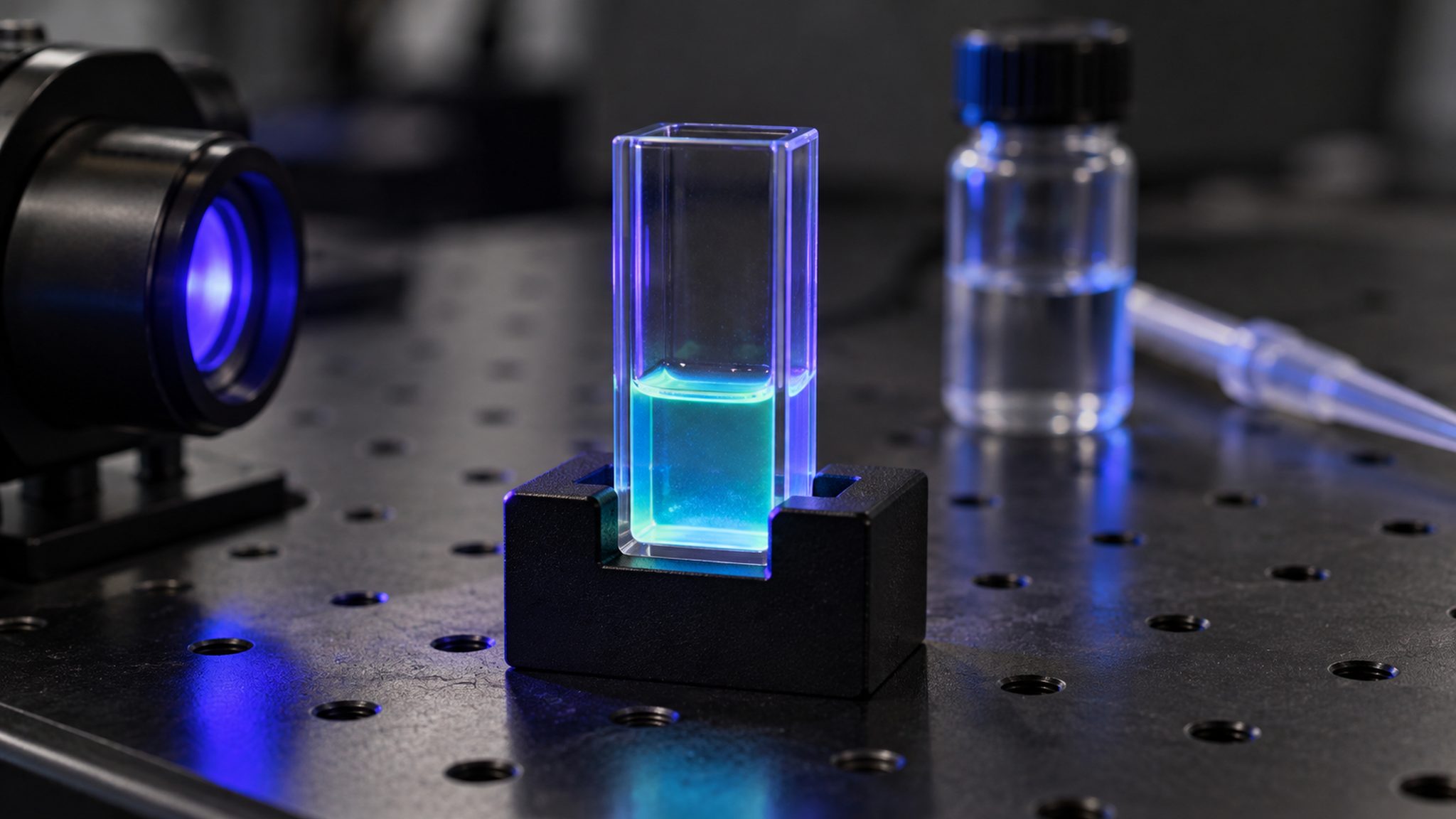
- Fluorescence lifetime describes how fluorescent intensity decays with time. A difference in lifetime behaviour is an optical finding; it should not automatically be translated into a claim of greater brightness or better imaging.
- The reported changes in nanoscale organisation and optical behaviour support a structure–packing–property relationship. They demonstrate a design strategy in the studied system, without proving that every spacer produces the same outcome.
What Has Been Demonstrated, and What Remains Possible?
The research offers a way to tune materials, while the usefulness of a finished sensor or imaging product remains a separate question.
- The demonstrated result is control through molecular modification: a small structural change alters collective organisation and function. The official report does not establish a clinically validated imaging agent or a market-ready electronic component.
- Biosensing and bioimaging are proposed application areas because the material has tunable optical behaviour. Naming these possibilities does not establish detection accuracy, biological safety or effectiveness inside a living organism.
- Photonics, optoelectronics and molecular electronics are also listed as possible directions. These are research opportunities in the release, rather than evidence that a functioning commercial device has already been manufactured or deployed.
- The design significance lies in changing organisation without extensively replacing the underlying peptide framework. This provides researchers another variable to investigate when seeking a chosen material response through molecular design.
- For evaluating a future application, ask whether the desired performance survives the conditions of use. A useful laboratory relationship must still be connected to the requirements of the specific proposed product.
Way Forward
Test the Proposed Function
- Compare related designs under defined conditions to establish which changes in geometry and packing reliably produce the desired optical response.
- For proposed biological uses, investigate safety and application-specific performance before describing the material as suitable for diagnosis or use in living systems.
- Evaluate reproducibility and manufacturing feasibility separately from the initial molecular finding; a tunable laboratory system and a dependable product answer different questions.
Conclusion
- The durable lesson is the structure–packing–property relationship: a small change in a molecular connection can alter collective organisation and optical behaviour even when the fundamental peptide framework remains intact.
- Use this example to explain rational materials design, while distinguishing measured laboratory behaviour from a proposed application. Scientific promise becomes practical value only when the relevant performance requirements are demonstrated.
UPSC Practice Questions
Prelims MCQ 1
With reference to peptide self-assembly, consider the following statements:
- A peptide consists of amino-acid residues connected through peptide bonds.
- Self-assembly necessarily implies biological reproduction.
- Changing the connection between molecular components can alter their collective packing.
How many of the above statements are correct?
(a) Only one (b) Only two (c) All three (d) None
Answer: (b) Only two
Explanation:
Statements 1 and 3 are correct. Self-assembly concerns spontaneous molecular organisation; it does not necessarily involve living systems or reproduction.
Prelims MCQ 2
Which interpretation best describes the significance of the reported methylene-spacer research?
(a) It establishes the clinical safety of all peptide materials. (b) It proves that a longer fluorescence lifetime always means greater brightness. (c) It shows that a small geometry change can alter packing and optical behaviour. (d) It demonstrates that peptides are individual amino acids.
Answer: (c) It shows that a small geometry change can alter packing and optical behaviour.
Explanation:
The report connects the spacer-induced geometry change with different molecular packing, supramolecular chirality and fluorescence lifetime behaviour. Clinical safety and universal brightness improvements are not established.
UPSC Mains Questions
- Explain the structure–packing–property relationship in functional materials using peptide self-assembly as an example.
- A promising laboratory material is not necessarily a usable biomedical product. Discuss with reference to peptide-based optical materials.
Source: PIB, Ministry of Science & Technology.
Frequently Asked Questions
What is peptide self-assembly?
Peptide self-assembly is the spontaneous organisation of peptide-based molecular components into ordered structures. It describes how molecules arrange collectively; it does not by itself imply a living system or biological reproduction.
What did the methylene spacer change?
The spacer changed the relative orientation of peptide and pyrene components. The official report links this geometry change to different packing, supramolecular chirality, fluorescence lifetime behaviour and nanoscale organisation.
What is supramolecular chirality?
It concerns handedness in the organised assembly of molecules. Chirality means a structure cannot be superimposed on its mirror image; the supramolecular level focuses attention on collective organisation rather than an isolated molecule.
Are these materials ready for medical use?
The official report identifies biosensing and bioimaging as potential applications. It does not establish a clinically validated product, biological safety or diagnostic performance; those require evidence relevant to the proposed use.
Tell Google you want more of this.
Add Anantam IAS as a preferred sourceOne tap, and this site shows up more often in your own Top Stories, AI Overviews and AI Mode. Remove it any time.