Why in News?
On 28 October 2026, the Union Cabinet approved the Container Manufacturing Promotion Scheme to support domestic container production through finance, operating assistance and common testing facilities.
- Interest assistance provides 3% annual subvention on eligible capital loans for new facilities and expansion of existing manufacturing capacity.
- Operating assistance covers containers manufactured to global shipping standards and sold by eligible manufacturers; production alone is not the stated condition.
- Testing and certification support includes common facilities such as dynamic longitudinal impact testing.
- The release describes expected capacity, employment and supply-chain gains. These are projected effects of the approved scheme, not demonstrated results.
- Container supply connects manufacturing capability with maritime logistics. A larger factory base matters only when its products satisfy users’ quality and commercial requirements.
- The design addresses different constraints: capital finance, the cost of supplying saleable containers and access to testing infrastructure.
UPSC Relevance
Prelims Relevance
- CMPS: Container Manufacturing Promotion Scheme.
- Interest subvention: assistance that reduces eligible borrowers’ interest burden.
- Greenfield and brownfield: new facilities and expansion of existing capacity.
- Operational assistance: linked here to standards-compliant containers manufactured and sold.
- Common testing facilities: infrastructure usable by multiple manufacturers.
Mains Relevance
GS Paper 3
- Industrial policy instruments and manufacturing competitiveness.
- Domestic capability, quality standards and resilient logistics supply chains.
Essay
- Public support produces durable capability when finance and quality requirements work together.
Background and Context
Why Container Manufacturing Needs More Than Factory Capacity
The policy problem is to produce containers that buyers can use reliably and purchase at competitive prices.
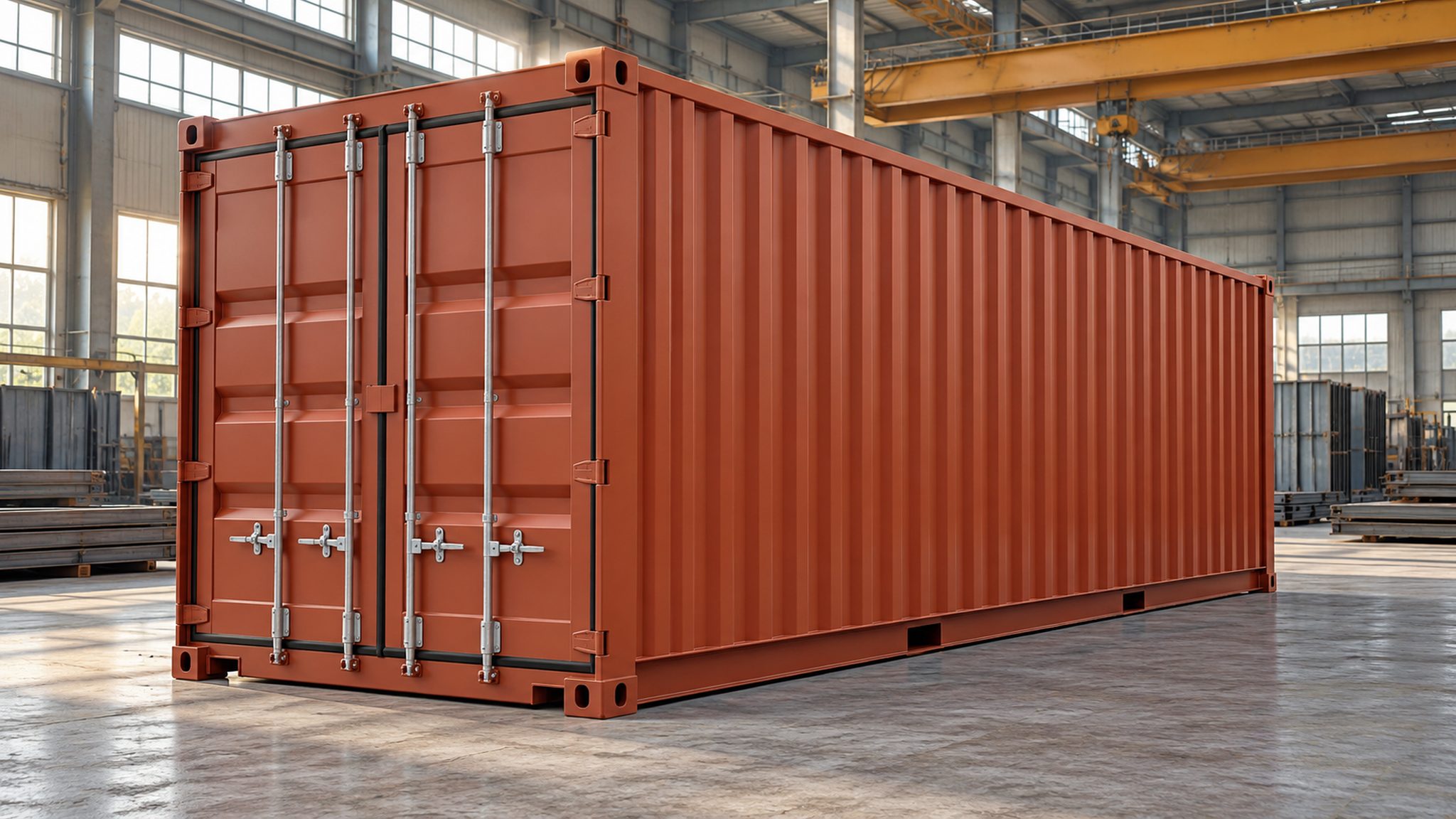
- A container must work within a shipping and handling system. Buyers need dependable products, so the scheme expressly links assistance to global shipping standards rather than treating every manufactured box as equivalent.
- Domestic capacity can reduce dependence on imported equipment, but capacity is a production possibility. Factories still need orders, suitable inputs and acceptable quality before that possibility becomes useful supply for logistics operators.
- The Cabinet release identifies ancillary industries, including corner castings, specialised steel, wooden frames and paints. Their inclusion shows that container manufacturing depends on a supplier network, not only the final assembly unit.
- Manufacturing support and port governance address different parts of logistics. Producing equipment does not itself remove delays in port coordination, inland movement or cargo handling; each constraint needs its own response.
- For policy evaluation, separate installed capacity from actual production and sales. An announced expansion cannot establish improved competitiveness until buyers accept output and manufacturers sustain delivery under the required standards.
How the Three Support Instruments Work
Each instrument targets a different cost or capability constraint; combining them does not make their conditions interchangeable.
- Capital expenditure creates or expands productive assets. Interest Subvention Assistance reduces the interest burden on eligible capital loans, helping the financing side of investment rather than replacing the entire cost of building a factory.
- Both greenfield facilities and brownfield expansion are covered by the announced loan-support component. The distinction concerns whether capacity starts at a new facility or grows within an existing manufacturing operation.
- Operational Expenditure Assistance is intended to bridge the cost gap for eligible manufacturers. The release connects it to containers that meet global shipping standards and are manufactured and sold, making saleability part of the design.
- Common testing infrastructure addresses a capability that individual manufacturers may find costly to establish separately. The named impact-testing example concerns product performance; it is not a substitute for every other applicable quality requirement.
- The key comparison is finance versus product qualification: cheaper borrowing can help establish capacity, while testing establishes relevant performance. Passing a test cannot repay a loan, and subsidised credit cannot establish compliance.
What Approval Establishes and What Still Needs Evidence
The approval defines policy support and intended effects; implementation evidence must establish whether the expected gains follow.
- The Cabinet announcement confirms the approved components. It does not prove that all eligible firms have received assistance, that new plants are operating or that every domestically produced container has obtained required certification.
- The release gives anticipated capacity and employment effects. Treating these projections as realised outcomes would confuse the purpose of public spending with its measured results, a common error when assessing industrial-policy announcements.
- The summary does not specify every application, verification or payment procedure. Writers and applicants should not invent reimbursement rates or assume automatic eligibility merely because a firm manufactures containers in India.
- Evaluation should examine compliant sales and sustained production alongside assistance paid. Broader industrial-output measurement offers context, but an aggregate index cannot by itself isolate whether this particular scheme caused a change.
- Supply-chain resilience requires reliable alternatives as well as production capability. A defensible assessment would examine supplier concentration, quality failures and delivery reliability, rather than assuming that domestic origin alone guarantees uninterrupted availability.
Way Forward
Tie Support to Verifiable Performance
- Publish clear eligibility and claim-verification rules, including how standards compliance and completed sales will be established before operating assistance is paid.
- Track loan support, testing access and compliant sales separately so that a bottleneck in one component is visible rather than hidden by aggregate spending.
- Compare expected and realised outcomes using consistent definitions; investigate whether supported capacity remains commercially useful after initial assistance.
Conclusion
- CMPS combines investment finance, operating support and testing capability. Its value depends on converting these inputs into standards-compliant containers that buyers actually purchase.
- In a Mains answer, distinguish the policy instrument, its condition and the outcome requiring evidence. Cabinet approval supports the first claim; sustained industrial competitiveness needs later verification.
UPSC Practice Questions
Prelims MCQ 1
With reference to the approved Container Manufacturing Promotion Scheme, consider the following statements:
- Interest assistance covers eligible capital loans for new facilities and expansion of existing capacity.
- Operational assistance is described for standards-compliant containers manufactured and sold.
- The Cabinet release establishes that all projected employment gains have already occurred.
How many of the above statements are correct?
(a) Only one (b) Only two (c) All three (d) None
Answer: (b) Only two
Explanation:
Statements 1 and 2 reflect the approved design. Statement 3 is incorrect: the employment effects are estimates, not realised outcomes.
Prelims MCQ 2
Which policy constraint is most directly addressed by common container-testing facilities?
(a) The absence of any need for global shipping standards (b) The complete financing cost of every new plant (c) The automatic allocation of export orders (d) Access to shared infrastructure for assessing product performance
Answer: (d) Access to shared infrastructure for assessing product performance
Explanation:
Common testing facilities support performance assessment and certification capacity. They neither abolish standards nor automatically finance plants or provide buyers.
UPSC Mains Questions
- Explain how combining capital-loan support, operating assistance and testing infrastructure can address distinct constraints in container manufacturing.
- How should India evaluate whether manufacturing incentives improve supply-chain resilience? Discuss with reference to the Container Manufacturing Promotion Scheme.
Source: PIB, Cabinet.
Frequently Asked Questions
What is CMPS?
The Container Manufacturing Promotion Scheme is a Cabinet-approved intervention supporting domestic container production through eligible capital-loan interest assistance, operating assistance for qualifying containers manufactured and sold, and common testing facilities.
Does the scheme cover expansion of existing factories?
The announced interest-assistance component covers eligible capital loans for both new greenfield facilities and brownfield expansion of existing capacity. The approval summary should not be read as automatic eligibility for every factory.
Is manufacturing a container enough for operating assistance?
The Cabinet release describes assistance for containers manufactured according to global shipping standards and sold by eligible manufacturers. This wording includes standards compliance, sale and manufacturer eligibility rather than production alone.
Are projected capacity and employment gains already achieved?
No. The release presents them as envisaged impacts. Establishing actual gains requires implementation and outcome evidence, including operating capacity, compliant sales and employment measured after the scheme begins functioning.
Tell Google you want more of this.
Add Anantam IAS as a preferred sourceOne tap, and this site shows up more often in your own Top Stories, AI Overviews and AI Mode. Remove it any time.