The International Fund for Agricultural Development and the Government of India have agreed on a fresh Country Strategic Opportunities Programme for the eight-year cycle from 2026 to 2033. The COSOP IFAD India framework, finalised in mid-May 2026, sets the terms for the next phase of one of India’s longest-running multilateral partnerships on rural development. It moves beyond standalone projects toward an outcome-anchored programme covering smallholder agriculture, market integration, climate resilience, and inclusion.
IFAD has worked with India since 1979 and has co-financed more than thirty projects across most of its agro-ecological zones. The new COSOP refresh comes at a moment when smallholder farmers face overlapping stresses: erratic monsoons, volatile farm-gate prices, mounting input costs, and the slow churn of rural-to-urban migration. The 2026-2033 programme positions IFAD’s support to complement India’s own flagship missions rather than run parallel to them.
This explainer walks through what the COSOP IFAD India framework covers, how it builds on the earlier 2018-2024 cycle, which districts and themes will see priority, and what it means for the UPSC syllabus on rural development, multilateral cooperation, and climate-resilient agriculture.
Quick Facts
- Programme name: Country Strategic Opportunities Programme, COSOP IFAD India.
- Duration: Eight years, 2026 to 2033.
- Counterpart agencies: Department of Economic Affairs, Ministry of Finance for sovereign loans; Department of Agriculture and Farmers Welfare and partner state agencies for implementation.
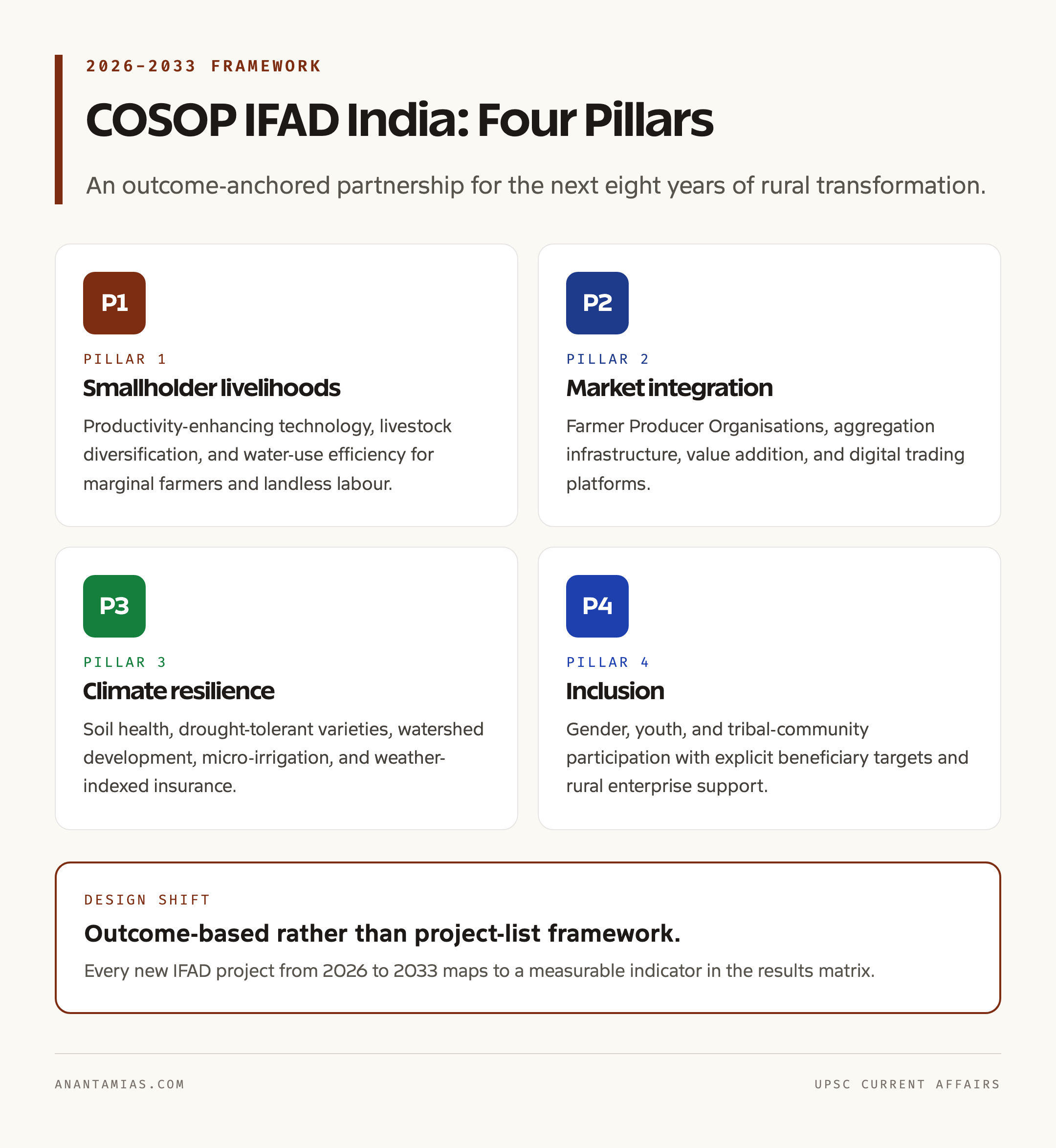
- Thematic pillars: Smallholder livelihoods, market integration through Farmer Producer Organisations, climate-resilient agriculture, and gender-youth inclusion.
- Partnership vintage: IFAD has supported India since 1979, financing more than thirty projects.
- IFAD type: A specialised agency of the United Nations and an international financial institution, headquartered in Rome.
What Just Happened
IFAD and the Department of Economic Affairs concluded the COSOP IFAD India 2026-2033 process after a multi-round consultation that covered state governments, civil society, Farmer Producer Organisations, and research institutions. The framework was signed off in mid-May 2026 and will guide every new IFAD-financed operation in India through 2033, along with policy-engagement work that runs alongside lending.
Unlike older COSOPs that listed indicative projects, the 2026-2033 framework is organised around outcomes. It commits to measurable improvements in farm productivity, market access, climate resilience, and women-and-youth participation in rural value chains. Each new project will be designed to fit within the framework’s results matrix, which links inputs to mid-term and long-term indicators that align with India’s own development priorities.
Geographically, the COSOP IFAD India strategy will lean toward aspirational districts, tribal subplan blocks, and rainfed agro-ecological zones in central and eastern India. The focus reflects where smallholder vulnerability is highest and where state capacity for converged delivery still has room to grow.
Background and Historical Context
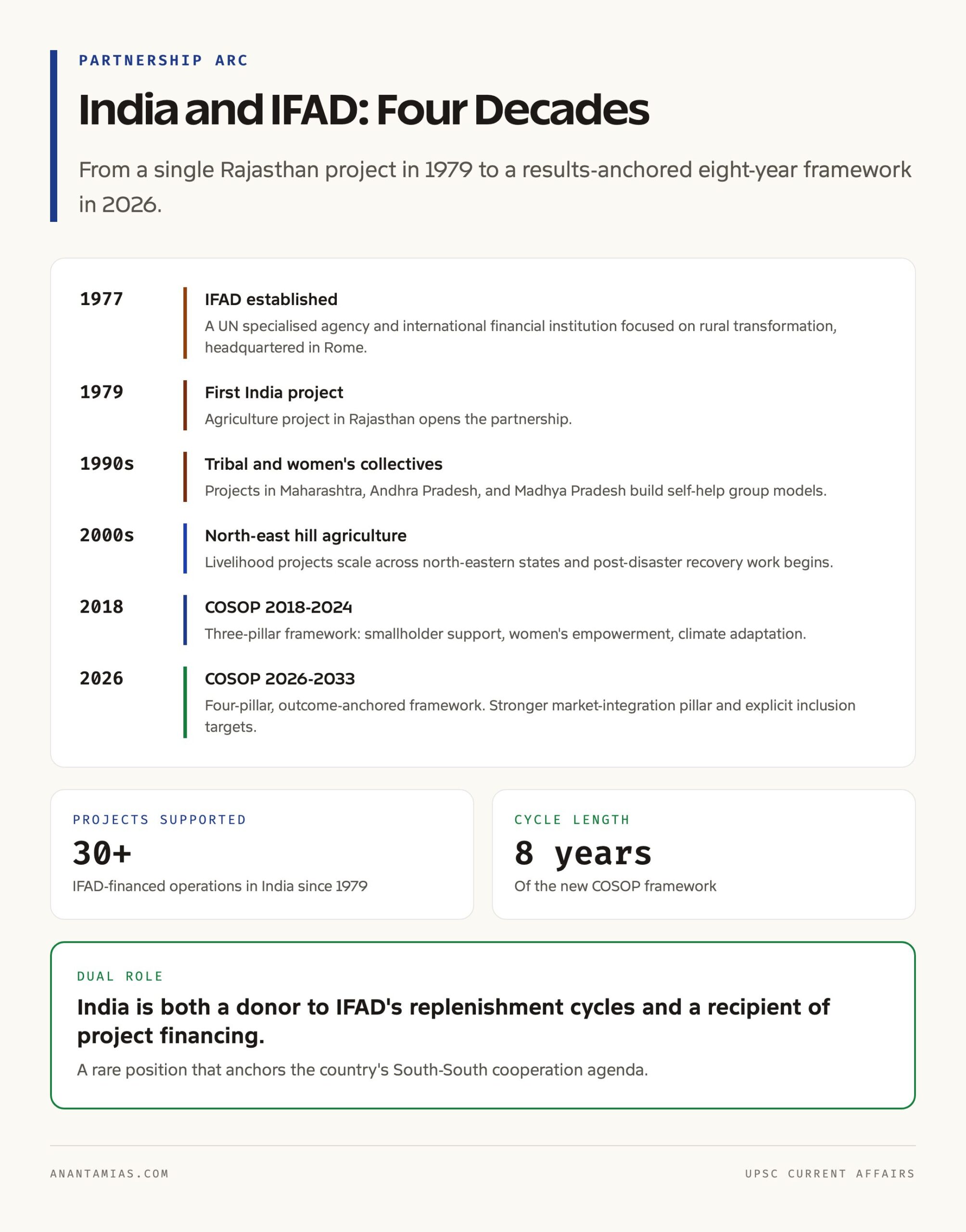
IFAD was created in 1977 as a response to the food crises of the early 1970s. It is the only specialised United Nations agency and international financial institution focused exclusively on rural transformation. India was a founding member and has been both a contributor to IFAD’s resources and a recipient of its financing.
The India-IFAD partnership opened in 1979 with the first agriculture project in Rajasthan. Over the following four decades, projects spread across tribal development in Maharashtra, women-led microenterprise in Andhra Pradesh, hill agriculture in the northeast, dryland farming in Tamil Nadu, and post-disaster rural recovery in Odisha and Kerala. By the early 2020s, IFAD had co-financed dozens of operations cumulatively reaching millions of rural households.
The previous COSOP cycle of 2018-2024 emphasised three pillars: smallholder farmer support, women’s empowerment in rural enterprises, and adaptation to climate variability. Mid-term evaluation findings showed strong results on group formation, women’s collectives, and climate-adaptation practices in dryland regions, but mixed performance on market integration and post-harvest infrastructure. The 2026-2033 design corrects for those gaps. For broader context on how rural finance and structural transformation intersect, our analysis of structural transformation in rural India frames the macro picture.
Key Provisions of the COSOP IFAD India 2026-2033
The new framework rests on four pillars. The first pillar focuses on smallholder livelihoods. It targets farmers with landholdings below two hectares and landless rural labour, through productivity-enhancing technologies, water-use efficiency, livestock-based diversification, and improved access to extension services. Specific support flows through state-led missions and federations of self-help groups.
The second pillar targets market integration. The previous cycle showed that productivity gains alone do not translate into income gains without dependable market linkages. The COSOP IFAD India strategy now invests in Farmer Producer Organisations, aggregation infrastructure, digital trading platforms, value-addition centres, and supply contracts with formal buyers. Several state-level FPO promotion missions, including those under the central FPO scheme, will be co-financed or technically supported.
The third pillar covers climate-resilient agriculture. It funds soil-health interventions, drought-tolerant varieties, micro-irrigation, watershed development, and weather-indexed insurance linkages. The pillar dovetails with the National Mission on Sustainable Agriculture and state-level climate-adaptation plans. The fourth pillar pushes inclusion. It mandates gender-disaggregated targets, youth-enterprise components, and tribal-community programming, with at least half the direct beneficiaries expected to be women.
Why It Matters
The COSOP IFAD India 2026-2033 framework matters because India’s rural transformation is at a difficult crossing. Agriculture continues to employ roughly two-fifths of the workforce while contributing about a sixth of GDP. Smallholders dominate landholding distribution, and their viability is shaped by overlapping price, climate, and credit shocks. Standalone government schemes can struggle to address all four risks simultaneously.
IFAD’s value-add is not the volume of finance but the methodology. Its projects typically pilot delivery models that state governments can scale through their own resources later. The COSOP framework also brings convergence: a single results matrix lets policy makers track whether productivity, income, climate-resilience, and inclusion indicators move together rather than separately. That discipline is hard to enforce within India’s domestic-scheme architecture alone.
For multilateral cooperation, the partnership matters because IFAD is one of the few UN agencies where India is both a donor and a recipient. Indian contributions to IFAD’s replenishment cycles signal commitment to South-South cooperation, and the experience gained from IFAD-financed projects has influenced India’s bilateral assistance to other developing countries.
Detailed Analysis: How COSOP IFAD India Translates into Projects
Each COSOP cycle generates a pipeline of specific projects. Under the previous cycle, operations like the Odisha-PVTG empowerment programme, the Andhra Pradesh inclusive market expansion, the Mizoram livelihoods project, and the Jharkhand tribal empowerment initiative were active. Under the 2026-2033 cycle, the pipeline is expected to favour rainfed-belt states and aspirational districts where convergence opportunities with the central rural-development schemes are strongest.
A typical IFAD-financed project blends a sovereign loan from IFAD with co-financing from the state government and complementary grant components, and runs over six to eight years. Implementation goes through a dedicated project management unit set up by the state, supported by IFAD’s country team and roving technical missions. Procurement, financial management, and safeguards follow IFAD’s guidelines, which align broadly with World Bank and Asian Development Bank standards.
The COSOP IFAD India framework also embeds policy-engagement targets alongside lending. IFAD provides analytical work on smallholder economics, climate adaptation, and rural-finance design that feeds into central and state policy discussions. For example, IFAD’s evidence base on women’s collectives has shaped how the Deendayal Antyodaya National Rural Livelihoods Mission designs its federation strategies.
Comparative Perspective
IFAD is one of three main multilateral institutions financing Indian rural and agricultural development. The World Bank works on similar themes with larger ticket sizes and broader sectoral coverage. The Asian Development Bank focuses on rural connectivity, water resources, and energy. IFAD’s distinctive position is its laser focus on smallholder rural transformation and its mandate to reach the poorest rural communities.
Globally, IFAD operates in over a hundred countries, with country strategic opportunities programmes designed for each. The Indian COSOP cycle is comparable in length and architecture to those for other large recipients such as Indonesia, Ethiopia, and Bangladesh. The differentiator for India is the scale of domestic schemes and the depth of state-level institutional capacity, which lets IFAD operate more as a pilot-and-policy partner than as a primary financier.
Challenges in Delivering the COSOP IFAD India Strategy
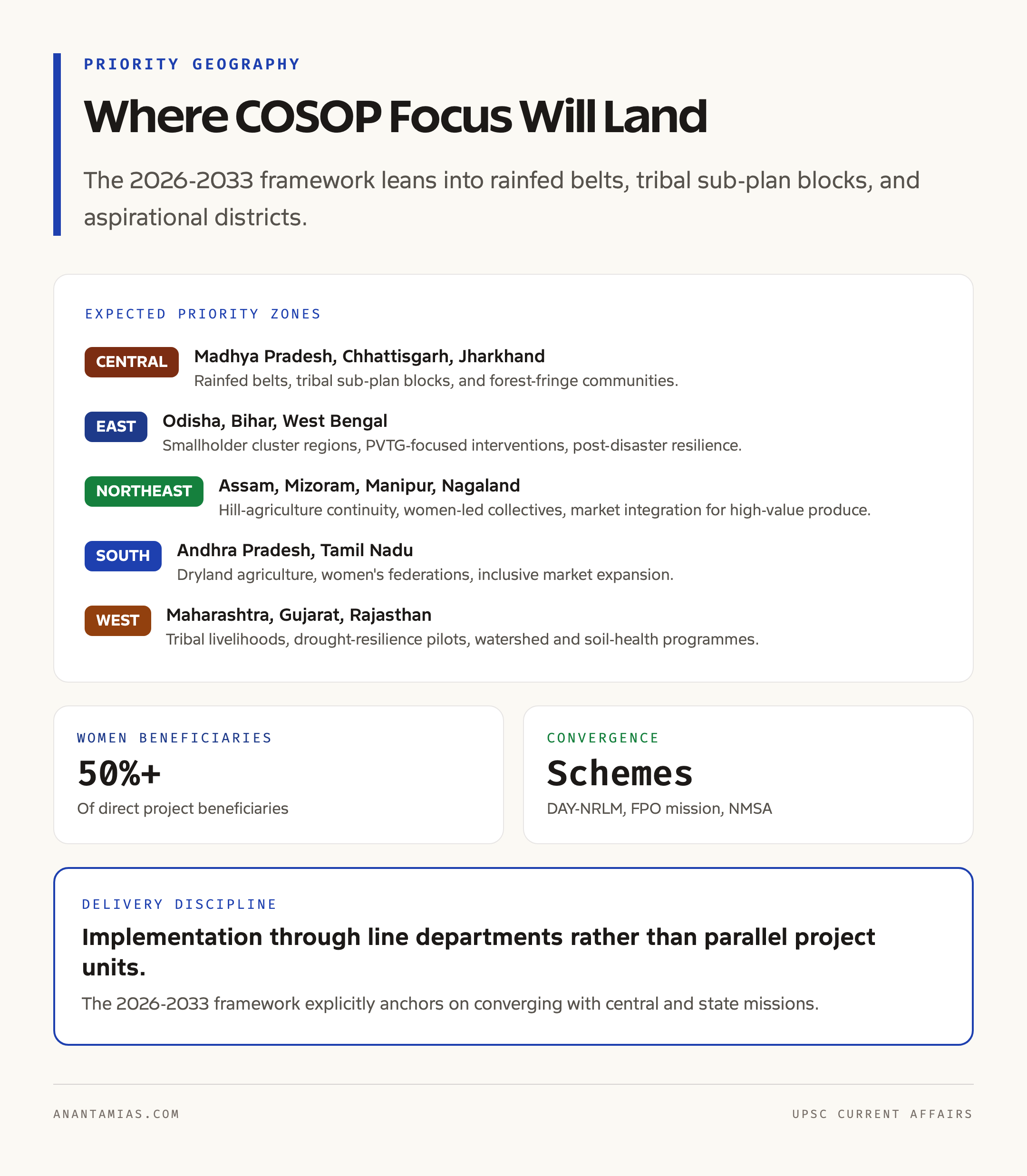
The first challenge is convergence with domestic schemes. IFAD projects work best when they layer onto existing central or state programmes rather than creating parallel structures. Mid-term reviews from the previous cycle flagged cases where implementation arrangements drifted into parallel project management instead of strengthening line departments.
The second challenge is market integration. Productivity gains in smallholder agriculture often hit a ceiling at aggregation. Without functional Farmer Producer Organisations, cold-chain links, and contractual buyers, gains slip away in post-harvest losses and distress sales. The 2026-2033 framework foregrounds market integration, but the execution challenge is real: FPOs need working capital, governance support, and digital infrastructure to scale.
The third challenge is climate co-benefits. Climate-resilient agriculture requires longer time horizons than typical project cycles. Soil-health restoration, watershed treatment, and crop diversification show full results over a decade. IFAD’s eight-year framework gives more space than three- to five-year domestic schemes, but sustained results depend on whether state governments continue investments after project closure. The link to broader structural transformation in rural India determines whether incremental gains translate into durable income shifts.
Prelims Pointers
- IFAD was established in 1977 as a specialised agency of the United Nations and an international financial institution headquartered in Rome.
- India is both a contributing member and a beneficiary of IFAD financing; it has been associated with IFAD since the agency’s inception.
- The COSOP is IFAD’s medium-term country engagement framework, typically running five to eight years.
- IFAD’s financing instruments include sovereign loans on concessional and ordinary terms, grants, and Debt Sustainability Framework support for low-income countries.
- IFAD’s flagship publication is the Rural Development Report, released periodically with thematic focus.
- The President of IFAD is elected by the Governing Council, where India sits on the Executive Board through periodic rotations.
Mains Questions
- Discuss the role of multilateral institutions like IFAD in India’s rural development. How does the COSOP IFAD India 2026-2033 framework complement domestic schemes? (GS Paper II, International Institutions)
- Examine how smallholder agriculture in India faces overlapping price, climate, and credit risks. Suggest a converged policy response drawing on the COSOP IFAD India framework. (GS Paper III, Agriculture)
- Market integration of smallholders through Farmer Producer Organisations is often presented as a solution to distress sales. Critically assess this proposition with reference to capacity and capital constraints. (GS Paper III, Economy)
- India’s experience as both donor and recipient of IFAD support offers lessons in South-South cooperation. Discuss the implications for India’s development partnership programme. (GS Paper II, International Relations)
Way Forward
The COSOP IFAD India 2026-2033 framework will deliver to the extent that it stays anchored in three disciplines. First, convergence must be operational, not aspirational. Each new project should build on or strengthen an existing central or state scheme, with implementation through line departments rather than parallel units. Second, the market-integration pillar needs sustained finance for Farmer Producer Organisations, including equity grants, working-capital lines from NABARD, and supply contracts with formal buyers under the eNAM and unified market platforms.
Third, climate resilience must be measured against decade-long indicators, not project-cycle proxies. Soil-organic-carbon trajectories, water-table behaviour in treated watersheds, and crop-yield variability under stress conditions are the outcomes that matter. If the COSOP framework can institutionalise these measurements alongside its income and inclusion targets, it will leave behind a durable contribution to India’s rural transformation.
Frequently Asked Questions
What is the COSOP IFAD India 2026-2033 framework?
It is the Country Strategic Opportunities Programme that governs the partnership between the International Fund for Agricultural Development and India for the eight-year cycle from 2026 to 2033. It defines the thematic priorities, geographic focus, lending pipeline, and policy-engagement agenda.
What are the four pillars of the new COSOP?
The four pillars are smallholder livelihoods, market integration through Farmer Producer Organisations, climate-resilient agriculture, and inclusion of women, youth, and tribal communities. Each pillar maps to measurable outcome indicators in the results framework.
When did India start working with IFAD?
The partnership began in 1979 with IFAD’s first project in Rajasthan. Over the following four decades, IFAD co-financed more than thirty projects across most agro-ecological zones in India.
Is IFAD a part of the United Nations?
Yes. IFAD is a specialised agency of the United Nations and at the same time an international financial institution. It was established in 1977 and is headquartered in Rome.
Which states are likely to be priority under COSOP 2026-2033?
The framework leans toward rainfed agro-ecological zones, aspirational districts, and tribal sub-plan blocks in central and eastern India. Specific state pipelines will be confirmed as project designs are finalised through 2026 and 2027.
How does IFAD financing flow into India?
IFAD provides sovereign loans through the Department of Economic Affairs, Ministry of Finance, which are passed on to implementing state agencies along with state co-financing and complementary grant components.
Does India contribute to IFAD as well?
Yes. India contributes to IFAD’s replenishment cycles as a member country, even while receiving project financing. This dual role reflects India’s commitment to South-South cooperation and to the multilateral rural-development agenda.
How does COSOP IFAD India relate to the Sustainable Development Goals?
The COSOP framework’s outcomes link directly to SDG 1 on poverty, SDG 2 on hunger, SDG 5 on gender equality, SDG 13 on climate action, and SDG 17 on partnerships. Project monitoring includes SDG-aligned indicators.
What is the role of Farmer Producer Organisations in the new framework?
Farmer Producer Organisations are the central institutional vehicle for the market-integration pillar. The COSOP supports FPO formation, governance, working capital, post-harvest infrastructure, and digital market linkages, complementing the central FPO promotion scheme.
How does the new COSOP differ from the previous 2018-2024 cycle?
The 2026-2033 framework is more outcome-focused, has a stronger market-integration pillar, embeds climate-resilience as a cross-cutting theme rather than a stand-alone pillar, and includes explicit gender and youth targets. It also leans more on convergence with central and state schemes rather than parallel project structures.
Tell Google you want more of this.
Add Anantam IAS as a preferred sourceOne tap, and this site shows up more often in your own Top Stories, AI Overviews and AI Mode. Remove it any time.