India and Vietnam have spent two decades climbing the same diplomatic staircase, one polite step at a time. In May 2026, they finally skipped a tread. During Vietnamese General Secretary and President To Lam’s three-day state visit to New Delhi, the two sides upgraded their decade-old Comprehensive Strategic Partnership to an Enhanced Comprehensive Strategic Partnership, a tier Vietnam reserves for its closest external relationships.
The India-Vietnam ECSP arrives at a moment when Southeast Asia is once again becoming the centre of strategic gravity. China’s pressure in the South China Sea, the realignment of supply chains away from single-country dependence, and the Indo-Pacific’s quiet militarisation have all sharpened the case for two like-minded democracies to coordinate more closely. The ECSP locks that coordination into a treaty-grade framework with thirteen new agreements, a 25 billion dollar bilateral trade target, and a 2026 to 2030 action plan.
This article walks through what changed during the To Lam visit, why the India-Vietnam ECSP matters for UPSC aspirants reading international relations and Act East policy, and where the relationship is likely to head before the partnership is reviewed again.
Quick Facts
- Upgrade date: 6 May 2026, during To Lam’s state visit to India from 5 to 7 May.
- New tier: Enhanced Comprehensive Strategic Partnership, Vietnam’s highest external relationship category alongside China, Russia and a handful of others.
- Anchor framework: Joint Statement on the ECSP plus a 2026 to 2030 Plan of Action.
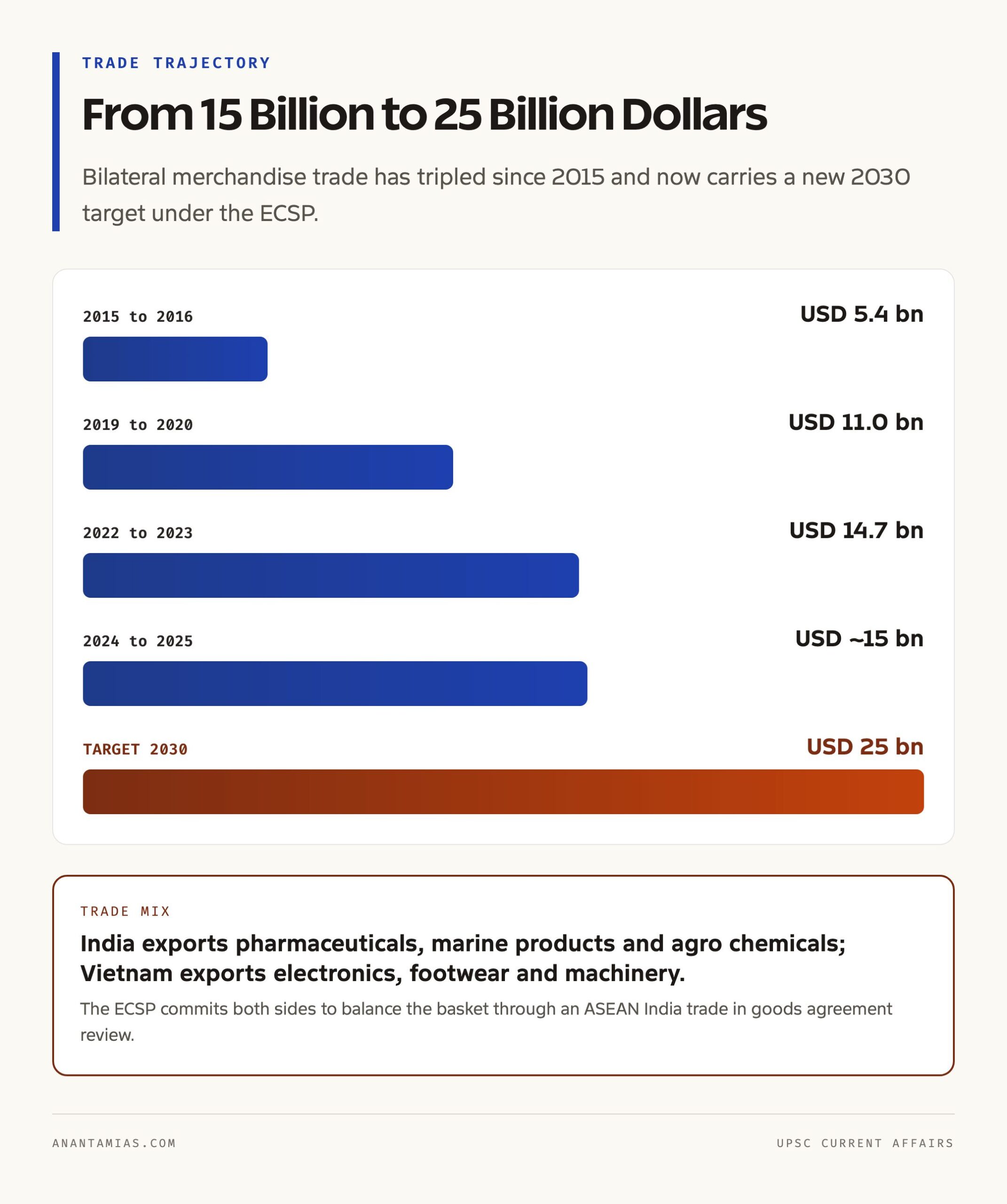
- Trade target: 25 billion dollars in bilateral trade by 2030, up from a current base of roughly 15 billion dollars.
- Defence dialogue: Launch of a 2+2 dialogue mechanism at Foreign and Defence Secretary level.
- New deals: Thirteen agreements covering digital technology, critical minerals, rare earths, digital payments, urban cooperation, culture, customs, agriculture and judicial training.
What Just Happened
To Lam landed in New Delhi on 5 May 2026 for his first bilateral state visit to India after taking over as Vietnam’s General Secretary and President. The visit coincided with the tenth anniversary of the Comprehensive Strategic Partnership signed during Prime Minister Narendra Modi’s 2016 visit to Hanoi. The agenda made the intent obvious from day one.
Prime Minister Modi and President To Lam held delegation level talks, addressed the India Vietnam Business Forum, paid tribute at Rajghat, and unveiled the Joint Statement on the ECSP. Both leaders described the upgrade as a reflection of the trust accumulated over fifty years of diplomatic relations and the convergence between India’s Act East and Vietnam’s Act West orientations.
The India-Vietnam ECSP is not a paper relabel. It is paired with a detailed Plan of Action 2026 to 2030 that locks in annual summits, regular 2+2 dialogues, a target of 25 billion dollars in trade, and concrete deliverables in defence industry collaboration, rare earth and critical mineral processing, civil nuclear cooperation, semiconductors, digital public infrastructure exchange, and joint maritime exercises. UPI and Vietnam’s NAPAS payment network agreed to launch interoperable cross-border payments. The two coast guards signed a fresh memorandum on maritime law enforcement.
Background and Historical Context
The India Vietnam story stretches well beyond modern diplomacy. Buddhist exchanges, the Cham temples of central Vietnam, and the Sanskrit inscriptions at My Son testify to a civilisational link dating back nearly two thousand years. In the twentieth century, the two nations grew close as fellow travellers in the Non Aligned Movement, with Jawaharlal Nehru and Ho Chi Minh exchanging visits in 1954 and 1958.
Building Blocks of the Relationship
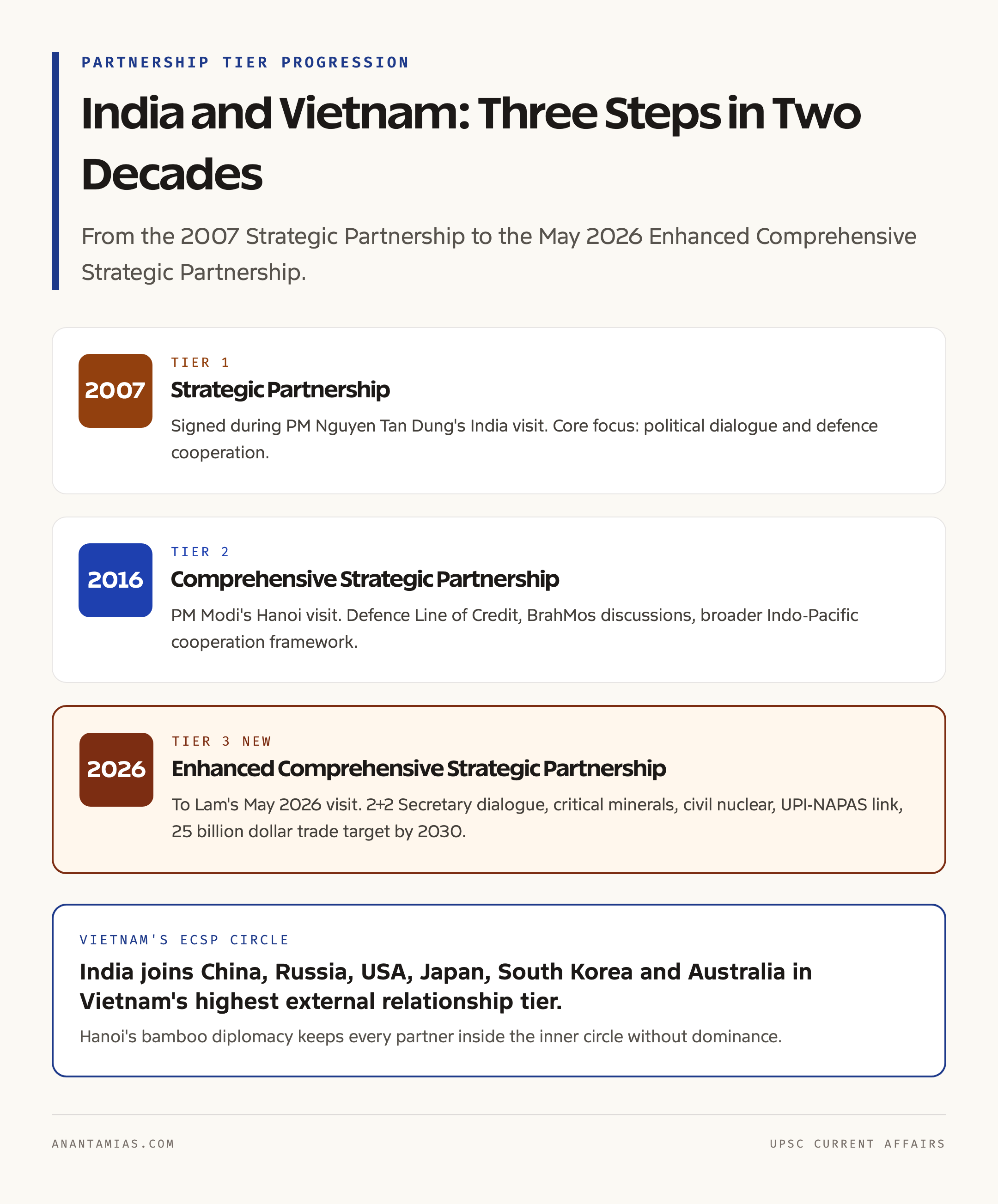
Formal diplomatic relations were upgraded to ambassador level in 1972. India was one of the few non-communist countries to recognise the Socialist Republic of Vietnam in 1976 and supported Hanoi during its decade of isolation after the Cambodia intervention. The Strategic Partnership came in 2007 during Prime Minister Nguyen Tan Dung’s India visit. The leap to Comprehensive Strategic Partnership in 2016 brought defence, security and Indo-Pacific into the centre of the agenda, including a 100 million dollar Line of Credit to Vietnam for the purchase of patrol vessels.
The new India-Vietnam ECSP builds on this base. It is the third tier in a sequence that began with Strategic Partnership in 2007 and matured into CSP in 2016. The Enhanced version adds three things: a regularised 2+2 dialogue, formal civil nuclear cooperation, and a critical minerals framework that did not exist a decade ago. India’s Act East Policy and its growing engagement with Indo-Pacific geopolitics provide the structural backdrop.
Key Features of the India-Vietnam ECSP
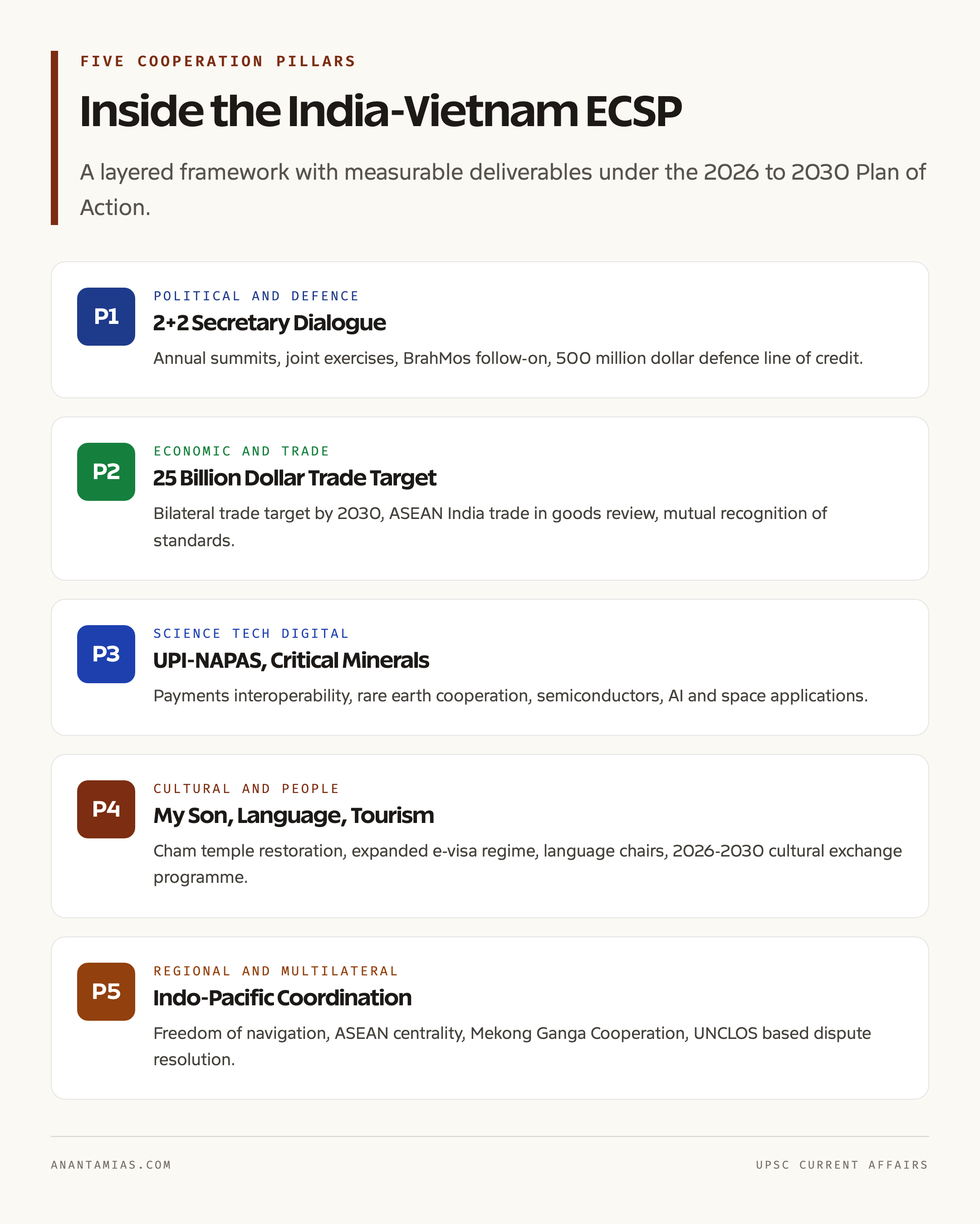
The Joint Statement organises the partnership across five interlocking pillars. Each pillar has measurable targets that move it beyond the symbolic.
- Political and defence cooperation: Annual summits, 2+2 Foreign and Defence Secretary dialogue, regular naval exercises, expansion of the BrahMos cruise missile contract follow-on, and joint training under the existing 500 million dollar Defence Line of Credit.
- Economic and trade cooperation: Bilateral trade target of 25 billion dollars by 2030, early conclusion of an ASEAN India Trade in Goods Agreement review, mutual recognition of standards, and a joint critical minerals working group.
- Science, technology and digital: UPI-NAPAS interoperability, cooperation in semiconductors, artificial intelligence, space applications under ISRO Vietnam Space Agency collaboration, and a memorandum on digital public infrastructure.
- Cultural and people-to-people ties: Restoration of the Cham temple complex at My Son, expansion of the e-visa regime, Hindi and Vietnamese language exchange chairs, and a new Cultural Exchange Programme for 2026 to 2030.
- Regional and multilateral coordination: Joint positions on Indo-Pacific freedom of navigation, ASEAN centrality, Mekong Ganga Cooperation, UNCLOS based dispute resolution, and reformed multilateralism.
Why It Matters
The India-Vietnam ECSP matters for three reasons that map cleanly onto India’s broader foreign policy. First, it strengthens India’s Act East Policy by placing Vietnam at the centre of a network that already includes Japan, Australia and the United States in the Quad and the Indo-Pacific. Vietnam shares a 1300 kilometre coastline with the South China Sea and a long land border with China, which makes it strategically irreplaceable for any Indian role east of the Strait of Malacca.
Second, the ECSP secures supply chains in sectors that have become national-security questions. Vietnam holds the second largest rare earth reserves in the world after China but exports almost none in processed form. India’s growing electronics manufacturing and electric mobility plans need stable rare earth supply that bypasses Chinese choke points. The critical minerals working group set up under the ECSP is the first bilateral framework outside the Quad to address this.
Third, the partnership demonstrates that India can build deep ties with a one-party communist state when interests converge. Vietnam balances its long border with China through diversified relationships, and India has now joined the inner circle of that balancing strategy alongside Russia, China, the United States, Japan and Australia.
Detailed Analysis
Three threads run through the ECSP and deserve closer reading. The first is defence industrial cooperation. The BrahMos sale to Vietnam, signed in 2022 and partially delivered, was India’s first major export of an indigenous strike missile. The ECSP commits both sides to a follow-on order, expansion to Akash, and joint development of light combat systems. The defence line of credit has been topped up. Vietnamese pilots have begun training on the Su-30MK series at Indian air force schools.
The second thread is connectivity. Vietnam joins India in pushing for a credible International North South Transport Corridor and an India Myanmar Thailand Trilateral Highway extension. Direct flights between Indian metros and Hanoi, Ho Chi Minh City, Da Nang and Phu Quoc have multiplied since 2022. Tourism crossed 500,000 Indian visitors in 2025 and is expected to double by 2030 under the new visa regime.
The third thread is the careful management of the China factor. Neither India nor Vietnam mentions China by name in the ECSP joint statement, but the references to freedom of navigation, the rule of law in the South China Sea, UNCLOS, peaceful resolution of disputes and reformed multilateralism make the subtext obvious. Both countries have ongoing territorial disputes with Beijing and have learnt that a public alliance against China is less useful than quiet coordination on capacity building, exercises and procurement.
Comparative Perspective
Vietnam now holds Enhanced or Comprehensive Strategic Partnerships with seven countries: China, Russia, India, the United States, South Korea, Japan and Australia. The India tier upgrade places New Delhi alongside Washington and Seoul as the most recent additions to the top category. Hanoi’s bamboo diplomacy is deliberately calibrated so no partner becomes dominant.
Compared with India’s other Enhanced or Special Strategic Partnerships, the Vietnam ECSP sits closer to the Japan model than the Russia model. Japan offers technology and capital. Russia offers legacy defence supply. Vietnam offers regional positioning, critical minerals and a manufacturing alternative. The mix is different enough that the partnership complements rather than competes with existing ties. The BRICS grouping and the Shanghai Cooperation Organisation do not include Vietnam, which makes the bilateral channel more important for India’s Southeast Asia outreach.
Challenges Ahead
The ECSP is ambitious but not frictionless. Trade is still skewed in India’s favour, with Indian exports of pharmaceuticals, marine products and agro chemicals exceeding Vietnamese exports of electronics and footwear. Vietnam wants better market access for its consumer electronics and agricultural goods, and India wants stronger protection for its services exports.
Defence deals move slowly. The BrahMos order has been delivered only in part, and Hanoi has been cautious about further high profile purchases that might invite Chinese retaliation. Civil nuclear cooperation will need careful framing because Vietnam’s earlier reactor plans were shelved in 2016. The 2+2 dialogue at Secretary level is a useful start but stops short of the ministerial 2+2 that India runs with the United States, Japan and Australia.
Connectivity remains the weakest link. Direct shipping lines between Indian east coast ports and Vietnamese deep water ports are thin, and the absence of an active India ASEAN free trade agreement review continues to depress trade growth.
Prelims Pointers
- ECSP tier: Vietnam’s top external relationship category; India joins China, Russia, the United States, Japan, South Korea and Australia in this group.
- Visit dates: General Secretary and President To Lam, 5 to 7 May 2026.
- Trade target: 25 billion dollars by 2030.
- 2+2 Dialogue: Foreign and Defence Secretary level, the first such structure between India and an ASEAN partner.
- Mekong Ganga Cooperation: Six-member regional grouping including India, Cambodia, Laos, Myanmar, Thailand and Vietnam, launched in 2000.
- Critical minerals: New working group under the ECSP to focus on rare earths, lithium and processing technology.
Mains Practice Questions
- GS Paper 2: Discuss the significance of the India-Vietnam Enhanced Comprehensive Strategic Partnership for India’s Act East Policy and Indo-Pacific strategy.
- GS Paper 2: Critically examine the role of bilateral strategic partnerships in advancing India’s foreign policy objectives, with reference to the India Vietnam ECSP.
- GS Paper 3: How can critical mineral partnerships with Vietnam and other ASEAN states reduce India’s strategic dependence on a single source country?
- GS Paper 2: Vietnam’s bamboo diplomacy offers lessons for middle powers navigating major power rivalry. Discuss in the context of India’s own non aligned tradition.
Way Forward
The ECSP gives both governments a framework. Translating it into outcomes will require steady execution rather than fresh announcements. Defence orders need to clear faster, the trade in goods agreement review with ASEAN must move, and the 2+2 mechanism should mature into a ministerial format within three years. Critical minerals work must produce a pilot processing facility before the next summit. The cultural component, often dismissed as soft power, will quietly underpin the economic and strategic agenda by widening the base of constituents who care about the relationship.
For India, the India-Vietnam ECSP is the most concrete addition to Act East since the 2016 CSP. For Vietnam, it is a hedge that gives Hanoi more diplomatic room. For students of international relations, it is a textbook case of how middle powers build leverage through layered partnerships rather than formal alliances.
Frequently Asked Questions
What is the India-Vietnam ECSP and when was it signed?
The India-Vietnam ECSP, or Enhanced Comprehensive Strategic Partnership, was signed on 6 May 2026 during Vietnamese General Secretary and President To Lam’s state visit to India. It upgrades the existing Comprehensive Strategic Partnership of 2016 to Vietnam’s highest external relationship tier.
How is the ECSP different from the Comprehensive Strategic Partnership?
The ECSP adds a Foreign and Defence Secretary level 2+2 dialogue, a critical minerals working group, civil nuclear cooperation, UPI-NAPAS interoperability and a binding 2026 to 2030 Plan of Action with measurable targets. The 2016 CSP was broader but lacked these specific mechanisms.
Why does the India-Vietnam ECSP matter for the Act East Policy?
Vietnam sits at the geographic centre of Southeast Asia and shares a long land and maritime boundary with China. Locking in a top tier partnership with Hanoi gives India strategic depth in the South China Sea and a credible economic partner east of Singapore, which is essential for the Act East Policy.
What is the trade target set under the ECSP?
Both governments have set a bilateral trade target of 25 billion dollars by 2030, up from roughly 15 billion dollars in 2024 to 2025.
What are the five pillars of the India-Vietnam ECSP?
The five pillars are political and defence cooperation, economic and trade cooperation, science technology and digital, cultural and people-to-people ties, and regional and multilateral coordination.
How does Vietnam manage relations with both India and China simultaneously?
Vietnam practises bamboo diplomacy, balancing relationships with all major powers including China, Russia, India, the United States, Japan, South Korea and Australia. Vietnam refuses formal alliances but maintains close cooperation with each so no single partner can dominate.
Is the ECSP linked to the BrahMos missile deal?
Yes. The original BrahMos contract was signed in 2022 and partial delivery has happened. The ECSP commits both sides to a follow-on order and expansion to other Indian air defence platforms, including the Akash missile system.
Which countries have Enhanced Comprehensive Strategic Partnerships with Vietnam?
As of May 2026, Vietnam maintains its top tier ECSP relationship with China, Russia, India, the United States, South Korea, Japan and Australia.
How does the ECSP help India’s critical minerals security?
Vietnam holds the second largest rare earth reserves in the world. The new critical minerals working group will identify joint exploration, processing and supply contracts, helping India reduce its near total dependence on Chinese supply for rare earths and several battery metals.
What role does Mekong Ganga Cooperation play in the relationship?
The Mekong Ganga Cooperation, launched in 2000, brings together India and the five lower Mekong nations including Vietnam. It now serves as a regional umbrella for connectivity, culture and capacity building, complementing the bilateral ECSP framework.
Tell Google you want more of this.
Add Anantam IAS as a preferred sourceOne tap, and this site shows up more often in your own Top Stories, AI Overviews and AI Mode. Remove it any time.