Why in News?
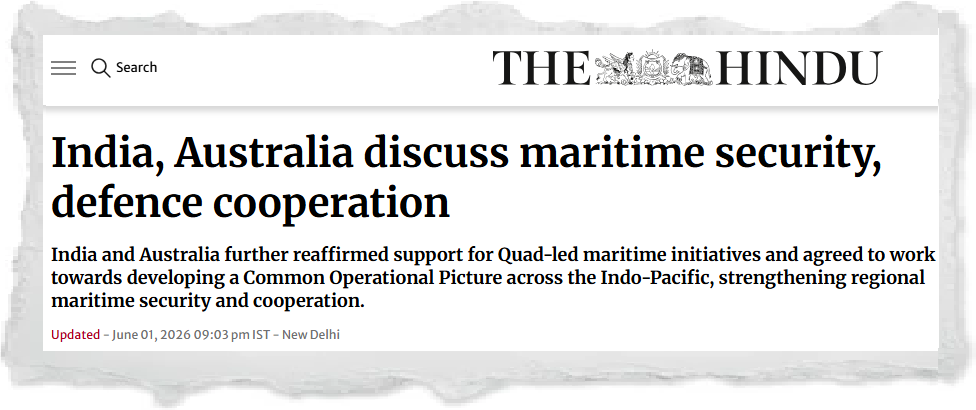
India and Australia held the second India–Australia Defence Ministers’ Dialogue in New Delhi on June 1, 2026. Defence Minister Rajnath Singh and Australian Deputy Prime Minister and Defence Minister Richard Marles reviewed bilateral defence ties and reaffirmed their commitment to strengthening maritime security, defence industry cooperation, interoperability, and emerging technology collaboration across the Indo-Pacific.
UPSC Relevance
Prelims:
Quad, UNCLOS, Indo-Pacific, maritime security initiatives, defence exercises, military logistics agreements.
Mains:
GS-II: India and its bilateral relations, international groupings,
GS-III: Internal security, defence technology, maritime security, strategic affairs.
Background
India and Australia have transformed their relationship from a primarily economic partnership into a comprehensive strategic partnership over the last decade. Shared concerns regarding maritime security, freedom of navigation, resilient supply chains, and regional stability have brought the two countries closer.
The relationship gained momentum through:
- Comprehensive Strategic Partnership (2020)
- Mutual Logistics Support Arrangement (MLSA)
- Growing cooperation within the Quad framework
- Regular bilateral and multilateral military exercises
- Expanding defence industrial engagement
The latest Defence Ministers’ Dialogue reflects the increasing strategic convergence between the two countries in the Indo-Pacific region.
Evolution of India–Australia Defence Relations
From Strategic Dialogue to Operational Cooperation
India and Australia have gradually expanded defence engagement from policy consultations to practical military cooperation. The relationship now includes:
- Joint military exercises across all three services.
- Intelligence and information-sharing mechanisms.
- Logistics cooperation.
- Maritime surveillance collaboration.
- Defence technology engagement.
The two countries increasingly view each other as important security partners in maintaining stability across the Indian Ocean and Pacific regions.
Shared Strategic Outlook
Both nations support:
- A free, open, inclusive and rules-based Indo-Pacific.
- Respect for international law.
- Freedom of navigation and overflight.
- Peaceful resolution of disputes.
- Opposition to unilateral attempts to alter the status quo.
These principles align closely with India’s Indo-Pacific Oceans Initiative (IPOI) and Australia’s Indo-Pacific Strategy.
Maritime Security: The Core Pillar of Cooperation
Growing Importance of the Maritime Domain
The Indian Ocean Region has become central to global trade, energy transportation, and strategic competition. A significant portion of global commerce passes through critical sea lanes in the region.
Both countries recognise that maritime security is no longer limited to naval operations but now includes:
- Maritime domain awareness.
- Undersea infrastructure protection.
- Submarine monitoring.
- Cybersecurity of maritime assets.
- Protection of critical sea lanes.
Joint Maritime Security Collaboration Roadmap
A major outcome of the dialogue was progress towards finalising a Joint Maritime Security Collaboration Roadmap.
The proposed framework seeks to enhance cooperation in:
- Maritime surveillance.
- Information sharing.
- Undersea monitoring.
- Coast Guard coordination.
- Operational interoperability.
This roadmap is expected to become a cornerstone of future India–Australia security cooperation.
Underwater Security and Emerging Challenges
An important focus area discussed during the meeting was underwater security.
Growing concerns include:
- Vulnerability of submarine communication cables.
- Increased submarine activities.
- Grey-zone operations in maritime spaces.
- Protection of offshore energy infrastructure.
India and Australia are exploring advanced technologies and sensor systems to improve underwater situational awareness and maritime domain awareness.
Defence Industrial Cooperation
Expanding Defence Manufacturing Partnership
A significant development was the decision to work towards a Memorandum of Understanding on the Provision of Defence Articles and Defence Services.
The proposed arrangement could facilitate:
- Defence exports and imports.
- Joint development projects.
- Technology sharing.
- Defence supply chain integration.
- Industrial partnerships.
This aligns with India’s objective of becoming a major defence manufacturing hub under the “Atmanirbhar Bharat” initiative.
Emerging Technologies Cooperation
The dialogue also highlighted collaboration in future-oriented technologies such as:
- Advanced sensor systems.
- Maritime surveillance technologies.
- Artificial Intelligence applications.
- Defence innovation.
- Research and development partnerships.
Australia also invited India to participate in the 2026 Australian Defence Science, Technology and Research Summit.
Military-to-Military Cooperation
Joint Exercises
The two countries welcomed growing participation in major military exercises, including:
| Exercise | Nature |
|---|---|
| Milan | Naval Exercise |
| Kakadu | Maritime Exercise |
| Talisman Sabre | Joint Military Exercise |
| Pitch Black | Air Force Exercise |
| Austrahind | Army Exercise |
These exercises improve interoperability and operational familiarity between the armed forces.
Logistics Cooperation
The Mutual Logistics Support Arrangement enables:
- Access to military bases.
- Refuelling and replenishment.
- Maintenance support.
- Greater operational reach.
The dialogue also endorsed continued aircraft deployments from each other’s territories to strengthen practical cooperation.
The Quad Dimension
Strengthening Regional Security Architecture
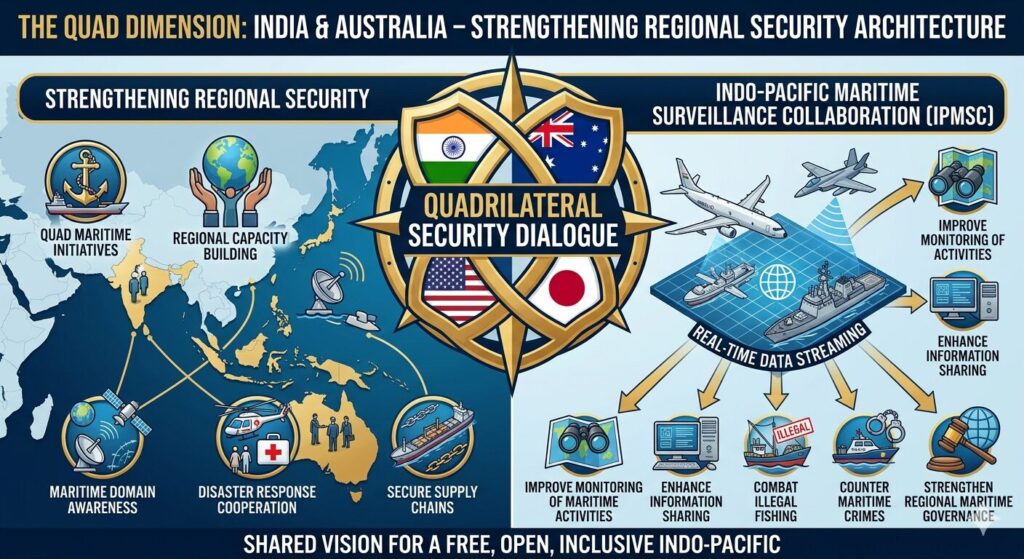
India and Australia are key members of the Quadrilateral Security Dialogue alongside the United States and Japan.
The ministers reiterated support for:
- Quad maritime initiatives.
- Regional capacity building.
- Maritime domain awareness.
- Disaster response cooperation.
- Secure supply chains.
Indo-Pacific Maritime Surveillance Collaboration (IPMSC)
Both sides expressed support for the Quad’s Indo-Pacific Maritime Surveillance Collaboration (IPMSC) initiative.
The initiative seeks to:
- Improve monitoring of maritime activities.
- Enhance information sharing.
- Combat illegal fishing.
- Counter maritime crimes.
- Strengthen regional maritime governance.
What is the Significance for India?
Securing the Indian Ocean Region
Australia’s strategic location and maritime capabilities complement India’s position as a major Indian Ocean power.
Enhanced cooperation can help:
- Protect sea lanes of communication.
- Monitor maritime threats.
- Improve regional stability.
- Strengthen maritime deterrence.
Defence Modernisation
Collaboration with Australia provides opportunities for: Technology acquisition, Joint research, Defence innovation, Industrial partnerships.
Balancing Strategic Competition
The growing partnership contributes to maintaining a stable balance of power in the Indo-Pacific while supporting a rules-based international order.
Challenges
Divergent Strategic Priorities
Despite convergence, India and Australia may occasionally differ on:
- Regional crises, China-related policies Trade and economic considerations.
Resource Constraints
Implementing ambitious maritime and technological initiatives requires: Sustained investments, Infrastructure development, Human resource capacity.
Evolving Security Environment
Rapid technological changes and emerging threats such as cyber warfare, autonomous systems, and grey-zone tactics require continuous adaptation.
Way Forward
Enhance Maritime Domain Awareness
India and Australia should accelerate cooperation in surveillance systems, information-sharing networks, and undersea monitoring technologies.
Expand Defence Industrial Collaboration
Joint production, co-development projects, and defence innovation partnerships should be encouraged to deepen strategic interdependence.
Institutionalise Strategic Dialogue
Regular defence, foreign policy, and security consultations can ensure long-term alignment on regional issues.
Strengthen Quad Cooperation
Greater synergy between bilateral and Quad initiatives can contribute to a more secure and resilient Indo-Pacific.
Conclusion
India–Australia defence ties have evolved into one of the most significant strategic partnerships in the Indo-Pacific. With growing cooperation in maritime security, defence technology, industrial collaboration, and regional governance, both countries are positioning themselves as important stakeholders in shaping a stable and rules-based regional order. The latest Defence Ministers’ Dialogue demonstrates that the partnership is moving beyond symbolism towards substantive and operational cooperation.
Practice Questions
Prelims Question 1 (Inference-Based)
Consider the following statements:
- Enhanced maritime domain awareness contributes to both national security and protection of global trade routes.
- Undersea infrastructure such as communication cables has emerged as a critical component of maritime security.
Which one of the following is the most appropriate inference from the above statements?
(a) Maritime security is no longer confined to traditional naval warfare alone.
(b) Maritime security is relevant only for countries possessing large navies.
(c) Maritime security concerns arise only during wartime.
(d) Maritime surveillance has replaced naval forces in the Indo-Pacific.
Answer: (a)
Explanation: The statements indicate that maritime security today encompasses economic, technological, and infrastructure dimensions beyond conventional naval operations. Hence, maritime security has become a broader strategic concept.
Prelims Question 2
Consider the following pairs:
| Exercise | Participating Countries |
|---|---|
| 1. Austrahind | India and Australia |
| 2. Pitch Black | Australia-led Air Force Exercise |
| 3. Kakadu | Multinational Naval Exercise hosted by Australia |
How many pairs given above are correctly matched?
(a) Only one
(b) Only two
(c) All three
(d) None
Answer: (c)
Explanation:
- Pair 1: Correct. Austrahind is a bilateral Army exercise between India and Australia.
- Pair 2: Correct. Pitch Black is a major multinational air combat exercise hosted by Australia.
- Pair 3: Correct. Kakadu is Australia’s premier multinational maritime exercise involving several regional navies.
Therefore, all three pairs are correctly matched.
Mains Questions
- India–Australia defence cooperation has emerged as a critical pillar of Indo-Pacific security architecture. Examine its significance for India’s strategic interests.
- Discuss the growing importance of maritime domain awareness and undersea security in the evolving geopolitics of the Indo-Pacific region.
Tell Google you want more of this.
Add Anantam IAS as a preferred sourceOne tap, and this site shows up more often in your own Top Stories, AI Overviews and AI Mode. Remove it any time.