Why in News?
NITI Aayog’s Frontier Tech Hub released the Data Centre Evaluation Framework on 14 October 2026, with PIB reporting it on 15 October, to guide sustainable state-level investment decisions.
- The framework addresses power, water, siting, economic value and governance through five connected pillars.
- It recommends assessing grid readiness, basin-level water stress and public-supply impacts before supporting projects.
- It is a decision-support tool for states, not an additional regulatory layer or a substitute for existing approvals.
- Data centres support AI, cloud computing and digital services, but depend on physical electricity, cooling, land and connectivity.
- The policy question is whether local infrastructure can sustain an investment and whether public support produces measurable benefits.
UPSC Relevance
Prelims Relevance
- Issuing institution: NITI Aayog’s Frontier Tech Hub.
- Net grid draw: electricity a facility needs from the grid after accounting for its other supplies.
- Basin-level water stress: resource pressure extending beyond an individual project boundary.
- Colocation: hosting customers’ computing equipment in shared facility infrastructure.
- Policy status: a decision-support framework for state governments.
Mains Relevance
GS Paper 3
- Digital infrastructure planning under electricity and water constraints.
- Evaluating investment incentives through resource sustainability and technological capability.
GS Paper 2
- Coordination among state agencies, utilities and investors with clear accountability.
Essay
- Digital growth depends on the stewardship of physical resources.
Background and Context
From Investment Attraction to Infrastructure Readiness
A project proposal becomes viable only when its physical requirements fit the location and the state can deliver its commitments.
- A data centre houses computing equipment alongside power, cooling and connectivity systems. Its role in digital services does not remove its dependence on physical resources shared with other users in the surrounding economy.
- The framework links five pillars: Power and Energy; Water and Cooling; Siting and Environmental Sustainability; Economic and Strategic Value; and Policy, Governance and Implementation. Their value lies in assessing interdependent requirements rather than isolated promises.
- Investment readiness means checking infrastructure availability, resource requirements and implementation capacity before committing state support. An announced project can otherwise encounter delays when electricity connections, water supply or essential supporting facilities cannot arrive as expected.
- Siting is a resource decision, not merely a land transaction. States should identify suitable zones by considering power, water, connectivity and environmental sustainability together, because a convenient plot can still impose difficult infrastructure demands.
- The framework provides decision support, without creating another regulatory layer. Its recommendations help states evaluate proposals and anticipate constraints; they should not be described as a new law granting exemptions or automatically approving individual projects.
Why Power and Water Must Be Assessed Together
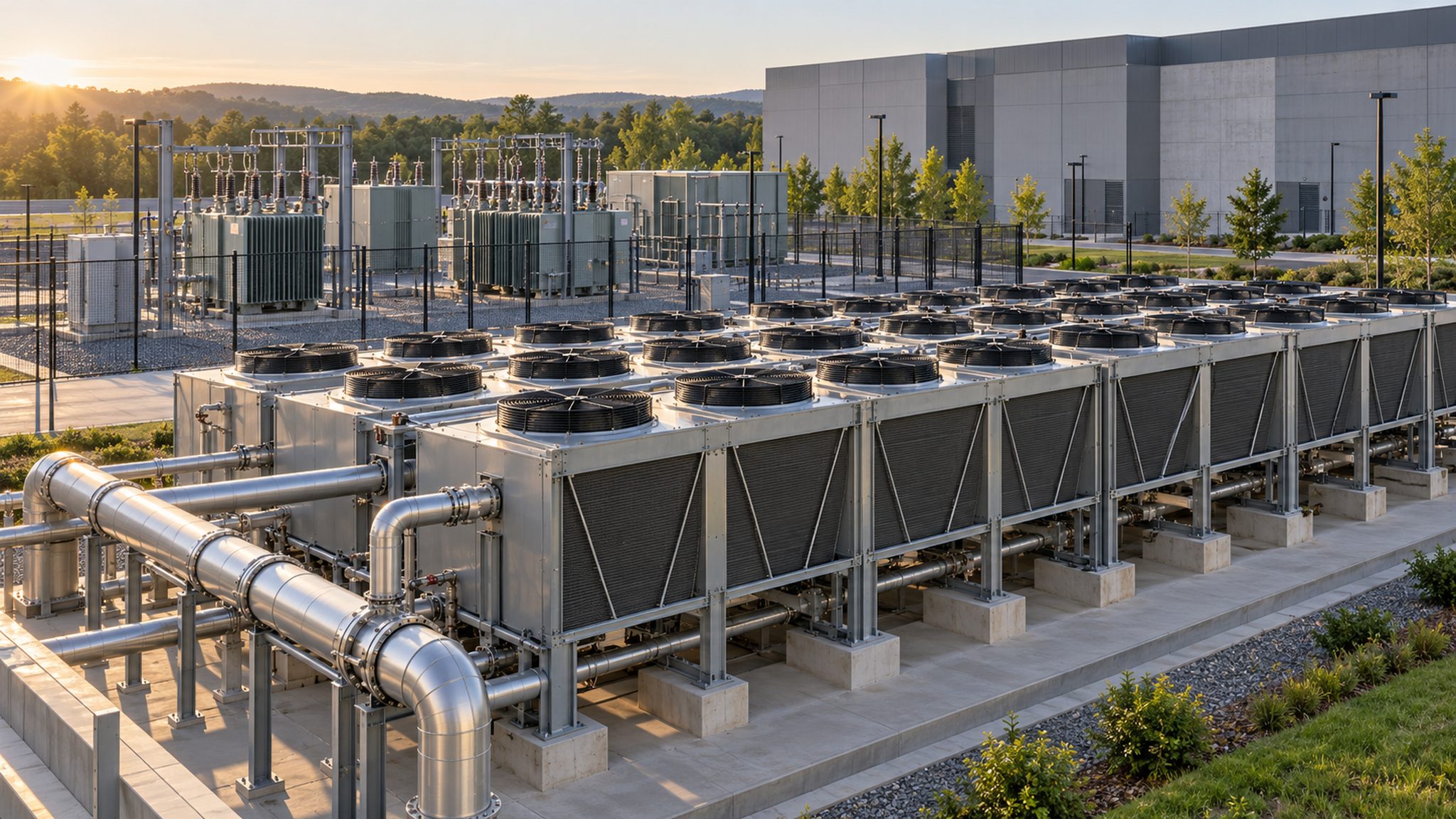
Computing consumes electricity and releases heat, making power supply and cooling choices central to both operating reliability and resource sustainability.
- Grid readiness asks whether the electricity system can serve the proposed load. Net grid draw concerns the demand remaining on that system after other supplies are considered; renewable procurement alone does not establish local network readiness.
- The framework recommends renewable energy and storage-backed power. For planning, states must examine how supply arrangements meet operating needs over time, rather than treating a renewable-energy commitment as proof that continuous demand is already covered.
- Water and cooling require attention beyond the facility fence. A source that appears adequate for one project may face competing demands across its basin, so the framework calls for assessing water stress and public-supply impacts.
- Rainwater harvesting, on-site treatment and storage are recommended resource measures. Their usefulness depends on local conditions and the operating design; listing them in a proposal does not demonstrate that the project avoids pressure on public supplies.
- Lifecycle planning extends environmental assessment beyond daily operations to e-waste, batteries and other hazardous waste. Disposal responsibilities matter because investment readiness includes managing the material consequences of infrastructure, not just securing inputs at project commissioning.
Measuring Public Value Instead of Project Size
The framework asks states to connect facilitation with economic outcomes that can be assessed after a facility starts operating.
- Colocation and active compute services represent different activities: hosting equipment is not identical to providing computing services. Distinguishing them helps states examine what a proposal delivers, rather than assuming every facility creates the same economic value.
- State incentives should be linked to measurable outcomes, as the framework recommends. Public support can then be assessed against delivered commitments, rather than being justified only by the scale or visibility of the initial investment announcement.
- Domestic capability is a separate policy objective from attracting buildings and equipment. The framework promotes Indian participation across IT and non-IT infrastructure, while the release highlights research collaboration, advanced cooling and resource-efficient computing as opportunities.
- Time-bound approvals work best with clear accountability and monitoring of commitments. Predictability can reduce implementation risk, but faster processing should follow better preparation and coordination rather than conceal unresolved infrastructure requirements or resource constraints.
- A useful policy comparison is investment attraction versus investment readiness: the former secures interest; the latter tests deliverability. The framework seeks both sustainable capacity and lasting economic value, rather than treating an announcement as completion.
Way Forward
Make Support Conditional on Deliverable Commitments
- Require proposals to explain net grid demand, cooling choices and water sources, with the responsible utility or agency identified.
- Tie incentives to measurable commitments and review delivery after operations begin, including resource management and domestic capability.
- Coordinate power, water, environment and industry agencies around shared project milestones so unresolved dependencies surface before approvals or support are promised.
Conclusion
- Data-centre growth should be judged by whether infrastructure and resources can support it over time. A credible proposal connects electricity, cooling, location and implementation commitments rather than presenting each as a separate assurance.
- For analysis, distinguish public value from investment size: the framework’s contribution is structured evaluation, not a new regulatory mandate. States must translate its recommendations into location-specific decisions and monitor whether promised benefits actually follow.
UPSC Practice Questions
Prelims MCQ 1
With reference to the Data Centre Evaluation Framework, consider the following statements:
- It was released by NITI Aayog’s Frontier Tech Hub.
- It recommends evaluating basin-level water stress and public-supply impacts.
- It creates an additional statutory approval layer for every data centre.
How many of the above statements are correct?
(a) Only one (b) Only two (c) All three (d) None
Answer: (b) Only two
Explanation:
The first two statements are correct. The framework is a decision-support tool and is explicitly intended to avoid an additional regulatory layer.
Prelims MCQ 2
Which approach best reflects investment readiness for a proposed data centre?
(a) Granting incentives solely according to announced investment (b) Assuming renewable procurement establishes grid readiness (c) Assessing infrastructure, resource availability and implementation commitments before providing support (d) Treating land availability as sufficient for project viability
Answer: (c) Assessing infrastructure, resource availability and implementation commitments before providing support
Explanation:
Investment readiness tests whether a project can be supported sustainably, including electricity, water, siting and implementation requirements.
UPSC Mains Questions
- Why must states move from attracting data-centre investments to establishing investment readiness? Discuss with reference to power and water constraints.
- Explain how outcome-linked incentives and inter-agency coordination can improve the public value of data-centre investments.
Source: PIB, NITI Aayog.
Frequently Asked Questions
What is the Data Centre Evaluation Framework?
It is a decision-support framework released by NITI Aayog’s Frontier Tech Hub to help states assess data-centre proposals against infrastructure readiness, environmental sustainability, economic value and implementation requirements.
Does the framework create a new regulation?
No. The official release describes it as a decision-support tool intended to improve planning and project evaluation without adding a regulatory layer. It should not be presented as a new statutory approval regime.
Why is basin-level water stress relevant?
A facility shares water resources with other users beyond its immediate boundary. Basin-level assessment helps reveal competing demands and potential effects on public supplies that a project-level water commitment may miss.
Why distinguish colocation from active compute services?
Colocation provides facility infrastructure for customers’ equipment, while active compute services involve providing computing services. The distinction helps states evaluate the actual activity and benefits promised by a particular investment proposal.
Tell Google you want more of this.
Add Anantam IAS as a preferred sourceOne tap, and this site shows up more often in your own Top Stories, AI Overviews and AI Mode. Remove it any time.