
Why in News?
The government is considering delimitation based on the 2011 Census to fast-track the implementation of the Women’s Reservation Act, 2023. Under the proposed amendments, the number of Lok Sabha seats will increase from 543 to 816, with 273 seats reserved for women.
| UPSC Relevance: GS-2 Polity and Governance; GS-2 Social Justice: Issues related to Women Mains: Women’s Reservation: Need, Significance and Challenges. |
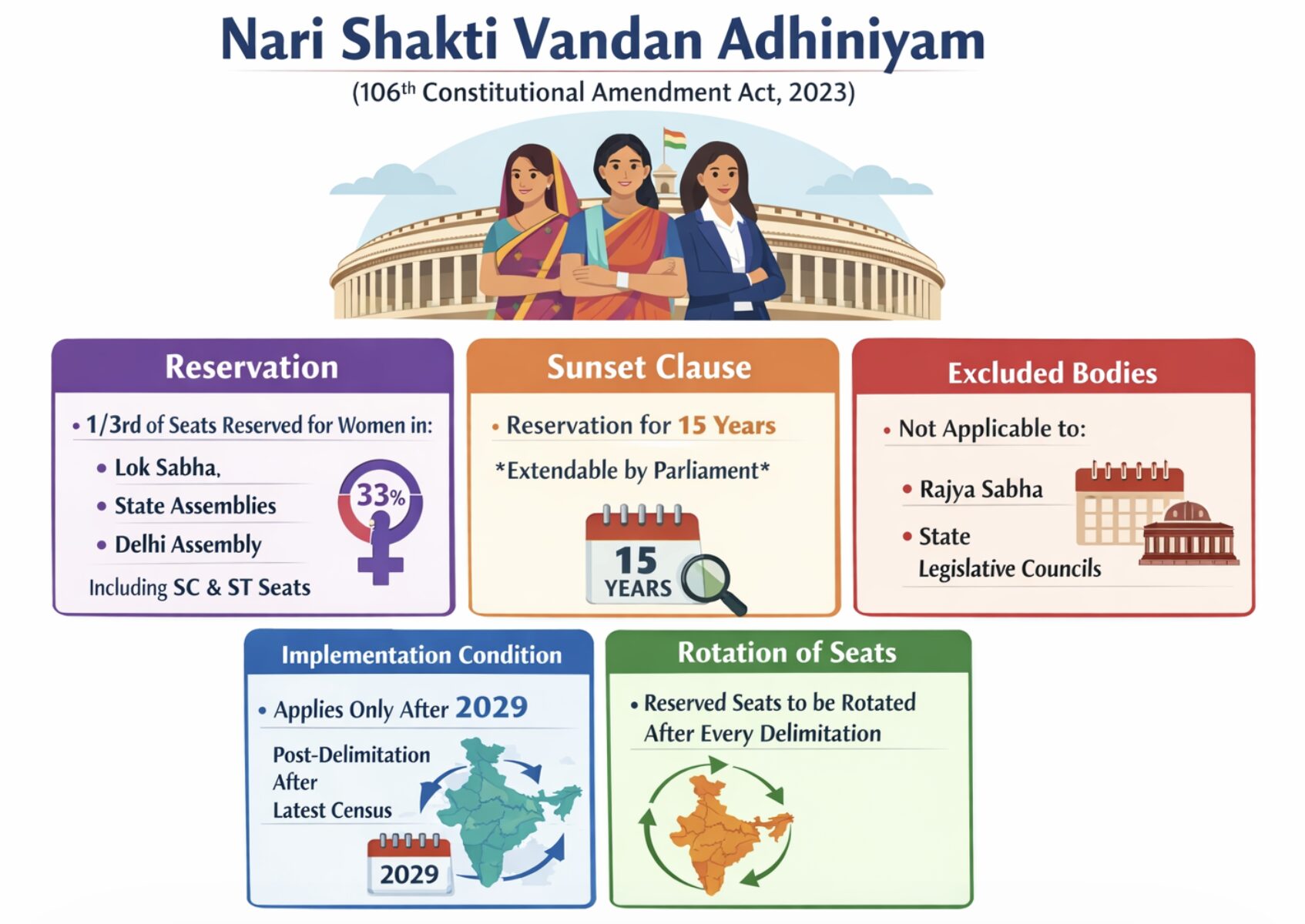
Nari Shakti Vandan Adhiniyam (106th Constitutional Amendment Act 2023):
- Reservation: The 106th CAA seeks to reserve 1/3rd of the total number of seats for women in the Lok Sabha, State Legislative Assemblies, and the Delhi Legislative Assembly, including seats reserved for SCs and STs.
- Sunset Clause: The reservation is initially for 15 years, which may be extended by Parliament.
- Implementation Condition: Such a quota will apply only after 2029, once the delimitation exercise following the latest Census concludes.
- Rotation of Seats: Seats reserved for women will be rotated after every delimitation exercise.
- Excluded Bodies: Does not apply to Rajya Sabha or State Legislative Councils.
| What is Delimitation? • Delimitation means the process of fixing the number of seats and boundaries of territorial constituencies in each State for the Lok Sabha and Legislative assemblies. It aims to ensure each constituency has a roughly equal population. • The Constitution under Article 82 mandates delimitation after each census to readjust the seats as per changes in population. • This exercise is performed by the ‘Delimitation Commission’ that is set up by an act of Parliament. Such an exercise was carried out based on the 1951, 1961 and 1971 Census. • The number of seats in the Lok Sabha, based on the 1971 Census, was fixed at 543, when the population was 54.8 crore. • The 42nd Constitutional Amendment Act, 1976, froze delimitation until 2001 to encourage population control. • The 84th Constitutional Amendment Act, 2001, put on hold delimitation until the first Census after 2026. |
Significance of Women’s Reservation:
- Addressing Gender Disparity: Addresses the low representation of women (roughly 15% in the 17th Lok Sabha) in Indian law-making bodies. Gender parity in governance and political participation is a prerequisite to the realisation of gender equality.
- Women-Led Development: Shifts the focus from mere women’s development to women-led development. Improves gender-sensitive policymaking.
Possible Policy Shift:
Recent reports suggest that women’s reservations may be implemented earlier than expected.
- Delimitation may be conducted using the 2011 Census data.
- Lok Sabha strength may increase from 543 to around 816 seats (~50% increase).
- State Assemblies may also expand proportionately.
Associated Challenges & Concerns:
- Use of Outdated Census Data: Basing women’s reservation on the 2011 Census is problematic. Rapid urbanisation, migration, and the after-effects of the COVID-19 pandemic have significantly reshaped population patterns, altering both urban and rural constituencies. Proceeding with outdated data risks misrepresenting current population realities.
- Delay possible demand for sub-quota: The upcoming Census may include caste enumeration beyond SC/ST categories. Inclusive women’s reservation might see likely demands of sub-quota for OBC women and representation for minority women. Delaying Census-based delimitation may postpone these demands temporarily.
Arguments against Women’s Reservation:
- Restricted Electoral Choice: Reservation limits the pool of candidates in certain constituencies to women only, potentially constraining voter choice. Critics argue that with ~24% seats already reserved for SCs and STs in the Lok Sabha, adding 33% reservation for women could be a disproportionate representation of people’s wishes.
- Reinforce gender stereotype: Reservation will incentivise women to contest, predominantly in reserved constituencies, against other women candidates. This may further reinforce the existing gender stereotype. Women elected under quota systems can be perceived as less competent or qualified than those elected in open seats.
- Issues with rotation of reserved constituencies: Rotation of reserved constituencies may reduce the incentive for the representatives to develop their constituency, as they may be ineligible to seek re-election from the same constituency. Frequent rotation may disrupt continuity and accountability.
- Does Not Address Structural Issues: Women’s reservation alone may not resolve deeper systemic problems, such as the criminalisation of politics, the lack of inner-party democracy, High campaign financing barriers and Limited political training opportunities for women. Thus, women’s representation may increase without improving the overall quality of democracy.
- Possible Elite Capture: Reserved tickets may be disproportionately given to women from established political families, dominant castes, or financially affluent groups, rather than empowering ordinary women. This can make the process look symbolic rather than transformative.
- Proxy Representation: Concerns about ‘sarpanch pati’ style proxies, where men may wield power on behalf of female representatives.
Way Forward:
- Use the latest census data (undergoing census) to ensure fair and updated representation of women in politics.
- Reservation in nomination: Make it mandatory for every recognised political party to nominate women candidates for election in at least 1/3rd of the constituencies.
- State funding of elections or subsidising the election expenditure of women candidates will encourage women’s participation in elections.
- Encourage Mahila Gram Sabha as it provides women with the playing field for garnering political experience, and create a pipeline of women leaders from local bodies to state and national politics.
- Combat criminalisation of politics to improve the overall quality of democracy, and Gender sensitisation of political parties.
UPSC Mains PYQ 2019
Q. The reservation of seats for women in the institutions of local self-government has had a limited impact on the patriarchal character of the Indian Political Process. Comment.
Tell Google you want more of this.
Add Anantam IAS as a preferred sourceOne tap, and this site shows up more often in your own Top Stories, AI Overviews and AI Mode. Remove it any time.