Denotified Nomadic Tribes are among the most invisible communities in India’s social map. Roughly 15 crore people, by Idate Commission estimates, belong to Denotified Nomadic Tribes, Nomadic Tribes, or Semi-Nomadic Tribes (collectively DNT-NT-SNT). Despite the scale, most policy conversations skip them. They were branded “criminal” by colonial law in 1871, denotified in 1952, and have lived in administrative limbo ever since.
April 2026 brought renewed attention to DNT welfare following parliamentary questions about implementation gaps in the SEED (Scheme for Economic Empowerment of DNTs) program and budgetary allocations to the Development and Welfare Board for Denotified, Nomadic and Semi-Nomadic Communities (DWBDNC).
This piece is a complete primer on Denotified Nomadic Tribes, the legal and historical baggage they carry, the commissions that mapped their condition, and the welfare architecture that’s slowly being built. For UPSC aspirants, this is GS-II social justice and Mains essay material.
Quick Facts at a Glance
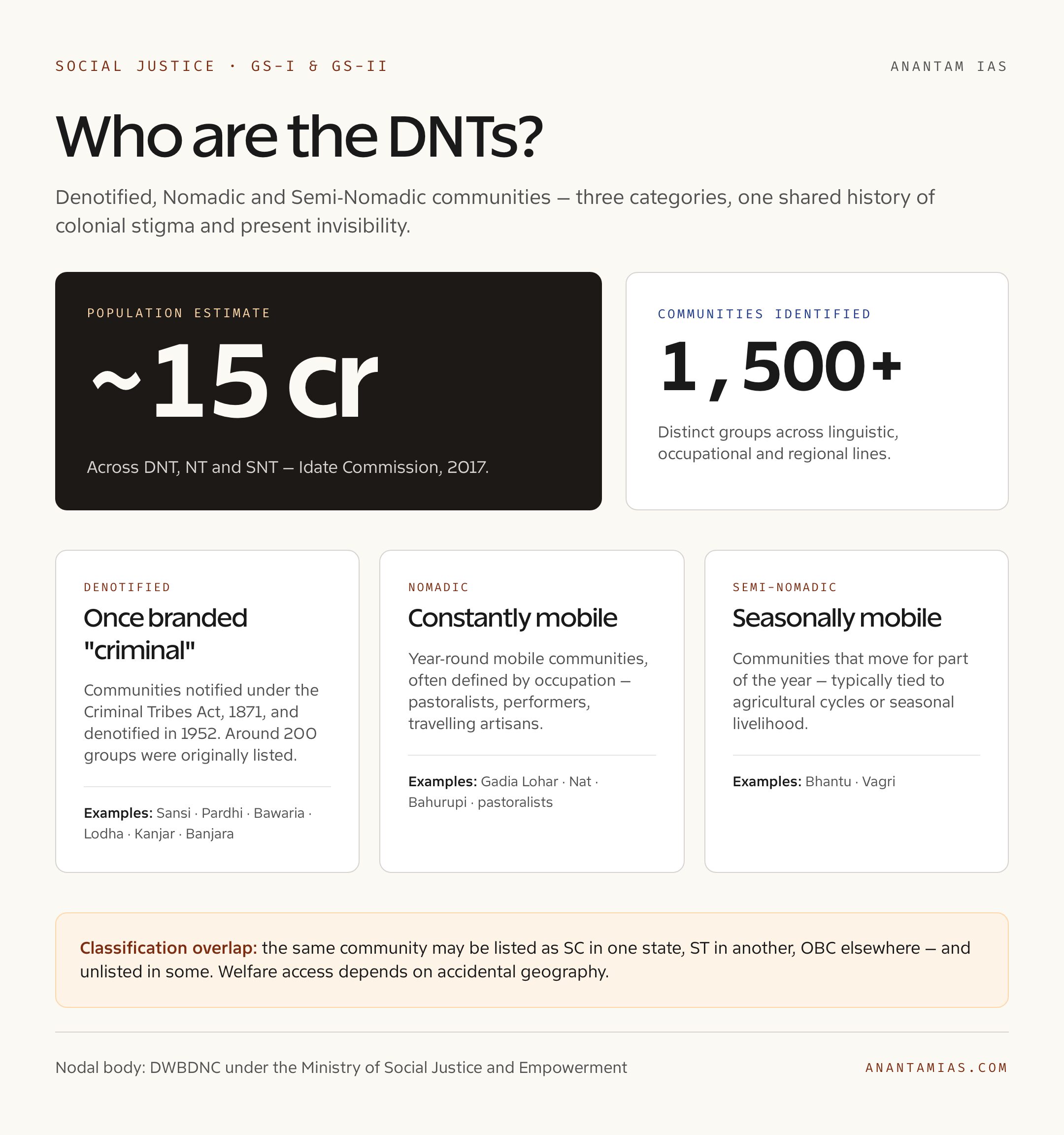
- Population estimate: ~15 crore across DNT, NT, and SNT (Idate Commission, 2017)
- Number of communities: 1,500+ identified groups
- Colonial law: Criminal Tribes Act, 1871
- Repeal year: Criminal Tribes Act repealed in 1949, denotification in 1952
- Replacement law: Habitual Offenders Act, 1952 (state-level variants)
- Key commissions: Lokur Committee (1965), Renke Commission (2008), Idate Commission (2017)
- Implementing body: DWBDNC (2019), under Ministry of Social Justice and Empowerment
- Flagship scheme: SEED (Scheme for Economic Empowerment of DNTs), launched 2022
- UPSC relevance: GS-I (Society), GS-II (Social Justice, Welfare Schemes)
What Just Happened
In April 2026, ahead of the monsoon session, parliamentary committee discussions surfaced the slow uptake of SEED scheme components and shortfalls in DNT scholarship disbursement. Civil society advocacy, particularly by the National Alliance Group for Denotified and Nomadic Tribes, pushed for accelerated implementation of Idate Commission recommendations.
The Ministry of Social Justice and Empowerment confirmed that the DWBDNC is finalising a national database of DNT communities, a critical baseline for targeted welfare. The April update reignited discussion on whether DNTs should receive a separate constitutional category or continue to be subsumed under SC/ST/OBC classifications, an ambiguity that has plagued the policy framework for decades.
Background and Historical Context
The story begins in colonial India. The British administration, struggling to control mobile communities that didn’t fit settled agriculture or wage labour, passed the Criminal Tribes Act, 1871. The Act notified entire communities as “habitually criminal” by birth, requiring them to register with police, restricting their movement, and subjecting them to surveillance.
The Long Shadow of the Criminal Tribes Act
Around 200 communities were notified under the 1871 Act. Their members carried passes, reported to police regularly, and lived in designated settlements. The Act extended through several amendments and remained on the statute books until 1949, when independent India repealed it. In 1952, the notified communities were officially “denotified,” giving rise to the term Denotified Tribes.
The repeal was symbolic but incomplete. State governments quickly enacted Habitual Offenders Acts, which targeted individuals rather than whole communities but practically continued police surveillance of DNT communities. Many DNTs report that they’re still treated as suspect by local police, hauled in for questioning whenever a crime occurs nearby. The colonial stigma never fully lifted.
Communities like Sansi, Pardhi, Bawaria, Kanjar, Lodha, and Banjara fall under Denotified Tribes. Nomadic Tribes include Gadia Lohar (blacksmiths), Nat (acrobats), Bahurupi (mimics), and various pastoralist groups. Semi-Nomadic communities like the Bhantu and Vagri move seasonally for livelihood.
Lokur, Renke, and Idate: Three Commissions, One Story
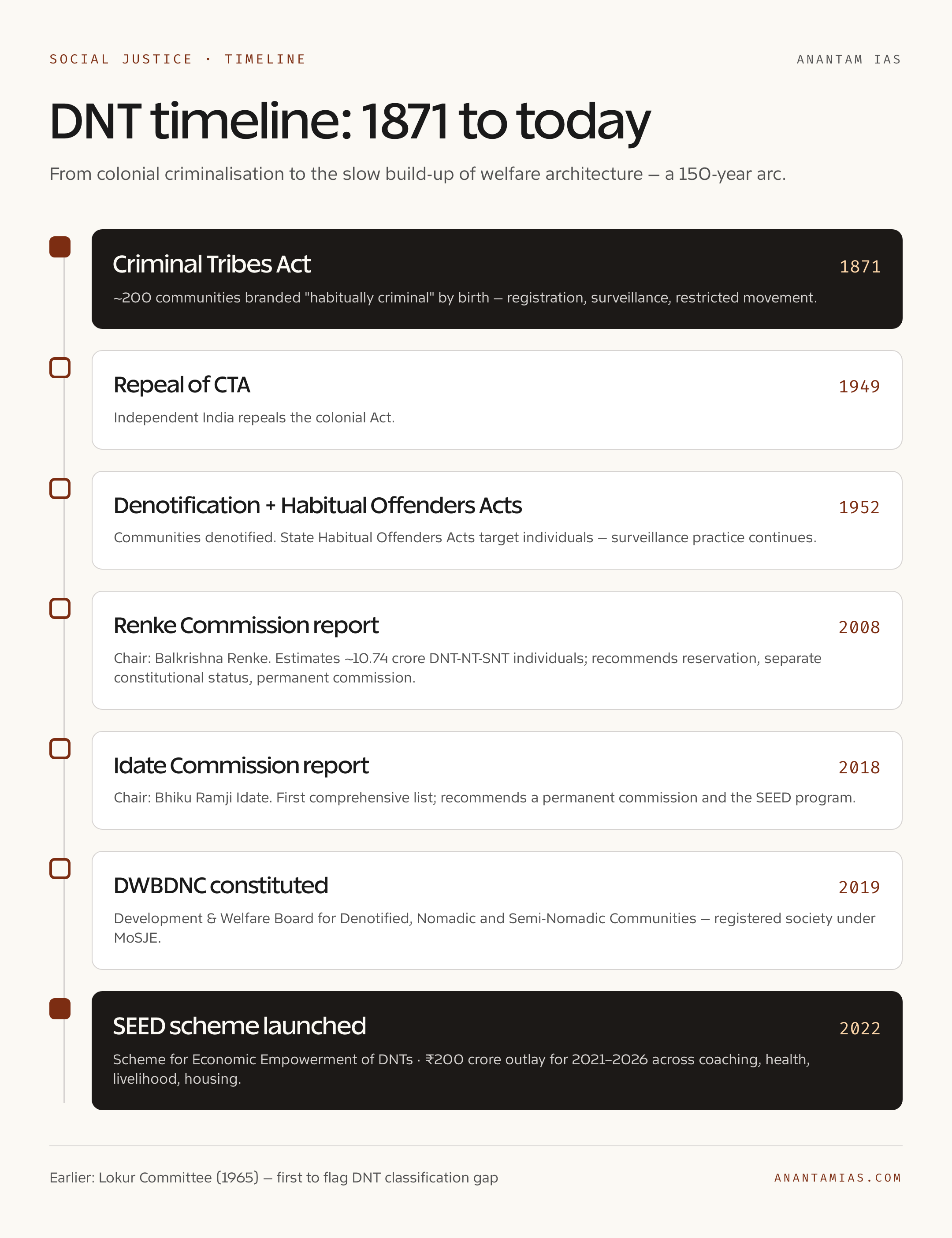
Three commissions have studied DNT-NT-SNT communities and tried to chart a way forward.
Lokur Committee (1965) examined Scheduled Castes and Scheduled Tribes lists. While not exclusively focused on DNTs, the committee flagged the problem of communities falling between SC, ST, and OBC categories.
Renke Commission (2008), formally the National Commission for Denotified, Nomadic and Semi-Nomadic Tribes, was chaired by Balkrishna Renke. Its report, submitted in 2008, identified roughly 10.74 crore DNT-NT-SNT individuals and recommended reservation in education and employment, separate constitutional status, a permanent commission, and welfare schemes covering housing, healthcare, and livelihood.
Idate Commission (2017), headed by Bhiku Ramji Idate, was set up in 2014 and submitted its report in January 2018. It compiled the first comprehensive list of DNT-NT-SNT communities, recommended a permanent commission with constitutional status (akin to SC/ST commissions), proposed welfare schemes including the SEED program, and suggested administrative reforms to remove the stigma associated with DNTs.
The Idate Commission’s recommendations led to the formation of DWBDNC in February 2019.
Key Provisions: Welfare Architecture for DNTs
DWBDNC
The Development and Welfare Board for Denotified, Nomadic and Semi-Nomadic Communities is a registered society under the Ministry of Social Justice and Empowerment. Its mandate covers identifying DNT-NT-SNT communities, formulating welfare schemes, monitoring implementation, and serving as the nodal body for grievance redressal. The board was constituted in February 2019.
SEED Scheme
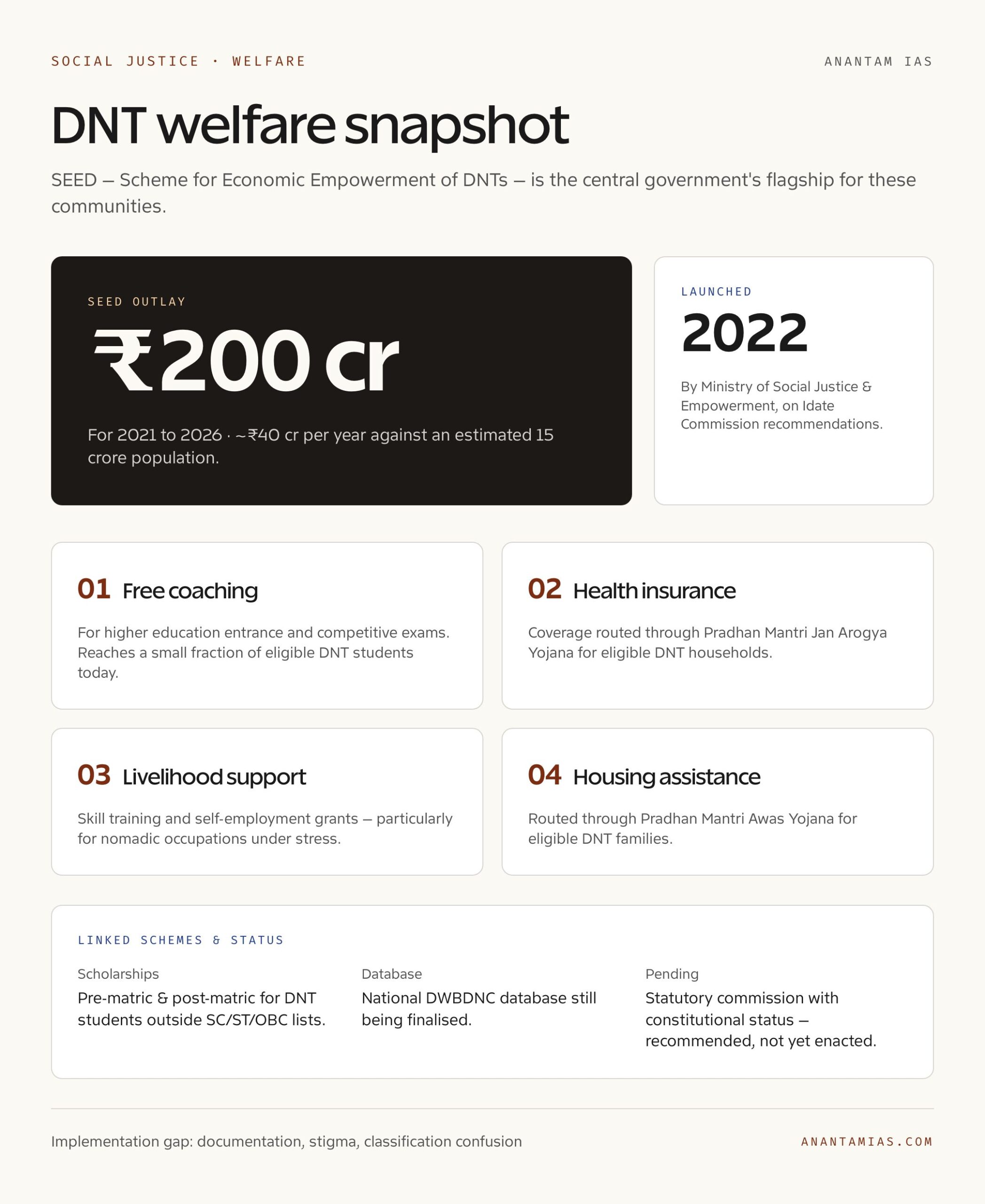
The Scheme for Economic Empowerment of DNTs, launched in 2022, is the central government’s flagship welfare program for these communities. SEED has four components:
- Free coaching for higher education and competitive exams
- Health insurance through Pradhan Mantri Jan Arogya Yojana
- Livelihood support through skill training and self-employment
- Housing assistance under Pradhan Mantri Awas Yojana for eligible families
The total SEED outlay is Rs 200 crore for the 2021 to 2026 period. Critics argue this is grossly insufficient given the population scale.
Pre-matric and Post-matric Scholarships
DNT students who don’t fall under SC, ST, or OBC categories are eligible for dedicated scholarships under the Ministry of Social Justice and Empowerment.
Linkages with Other Schemes
DNTs are eligible for benefits under PM Awas Yojana, Ayushman Bharat, MGNREGA, and various state-level welfare programs. The challenge is documentation: most DNT families lack residence certificates, ration cards, or caste certificates.
Why DNTs Matter for UPSC and Policy
DNT issues sit at the intersection of social justice, constitutional law, criminology, and development economics.
The constitutional question is sharp. Article 14 (equality before law), Article 15 (non-discrimination), and Article 16 (equality of opportunity in public employment) apply to DNTs as they do to all citizens. But Article 15(4), 15(5), and 16(4), which enable affirmative action for “socially and educationally backward classes” or SC/ST, don’t have a clean DNT bucket. Many DNT communities are listed under SC/ST/OBC depending on the state. Some are listed in one category in one state and a different category in another. Some aren’t listed anywhere.
This classification ambiguity has real consequences. A Pardhi family in Maharashtra may be listed as ST. The same community in Madhya Pradesh may be SC. In Rajasthan, OBC. Cross-state migration disrupts welfare access. For broader context on India’s social justice framework, our reference on fundamental rights and articles covers the relevant constitutional provisions.
Detailed Analysis: Why Welfare Doesn’t Reach
Three structural barriers explain why welfare schemes don’t translate into outcomes for DNT communities.
Documentation deficit. DNTs, especially nomadic groups, often lack permanent addresses, voter IDs, Aadhaar cards, or caste certificates. Without these, scheme enrolment is impossible. The DWBDNC’s national database, when complete, should help, but enrolment drives need to physically reach mobile communities.
Stigma and discrimination. Local administrators, police, and even health workers often carry inherited prejudices. DNT children face exclusion in schools. DNT job-seekers face hiring bias. This soft barrier is harder to legislate against.
Categorical confusion. As discussed, the SC/ST/OBC overlap creates inconsistent benefits across states. A constitutional commission for DNTs, on the lines of NCSC and NCST, has been recommended for nearly two decades but hasn’t materialised.
Budgetary limits. The SEED scheme’s Rs 200 crore for five years works out to roughly Rs 40 crore per year for an estimated 15 crore population. Even after accounting for non-targeted scheme overlaps, the per-capita allocation remains thin.
Comparative Perspective: Roma in Europe
The Indian DNT situation has parallels with the Roma communities of Europe, who similarly face historical stigma, mobility-based discrimination, and welfare access barriers. The European Union’s Framework for National Roma Integration Strategies (2011) and EU Roma Strategic Framework (2020 to 2030) offer some reference points: dedicated funding, anti-discrimination monitoring, and education-employment-housing-health pillars.
Like the Roma, Indian DNT communities are not a homogeneous group. They span linguistic, occupational, and regional diversity. Treating them as a single category risks the same pitfalls that plague European Roma policy.
Challenges and Critiques
The honest assessment is that DNT welfare in India is improving but from a very low base.
The Idate Commission recommended a permanent constitutional body for DNTs. Eight years later, DWBDNC remains a registered society without statutory teeth. Its recommendations are non-binding, its enquiries lack subpoena power, and its budget depends entirely on the Ministry of Social Justice.
The national database of DNT communities is still being finalised. Without baseline numbers, scheme targeting is guesswork.
State-level Habitual Offenders Acts continue to be invoked against DNT individuals. Reform of these laws has been recommended by multiple commissions but hasn’t happened in most states.
Education outcomes are stark. DNT literacy rates lag the national average by 15 to 20 percentage points. Drop-out rates are high. The SEED coaching component is welcome but reaches a small fraction of eligible students.
UPSC Prelims Pointers
- Criminal Tribes Act, 1871, was repealed in 1949; communities were denotified in 1952.
- Habitual Offenders Acts replaced the Criminal Tribes Act at state level after 1952.
- Renke Commission (2008) was the first national commission focused on DNT-NT-SNT.
- Idate Commission (2017) submitted its report in January 2018 and recommended formation of DWBDNC.
- DWBDNC was constituted in February 2019 under the Ministry of Social Justice and Empowerment.
- SEED Scheme (Scheme for Economic Empowerment of DNTs) launched in 2022 with Rs 200 crore outlay for 2021 to 2026.
- DNT population estimate: 15 crore (Idate Commission).
- Number of DNT-NT-SNT communities identified: 1,500+
- Famous DNT communities: Sansi, Pardhi, Bawaria, Lodha, Banjara, Gadia Lohar, Nat
- The first non-government commission to study DNT issues post-Independence was the Lokur Committee (1965).
Mains Practice Questions
- The colonial Criminal Tribes Act, 1871, continues to cast a long shadow on the lives of Denotified Nomadic Tribes in India. Discuss the legal and social challenges facing these communities and suggest reforms. (GS-II, 15 marks)
- Examine the recommendations of the Renke Commission and Idate Commission on DNT welfare. To what extent have these been implemented? (GS-II, 15 marks)
- Constitutional ambiguity in the categorisation of DNTs as SC, ST, or OBC has hindered effective welfare delivery. Discuss with examples. (GS-II, 10 marks)
- Compare the policy frameworks for Denotified Nomadic Tribes in India with similar marginalised mobile populations globally. What lessons can India draw? (GS-I and GS-II, 15 marks)
Way Forward and Conclusion
DNT welfare needs three structural shifts.
First, a permanent constitutional commission, on the lines of NCSC and NCST, with statutory backing and adequate resources. This was Idate Commission’s central recommendation and it’s overdue.
Second, harmonisation of SC/ST/OBC categorisation across states for DNT communities, so welfare access doesn’t depend on accidental geography.
Third, a comprehensive review of state Habitual Offenders Acts. Repealing or reforming these laws would lift a significant administrative burden from DNT communities and end ongoing police surveillance.
Funding needs to scale at least 10x to match the population. The SEED scheme deserves an honest mid-term review. The DWBDNC’s database, once complete, should drive saturation-mode enrolment under all relevant central and state schemes.
Denotified Nomadic Tribes have been waiting for substantive change since 1952. The 2026 attention is welcome, but headlines won’t change outcomes. Implementation will. For the broader social justice frame, our Indian Polity Notes offer constitutional grounding for these welfare debates.
Frequently Asked Questions
Q1: Who are Denotified Nomadic Tribes?
A: Communities that were notified as “criminal tribes” under the colonial Criminal Tribes Act, 1871, and “denotified” in 1952 after the Act’s repeal. They include around 1,500 communities with an estimated population of 15 crore.
Q2: When was the Criminal Tribes Act repealed?
A: The Criminal Tribes Act, 1871, was repealed in 1949. Notified communities were officially denotified in 1952.
Q3: What is DWBDNC?
A: The Development and Welfare Board for Denotified, Nomadic and Semi-Nomadic Communities, constituted in February 2019 under the Ministry of Social Justice and Empowerment.
Q4: What is the SEED scheme?
A: Scheme for Economic Empowerment of DNTs, launched in 2022, covering free coaching, health insurance, livelihood support, and housing assistance with Rs 200 crore outlay for 2021 to 2026.
Q5: What did the Idate Commission recommend?
A: A permanent constitutional commission for DNTs, comprehensive welfare schemes, formation of DWBDNC, and a national database of DNT communities.
Q6: Are DNTs the same as Scheduled Tribes?
A: No. DNTs include some Scheduled Tribes, some Scheduled Castes, and some Other Backward Classes, depending on state-wise notifications. There is significant overlap and inconsistency.
Q7: What are Habitual Offenders Acts?
A: State-level laws enacted after the 1949 repeal of the Criminal Tribes Act. They target individuals rather than whole communities but have been criticised for continuing surveillance of DNT communities.
Q8: Who chaired the Renke Commission?
A: Balkrishna Renke chaired the National Commission for Denotified, Nomadic and Semi-Nomadic Tribes, which submitted its report in 2008.
Tell Google you want more of this.
Add Anantam IAS as a preferred sourceOne tap, and this site shows up more often in your own Top Stories, AI Overviews and AI Mode. Remove it any time.