Why in News?
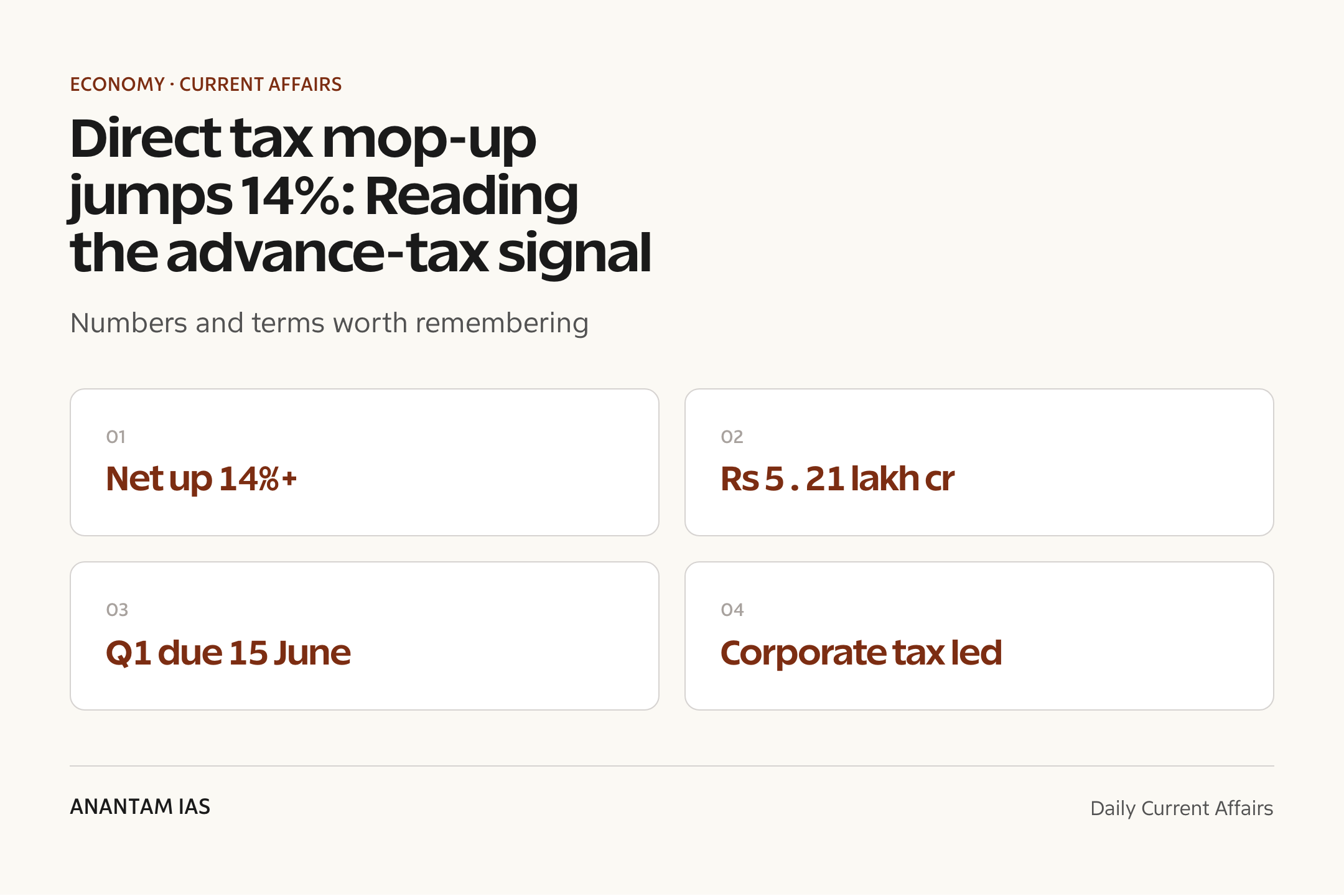
Net direct tax collections have grown by over 14% to cross Rs 5.21 lakh crore in the early weeks of the current fiscal, lifted mainly by stronger advance-tax payments after the first-quarter instalment fell due on 15 June. The Hindu reported the provisional numbers drawn from data released by the Central Board of Direct Taxes (CBDT).
For UPSC, the headline is less about the rupee figure and more about what it signals: tax buoyancy, the health of corporate profits and household incomes, and whether the government’s Budget direct-tax targets are on track. Advance tax is an early, forward-looking read on how firms expect the year to unfold, which is why each quarter’s instalment is watched closely.
- Net direct tax collections up over 14% to above Rs 5.21 lakh crore so far this fiscal, on CBDT provisional data.
- Advance tax drove the rise, with the first instalment of the year due by 15 June.
- Gross collections grew in double digits, with refunds rising only marginally, so the net figure stayed strong.
- Growth was led by corporate tax, with non-corporate (personal) tax also adding steadily.
- The trend marks a recovery from the comparatively tepid growth seen in the same period of the previous year.
The development matters in the context of:
- Matters as a real-time fiscal-health indicator for the Union Budget’s revenue arithmetic.
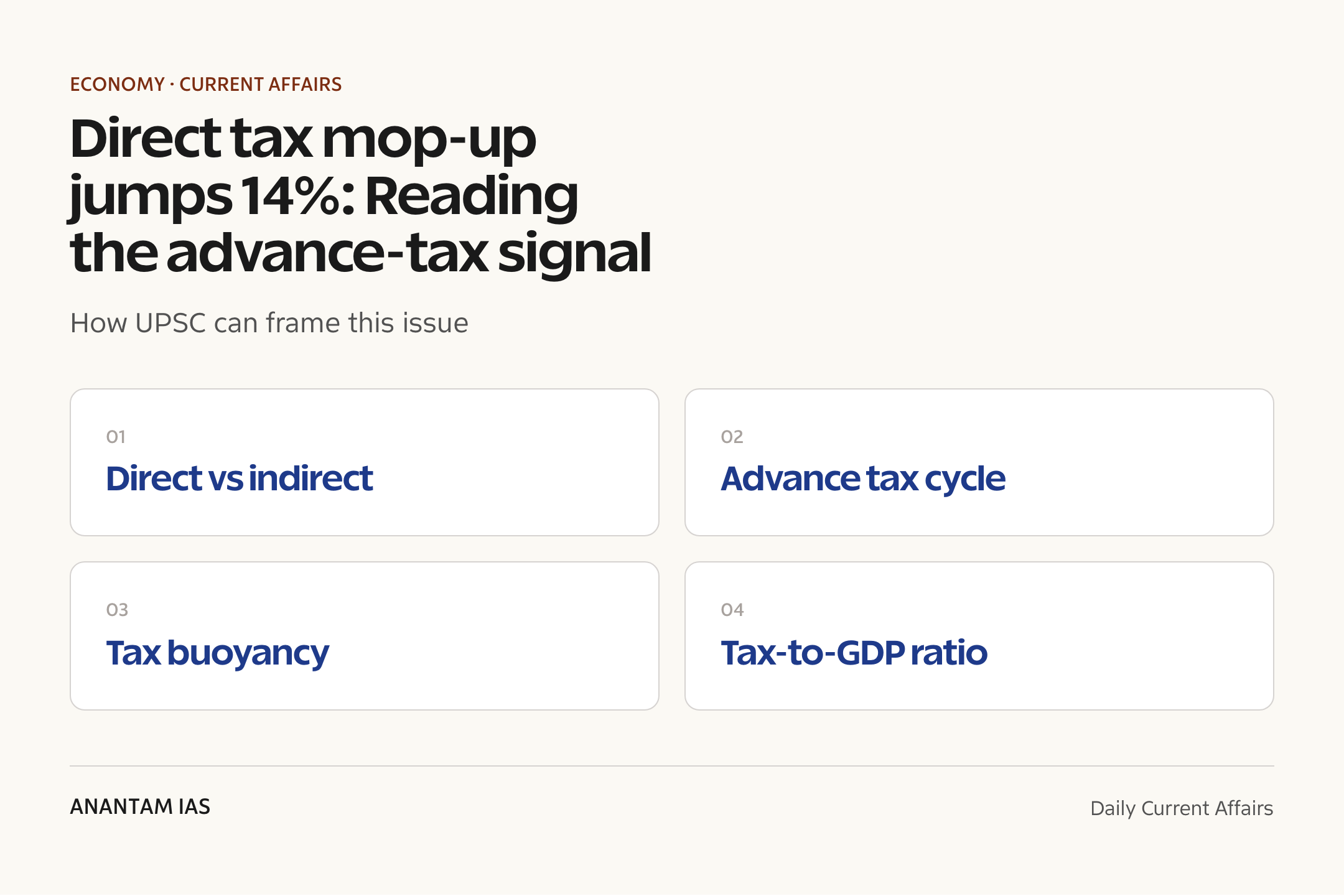
- Feeds into debates on tax buoyancy, the tax-to-GDP ratio, and the shift toward direct over indirect taxes.
UPSC Relevance
Prelims Relevance
- Direct vs indirect taxes: incidence and burden fall on the same person for direct taxes.
- Components of direct tax: corporate tax, personal income tax, and Securities Transaction Tax (STT).
- Advance tax: ‘pay-as-you-earn’ in four instalments (15 June, 15 Sep, 15 Dec, 15 March).
- TDS (Tax Deducted at Source) and self-assessment tax as collection modes.
- Gross vs net collections: net = gross minus refunds issued.
- CBDT administers direct taxes; it is a statutory body under the Central Boards of Revenue Act, 1963.
- Tax buoyancy: ratio of % change in tax revenue to % change in nominal GDP.
- Tax-to-GDP ratio: total tax revenue as a share of GDP, a measure of fiscal capacity.
- Income-Tax Act, 2025 replaced the 1961 Act as the framework law for direct taxation.
- The Department of Revenue (Ministry of Finance) oversees both CBDT and CBIC.
Mains Relevance
GS Paper 3
- Government Budgeting: mobilisation of resources, the role of direct taxes in financing the Budget, and the reliability of advance-tax data as a fiscal indicator.
- Indian Economy and issues relating to resource mobilisation: improving the tax-to-GDP ratio, widening the tax base, and the equity case for progressive direct taxation.
- Effects of tax buoyancy and revenue growth on fiscal-deficit management and the fiscal-consolidation path.
Essay
- Sound taxation as the price of a functioning state and the foundation of fiscal self-reliance.
Background and Context
Direct vs indirect taxes: where this number sits
Direct tax collection is one half of the Centre’s tax revenue, and its rise carries a specific economic meaning.
- Direct taxes are levied on income or wealth and are paid directly to the government by the person who bears them, so the burden cannot be shifted.
- Indirect taxes (mainly GST, customs, excise) are levied on goods and services, where the seller collects and the consumer ultimately bears the cost.
- Direct taxes are inherently progressive: higher incomes pay a higher share, which aids redistribution and equity.
- A rising direct-tax share within total revenue is generally read as a sign of a maturing, more equitable tax system.
- Read alongside the wider economy in our note on measuring growth beyond GDP.
What the latest CBDT data shows
The provisional figures point to a broad-based pick-up rather than a one-off spike.
- Net direct tax collection rose over 14% to cross Rs 5.21 lakh crore in the early part of the fiscal year.
- Gross collection grew in double digits, while refunds issued rose only slightly, keeping the net number buoyant.
- Corporate tax led the gains, indicating firmer company profits and advance-tax estimates.
- Non-corporate (personal income) tax added steadily, reflecting salary growth, capital-market gains and wider compliance.
- The CBDT releases such data periodically through the financial year as a running tally against the Budget estimate.
Advance tax: why 15 June matters
The jump is anchored to a calendar event, the first advance-tax instalment of the year.
- Advance tax is income tax paid in the year the income is earned, instead of a lump sum at year-end, on a ‘pay-as-you-earn’ basis.
- It applies to taxpayers whose tax liability for the year is Rs 10,000 or more (after TDS).
- It is paid in four instalments: 15% by 15 June, 45% by 15 September, 75% by 15 December, and 100% by 15 March.
- The first-quarter instalment makes June a key month, so collections rise sharply and offer an early read on the year ahead.
- Because firms self-estimate, advance tax reflects business expectations, not just past performance.
Components and collection machinery
Direct-tax revenue flows in through several distinct channels.
- Corporate tax: levied on company profits, historically the largest single component of direct tax.
- Personal income tax: levied on individuals, HUFs and firms, and now rivalling corporate tax in size.
- Securities Transaction Tax (STT): a small levy on trades in listed securities, sensitive to stock-market activity.
- Collection modes include TDS (deducted at source on salaries, interest and contracts), advance tax, and self-assessment tax filed with the return.
- CBDT, under the Department of Revenue, frames policy and administers collection through the Income Tax Department.
Tax buoyancy and tax-to-GDP
The deeper exam concepts behind a ‘collections jump’ are buoyancy and tax-to-GDP.
- Tax buoyancy measures how responsive tax revenue is to economic growth: a buoyancy above 1 means tax revenue grows faster than nominal GDP.
- Direct-tax growth running ahead of GDP growth signals healthy buoyancy and a widening, better-complying base.
- Tax-to-GDP ratio captures how much of national income the state can mobilise; India’s has been rising but stays modest by developed-country standards.
- A higher ratio gives the government more fiscal space for capital spending and welfare without excessive borrowing.
- Strong collections ease the fiscal-deficit path and reduce reliance on disinvestment or extra market borrowing.
Budget targets and the policy backdrop
Early collections are judged against the year’s Budget targets and a changing tax-law landscape.
- The Union Budget sets a direct-tax revenue target; quarterly data shows whether actual receipts are tracking ahead or behind.
- Strong early growth gives the government room on the fiscal-consolidation glide path it has committed to.
- The Income-Tax Act, 2025 replaced the six-decade-old 1961 Act, simplifying language and structure; see our explainer on the New Income-Tax Act, 2025.
- Recent reforms have widened the base and rationalised rates, including measures such as the abolition of angel tax for startups.
- Robust direct-tax buoyancy complements other external-sector buffers covered in our note on the RBI’s forex reserves.
Way Forward
Widen the base, deepen compliance
- Use data analytics, AIS and pre-filled returns to bring more taxpayers into the net without raising rates.
- Sustain faceless assessment and faster refunds to keep voluntary compliance high.
Raise the tax-to-GDP ratio
- Lift India’s tax-to-GDP closer to peer levels by curbing exemptions and plugging evasion.
- Shift the revenue mix gradually toward more equitable direct taxation.
Protect buoyancy through stable policy
- Keep tax rules predictable so corporate advance-tax estimates stay confident.
- Avoid reading a single quarter’s spike as a durable trend; track all four instalments.
Conclusion
A 14%-plus rise in net direct tax collections on the back of strong advance tax is, at heart, a confidence signal: companies and individuals are estimating higher incomes and paying ahead. For the fiscal arithmetic, it widens the government’s room to spend and consolidate at the same time.
The exam takeaway is to look past the headline rupee figure to the structural story, tax buoyancy, a rising tax-to-GDP ratio, and a gradual tilt toward equitable direct taxation under the new Income-Tax Act, 2025. Sustained collection growth is most useful when it reflects a wider, better-complying base rather than a one-off market or profit surge.
UPSC Practice Questions
Prelims MCQ 1
With reference to advance tax in India, consider the following statements:
- It is paid in the financial year in which the income is earned.
- The first instalment of advance tax for a financial year falls due on 15 June.
- It is a form of indirect tax administered by the CBIC.
How many of the above statements are correct?
(a) Only one (b) Only two (c) All three (d) None
Answer: (b) Only two
Explanation:
Statements 1 and 2 are correct: advance tax is paid in the year income is earned, on a ‘pay-as-you-earn’ basis, with the first instalment due by 15 June. Statement 3 is wrong, advance tax is a mode of collecting direct (income) tax, administered by the CBDT, not an indirect tax under the CBIC.
Prelims MCQ 2
Which of the following best describes ‘tax buoyancy’?
(a) The ratio of direct taxes to indirect taxes in total revenue (b) The responsiveness of tax revenue to changes in nominal GDP (c) The share of total tax revenue in GDP (d) The gap between gross and net tax collections
Answer: (b) The responsiveness of tax revenue to changes in nominal GDP
Explanation:
Tax buoyancy is the ratio of the percentage change in tax revenue to the percentage change in nominal GDP; a value above 1 means tax revenue grows faster than the economy. Option (c) describes the tax-to-GDP ratio, a different concept.
UPSC Mains Questions
- Early-year direct-tax collections, driven by advance tax, are often treated as a barometer of economic health. Critically examine how reliable such data is as a fiscal indicator, and what it reveals about tax buoyancy in India. (250 words)
- Discuss the significance of raising India’s tax-to-GDP ratio and shifting the revenue mix toward direct taxes. What reforms can widen the direct-tax base without raising rates? (250 words)
Sources: The Hindu (Business) and Income Tax Department / CBDT.
Frequently Asked Questions
What are direct taxes?
Direct taxes are levied on income or wealth and are paid directly to the government by the person who bears them, so the burden cannot be passed on. The main components in India are corporate tax, personal income tax and the Securities Transaction Tax, all administered by the CBDT.
What is advance tax?
Advance tax is income tax paid during the year the income is earned, rather than as a lump sum afterwards, on a ‘pay-as-you-earn’ basis. It is due in four instalments (15 June, 15 September, 15 December and 15 March) and applies when annual tax liability is Rs 10,000 or more after TDS.
Why did collections jump in June?
June saw a sharp rise because the first advance-tax instalment of the financial year falls due on 15 June. Taxpayers paying ahead, especially companies, push collections up at this point, giving an early read on income expectations for the year.
What is the difference between gross and net collections?
Gross collection is the total tax gathered before any refunds. Net collection is gross minus the refunds issued to taxpayers during the period. The net figure is the one that finances the Budget, which is why a small rise in refunds alongside strong gross growth still leaves net collections high.
What is tax buoyancy?
Tax buoyancy measures how responsive tax revenue is to economic growth, calculated as the percentage change in tax revenue divided by the percentage change in nominal GDP. A buoyancy above 1 means tax revenue is growing faster than the economy, a sign of a healthy, widening tax base.
Which body administers direct taxes in India?
The Central Board of Direct Taxes (CBDT), a statutory body under the Department of Revenue in the Ministry of Finance, frames policy and oversees collection through the Income Tax Department. Indirect taxes are handled separately by the CBIC.
Tell Google you want more of this.
Add Anantam IAS as a preferred sourceOne tap, and this site shows up more often in your own Top Stories, AI Overviews and AI Mode. Remove it any time.