Why in News?
On 1 July 2025, the Goods and Services Tax (GST) completed eight years since its midnight rollout in 2017. PIB marked the milestone, calling GST India’s largest indirect-tax reform and the practical face of ‘One Nation, One Tax’ that knit a fragmented market of state levies into one national tax.
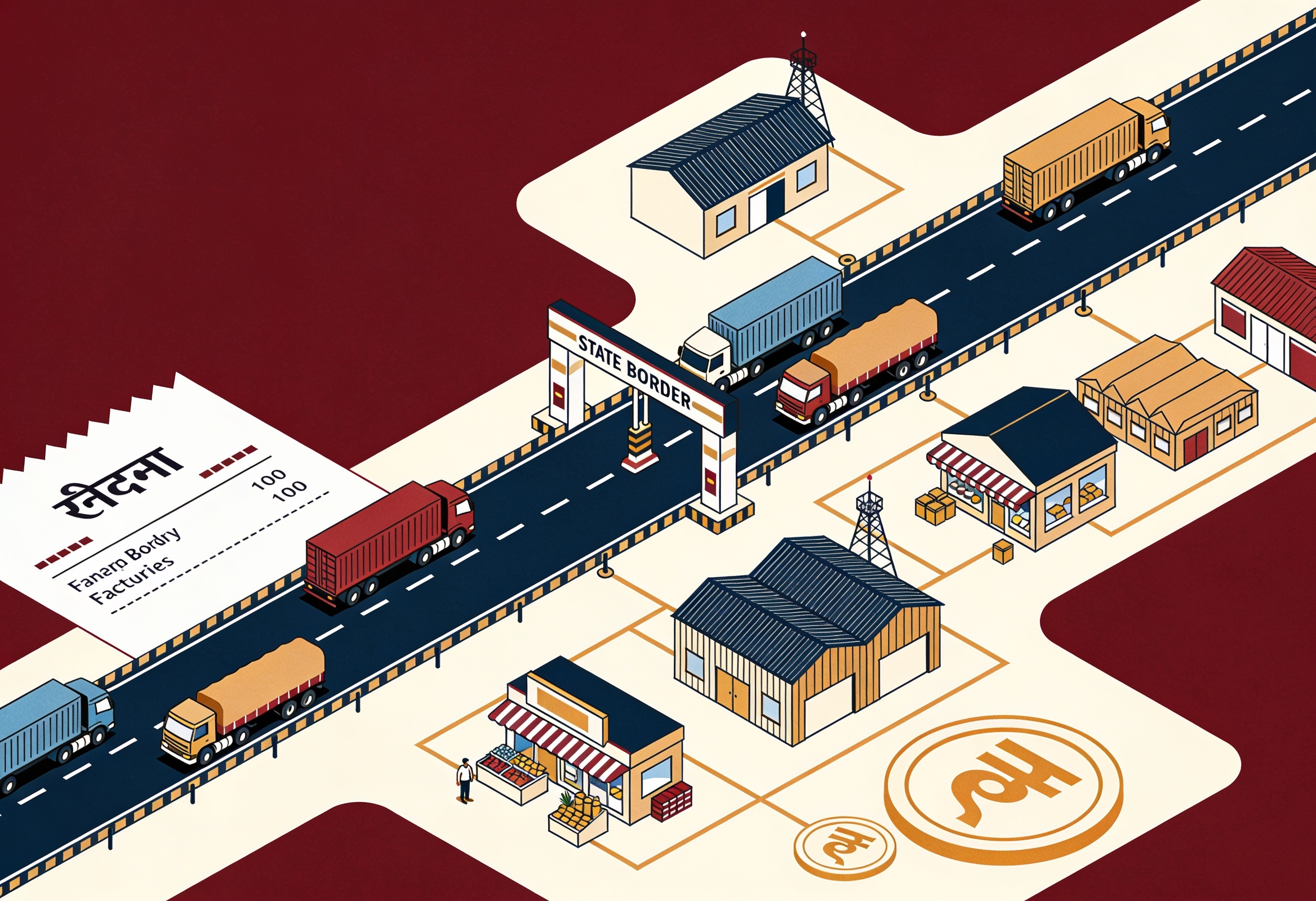
The headline numbers have firmed up: active GST registrations crossed 1.51 crore by 30 April 2025, and gross collection touched a record Rs 22.08 lakh crore in 2024-25 at an average of about Rs 1.84 lakh crore a month. Eight years in, the live debate is no longer whether GST works but how to simplify its slabs and sharpen the Council’s cooperative-federalism design.
- GST rolled out on 1 July 2017 via the 101st Constitutional Amendment; 1 July 2025 marks year eight.
- Active registrations rose from about 60 lakh at launch to over 1.51 crore as of 30 April 2025 (PIB).
- Gross collection hit a record Rs 22.08 lakh crore in 2024-25, up 9.4% year-on-year; monthly average about Rs 1.84 lakh crore.
- The GST Council has held 55 meetings since 2016 to set rates and ease compliance.
- Petroleum products and alcohol for human consumption stay outside GST and are still taxed by the Centre and states separately.
The development matters in the context of:
- Why this matters for fiscal federalism: GST pooled the indirect-tax powers of the Centre and states into a single Council, a rare shared-sovereignty experiment.
- Why this matters for the economy: indirect-tax design shapes inflation, the cost of doing business and the formalisation of the economy.
- Why this matters for governance: revenue buoyancy and dispute resolution test whether a multi-rate, IT-driven tax can stay simple over time.
UPSC Relevance
Prelims Relevance
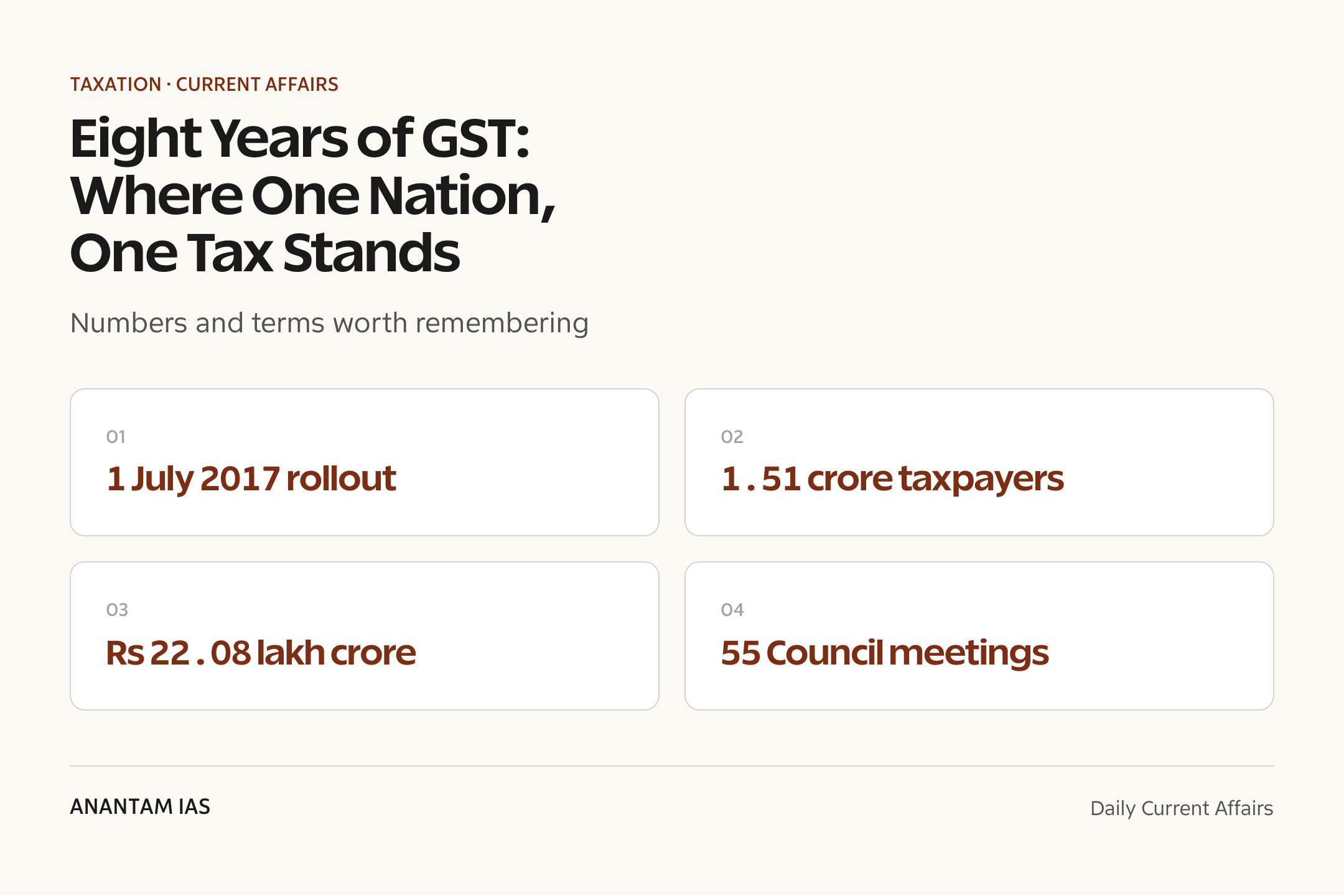
- 101st Constitutional Amendment Act, 2016 (introduced as the 122nd Amendment Bill) enabled GST.
- Article 279A created the GST Council; assent received on 8 September 2016.
- GST Council chair is the Union Finance Minister; states/UTs nominate members.
- Dual structure: CGST + SGST on intra-state supply; IGST on inter-state supply and imports.
- GST is a destination-based, value-added consumption tax that removes the cascading ‘tax-on-tax’ effect.
- Four main slabs: 5%, 12%, 18%, 28%; special rates of 3% on gold/silver/jewellery and 0.25%/1.5% on diamonds.
- GST Compensation Cess levied on demerit/luxury goods (tobacco, aerated drinks, motor vehicles).
- GST subsumed central excise, service tax, VAT, octroi and several cesses.
- Petroleum, natural gas, ATF, crude, alcohol for human consumption are constitutionally outside GST for now.
- GSTN runs the IT backbone; the Council was set up under the 122nd Amendment Bill after ratification by over 15 states.
Mains Relevance
GS Paper 3
- GST as indirect-tax reform: revenue buoyancy, formalisation, and the case for slab rationalisation.
- Impact of GST on logistics, MSMEs and the cost of doing business.
GS Paper 2
- GST Council as a model of cooperative (and competitive) fiscal federalism; the weighting of Centre and state votes.
Essay
- Cooperative federalism in practice: can shared sovereignty over taxation endure?
- Reform is a process, not an event: eight years of refining ‘One Nation, One Tax’.
Background and Context
What GST Replaced and How It Is Built
GST folded a tangle of central and state indirect taxes into a single value-added levy collected at the point of consumption.
- It subsumed central excise duty, service tax and state VAT, along with octroi, entry tax and several cesses, ending the cascading ‘tax-on-tax’ burden.
- The architecture is dual: CGST and SGST apply together on intra-state supply, while IGST covers inter-state supply and imports.
- GST is destination-based — revenue accrues where goods or services are consumed, not where they are produced, with seamless input-tax credit along the chain.
- All registration, return filing and payment runs through the GSTN portal, making compliance largely digital.
The GST Council: Constitutional Design
The Council is the institutional heart of GST and its main claim to cooperative federalism.
- Created by Article 279A after the 101st Amendment (the 122nd Amendment Bill), which received presidential assent on 8 September 2016.
- Chaired by the Union Finance Minister, with the Union Minister of State for Finance and a minister nominated by each state/UT as members.
- Decisions need a three-fourths majority; the Centre holds one-third of the weighted votes and the states together two-thirds — neither side can act alone.
- It has met 55 times since formation, setting rates and clearing compliance reforms such as e-invoicing and GST Appellate Tribunals.
Revenue and Tax-Base Story So Far
The numbers point to steadily widening collections and a deepening tax base.
- Active GST registrations grew from about 60 lakh at launch to over 1.51 crore by 30 April 2025.
- Gross collection rose from Rs 11.37 lakh crore in 2020-21 to a record Rs 22.08 lakh crore in 2024-25.
- The 2024-25 figure reflects 9.4% year-on-year growth and a monthly average near Rs 1.84 lakh crore.
- PIB links the rise to the formalisation of the economy and improved compliance, not just higher rates.
The Slab Structure and the Rationalisation Debate
GST’s multiple rates are its most contested feature, with a long-running push to simplify them.
- Four main slabs — 5%, 12%, 18% and 28% — cover most goods and services.
- Special rates apply to precious metals: 3% on gold, silver and jewellery, and 0.25% / 1.5% on rough and cut diamonds.
- A Compensation Cess sits on top of 28% for demerit and luxury goods such as tobacco, aerated drinks and large vehicles.
- Critics argue that several slabs and many exemptions blunt the original promise of a simple, single tax and complicate classification disputes.
Ground-Level Gains: MSMEs and Logistics
Beyond revenue, GST reshaped how small firms comply and how goods move across India.
- The exemption threshold for goods was raised from Rs 20 lakh to Rs 40 lakh, easing the load on small traders.
- A composition scheme lets small taxpayers pay a flat rate on turnover with simpler returns, now extended to service providers up to Rs 50 lakh.
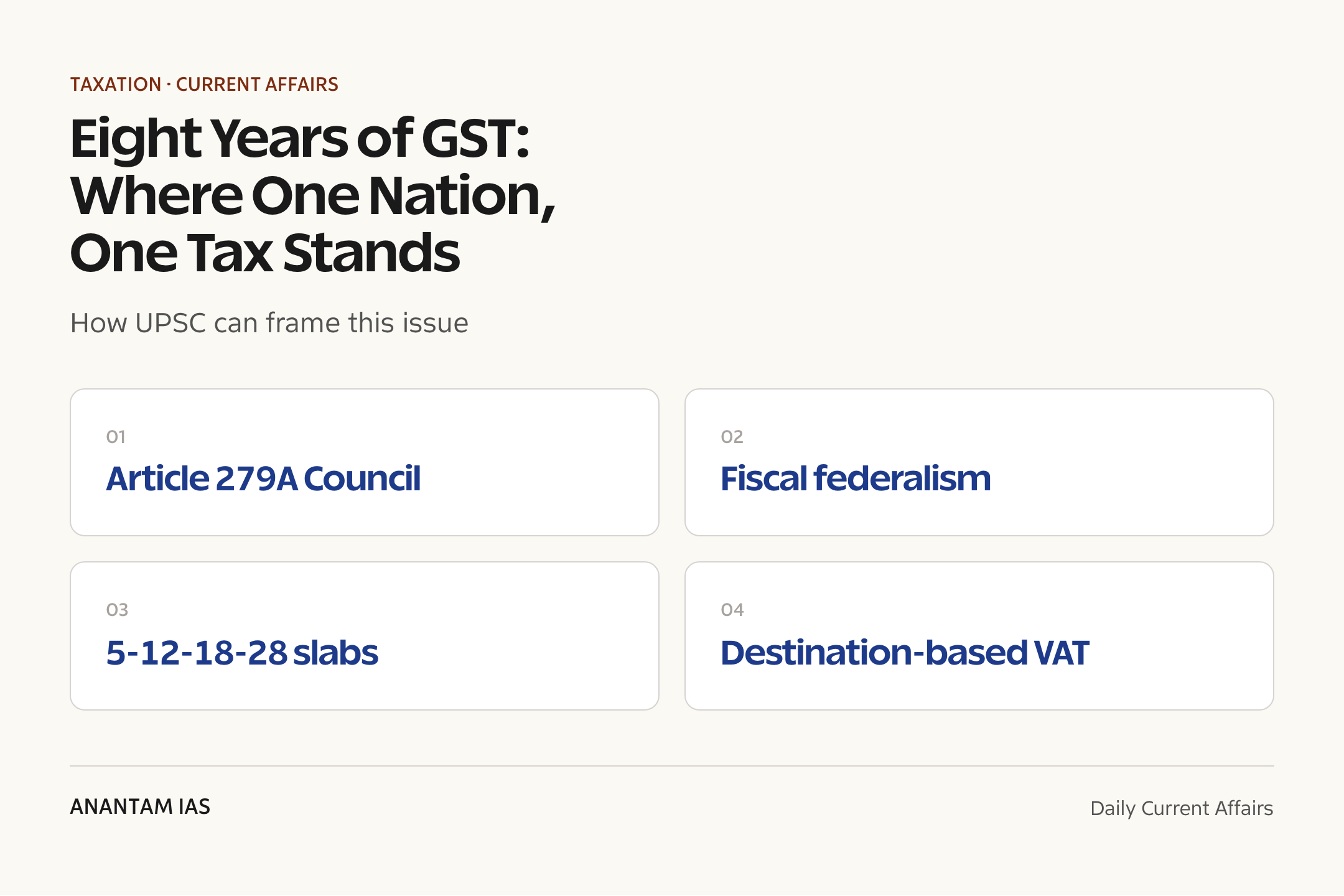
- Removing state-border check-posts cut transport time by over 33% in several studies, lowering fuel costs and congestion.
- Firms no longer need a warehouse in every state, enabling leaner, more centralised supply chains.
What Stays Outside GST
GST is not yet universal; some politically and fiscally sensitive items remain on the old regime.
- Petroleum crude, petrol, diesel, ATF and natural gas are within GST’s legal ambit but not yet notified — they still attract central excise and state VAT.
- Alcohol for human consumption is constitutionally outside GST and remains a major state revenue source.
- Electricity and stamp duty on property also sit outside, so input credit does not flow seamlessly across these sectors.
- Bringing fuel and alcohol in would deepen the common market but threatens the revenue autonomy states still guard.
Way Forward
Simplify the rate structure
- Move toward fewer slabs and trim exemptions to cut classification disputes and restore the ‘one tax’ spirit.
- Pair any rationalisation with revenue-neutral safeguards so states are not destabilised.
Strengthen the Council and dispute system
- Make GST Appellate Tribunal benches fully operational to clear the backlog of disputes quickly.
- Keep Council decisions consensual to protect its cooperative-federalism credibility.
Widen the base thoughtfully
- Build consensus on phasing petroleum and natural gas into GST to complete the common market.
- Sustain GSTN upgrades, data analytics and anti-evasion tools to keep collections buoyant.
Conclusion
Eight years on, GST has done the hard part: it created a single national market, widened the tax base to over 1.51 crore registrants, and pushed collections to a record Rs 22.08 lakh crore. The reform’s core machinery — the dual structure, the GSTN backbone and the GST Council — has held under stress.
The unfinished agenda is about quality, not survival. Fewer slabs, faster dispute resolution and a credible path for fuel and alcohol would turn a working tax into a genuinely simple one. As GST enters its ninth year, the test is whether cooperative federalism can deliver simplification without unsettling state revenues.
UPSC Practice Questions
Prelims MCQ 1
With reference to the Goods and Services Tax (GST) in India, consider the following statements:
- The GST Council was established under Article 279A of the Constitution.
- Decisions of the GST Council require a three-fourths majority of weighted votes.
- Alcohol for human consumption is taxed under GST instead of state excise.
How many of the above statements are correct?
(a) Only one (b) Only two (c) All three (d) None
Answer: (b) Only two
Explanation:
Statements 1 and 2 are correct: the Council is created under Article 279A and decides by a three-fourths majority. Statement 3 is wrong — alcohol for human consumption is outside GST and remains a state subject taxed via state excise/VAT.
Prelims MCQ 2
Which of the following taxes was NOT subsumed under the Goods and Services Tax?
(a) Central excise duty (b) Service tax (c) State VAT (d) Basic customs duty
Answer: (d) Basic customs duty
Explanation:
GST subsumed central excise, service tax and state VAT, among others. Basic customs duty on imports continues separately (though IGST applies on imports), so it is not subsumed.
UPSC Mains Questions
- Eight years after its rollout, the Goods and Services Tax has widened India’s tax base and raised collections to record levels, yet its multiple-slab design draws criticism. Examine the achievements and the unfinished agenda of GST as an indirect-tax reform.
- The GST Council is often cited as an experiment in cooperative federalism. Analyse how its constitutional design balances the fiscal interests of the Centre and the states, and the tensions that have emerged in practice.
Sources: PIB, Ministry of Finance and NewsOnAir, Prasar Bharati.
Frequently Asked Questions
When did GST complete eight years in India?
GST completed eight years on 1 July 2025. It was rolled out at midnight on 1 July 2017 through the 101st Constitutional Amendment, replacing a web of central and state indirect taxes with a single value-added tax often described as ‘One Nation, One Tax’.
How many GST taxpayers are registered now?
As of 30 April 2025, India had over 1.51 crore active GST registrations, according to PIB. The base has grown from roughly 60 lakh at launch in 2017, reflecting the steady formalisation of the economy and easier digital compliance through the GSTN portal.
What were GST collections in 2024-25?
Gross GST collection reached a record Rs 22.08 lakh crore in 2024-25, a 9.4% year-on-year rise, with an average monthly collection of about Rs 1.84 lakh crore. The figure reflects wider compliance and stronger economic activity rather than higher headline rates.
What is the GST Council and who chairs it?
The GST Council is the body that sets GST rates and rules. Created under Article 279A, it is chaired by the Union Finance Minister, with each state and Union Territory nominating a member. Decisions need a three-fourths majority of weighted votes, balancing Centre and state interests.
What are the main GST slabs?
GST has four main slabs of 5%, 12%, 18% and 28%. Special rates apply to precious metals — 3% on gold and jewellery and lower rates on diamonds — and a Compensation Cess sits above 28% on demerit and luxury goods such as tobacco, aerated drinks and large vehicles.
Which items are outside GST?
Petroleum crude, petrol, diesel, ATF and natural gas are within GST’s legal ambit but not yet notified, so they still attract excise and VAT. Alcohol for human consumption, electricity and stamp duty also stay outside GST, remaining important sources of state revenue.
Tell Google you want more of this.
Add Anantam IAS as a preferred sourceOne tap, and this site shows up more often in your own Top Stories, AI Overviews and AI Mode. Remove it any time.