Why in News?
The Supreme Court’s October 15 judgment on online child safety, reported by The Hindu on October 18, directed a coordinated detection and reporting framework while protecting children’s internet access.
- The Union must create a National Hash and URL List Database for detecting and removing child sexual exploitation and abuse material, or CSEAM.
- Database entries require final independent assessment by at least three trained human analysts; software may assist preliminary screening.
- Platforms must distinguish verified database matches from material detected through their own review, with different removal and reporting routes.
- These are judicial directions requiring implementation; the judgment does not establish that the database or all prescribed procedures are already operational.
- Repeated circulation can prolong harm even after an original upload disappears; coordination across platforms addresses that continuing exposure.
- The governance question is how to combine rapid removal, accountable decisions and access rights without treating children themselves as the problem.
UPSC Relevance
Prelims Relevance
- Perceptual hash: identifier based on content characteristics, used to recognise matching material.
- URL listing: identification of locations hosting verified material.
- Known origin: material matching a verified national database entry.
- Unknown origin: detected material outside that verified matching route.
- Reporting authorities: Special Juvenile Police Unit, local police and/or the cyber-crime portal under the applicable POCSO reporting framework.
Mains Relevance
GS Paper 2
- Child rights, proportionate regulation and accessible grievance redressal.
- Accountability of private intermediaries and implementation of judicial directions.
GS Paper 3
- Technology-assisted detection, human verification and cybercrime reporting.
Essay
- Digital inclusion requires both access and protection.
Background and Context
Why child protection must preserve access
The judgment treats children as rights-holders whose learning and participation must remain possible while harmful material and responsible actors face effective intervention.
- Internet access supports learning, expression and social connection, including for children in remote areas or with special needs. The Court rejects an approach that excludes children because platforms have failed to protect them.
- CSEAM means child sexual exploitation and abuse material. Its continuing circulation can repeat the injury to a child; removing one upload is insufficient when copies remain available elsewhere or are repeatedly shared again.
- Platform responsibility extends beyond visibly explicit files. Review must consider captions, keywords, links and promoted tools together, because apparently ordinary advertisements can direct users towards exploitative material hosted outside the original platform.
- The Supreme Court judgment calls for proportionate safeguards and implementation measures. A direction to create a national system does not prove completed deployment, universal platform adoption or successful prevention of every harmful upload.
- As with internet suspension safeguards, reasoned and reviewable restrictions matter. Here, the immediate object is particular harmful content and accountable platform action, while children retain legitimate opportunities to learn and communicate online.

How verified entries change the removal route
The central distinction is whether harmful material has already passed the national database’s verification process or still requires assessment through the ordinary route.
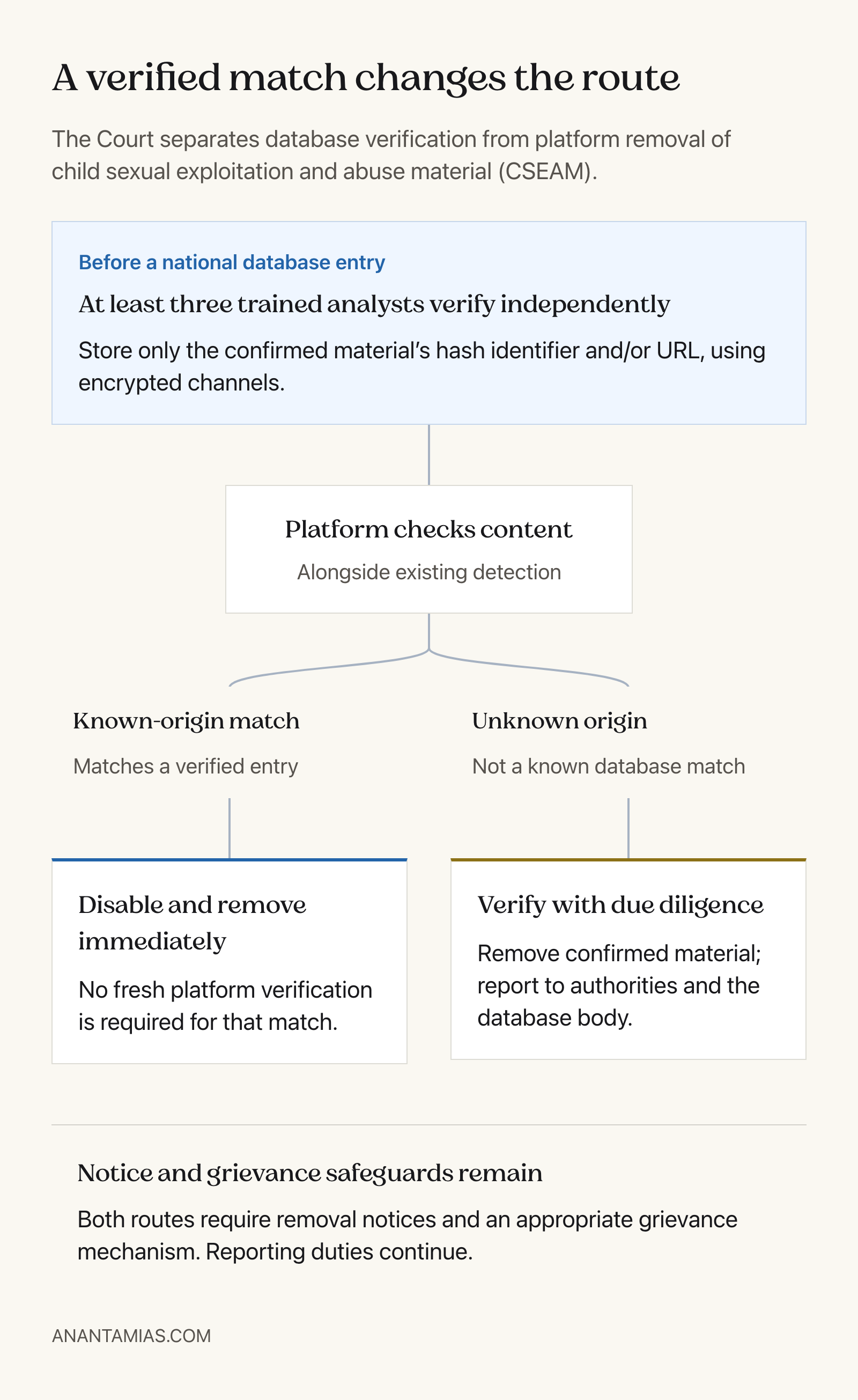
- Entry verification may begin with specialised software, but at least three trained human analysts must independently determine whether material constitutes CSEAM. This assessment comes before its identifiers enter the shared national detection system.
- Database contents must be confined to the perceptual hash identifier and/or URL of confirmed material, entered through encrypted channels. The database is not a repository for storing the underlying abusive images or videos.
- A known-origin match requires the intermediary to disable and remove matching content immediately without awaiting further verification at its end. Earlier human assessment of the database entry enables this faster action across participating platforms.
- Unknown-origin removal must follow proper verification and due diligence under the IT Rules. The intermediary must promptly report it to proper authorities and the database body, which separately assesses eligibility for a new entry.
- Reporting differs by route: unknown-origin removals have specified two-hour reporting triggers; known matches require weekly consolidated reports to the database authority. Paragraph 316 separately preserves reporting under POCSO’s framework for removed or disabled CSEAM.
Speed needs an accountable correction mechanism
Shared detection can accelerate protection, but classification mistakes require notices, appropriate appeals and records that identify who made each consequential decision.
- Removal notices must state whether action followed a platform’s own detection or a database match. This identifies the decision-making route and helps affected users understand which authority can examine a challenge to removal.
- Appeal routes differ accordingly: platform-detected removal follows the IT Rules’ grievance mechanism and subsequent appellate route; database-match removal is challenged before the designated database authority under a grievance mechanism the Union must establish.
- Human accountability also applies to complaints: automated tools may assist preliminary screening, but a trained grievance officer must decide the outcome. Recorded findings and a digital signature make responsibility traceable instead of anonymous.
- Accessible reporting connects detection with access to justice in cybercrime. A clear complaint category, identifiable officers and reasoned responses help users seek protection without needing specialist technical knowledge or navigating an opaque platform interface.
- Hash matching complements ordinary detection rather than replacing it. A database can recognise verified entries, but unfamiliar material still needs scrutiny; absence of a match cannot itself establish that content is lawful or harmless.
Way Forward
Make the safeguards operational and auditable
- Specify independent verification and correction procedures before expanding shared database use, including secure entry controls and responsibility for erroneous classifications.
- Publish clear reporting instructions distinguishing unknown-origin deadlines, consolidated known-match reporting and the continuing duties towards proper authorities.
- Evaluate complaint handling and correction outcomes alongside removal speed; an impressive removal count alone cannot establish accurate classification or effective victim protection.
Conclusion
- Online child safety requires coordinated detection without sacrificing children’s participation. The judgment connects verified shared identifiers, platform duties and reporting to authorities, while retaining human responsibility for consequential classification decisions.
- For governance answers, distinguish rapid action on a verified match from assessment of unfamiliar material. Protection becomes more credible when removal is paired with clear notices, an appropriate appeal route and demonstrable implementation.
UPSC Practice Questions
Prelims MCQ 1
With reference to the proposed National Hash and URL List Database, consider the following statements:
- Its entries must be confined to hash identifiers and/or URLs of confirmed CSEAM.
- Final verification before an entry requires at least three trained human analysts.
- Every database match requires fresh human verification by the intermediary before removal.
How many of the above statements are correct?
(a) Only one (b) Only two (c) All three (d) None
Answer: (b) Only two
Explanation:
Statements 1 and 2 are correct. A match against a verified entry must be disabled and removed immediately without awaiting further verification by the intermediary.
Prelims MCQ 2
Which statement best explains the role of hash matching in the judgment?
(a) It replaces all ordinary detection and reporting duties. (b) Absence of a match proves that material is lawful. (c) It supports recognition of verified material alongside existing detection processes. (d) It requires storing abusive videos in the national identifier database.
Answer: (c) It supports recognition of verified material alongside existing detection processes.
Explanation:
The judgment expressly requires database matching alongside ordinary detection. Unknown-origin material still needs due diligence, reporting and assessment; the database stores identifiers and/or URLs.
UPSC Mains Questions
- How can technology-assisted content moderation protect children while preserving access rights and procedural fairness? Discuss with reference to the Supreme Court’s directions.
- Distinguish the governance requirements for verified database matches and previously unidentified harmful content. Explain why human oversight and reporting duties remain necessary.
Sources: Supreme Court of India judgment and The Hindu.
Frequently Asked Questions
Did the Supreme Court ban children from using the internet?
No. The Court treated children as entitled to internet access and protection. It directed attention towards harmful material, responsible actors and proportionate safeguards rather than excluding children from legitimate online participation.
What will the national database contain?
Its entries must contain only hash identifiers and/or URLs of confirmed material, submitted through encrypted channels. Final classification before entry requires independent determination by at least three trained human analysts.
How does a known match differ from unknown-origin material?
A verified database match requires immediate removal without further platform verification. Unknown-origin removal requires proper due diligence and reporting; the database authority separately assesses whether its identifiers should become a new entry.
Is the national database already operational?
The judgment directs the Union to create the database and establish associated procedures. The sources reviewed establish these directions, not completed national deployment or universal adoption by intermediaries.
Tell Google you want more of this.
Add Anantam IAS as a preferred sourceOne tap, and this site shows up more often in your own Top Stories, AI Overviews and AI Mode. Remove it any time.