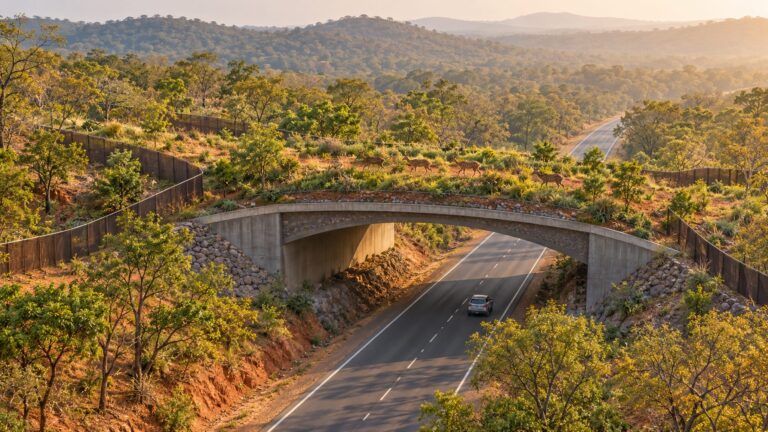
Why in news?
Delhi LG Taranjit Singh Sandhu called e-mobility a broader transformation, urging an integrated ecosystem with Delhi taking the lead.
UPSC Relevance
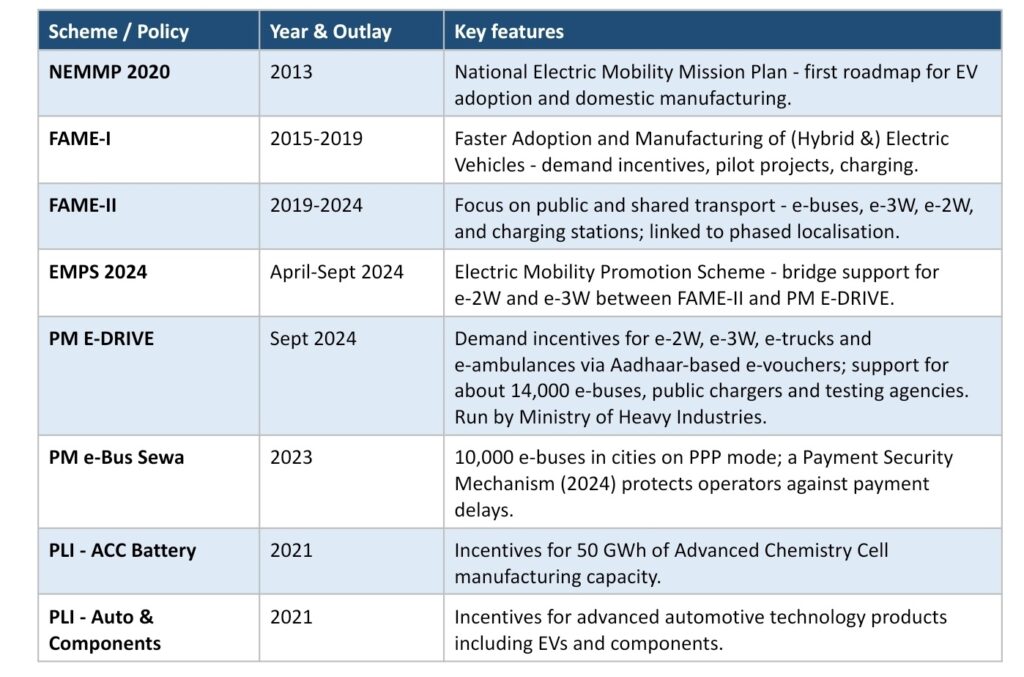
Prelims – FAME, PM E-DRIVE, PM e-Bus Sewa, PLI-ACC.
Mains – GS3: Infrastructure – energy and roads; Conservation, environmental pollution and degradation.
What is Electric Mobility?
Electric mobility (e-mobility) means vehicles that run fully or partly on electricity stored in batteries or produced on board, instead of only petrol or diesel. But it is more than the vehicle. It is an ecosystem of batteries, charging, power generation, manufacturing, recycling and digital systems.
As the world shifts to clean transport, electric mobility is vital for India, which imports over 85% of its crude oil and targets net zero by 2070 and cleaner air.
Types of electric vehicles
- Battery Electric Vehicle (BEV) – Runs only on a battery charged from the grid. Eg. e-scooters, e-buses.
- Hybrid Electric Vehicle (HEV) – Combines an engine and a motor; battery charged by the engine and braking.
- Plug-in Hybrid (PHEV) – Hybrid with a larger battery that can also be charged from the grid.
- Fuel Cell Electric Vehicle (FCEV) – Generates electricity on board from hydrogen; only water is emitted.
India’s EV landscape
- Two and three-wheelers make up the bulk of EV sales. E-rickshaws have spread quietly across small towns.
- EVs form around 7-8% of total vehicle sales in India, still far from the commonly cited 2030 goal of 30% for private cars, 70% for commercial cars, 40% for buses and 80% for two- and three-wheelers.
Why does India Need E-Mobility?
- Energy security – India imports more than 85% of its crude oil. Transport is the largest user of petroleum, so electrification cuts the import bill and exposure to oil shocks.
- Climate commitments – Updated NDC (2022) aims to cut emission intensity of GDP by 45% from 2005 levels and reach 50% non-fossil power capacity by 2030; net zero by 2070 (Panchamrit, COP26).
- Air quality – Vehicles are a major source of PM2.5 and NOx in cities like Delhi. EVs have zero tailpipe emissions.
- Efficiency – Electric motors convert most of their energy into motion, while internal combustion engines waste much of it as heat. Running cost per km is much lower.
- Industrial opportunity – A domestic EV ecosystem can create jobs in batteries, electronics, software and components, and link India to global value chains. Made-in-India EVs are already being exported.
- Renewable energy integration – EV batteries can store solar power and, in future, support the grid through vehicle-to-grid (V2G) systems.
- Urban liveability – Clean public transport, e-buses and last-mile e-rickshaws improve mobility for millions who depend on shared transport.
- Delhi’s case – Delhi has more registered vehicles than the other three metros together. Its pollution and congestion make it a natural testbed for integrated e-mobility.
Government Schemes and Policies
Challenges
- High upfront cost – Batteries form a large share of an EV’s cost, making EVs costlier to buy despite lower running costs.
- Thin charging network – Public chargers number only in tens of thousands and are concentrated in a few cities and highways. Range anxiety remains, especially outside metros.
- Import dependence – India lacks domestic lithium, cobalt and nickel production and cell manufacturing at scale. China dominates processing; its curbs on rare earth magnet exports in 2025 hit Indian automakers.
- “Long tailpipe” problem – About three-fourths of India’s electricity still comes from coal, so the climate benefit depends on cleaning the grid.
- Safety and quality – Battery fires in e-scooters (2022) exposed gaps in standards and India’s heat conditions; this led to stricter battery norms (AIS-156).
- Subsidy misuse and dependence – Some manufacturers were found violating FAME-II localisation rules. Sales often dip when incentives are cut.
- Recycling and waste – Battery recycling capacity is limited and largely informal, risking toxic waste and loss of valuable minerals.
- Heavy vehicles and jobs – Trucks are hard to electrify; workers in ICE components and roadside repair need reskilling.
Way Forward
- Ecosystem approach – Plan vehicles, charging, power and urban transport together. Success should be judged by cleaner air, reliable public transport and convenient charging, not only by the number of EVs sold.
- Public transport first – Prioritise e-buses, e-rickshaws and last-mile links so that the shift benefits the majority who use shared transport.
- Secure critical minerals – Use the National Critical Mineral Mission, KABIL’s overseas assets (eg. lithium blocks in Argentina) and the Minerals Security Partnership; promote recycling as “urban mining”.
- Battery innovation – Invest in LFP and sodium-ion cells that need fewer scarce minerals; complete cell factories under PLI-ACC.
- Smarter charging – Interoperable standards, chargers at fuel pumps and parking lots, a final battery swapping policy, and time-of-day tariffs.
- Greener grid – Link charging with rooftop solar (PM Surya Ghar) and renewable power to address the long tailpipe.
- Easier finance – Priority sector lending for EVs, risk guarantee funds, battery-as-a-service models and a reliable second-hand market.
- Skills and research – Reskill mechanics and ICE workers; involve universities and start-ups in solutions suited to Indian cities.
E-mobility is finally about more than the vehicle. It is about cleaner air, energy independence and a new industrial base. Getting the ecosystem right will decide whether India leads this transition or depends on others for it.
Practice MCQ
Q1. With reference to the PM E-DRIVE scheme, consider the following statements:
- It is implemented by the Ministry of Heavy Industries.
- It provides demand incentives for the purchase of electric private cars.
- Buyers receive demand incentives through Aadhaar-authenticated e-vouchers.
How many of the statements given above are correct?
(a) Only one
(b) Only two
(c) All three
(d) None
Answer: (b)
Explanation: Statement 2 is incorrect. PM E-DRIVE supports e-2W, e-3W, e-trucks, e-ambulances and e-buses, but not private electric cars.
Q2. Consider the following statements:
Statement I: Lithium Iron Phosphate (LFP) batteries are increasingly preferred for electric vehicles in India.
Statement II: LFP batteries do not use cobalt or nickel and have better thermal stability than NMC batteries.
Which one of the following is correct in respect of the above statements?
(a) Both Statement I and Statement II are correct and Statement II explains Statement I
(b) Both Statement I and Statement II are correct and Statement II does not explain Statement I
(c) Statement I is correct but Statement II is incorrect
(d) Statement I is incorrect but Statement II is correct
Answer: (a)
Explanation: LFP cells avoid costly and import-dependent cobalt and nickel and are less prone to overheating, which suits India’s hot climate and cost-sensitive market. Their lower energy density is the main trade-off.
Mains Practice Question
“Electric mobility in India is less about replacing vehicles and more about building an ecosystem.” Discuss the significance of e-mobility for India, examine the challenges in its adoption and suggest measures to address them. (15 Marks, 250 Words)
Tell Google you want more of this.
Add Anantam IAS as a preferred sourceOne tap, and this site shows up more often in your own Top Stories, AI Overviews and AI Mode. Remove it any time.