Why in News?
On 21 October 2026, eMudhra confirmed weak keys affecting eight global TLS intermediate certification authorities, following Google’s disclosure of protective measures for Chrome and Android users.
- Google attributed the compromised intermediate keys to insufficient randomness, allowing forged HTTPS certificates against clients still trusting those keys.
- Chrome distributed a key-based blocklist; Android received equivalent protection through Google Play Services.
- Google expected broad release of the affected root’s removal on 27 October; that deadline was still ahead on 22 October.
- eMudhra said its separate Indian DSC and eSign services were unaffected and reported no infrastructure compromise or data breach.
- A certificate can look valid cryptographically while relying on an issuing key that should no longer be trusted.
- Institutional trust depends on how quickly a withdrawal decision reaches the software making an authentication decision.
UPSC Relevance
Prelims Relevance
- Public key infrastructure and certification authorities
- Root, intermediate and server certificates
- Cryptographic entropy
- Certificate Transparency
- Revocation and client trust stores
Mains Relevance
GS Paper 3
- Trust management across browsers, operating systems and embedded clients.
- Distinguishing a cryptographic vulnerability from confirmed malicious exploitation.
GS Paper 2
- Accountability and coordinated remediation in privately operated digital trust infrastructure.
Essay
- Trust requires a credible mechanism for withdrawing authority.
Background and Context
How a Certificate Chain Delegates Trust
HTTPS identity checks depend on a chain of signatures and a trusted starting point inside the client.
- A root certificate acts as a trust anchor recognised by client software. Its authority can extend through an intermediate certificate to a website certificate, letting the client assess the website’s claimed identity.
- An intermediate certification authority receives delegated signing authority within that hierarchy. Compromising its private key can let an attacker forge certificates that appear to come from an accepted issuer, even without stealing the root’s key.
- Cryptographic entropy means unpredictability in key generation. Insufficient randomness can make a supposedly secret key recoverable; increasing the apparent complexity of a certificate’s contents does not repair the underlying weakness in its signing key.
- Google identified weak private keys associated with eight subordinate CA certificates. This establishes a failure in delegated trust; it does not establish that the root private key itself was stolen or mathematically recovered.
- eMudhra linked the problem to a key-generation ceremony and said the root cause remained under investigation. Its account of a flawed handling step should remain attributed, rather than treated as an independently completed forensic conclusion.
Why Trust Withdrawal Must Reach the Client
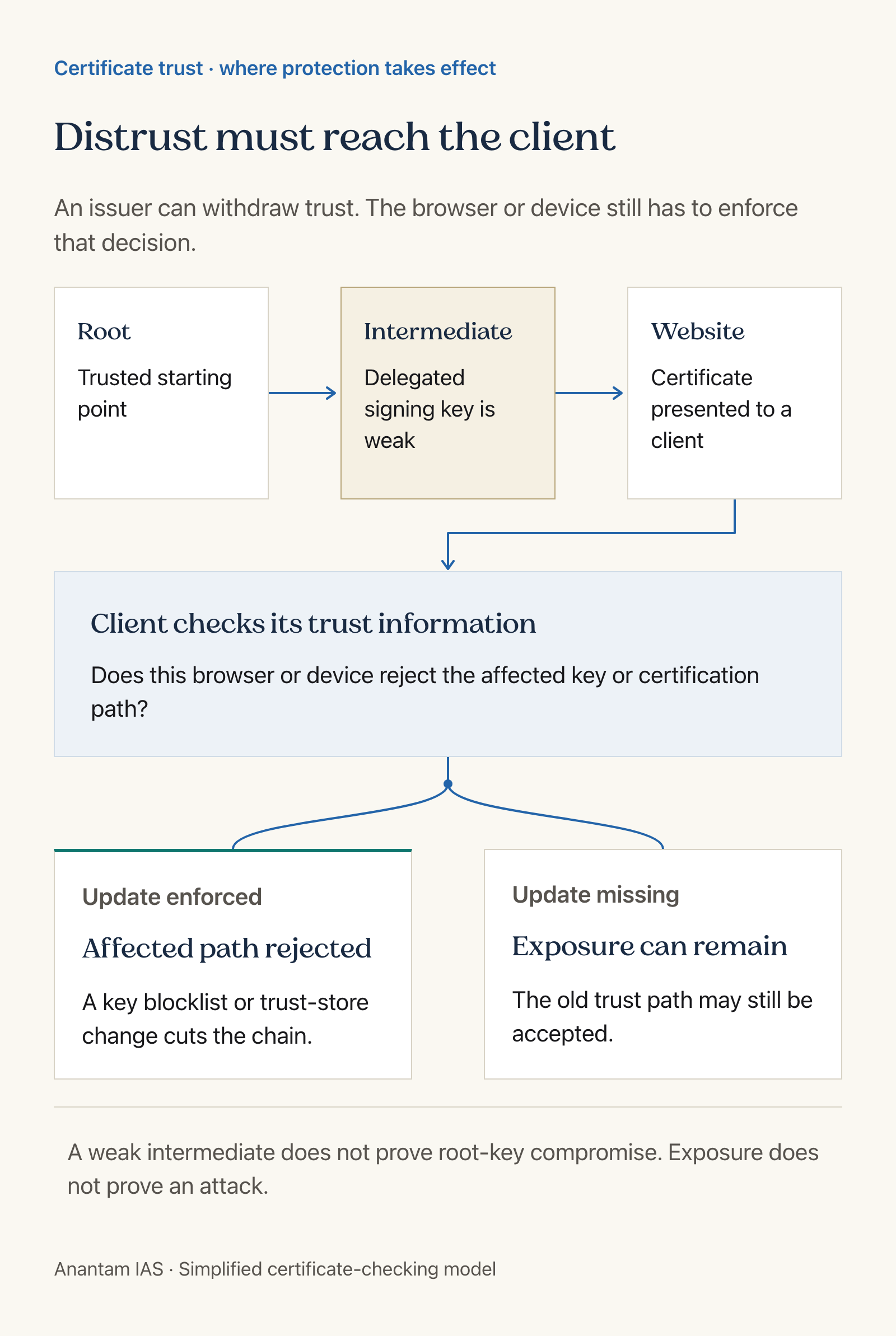
Revocation works only when the software accepting a certificate applies the withdrawal decision.
- An issuer’s revocation decision and a client’s rejection are separate events. A browser, application or device must obtain and enforce suitable status information or distrust instructions before it stops accepting the affected certification path.
- Chrome used its CRLSet mechanism to block hashes identifying the affected public keys. Google said this protected Chrome users against certificates sharing those keys without requiring a browser update or restart to take effect.
- Key-based blocking targets the compromised signing identity rather than merely one certificate’s label. The relevant protection is that a client rejects certificates using the blocked keys, including certificates an attacker could otherwise present as trusted.
- Google also removed the signing root from its root store for consumers that do not receive CRLSet updates. Broad release was expected on 27 October, so the announcement and completed delivery must be distinguished.
- Root removal can also invalidate legitimate certificate chains. Google instructed affected website operators to obtain certificates from another trusted hierarchy; continuity planning must accompany trust withdrawal so authentic services remain reachable after clients enforce distrust.
What Transparency and Service Separation Establish
Evidence about one protection or service cannot be extended to every device, certificate or business.
- Certificate Transparency records publicly trusted certificates in auditable logs. Google found no TLS certificates chaining to six affected intermediates logged before its blocking action, supporting its protection assessment for clients that enforce CT requirements.
- CT enforcement matters: Google’s conclusion covered Chrome and qualifying Android applications. It should not become a blanket assurance about every embedded device or application, because clients can apply different certificate acceptance and update policies.
- A forgery capability is not proof of a completed attack. Google described the exposure and defensive response; the available evidence does not establish that attackers actually impersonated government websites or intercepted particular users’ communications.
- eMudhra said Indian DSC and eSign operations use infrastructure separate from global TLS. Report that as the company’s service-specific assurance; the incident does not justify assuming that all Indian digital signatures have become invalid.
- Independent audits and hardware safeguards did not prevent the reported weakness from reaching trusted intermediates. The governance lesson concerns validating the keys actually accepted by clients, alongside checking the processes and equipment used to create them.
Way Forward
Make Distrust Operational
- Inventory certificate chains across websites, applications and embedded systems; identify which clients receive root-store and revocation updates.
- Replace affected legitimate TLS certificates before the announced root-removal rollout, using a different accepted certification hierarchy.
- Publish clear incident scope and independently supported findings; separate key weakness, confirmed exploitation and consequences for different services.
Conclusion
- Digital trust is revocable authority: secure key generation creates it, while reliable client enforcement withdraws it. A central warning alone cannot protect a device that continues accepting a compromised issuing key.
- In an answer on cyber governance, connect delegation, detection and distrust delivery. Keep the distinction between a vulnerable trust chain and a proven breach, and examine service continuity when legitimate certificates must be replaced.
UPSC Practice Questions
Prelims MCQ 1
With reference to digital certificate trust, consider the following statements:
- An intermediate certification authority can hold delegated signing authority under a trusted root.
- Compromise of an intermediate private key necessarily establishes compromise of the root private key.
- Client enforcement is necessary for a distrust decision to prevent acceptance of affected certificates.
How many of the above statements are correct?
(a) Only one (b) Only two (c) All three (d) None
Answer: (b) Only two
Explanation:
Statements 1 and 3 are correct. An intermediate can issue certificates under delegated authority, but its key compromise does not prove that the root private key was compromised.
Prelims MCQ 2
Which best describes the role of Certificate Transparency in the reported eMudhra incident?
(a) It replaced all compromised private keys automatically. (b) It guaranteed protection for every device using HTTPS. (c) It supported protection for clients enforcing certificate logging requirements. (d) It proved that the root private key had been stolen.
Answer: (c) It supported protection for clients enforcing certificate logging requirements.
Explanation:
Google tied its assessment to the absence of certificates from six affected TLS intermediates in CT before blocking and to clients enforcing CT. Logging does not replace keys or establish root-key compromise.
UPSC Mains Questions
- Explain why a certification authority’s revocation decision must be accompanied by client-side enforcement. Discuss the implications for digital trust governance.
- Distinguish cryptographic vulnerability, confirmed exploitation and service disruption in a certificate-trust incident. How should public communication reflect these distinctions?
Sources: Google Chrome Security and eMudhra.
Frequently Asked Questions
What went wrong with the eMudhra intermediate certificates?
Google reported insufficient randomness in private-key generation for eight subordinate CA certificates. Weak keys could enable forged HTTPS certificates against clients that continued trusting the affected keys.
Was the root private key compromised?
The disclosed incident concerned intermediate private keys. Removal of the signing root was a defensive trust decision; it does not by itself establish that the root private key was compromised.
Why is revocation different from client protection?
Revocation records a withdrawal of trust. Protection depends on a browser, application or device receiving and enforcing that decision through mechanisms such as status checking, key blocklists or trust-store updates.
Were Indian DSC and eSign services affected?
eMudhra said its Indian DSC and eSign businesses operate on separate infrastructure and were unaffected. This is the company’s service-specific statement, not a claim that every certificate ecosystem was free of risk.
Tell Google you want more of this.
Add Anantam IAS as a preferred sourceOne tap, and this site shows up more often in your own Top Stories, AI Overviews and AI Mode. Remove it any time.