Why in News?
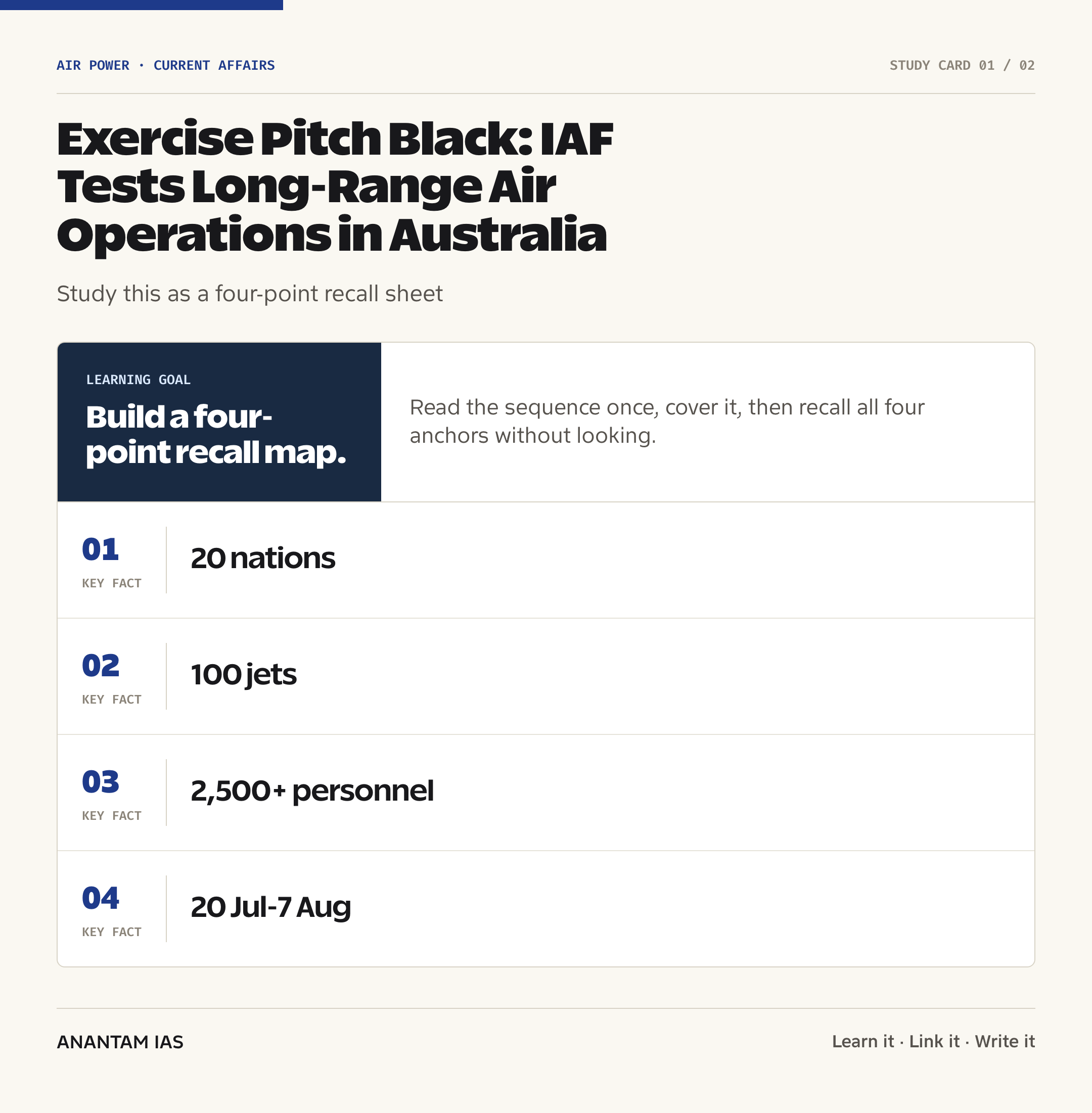
The Indian Air Force began participating in Exercise Pitch Black 2026 on 20 July at RAAF Base Darwin, Australia. The exercise runs until 7 August 2026 and brings air forces together for realistic, large-scale multinational air-combat training.
The PIB confirmed that the Indian contingent is operating Rafale multirole fighters, supported by a C-17 Globemaster III transport aircraft and an IL-78 air-to-air refuelling aircraft. This mix tests not only combat flying but also the deployment, sustainment and refuelling needed for operations far from home bases.
- The RAAF describes Pitch Black as its premier biennial multinational air-combat exercise, with a strong emphasis on night flying over the large training areas of northern Australia.
- Australia’s official release lists up to 100 jet aircraft, more than 2,500 personnel and 20 participating nations across RAAF Bases Darwin, Tindal and Amberley.
- The Indian contingent includes pilots, engineers, technicians, controllers and other specialists, showing that expeditionary air power depends on a complete operational system rather than fighters alone.
- Training includes Large Force Employment, in which many combat and support aircraft are planned and controlled as one coordinated mission package.
- The exercise is intended to improve interoperability, force integration and the exchange of operational practices among participating air forces.
The development matters in the context of:
- For India, the deployment tests the ability to move, support and employ combat aircraft over extended distances in an unfamiliar multinational environment.
- For India and Australia, Pitch Black sits within a wider effort to build procedural interoperability, reciprocal aircraft familiarity and defence cooperation in the Indo-Pacific.
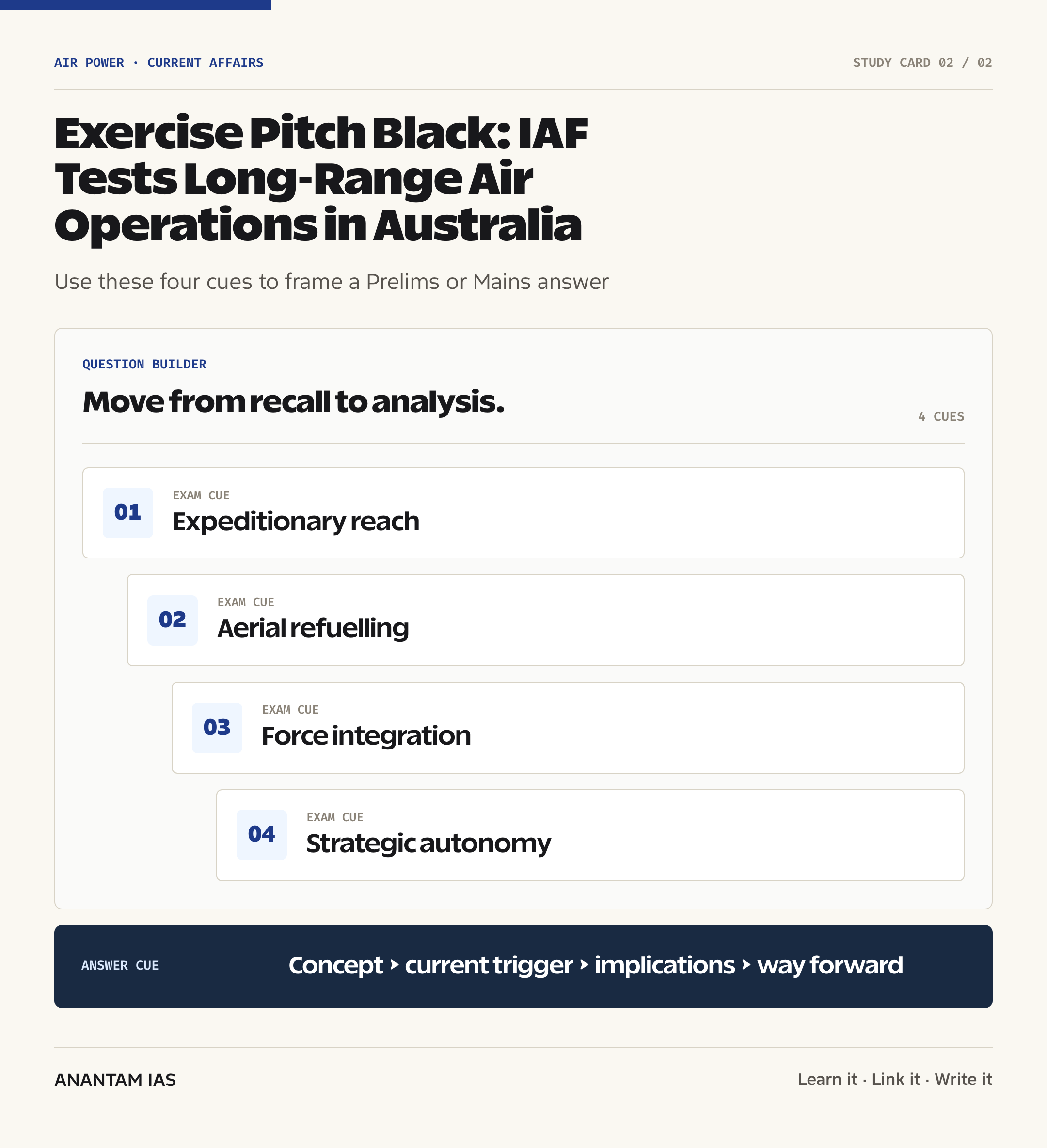
- The exercise demonstrates practical cooperation without turning India into a treaty ally; it fits India’s preference for issue-based partnerships and strategic autonomy.
UPSC Relevance
Prelims Relevance
- Exercise Pitch Black is a biennial multinational air-combat exercise hosted by the Royal Australian Air Force.
- Its principal operating locations in 2026 are RAAF Bases Darwin, Tindal and Amberley; Darwin and Tindal are in the Northern Territory, while Amberley is in Queensland.
- The name Pitch Black reflects the exercise’s historical emphasis on night flying over the sparsely populated training areas of northern Australia.
- India’s 2026 package includes the Rafale multirole fighter, the C-17 Globemaster III transport aircraft and the IL-78 tanker.
- Air-to-air refuelling transfers fuel between aircraft during flight, extending range, endurance or time available in the mission area.
- Large Force Employment coordinates numerous combat and enabling aircraft in a complex mission rather than training each platform in isolation.
- The IAF had earlier participated in the 2018, 2022 and 2024 editions, according to the Ministry of Defence.
- India and Australia signed a Mutual Logistics Support Arrangement in 2020, which supports reciprocal logistics access subject to agreed procedures.
Mains Relevance
GS Paper 3
- Security and defence capability: expeditionary air operations, aerial refuelling, strategic airlift and integrated mission planning.
- Technology and doctrine: the complementary roles of fighters, tankers, transports, controllers, ground crews and secure communications.
- Capacity building: realistic multinational exercises as a way to test procedures, readiness and sustainment under operational pressure.
GS Paper 2
- India-Australia relations: defence cooperation, the 2020 logistics arrangement and growing operational familiarity.
- Indo-Pacific engagement: working with diverse partners while retaining India’s strategic autonomy and independent decision-making.
Essay
- Interoperability is built through repeated practice, common procedures and trust, not declarations alone.
- Strategic autonomy can coexist with deep operational partnerships when cooperation is transparent and interest-based.
Background and Context
What Exercise Pitch Black Tests
Pitch Black is designed to make different air forces plan and execute demanding missions inside one coordinated training architecture.
- The RAAF calls it Australia’s largest collective air-force training activity with partners and allies, using extensive military airspace for realistic and complex scenarios.
- A multinational mission must align planning cycles, airspace control, communications, safety rules, identification procedures and mission debriefs before aircraft can act as an integrated force.
- Large Force Employment normally combines different mission roles in one package. Fighters may conduct air defence or strike tasks while tankers, transports, surveillance platforms and controllers enable the larger operation.
- Night flying raises the demand for instrument discipline, situational awareness, command and control and reliable ground support. The exercise name reflects this long-standing training emphasis.
- Australia says the 2026 edition runs from 20 July to 7 August across Darwin, Tindal and Amberley. The vast northern training areas permit complex flying with fewer civil-airspace constraints than many crowded regions.
- Darwin and Tindal give participants access to northern operating bases and large training airspace, while Amberley supports the wider exercise from Queensland. Distributed activity tests coordination across distance rather than concentrating every function at one airfield.
- Air-combat training also depends on aviation safety and force protection. Controllers must sequence mixed aircraft, crews must follow diversion and emergency procedures, and ground teams must manage foreign equipment around active flight lines.
- This is a training exercise, not a combat deployment. Public information does not reveal every scenario, tactical result or readiness metric, so participation should not be treated as proof of a specific wartime capability.
Scale and Participating Forces
The 2026 edition creates a diverse operating environment by combining aircraft and personnel from 20 nations.
- The Australian Department of Defence announced up to 100 jet aircraft supported by more than 2,500 personnel. A later arrival report used a broader count of more than 100 aircraft, which can include support platforms; the two official formulations should not be conflated.
- Australia listed aircraft participation from the United States, Japan, Papua New Guinea, Indonesia, the Philippines, Thailand, Republic of Korea, India, Singapore, Germany, France and Spain, alongside Australian forces.
- Embedded personnel come from New Zealand, Fiji, Canada, Brunei, Malaysia, Finland and Sweden. Embedded participation allows specialists to contribute to planning, control or support even without a national aircraft detachment.
- The 2026 edition includes the first Pitch Black appearance of Japan’s F-35 Lightning II and Indonesia’s T-50I Golden Eagle, according to Australia.
- The mix exposes crews to aircraft with different performance, sensors, refuelling needs and operating procedures. It also tests whether command structures can create a usable common operating picture without erasing national controls.
- Different levels of participation matter. A country flying combat aircraft, one providing a tanker and one embedding planners all contribute differently, so a nation count alone does not measure the depth of operational integration.
- The exercise has been held in Darwin since 1983. PIB describes a 45-year history, while the exact scale and participants have expanded over time.
India's Three-Aircraft Capability Package
India’s Rafale-C-17-IL-78 combination turns the deployment into a test of an air-power system rather than a fighter-only appearance.
- The Rafale is a multirole combat aircraft able to perform air-to-air and air-to-surface missions. At Pitch Black, its wider significance lies in working inside a multinational planning and control environment.
- The C-17 Globemaster III provides strategic and tactical airlift. It can move personnel, equipment and sustainment loads needed to establish and support a deployed contingent far from India.
- The IL-78 is an aerial refuelling aircraft. Tanker support can extend fighter range and endurance, reduce dependence on intermediate stops and create more flexible mission profiles.
- PIB also lists engineers, technicians and controllers within the contingent. Their work covers aircraft serviceability, mission systems, ground handling, communications and coordination with the host base.
- An expeditionary deployment must manage spares, fuel, maintenance, crew rest, mission data, weapons safety and host-nation procedures. A sortie can launch only when this less visible chain works.
- Serviceability during a distant exercise offers a practical stress test. The contingent must diagnose faults, obtain authorised parts and maintain safe flying rates while working within host-base infrastructure and supply rules unfamiliar to routine operations in India.
- The IAF’s earlier participation in 2018, 2022 and 2024 creates a learning sequence. Repeated attendance allows procedures and professional relationships to mature beyond a one-time familiarisation event.
What Interoperability Actually Means
Interoperability is the ability of forces from different countries to operate together effectively while each remains under national authority.
- Technical interoperability concerns compatible communications, data exchange, refuelling interfaces, identification systems and safe operation around different aircraft types.
- Procedural interoperability concerns shared mission-planning formats, terminology, airspace rules, command relationships, emergency actions and debrief methods.
- Human interoperability develops when pilots, controllers, engineers and planners understand how partners make decisions under time pressure. Trust reduces avoidable friction but does not remove national caveats.
- Interoperability is not the same as identical equipment. Forces can retain different aircraft and doctrines if they establish reliable interfaces, shared reference points and fallback procedures for the parts of a mission that must connect.
- In June 2026, Indian and Australian defence ministers said they looked forward to operationalising a bilateral Implementing Arrangement on Air-to-Air Refuelling at Pitch Black. That statement identifies an intended milestone; official day-one reporting did not yet confirm completion of a specific cross-refuelling event.
- The same ministerial dialogue linked procedural cooperation to the 2020 Mutual Logistics Support Arrangement and agreed to continue aircraft deployments from each other’s territories to build familiarity.
- Readers can place this exercise within the broader India-Australia defence partnership, where logistics, maritime security and technology cooperation are increasingly connected.
Indo-Pacific Significance for India
Pitch Black gives India practical access to a wide network of air forces without requiring a formal alliance commitment.
- The participant list crosses several strategic groupings and regions. It includes treaty allies of the United States, Southeast Asian states, European partners and India, creating a broader training network than any single minilateral grouping.
- Working with a varied group lets India compare procedures without adopting one partner’s model wholesale. The useful output is a set of adaptable practices that can be incorporated into Indian doctrine after national assessment.
- For India, such exercises support operational reach, defence diplomacy and crisis familiarity. Personnel learn whom to contact, how partners plan and where procedural gaps may appear during a real contingency.
- Australia presents the exercise as supporting a peaceful and prosperous region through integration. India can share that stability goal while deciding independently where and how its forces operate.
- This approach fits minilateralism: small or flexible coalitions can solve practical problems without creating a universal institution or binding every member to the same strategic position.
- The exercise also supports air-force familiarity alongside maritime cooperation in the Quad and other forums. But Pitch Black is not a Quad exercise, and its 20 participants should not be reduced to a four-country framework.
- India’s broader challenge is to convert repeated exercises into doctrine, maintenance learning and joint preparedness while preserving strategic autonomy and avoiding automatic alignment.
Benefits, Limits and Evaluation
A serious assessment separates the training benefits of multinational exercises from claims that the public evidence cannot support.
- Exercises provide a controlled setting to expose communication gaps, incompatible procedures, maintenance bottlenecks and command ambiguities before a crisis.
- Large-force missions can improve planning speed and crew confidence, but scripted success does not reproduce every feature of combat, including adversary adaptation, political uncertainty and losses.
- The value for India should be measured through lessons captured, procedures revised, turnaround time, serviceability and the ability to integrate transport and tanker support with combat aircraft.
- India should also evaluate whether bilateral arrangements produce usable outcomes, such as reciprocal logistics, verified refuelling compatibility and clearer processes for aircraft deployment from each other’s territories.
- Security cooperation needs public clarity about its purpose. Transparent descriptions of exercises reduce the risk that defence preparedness is confused with bloc politics or offensive intent.
- The strongest outcome is not a publicity count of sorties. It is a repeatable institutional ability to plan, sustain, communicate and learn with partners under demanding conditions.
Way Forward
Institutionalise lessons
- Convert exercise observations into standard operating procedures, doctrine updates and measurable training goals for later IAF deployments.
- Run joint debriefs across pilots, controllers, maintenance crews and logisticians so that support-chain lessons receive the same attention as flying performance.
Deepen enabler integration
- Test the complete chain linking strategic airlift, tanker planning, fighter missions and host-base sustainment instead of assessing each platform separately.
- Operationalise bilateral refuelling and logistics arrangements only after completing safety, technical and legal certification, with clear national command responsibility.
Build secure interoperability
- Improve secure communications and common planning methods while protecting sensitive mission data and sovereign decision-making.
- Use table-top drills before flying serials to rehearse emergencies, communications failure, diversion and search-and-rescue procedures.
Link exercises to strategy
- Match participation to defined Indian objectives in readiness, defence diplomacy and Indo-Pacific stability, rather than treating attendance as an end in itself.
- Explain the defensive training purpose publicly and maintain strategic autonomy by keeping operational commitments subject to national approval.
Conclusion
Exercise Pitch Black 2026 tests whether the IAF can deploy and sustain a balanced air-power package across long distances while operating safely with forces that use different aircraft, procedures and command systems. The Rafale attracts attention, but the C-17, IL-78 and specialist personnel make the expedition possible.
Its durable value lies in interoperability with safeguards: technical compatibility, procedural familiarity, professional trust and lessons that improve Indian readiness. Cooperation can deepen without surrendering national command or strategic autonomy.
UPSC Practice Questions
Prelims MCQ 1
With reference to Exercise Pitch Black 2026, consider the following statements:
- It is a biennial multinational air-combat exercise hosted by the Royal Australian Air Force.
- India’s participating package includes Rafale, C-17 Globemaster III and IL-78 aircraft.
- The exercise is conducted exclusively at RAAF Base Amberley.
How many of the above statements are correct?
(a) Only one (b) Only two (c) All three (d) None
Answer: (b) Only two
Explanation:
Statements 1 and 2 are correct. Pitch Black is the RAAF’s biennial multinational air-combat exercise, and India deployed Rafale, C-17 and IL-78 aircraft. The 2026 activity spans Darwin, Tindal and Amberley, so Statement 3 is incorrect.
Prelims MCQ 2
Which one of the following best describes Large Force Employment in an air exercise?
(a) Coordinating many combat and support aircraft as one complex mission package (b) Replacing all crewed aircraft with autonomous systems (c) Restricting the exercise to transport aircraft and ground logistics (d) Transferring permanent command of national forces to the host country
Answer: (a) Coordinating many combat and support aircraft as one complex mission package
Explanation:
Large Force Employment integrates numerous aircraft and mission roles under a coordinated plan. Participating forces retain national command; the term does not imply autonomous-only operations or permanent command transfer.
UPSC Mains Questions
- Exercise Pitch Black shows that expeditionary air power depends as much on tankers, strategic airlift, maintenance and command systems as on fighter aircraft. Analyse the capability lessons for the Indian Air Force. (15 marks, 250 words)
- What does military interoperability mean in practice? Discuss its technical, procedural and human dimensions with reference to the expanding India-Australia defence relationship. (15 marks, 250 words)
- Multinational exercises can deepen operational partnerships without creating treaty alliances. Evaluate this proposition in the context of India’s strategic autonomy and Indo-Pacific engagement. (10 marks, 150 words)
Sources: PIB, Ministry of Defence and Australian Department of Defence.
Frequently Asked Questions
What is Exercise Pitch Black?
Exercise Pitch Black is the Royal Australian Air Force’s premier biennial multinational air-combat exercise. It uses northern Australia’s large training airspace for realistic missions, including night flying and large-force operations. The 2026 edition runs from 20 July to 7 August across RAAF Bases Darwin, Tindal and Amberley.
Which aircraft did India deploy?
The IAF deployed Rafale multirole fighters with a C-17 Globemaster III transport aircraft and an IL-78 aerial refuelling aircraft. The package combines combat power with strategic lift and tanker support. Pilots are accompanied by engineers, technicians, controllers and other specialists needed to sustain operations far from home bases.
How large is the 2026 exercise?
Australia announced up to 100 jet aircraft, more than 2,500 personnel and 20 participating nations. Aircraft and embedded personnel are operating across three RAAF bases. Official references to broader aircraft totals may include support platforms, so figures should be quoted with the wording and scope used by the source.
What does interoperability mean?
Interoperability is the ability of different national forces to operate together effectively. It includes compatible communications and refuelling systems, shared planning and safety procedures, and professional familiarity among crews and commanders. Each country still retains national authority, operational caveats and control over the use of its forces.
Why is the IL-78 important?
The IL-78 provides air-to-air refuelling, which can extend a fighter’s range, endurance or time in the mission area. Its presence allows the IAF to test tanker planning as part of a long-distance deployment. A tanker also adds coordination, safety and compatibility requirements that fighter-only training cannot reproduce.
Does participation make India an ally?
No. Participation in Pitch Black improves training, familiarity and practical cooperation, but it does not create a treaty alliance or transfer command of Indian forces. India can build deep operational partnerships for shared interests while retaining strategic autonomy and deciding independently whether, where and how its forces are employed.
Tell Google you want more of this.
Add Anantam IAS as a preferred sourceOne tap, and this site shows up more often in your own Top Stories, AI Overviews and AI Mode. Remove it any time.