At the Munich Security Conference on 14 February 2026, two men stood roughly a corridor apart and described the same agreement in two different languages. US Secretary of State Marco Rubio said Washington had won a commitment from India to stop buying “additional” Russian oil. Hours later, External Affairs Minister S. Jaishankar declined to confirm or deny it and said instead that India is “very much wedded to strategic autonomy,” that oil companies decide on “availability, cost and risks.” That gap, between a claimed concession and a refused confirmation, is the whole topic. And it sits on top of a fresh trade framework, announced 6 February 2026, that pulled a punishing US tariff back from 50% to 18%.
So the question that writes itself isn’t whether India should keep its strategic autonomy. It’s how much that autonomy costs when the cheapest barrel of oil and the largest export market start pulling in opposite directions. This is a GS2 international-relations problem wearing a GS3 economics jacket, and you can’t answer one half without the other.
The Issue, Framed
The fight here isn’t about whether India should be friends with Russia or with the United States. India wants both. The fight is about what happens when one friend makes a demand and the other holds the bill.
Let’s fix the vocabulary first, because most of the confusion around this topic comes from people using big words loosely. Strategic autonomy is the principle that India decides its foreign and economic policy on its own interest, not on instructions from any bloc or capital. It’s the grown-up version of non-alignment: Cold-War non-alignment meant staying out of two camps, while strategic autonomy means dealing with everyone and being captured by no one. Multialignment is how India does that in practice today, running deep ties with the US, Russia, the Gulf, and Europe at the same time, refusing to make any single one of them exclusive. The bet behind multialignment is simple: more partners means more options, and more options means more freedom.
Now the pressure points. Secondary sanctions are penalties one country imposes not on its target but on third parties who do business with that target, so the US can punish India for buying from Russia even though the US has no quarrel with India directly. A tariff used this way becomes a foreign-policy weapon, not a trade tool, and that’s exactly what a July 2025 US executive order set up: an interagency process to monitor countries importing Russian oil and to tariff them for it. CAATSA, the Countering America’s Adversaries Through Sanctions Act of 2017, is the US law that threatens exactly this kind of penalty on countries that buy major Russian defence or energy. And the current account deficit (CAD) is the gap between what India pays the world and what it earns from it, and oil is the single biggest line in that bill. Keep those four terms in your pocket; the entire editorial runs on them.
Here’s the tension in one line. The cheapest oil on the market came from Russia. The biggest customer for India’s exports is the United States. And the US made buying the first one expensive by threatening the second. So India’s autonomy stopped being a speech and became a price.
What the Data Says
The numbers tell a clean story if you read them in order: a sharp rise, a long plateau, then a forced fall. Start with how much of India’s oil came from Russia.
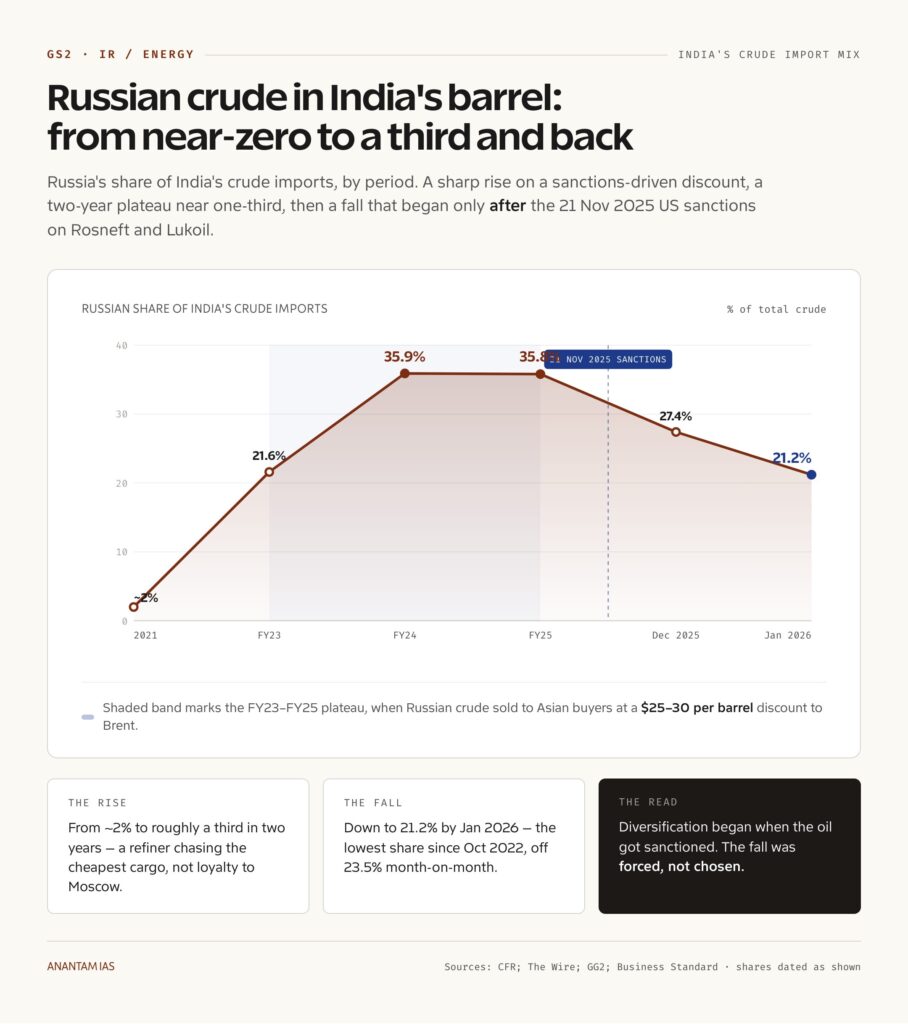
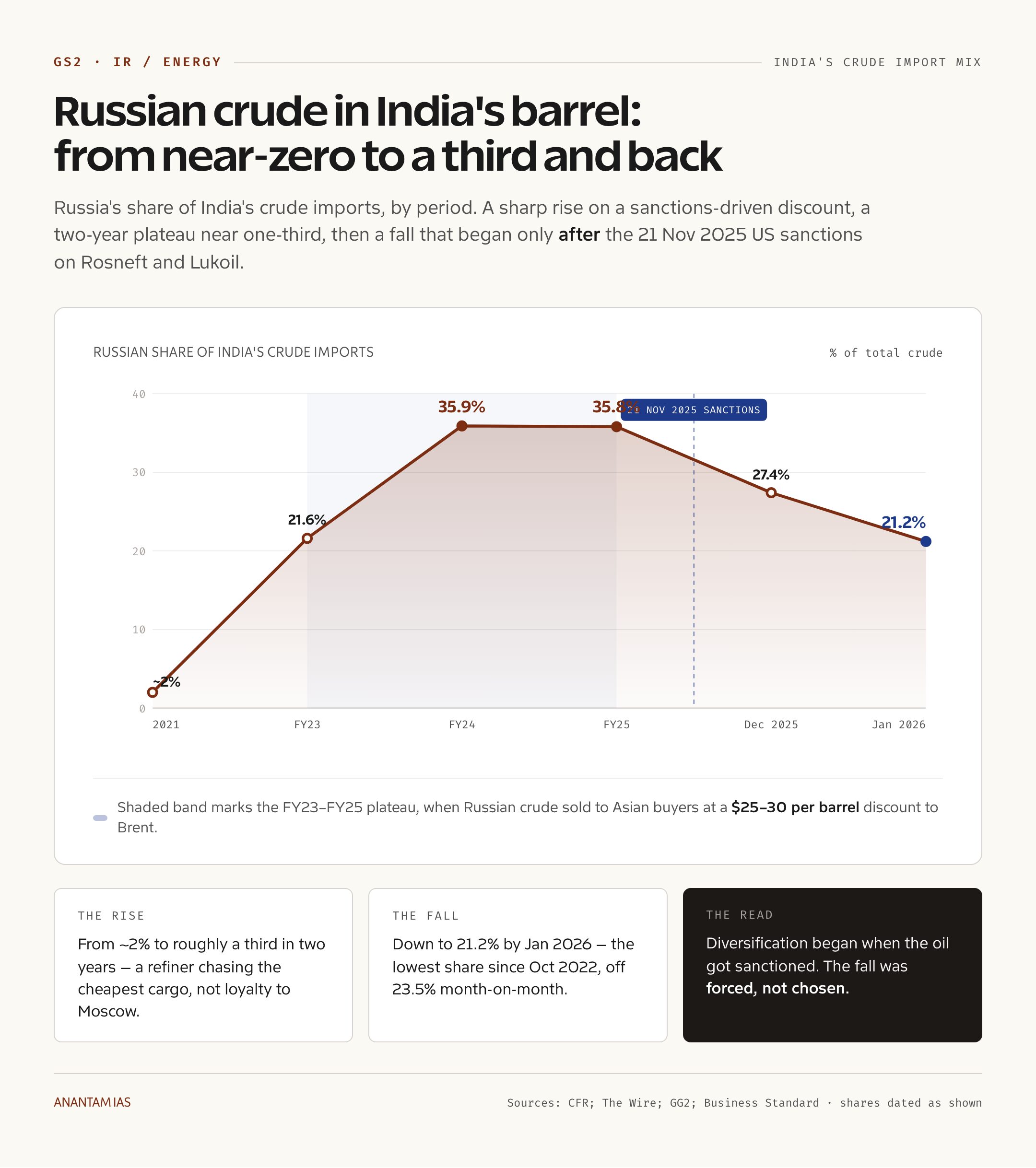
Before the Ukraine war, Russian crude was a rounding error in India’s barrel, around 2% in 2021. Then Western sanctions on Moscow created a discount, and India bought. The share jumped to 21.6% in FY 2022-23, then to 35.9% in FY 2023-24, holding at 35.8% in FY 2024-25. So in two years Russia went from a sliver to roughly a third of every barrel India imported. That’s not loyalty to Moscow. That’s a refiner chasing the cheapest cargo.
And the cargo really was cheap. Russia sold to Asian buyers at $25-30 a barrel below Brent through much of 2022-23. On a country that imports more than 85% of its crude, that discount isn’t a rounding gain. It’s a macro-stabiliser. India’s FY 2024-25 crude bill ran to 243 million tonnes for about $137 billion, so shaving even a few dollars off each barrel keeps petrol prices and the rupee steadier than they’d otherwise be.
Then the ceiling appeared. On 21 November 2025 the US sanctioned Rosneft and Lukoil, two of the suppliers Indian refiners leaned on, and the share began to slide. It fell to 27.4% by December 2025, then to 21.2% in January 2026, the lowest since October 2022, down 23.5% month-on-month. Middle Eastern crude rose to about 55% of imports, US oil imports climbed 31% year-on-year by December 2025. Read that timing carefully. The diversification didn’t begin when India decided Russia was a bad partner. It began when buying Russian oil got sanctioned. The fall was forced, not chosen, and that distinction matters for every argument that follows.
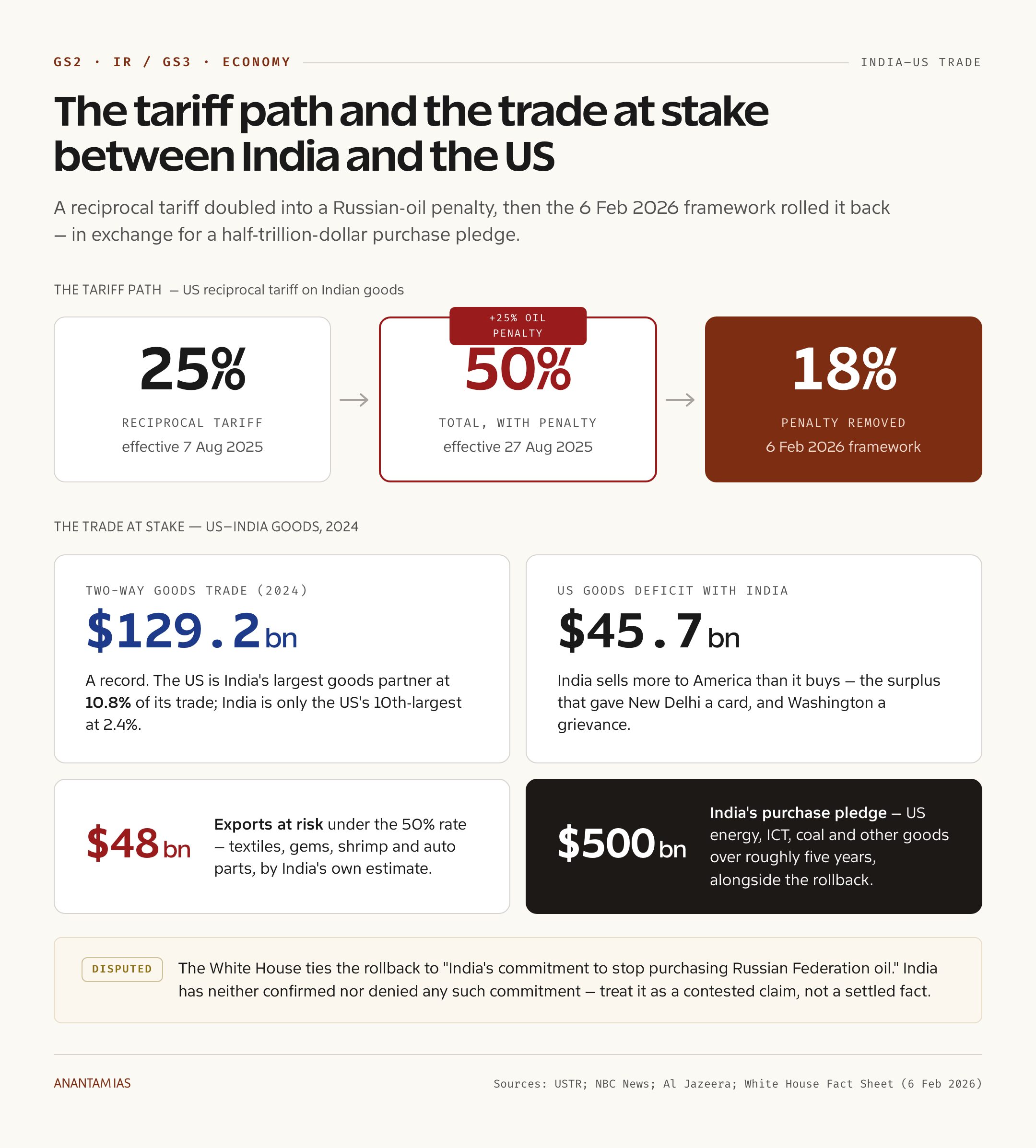
On the trade side, the stakes are large and the leverage cuts both ways. US-India goods trade hit a record $129.2 billion in 2024, and the US ran a $45.7 billion goods deficit with India, which is to say India sells more to America than it buys. The US is India’s largest goods partner at 10.8% of India’s trade; India is only the US’s 10th-largest at 2.4%. So America is more important to India’s exporters than India is to America’s, which is exactly the asymmetry that made the tariff threat bite.
One thing the deal text does not say is worth as much as what it does. The pressure on India to distance itself from Iran, to drop any BRICS de-dollarisation push, to lean away from China, was all over the political commentary around the 6 February 2026 framework. But the White House fact sheet itself mentions none of it. So treat Iran, BRICS and de-dollarisation as the backdrop to the bargaining, not as written terms of the trade. The only concession the document explicitly ties the tariff rollback to is Russian oil. That distinction keeps an answer accurate and stops it from inventing commitments that were never signed.
The Case For
The case for holding strategic autonomy is strong, and an answer that skips it sounds naive. So state it at full strength.
Energy affordability comes first, because it’s the one that touches 1.4 billion people. With import dependence above 85% and a current account deficit that moves with every oil shock, discounted crude was never a favour to Moscow. It was a buffer between a global price spike and an Indian household’s fuel bill. ICRA’s own arithmetic shows why: a $10-a-barrel rise adds $12-13 billion to the net oil bill and widens the CAD by about 0.3% of GDP. So abandoning the cheapest barrel on demand hands control of India’s inflation and its fiscal maths to whoever sets the next sanction.
There’s a global-good argument India makes too, and it’s worth knowing. By keeping over a million barrels a day of Russian crude flowing and re-exporting refined fuel to Europe, Indian refiners helped cap world prices rather than starve the market. India’s line is that pulling those barrels would have raised prices for everyone, not punished Moscow. You don’t have to accept it fully to see it’s a serious rebuttal to the “funding the war” charge.
Then there’s precedent, and this is the part that gives the autonomy case real spine. India signed a roughly $5 billion deal for the Russian S-400 air-defence system in 2018 under explicit US warning that CAATSA sanctions could follow. None ever did. The US House even passed a bipartisan India-specific waiver amendment by around 300 votes. On Iran, India’s Chabahar port held a sanctions waiver from 2018. So the record shows something genuinely useful for a Mains answer: India has leaned toward Russia and Iran before and still deepened ties with Washington. Autonomy has been tolerated, repeatedly, because India’s value as a partner outweighs the friction.
And that’s the deepest point. India’s worth to the US, on balancing China, on the Indo-Pacific, on the Quad, rests partly on its independence. A fully aligned India is a less useful swing power, not a more useful ally. So protecting the principle, as Jaishankar frames it when he says the autonomy stance “cuts across the political spectrum”, isn’t stubbornness. It’s preserving the very thing that makes India a partner worth courting.
The Case Against
Here’s what the autonomy case walks past. A principle you can’t pay for isn’t a principle. It’s a preference, and the bill came due in 2025.
The tariff pain was real and concentrated. The US imposed a 25% reciprocal tariff effective 7 August 2025, then stacked a second 25% “Russian-oil penalty” on 27 August 2025, taking the total to 50%. India’s own estimate was that the 50% rate threatened more than $48 billion of exports, the textiles, gems, shrimp, and auto parts that employ millions, in India’s single largest market. Autonomy that costs MSME jobs and export orders isn’t free, and pretending otherwise insults the people who’d lose the work.
Market access turned out to be the lever that moved the rate. The 6 February 2026 framework cut the reciprocal tariff from 25% to 18% and removed the penalty, but not for nothing. The White House fact sheet ties the rollback to “India’s commitment to stop purchasing Russian Federation oil,” and the deal came alongside India’s pledge to buy $500 billion of US energy, ICT, coal and other goods over roughly five years, plus tariff cuts on US farm and industrial products. So breathing room was bought, and the currency was concession. That’s the limit of autonomy in plain sight.
The structural tilt is the quietest and most important cost. Russia sells India cheap oil and legacy weapons. It does not sell the things India’s growth actually depends on, semiconductors, jet engines like GE’s, dollar-clearing for trade, FDI, and access to deep capital markets. Those run through the US and its allies. So the Russia relationship, however valuable, has a ceiling that the West-facing relationship does not, and that asymmetry caps how far any tilt toward Moscow can responsibly go.
There’s also a blunt point about who set the ceiling on the Russia tilt, and honesty demands you make it. The Russian share didn’t fall from 36% to 21% because India decided the relationship had run its course. It fell because the US sanctioned Rosneft and Lukoil in November 2025 and threatened tariffs that Trump publicly floated going as high as 500%. So the “diversification” that India can now point to as prudence was, in timing terms, a response to external pressure, not a sovereign choice made on its own clock. That doesn’t make it wrong. But it does show the limit: when autonomy and a powerful partner’s demand point the same way, it’s hard to tell principle from compliance, and the answer should say so plainly.
And then there’s the reputational tax, which is exactly what Munich exposed. When Washington claims a commitment and New Delhi won’t confirm it, India risks looking one of two unflattering ways: non-credible if it did promise and won’t admit it, or unreliable if it didn’t and let the claim stand. Strategic ambiguity buys flexibility, but it isn’t free either. Every time the gap shows, partners on both sides learn to discount what India says, and that’s a slow, real cost of trying to face every direction at once.
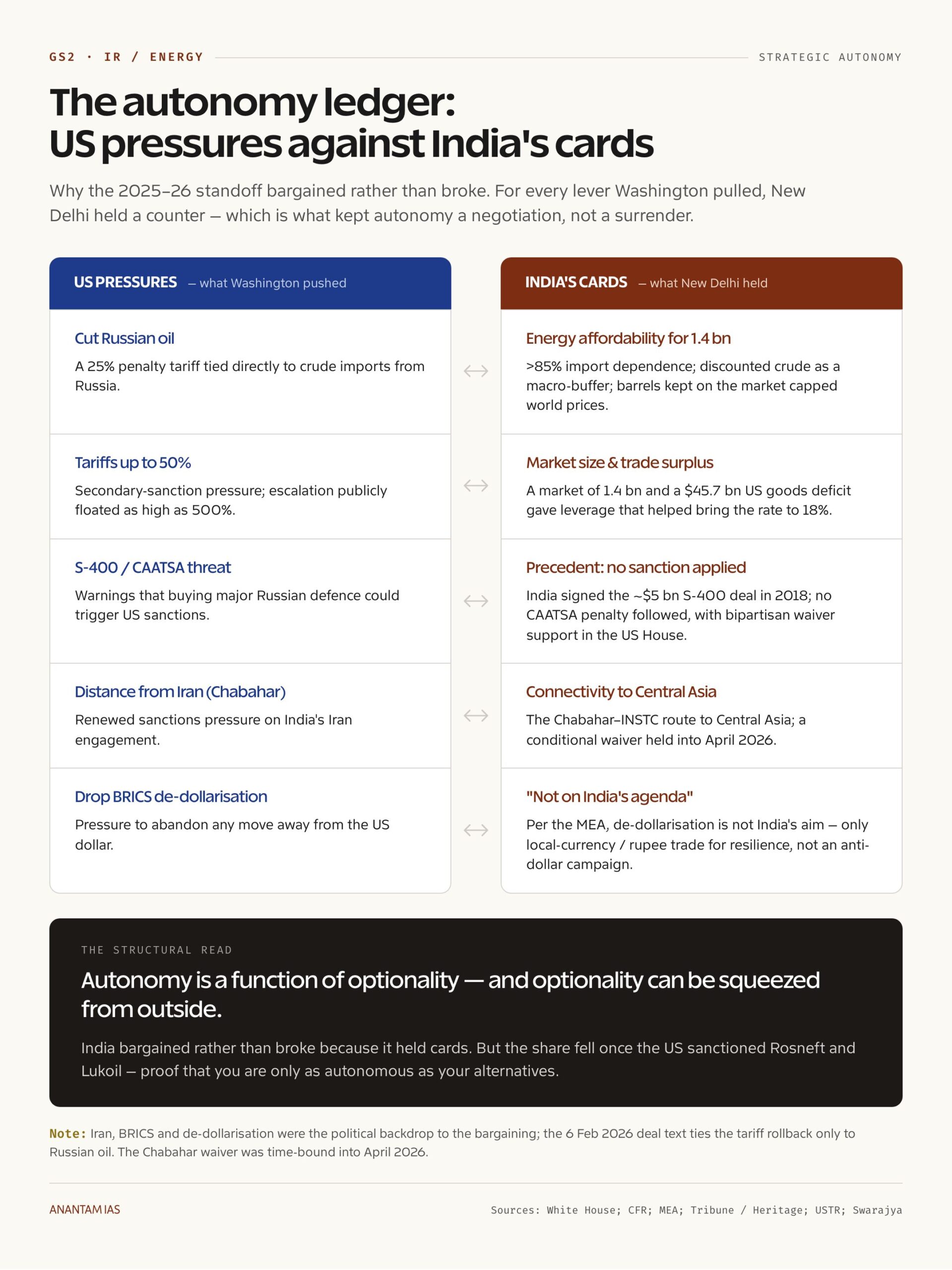
The Deeper Structural Read
Step back from oil cargoes and tariff schedules, and the real fault line shows up. The question was never “Russia or America.” It was whether India’s autonomy is a doctrine it can afford or a slogan it can only rent.
Autonomy is not the same as self-sufficiency, and conflating the two is the most common analytical error on this topic. India isn’t trying to need no one. It’s trying to never depend on only one. That’s why the Russian-oil episode is so revealing: India’s freedom to buy cheap crude existed only because there were buyers, sellers, shippers and insurers outside the sanctioning bloc. The moment the US sanctioned Rosneft and Lukoil and the share fell from 36% to 21%, the lesson landed hard, autonomy is a function of optionality, and optionality can be squeezed from outside. You’re only as autonomous as your alternatives.
Now bring in the money plumbing, because this is where the topic quietly turns into a GS3 economics question. India’s answer to dollar-based sanction risk has been to build rupee-trade rails, and the numbers are real: by February 2025 the RBI had cleared 123 correspondent banks from 30 countries running 156 Special Rupee Vostro Accounts. As 2026 BRICS chair, India put central-bank-digital-currency interlinking on the agenda. But read the official position precisely, because aspirants get this wrong constantly. De-dollarisation, the deliberate replacement of the US dollar as the world’s reserve and settlement currency, “is not part of India’s financial agenda,” per the MEA, and India has refused to back a common BRICS currency. So India promotes rupee trade for resilience, not as an anti-dollar campaign. That’s the difference between separating the plumbing from the politics and picking a fight. Jaishankar’s framing keeps them apart deliberately.
Here’s the structural read that belongs in your answer. India is running a hedging strategy in a world that’s drifting toward forced choices. Multialignment works beautifully when the great powers tolerate ambiguity. It strains the moment one of them, here the US, decides that buying from a rival is itself a hostile act and prices it with secondary tariffs. So the deeper question for a future policymaker isn’t whether to keep autonomy. It’s how to build enough genuine optionality, in energy, in defence, in finance, that no single partner can make the price of independence unbearable. Autonomy without alternatives is just a polite word for exposure.
What Should Be Done
So what does a serious autonomy policy look like, beyond the speeches? Not a plea for “balance,” but a set of moves that turn a principle into something India can actually pay for. Six of them, none jingoistic, all neutral.
- Diversify oil sourcing structurally, not reactively. Lock long-term contracts across the Gulf, the US, Latin America and Africa so no single supplier ever crosses a self-imposed share cap, and build that flexibility into refinery slates in advance. The Jan 2026 scramble after the Rosneft-Lukoil sanctions showed the cost of diversifying under duress. Optionality bought ahead of a crisis is far cheaper than optionality bought during one.
- Close the trade agreement on India’s terms. The 18% framework is interim; the binding Bilateral Trade Agreement was still under negotiation as of early 2026. Convert the framework into a durable deal that ring-fences sensitive agriculture and dairy and digital sovereignty while expanding genuine US market access. A rushed deal locks in concessions; a patient one trades access for access.
- Shrink the oil-beta of the economy. Accelerate Strategic Petroleum Reserve expansion, ethanol blending, EV adoption, renewables and refining efficiency. Every percentage point shaved off oil’s weight in the import bill is a percentage point of foreign-policy freedom bought back, because it loosens the CAD’s grip on every diplomatic decision.
- Keep monetary optionality without starting a currency war. Grow rupee-trade rails and the Vostro-account and CBDC links that give India sanction-resilient settlement, while saying plainly and repeatedly that India is not pursuing de-dollarisation. Resilience and rhetoric are different things; conflating them invites the exact pressure India is trying to avoid.
- Manage the messaging. Strategic ambiguity has its uses, but the Munich gap showed where it taxes credibility. State the autonomy principle plainly, let commercial decisions follow market logic openly, and stop leaving partners to guess what was promised. Clarity on principle costs nothing and buys trust.
- Protect the connectivity cards. The Chabahar waiver, India’s route to Central Asia and the INSTC corridor, was conditional and time-bound into 2026. Preserve the option without over-investing into sanction risk. A card you can play later is worth more than a bet you’re forced to defend now.
Every one of these strengthens autonomy by widening alternatives. A country with more suppliers, a deeper reserve, resilient payment rails and a clear voice doesn’t have to choose between principle and price. It can afford both, which is the entire point.
The War Behind the Oil: Origins and India’s Balancing Act
The discounted barrels did not appear out of nowhere. They are a by-product of the conflict that began on 24 February 2022, when Russia launched a full-scale invasion of Ukraine. The roots run deeper than any clash of personalities between Vladimir Putin and Volodymyr Zelensky: the trigger lies in the eastward expansion of NATO, the 2014 annexation of Crimea, and the long-simmering separatist war in the Donbas. Ukraine sits to Russia’s southwest, not to its north, and through the conflict it has leaned on military and financial backing from NATO members to hold the line.
India’s response has been a study in calibrated distance. New Delhi abstained on successive United Nations Security Council and General Assembly resolutions condemning the invasion, declining to name Russia as the aggressor while repeatedly calling for an end to hostilities. Prime Minister Narendra Modi’s line to Putin at Samarkand in September 2022, that “today’s era is not one of war,” was quoted approvingly in Western capitals even as India kept buying Russian crude. That is the balancing act in one sentence: refuse to condemn, refuse to endorse, and keep the supply lines open.
The costs of the war reach far beyond the oil counter. The conflict choked Black Sea grain corridors and squeezed the global supply of fertiliser and natural gas, feeding the food and energy inflation that India spent 2022 and 2023 absorbing. India has positioned itself as a potential bridge to peace, offering to facilitate dialogue while protecting its own energy and economic interests, the same strategic autonomy that the oil debate above turns on.
For Your Mains Answer
This topic is a GS2-GS3 crossover gift. It lets you connect foreign policy to macroeconomics in one frame, which is exactly the synthesis the higher-mark answers show.
GS paper mapping: GS2: India and its bilateral relations (US, Russia); effect of policies of developed countries on India’s interests; important international groupings (BRICS, Quad). GS3: energy security and import dependence; current account deficit, inflation and the external sector; effects of trade agreements and commodity shocks.
Likely question frames:
- “Strategic autonomy is meaningful only to the extent India has real alternatives.” Examine in light of the Russian-oil and US-tariff episode of 2025-26.
- Discuss how energy security and trade dependence shape the limits of India’s multialignment in a sanctions-driven international order.
- The cost of autonomy is borne in economics, not diplomacy. Critically analyse with reference to recent India-US trade negotiations.
Quotable data points:
- Russian crude in India’s imports: ~2% (2021) → 35.9% (FY24) → 35.8% (FY25) → 21.2% (Jan 2026).
- Russian discount: $25-30/bbl below Brent through 2022-23.
- US tariff path: 25% (7 Aug 2025) → 50% (27 Aug 2025) → 18% (6 Feb 2026 framework).
- India’s purchase pledge: $500 billion of US goods over ~5 years.
- US-India goods trade: ~$129.2 bn in 2024; US deficit $45.7 bn.
- Import dependence >85%; FY25 crude bill 243 MT for ~$137 bn.
- $10/bbl rise widens CAD ~0.3% of GDP, adds $12-13 bn to the oil bill.
- “Wedded to strategic autonomy… it cuts across the political spectrum” – S. Jaishankar, Munich, Feb 2026.
Keywords to use: strategic autonomy, multialignment, secondary sanctions, reciprocal tariff, energy security, current account deficit, de-dollarisation, supplier diversification, Strategic Petroleum Reserve.
Syllabus linkages: bilateral relations and their evolution from non-alignment to strategic autonomy; effect of developed-country policies on India; international groupings; energy security; external-sector vulnerability; trade agreements.
Balanced conclusion line: India’s strategic autonomy is real, but it’s priced in barrels and tariffs, not just declared in speeches; the task ahead is to build enough optionality in energy, finance and trade that no single partner can ever make independence unaffordable.
How to Build the Answer
Open with the tension, not a textbook line. The Munich gap between Rubio’s claim and Jaishankar’s refusal to confirm captures the whole problem in one image, and starting there tells the examiner you understand that this is about the price of autonomy, not its existence. A definition of strategic autonomy and multialignment can follow in the next sentence. The first line should frame the clash; the glossary comes second.
Bring the GS3 economics in early, because that’s where most answers stay thin. One strong body paragraph can carry three figures, the 85% import dependence, the $137 billion crude bill, and the $10/bbl-to-0.3%-of-GDP CAD link, and then say what they prove: that cheap oil was a macroeconomic buffer, not a diplomatic favour. The number is the anchor; the inference is the mark.
The second body paragraph should steelman the other side. If your stance defends autonomy, first admit the $48 billion in exports the 50% tariff threatened and the real jobs behind it. If your stance stresses the limits, first concede the energy-affordability logic. That’s how an answer reads balanced instead of one-sided.
Group the way-forward, never scatter it. Cluster the reforms under headings, supplier diversification, the trade agreement on India’s terms, shrinking the oil-beta, monetary optionality, clear messaging, connectivity cards, and use the topic’s own vocabulary so the answer sounds like policy analysis, not a news recap.
Close on the syllabus link and on judgment, not summary. The reliable pattern is “autonomy isn’t the question; affordable autonomy is,” which lets you balance principle against price in a single decisive line.
Common Mistakes to Avoid
- Don’t treat it as a pure IR question. Half the marks live in GS3 economics, the CAD, the oil bill, the trade balance. An answer with no numbers reads like an opinion column.
- Don’t assert the disputed claim as fact. Rubio said India committed to stop buying Russian oil; India neither confirmed nor denied it. Write it as a contested claim, attributed, never as settled fact.
- Don’t confuse rupee trade with de-dollarisation. India promotes local-currency settlement for resilience and explicitly rejects an anti-dollar agenda. Mixing the two is a factual error examiners catch.
- Don’t go jingoistic or anti-American. This is a balance-of-interest problem, not a morality play. Keep both capitals’ logic on the page.
- Don’t end on a slogan. Close with an implementable principle, optionality, not a flourish about “Bharat’s rise.”
A Compact Answer Spine
- Introduction: The Munich gap in one sentence; define strategic autonomy and multialignment in the next.
- Evidence: Two or three attributed figures, the oil-share arc, the tariff path, the CAD sensitivity, each tied to an implication.
- Arguments: The case for holding autonomy (energy security, precedent, swing-power value), then its limits (tariff cost, structural tilt to the West, reputational tax). Keep both fair.
- Structural diagnosis: Autonomy equals optionality; forced diversification after the Rosneft-Lukoil sanctions proves it can be squeezed from outside.
- Way forward: Six grouped moves, each with a clear actor, refiners, the trade negotiators, the RBI, the messaging apparatus.
- Conclusion: Adapt the balanced line to the exact question wording.
Diagram or Flowchart Idea
For a 15-marker, draw one causal chain rather than a decorative map: cheap Russian crude → 85% import dependence eased, CAD buffered → US secondary tariff (50%) → export pain ($48 bn at risk) → 6 Feb 2026 framework (tariff to 18%, $500 bn pledge) → forced diversification (share 36% → 21%). The examiner reads that logic in seconds and sees you’ve linked IR to economics.
For a 10-marker, skip the diagram and use a two-column table instead: “US pressures” against “India’s cards,” cut Russian oil versus energy security of 1.4 billion, 50% tariff versus India’s surplus and market size, distance from Iran versus the Chabahar-INSTC option. It does more work and evaluates faster under time pressure.
Ethics and Governance Angle
Even an IR-economics answer can carry one line on whose interest the State is protecting. Cheap crude wasn’t an abstraction; it was the petrol price of a delivery rider and the inflation rate of a pensioner. Naming that stake turns a geopolitics answer into a governance answer, because foreign policy that ignores the household it serves has misread its own mandate.
Then convert the value into design. Don’t just say “protect national interest.” Say how: a deeper Strategic Petroleum Reserve so a sanction can’t spike domestic fuel overnight, a trade deal that ring-fences the farmer’s price, payment rails that keep trade flowing if dollar access tightens. That’s the move from principle to administrative maturity.
A sentence pattern that travels across topics: “The objective is legitimate, but its sustainability depends on optionality, resilience and credibility.” It grants the State its goal without handing it a blank cheque, which is what a balance question rewards.
How to Use Data Without Sounding Mechanical
Use fewer numbers than you know. Three explained figures beat ten dumped on the page. Lead with one structural number (85% import dependence), use a second for the shock (tariffs to 50%), and a third for the resolution (down to 18%, share forced from 36% to 21%). One dependence figure, one pressure figure, one outcome figure is usually enough.
Never leave a statistic standing alone. Follow each with “this means” or “the implication is.” That single move turns a fact sheet into analysis, and in Mains the analysis is what’s marked, not the recall.
Finish by asking whether a tired examiner can follow your answer in one pass. If it needs rereading, simplify, short introduction, data early, two sides marked cleanly, grouped way forward. For UPSC, clarity is how depth becomes visible, and a clean structure beats a clever phrase every time.
FAQ
What is the difference between strategic autonomy and non-alignment?
Non-alignment was a Cold-War posture of staying out of the US and Soviet blocs, often by keeping distance from both. Strategic autonomy is more active: India engages deeply with every major power, the US, Russia, the Gulf, Europe, while refusing to let any one of them dictate its choices. Multialignment is the working method, running many partnerships at once so options stay open.
Did India actually agree to stop buying Russian oil in the 2026 trade deal?
This is disputed, and you should treat it as disputed. US Secretary of State Marco Rubio claimed at Munich in February 2026 that India committed to stop buying additional Russian oil, and the White House fact sheet ties the tariff rollback to “India’s commitment to stop purchasing Russian Federation oil.” But EAM S. Jaishankar declined to confirm or deny it, reaffirming strategic autonomy instead. Attribute the claim; don’t state it as settled fact.
How did Russian oil affect India’s economy?
India imports more than 85% of its crude, and Russia offered discounts of $25-30 a barrel below Brent through 2022-23. With the FY25 crude bill at about $137 billion and a current account deficit that widens roughly 0.3% of GDP for every $10/bbl rise, that discount worked as a macroeconomic buffer, easing fuel prices and the external balance. The Russian share rose to about 36% before US sanctions on Rosneft and Lukoil in November 2025 pushed it down to 21.2% by January 2026.
Is India pursuing de-dollarisation?
No, not by India’s official position. The MEA states de-dollarisation “is not part of India’s financial agenda,” and India has refused to back a common BRICS currency. What India does promote is local-currency and rupee trade for sanction-resilience, 156 Special Rupee Vostro Accounts across 30 countries by early 2025, and central-bank-digital-currency links. That’s building alternative plumbing, not running an anti-dollar campaign, and the two should not be confused.
Tell Google you want more of this.
Add Anantam IAS as a preferred sourceOne tap, and this site shows up more often in your own Top Stories, AI Overviews and AI Mode. Remove it any time.