Exercise Pragati arrived as a quiet but unmistakable signal. India hosted its first ever Indian-led multilateral military engagement involving eleven friendly nations, and the framing wasn’t accidental. The word “Pragati” means progress in Sanskrit, and that’s exactly the posture New Delhi wants to project: a maturing regional security partner that no longer just shows up at other people’s exercises but designs and runs its own.
This isn’t a token drill. The exercise pulled together combined arms training, counter-terrorism modules, and humanitarian assistance and disaster relief (HADR) practice into a single cohesive package. For UPSC aspirants, Exercise Pragati matters because it sits at the intersection of GS-II (international relations) and GS-III (security), and it tells you something concrete about how India’s defense diplomacy has evolved from bilateral handshakes to genuine multilateral leadership.
What makes this debut interesting is the choice of partners and the deliberate inclusion of smaller Indian Ocean Region states alongside larger Indo-Pacific players. India isn’t trying to replicate Malabar’s heavy maritime focus or Milan’s pure naval orientation. Pragati is land-centric, interoperability-driven, and pitched explicitly at countries that want a security partner without the strings that come attached to exercises hosted by major-power blocs.
Quick Facts at a Glance
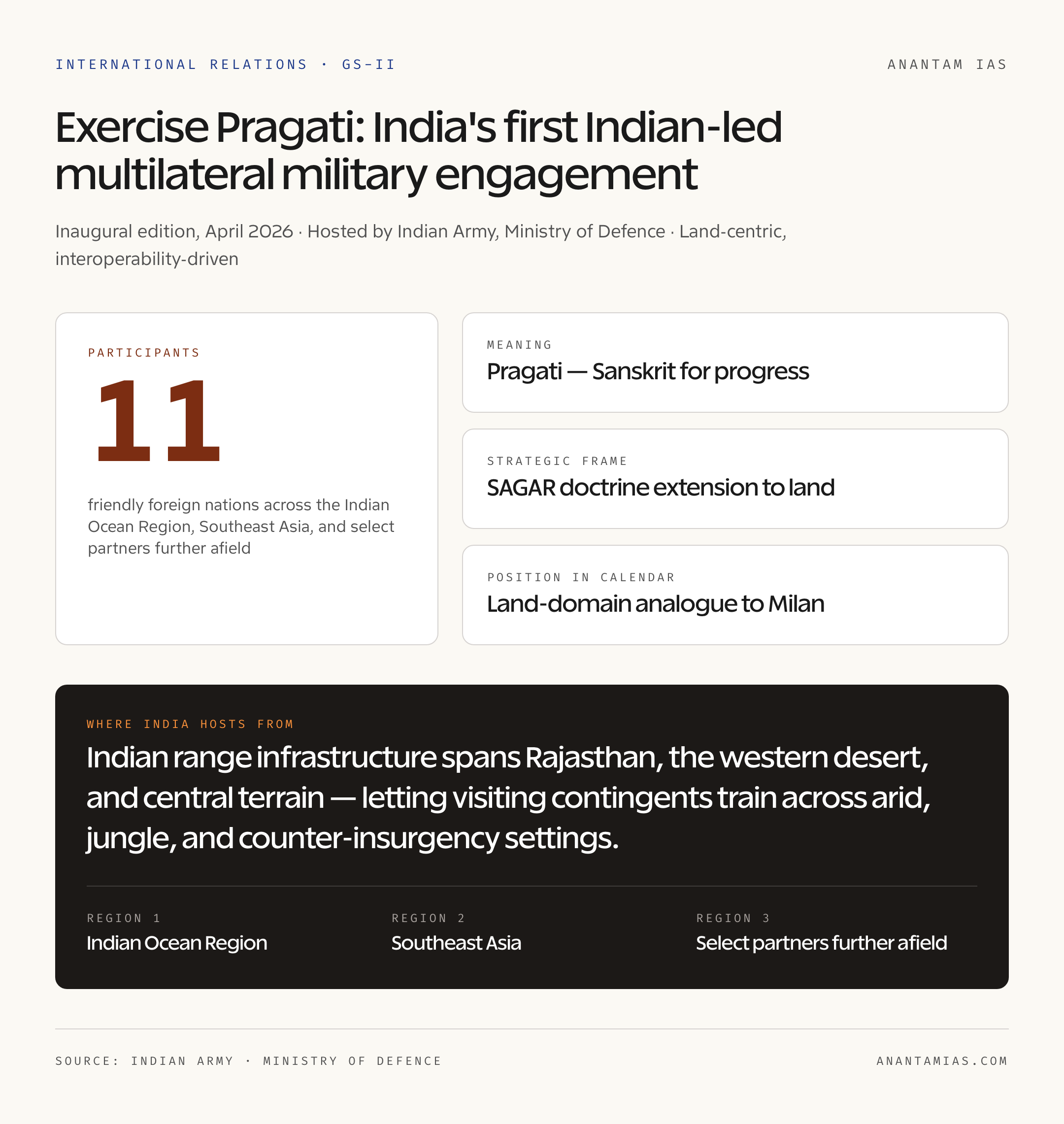
- Name: Exercise Pragati (Sanskrit for “progress”)
- Status: Inaugural edition, April 2026
- Host: Indian Army, Ministry of Defence
- Participants: 11 friendly foreign nations plus India
- Scope: Combined arms operations, counter-terrorism, HADR
- Significance: First Indian-led multilateral military engagement of this scale
- Strategic frame: Indo-Pacific defense diplomacy, SAGAR doctrine extension
- Comparable exercises: Malabar (naval, with Quad), Milan (multilateral naval), Garuda Shakti (with Indonesia)
What Just Happened: India Goes From Guest to Host
For decades India trained with partners through bilateral formats. We have Yudh Abhyas with the United States, Indra with Russia, Garuda Shakti with Indonesia, and dozens more. We also showed up at multilateral exercises hosted by others. Pragati flips that script. India is now the convening power, building the doctrine, writing the script, and inviting friendly nations to plug into an Indian-designed framework.
Eleven nations is a serious turnout for a debut. It means New Delhi has the convening capital to pull this off without needing an external sponsor. The participants span the Indian Ocean Region, Southeast Asia, and select partners from further afield, which signals that Pragati is being positioned as a flexible platform rather than a narrow regional drill.
The defense ministry framed Pragati around three operational pillars: combined arms training so participants can fight together with mixed units, counter-terrorism drills that reflect shared threats from non-state actors, and HADR modules that prepare militaries for the cyclones, earthquakes, and tsunamis that increasingly define the region’s security calendar.
Background and Historical Context
How India’s Exercise Diplomacy Evolved
India’s military exercise calendar has grown roughly tenfold over the last two decades. In the 1990s we had a handful of small bilateral drills, mostly with Russia and a few Commonwealth partners. The Look East policy of the early 2000s opened up Southeast Asian engagements. Then Act East accelerated everything, layering in Japan, Australia, and a thick belt of ASEAN partners.
The Quad’s revival in 2017 changed the texture again. Malabar became a four-nation naval exercise with the United States, Japan, and Australia, and that created a template for serious multilateral coordination. Milan, hosted by the Indian Navy off Visakhapatnam, scaled from a five-nation gathering in 1995 to over 50 participating navies in recent editions. Pragati extends that maturation curve into the land domain, which has historically been more guarded.
The shift also reflects strategic confidence. Hosting a multilateral exercise requires logistics, doctrine, training infrastructure, and the political bandwidth to manage eleven partners with different equipment, languages, and rules of engagement. India clearly believes it has all four.
Geographic Setting and Operational Theater
Pragati is a land-and-littoral exercise, which means the choice of training grounds matters. India has substantial range infrastructure across Rajasthan, the western desert, and central Indian terrain that can simulate everything from arid warfare to jungle counter-insurgency. The exercise leverages this diversity to give visiting contingents exposure to terrain types they may not have at home.
For UPSC, the geographic angle matters because it links to India’s larger Indian Ocean Region (IOR) doctrine. The SAGAR (Security and Growth for All in the Region) framework articulated in 2015 placed India as a net security provider in the IOR, and Pragati operationalizes that vision on land. The participating nations include several smaller IOR states whose security calculus has shifted as Chinese naval activity in the region has expanded.
Why Exercise Pragati Matters
Three reasons stand out. First, it signals a doctrinal upgrade. India is no longer content to be one of many participants in someone else’s exercise. The decision to host, to design, and to lead reflects a more confident defense posture. Second, it builds interoperability with smaller partners who often get crowded out of larger Quad-style formats. A small island state’s coast guard or army contingent can train meaningfully alongside Indian forces in a way that would be harder at Malabar.
Third, and this is the underrated point, Exercise Pragati creates an institutional muscle that India can scale. Once you’ve hosted eleven nations, hosting fifteen or twenty becomes a logistics problem rather than a strategic one. The exercise is a reusable platform.
Detailed Analysis of Exercise Pragati
The Combined Arms Component
Combined arms means infantry, armor, artillery, and air assets working together as one fighting unit. It’s the hardest thing to do well, especially across nationalities. Pragati’s combined arms component reportedly emphasizes integrated tactics at the company and battalion level, where junior leaders from different militaries have to coordinate in real time. This is where interoperability gets tested for real.
Counter-Terrorism Modules
Most participating nations face some version of an internal security threat, whether it’s Naxalism, separatism, or transnational terror networks. The CT component focuses on urban operations, hostage rescue scenarios, intelligence sharing protocols, and small-unit tactics. India’s experience in Kashmir, the Northeast, and Left Wing Extremism (LWE) areas gives it a depth of operational knowledge that genuinely interests partner forces.
HADR Practice
Humanitarian assistance and disaster relief has become the most consensual form of military cooperation. Nobody objects to militaries that get good at responding to cyclones. India’s HADR track record, including Operation Maitri after the 2015 Nepal earthquake, Operation Madad after the 2004 tsunami, and recent assistance to Sri Lanka and Myanmar, is the most exportable part of its defense brand. Pragati institutionalizes this learning.
The Diplomatic Layer
Beyond the tactical training, Pragati functions as a diplomatic instrument. Senior officer interactions, defense attaché engagements, and post-exercise strategic dialogues all happen on the margins. For partner nations weighing how much defense cooperation to extend with which major power, an exercise like Pragati offers a low-risk, high-signal way to deepen ties with India without alarming Beijing.
Comparative Perspective: Pragati vs Malabar vs Milan vs Garuda Shakti
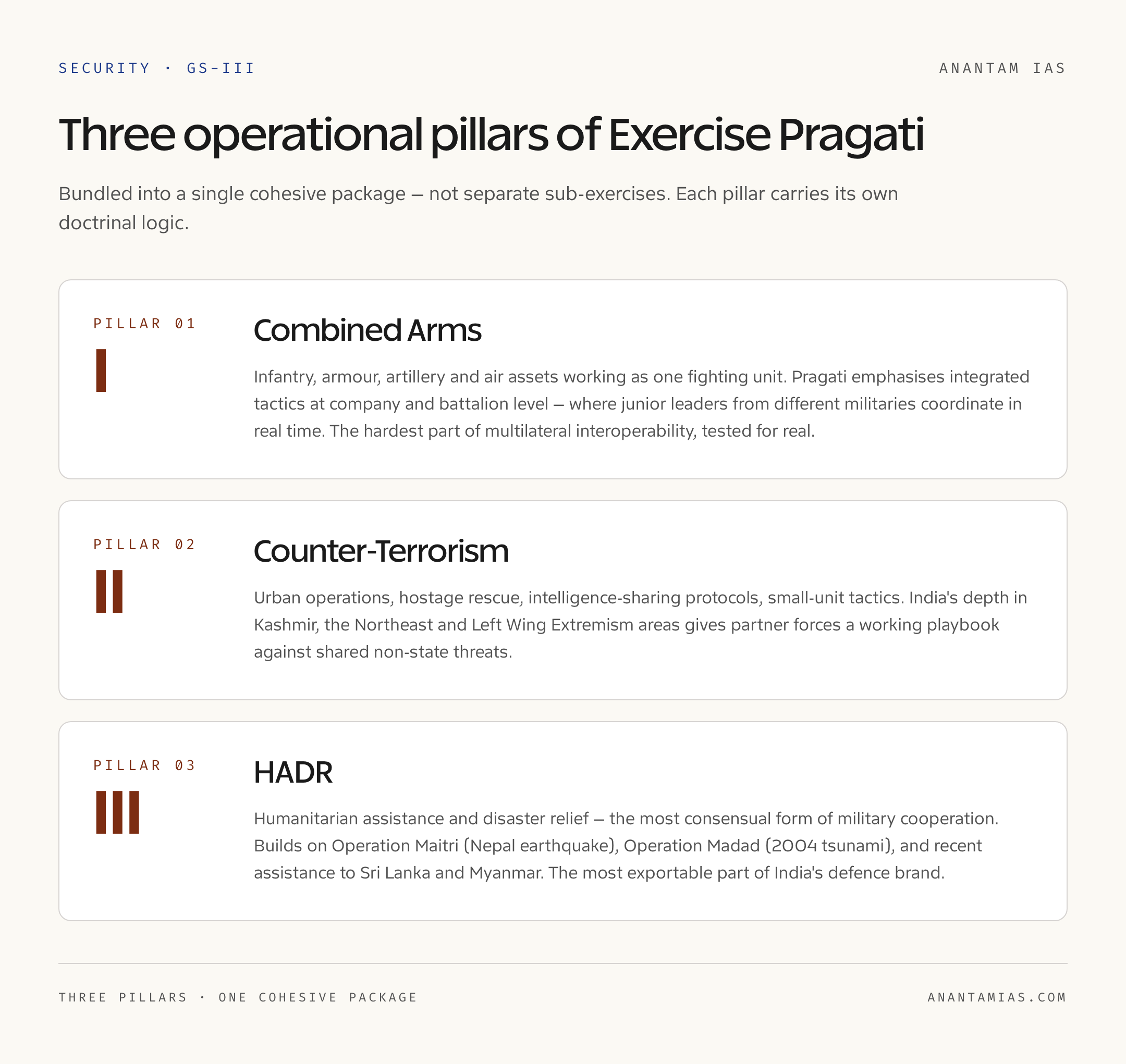
It helps to map Pragati against India’s existing exercise calendar.
Malabar is naval, originated as a US-India bilateral, expanded to include Japan in 2015 and Australia in 2020. It’s the strategic centerpiece of Quad military coordination, focused on anti-submarine warfare, carrier operations, and high-end maritime combat. Malabar is small in participant count but heavy in capability.
Milan is the Indian Navy’s multilateral biennial gathering at Visakhapatnam. It started small in 1995 with five Southeast Asian navies and now hosts over 50 navies. Milan is broad and inclusive but historically lighter on combat-intensity exercises, leaning more toward seamanship, search and rescue, and confidence building.
Garuda Shakti is a bilateral special forces exercise with Indonesia, focused on jungle warfare and counter-terrorism. It’s narrow in scope but deep in tactical content.
Exercise Pragati sits in a genuinely new space. It’s land-centric (unlike Malabar and Milan), multilateral (unlike Garuda Shakti), and India-led from inception (unlike Malabar’s US-origin lineage). It fills a gap in the Indian exercise portfolio that, until now, no single drill addressed.
For more context on India’s bilateral defense engagements, our explainer on the Cauvery river discusses how regional water cooperation parallels security cooperation in some ways, though the analogy only stretches so far.
Challenges and Critiques
Hosting eleven nations is hard. The first edition will inevitably surface coordination issues: language barriers, equipment compatibility gaps, doctrinal differences in how each military handles rules of engagement. These are normal first-edition wrinkles.
The harder challenge is sustainability. Many multilateral exercises stagnate after a strong debut because the host loses appetite, partners drift, or strategic priorities shift. India will need to commit to a regular cadence, probably biennial, and ensure that follow-on editions keep the eleven core nations engaged while gradually adding partners.
There’s also the China question. Beijing watches every Indian-led multilateral with attention. Pragati isn’t pitched as anti-China, and several participating nations would refuse to attend if it were, but the strategic geometry is unmistakable. India will have to manage that messaging carefully.
A final critique: critics may argue that India should focus on hardening its own border infrastructure and modernization rather than spending diplomatic energy on multilateral exercises. The counter is that exercises like Pragati are a force multiplier, not a substitute, and they cost a fraction of a single squadron of fighters.
You can see related themes in our piece on the Basic Structure Doctrine, which discusses how institutional foundations shape long-term capability.
UPSC Prelims Pointers
- Exercise Pragati is India’s first Indian-led multilateral military engagement of this scale
- Eleven friendly foreign nations participated in the inaugural edition (April 2026)
- Three operational pillars: combined arms, counter-terrorism, HADR
- “Pragati” means progress in Sanskrit
- Hosted by the Indian Army under Ministry of Defence
- Linked conceptually to the SAGAR doctrine (Security and Growth for All in the Region, 2015)
- Distinct from Malabar (naval, Quad), Milan (Indian Navy multilateral), Yudh Abhyas (with US), Indra (with Russia), Garuda Shakti (with Indonesia)
- Indo-Pacific defense diplomacy and Act East policy frame
Mains Practice Questions
- GS Paper II: “India’s transition from a participant to a host of multilateral military exercises reflects a maturing defense diplomacy.” Discuss with reference to Exercise Pragati and the SAGAR doctrine. (250 words)
- GS Paper III: Examine how multilateral military exercises like Exercise Pragati contribute to India’s internal and external security objectives. What are the operational challenges of hosting such exercises? (250 words)
- GS Paper II: Compare and contrast Exercise Pragati with Malabar and Milan in terms of scope, participants, and strategic intent. What gap does Pragati fill in India’s exercise portfolio? (150 words)
- GS Paper II: “Defense diplomacy is becoming a central pillar of India’s Indo-Pacific strategy.” Critically analyze with reference to recent multilateral exercises. (250 words)
Way Forward
Exercise Pragati needs three things to mature. First, a regular cadence — biennial is realistic, annual would be ambitious. Second, a doctrinal anchor document that articulates what Pragati is for, separate from Malabar or Milan, so partners know what to expect. Third, expanding partner participation gradually without diluting the operational depth.
If India gets these three right, Pragati could become the land-domain analogue to Milan, a recurring fixture that signals India’s role as a genuine regional security architect. The strategic value compounds with each edition, because every cycle deepens interoperability and trust networks that pay off when crises actually hit.
For aspirants tracking India’s evolving security posture, Pragati is a marker. It shows up alongside India’s geography and constitutional fundamentals as part of the comprehensive picture of how the country positions itself globally. Defense diplomacy isn’t a footnote anymore; it’s a core instrument of statecraft.
Frequently Asked Questions
What is Exercise Pragati?
Exercise Pragati is India’s first Indian-led multilateral military engagement involving eleven friendly nations, focused on combined arms operations, counter-terrorism, and HADR. The inaugural edition took place in April 2026.
How many countries participated in Exercise Pragati?
Eleven friendly foreign nations participated alongside India in the inaugural edition.
How is Exercise Pragati different from Malabar?
Malabar is a naval exercise involving the Quad nations (India, US, Japan, Australia) focused on high-end maritime combat. Pragati is land-centric, broader in participation, and India-led from inception rather than a US-origin format.
What does “Pragati” mean?
“Pragati” is a Sanskrit word meaning progress, signaling India’s intent to advance regional defense cooperation.
Which government body hosts Exercise Pragati?
The Indian Army under the Ministry of Defence hosts Exercise Pragati.
How does Exercise Pragati connect to the SAGAR doctrine?
SAGAR (Security and Growth for All in the Region) was articulated in 2015 as India’s vision for the Indian Ocean Region. Pragati operationalizes SAGAR in the land domain by training regional partners alongside Indian forces.
Why is Exercise Pragati important for UPSC?
It sits at the intersection of GS-II (international relations, defense diplomacy) and GS-III (security), and reflects India’s evolving role as a net security provider in the Indo-Pacific.
Will Exercise Pragati become a regular event?
The expectation is a regular cadence, likely biennial, though this depends on follow-on editions and partner commitment.
Tell Google you want more of this.
Add Anantam IAS as a preferred sourceOne tap, and this site shows up more often in your own Top Stories, AI Overviews and AI Mode. Remove it any time.