Counterfeit notes worth roughly ₹638 crore have been seized across India since 2017, and a single state, Gujarat, accounts for more than half of those detections. The numbers, compiled from National Crime Records Bureau filings and National Investigation Agency case files, surfaced again this week as parliamentary committees probed the steady drumbeat of fake Indian currency note recoveries in 2026.
The headline figure looks small against an economy of this size. But fake currency in India is not a volume problem. It is a sovereignty, security, and trust problem. Each high-quality counterfeit note that clears a teller window or a kirana counter chips at the central bank’s monopoly on legal tender, funds organised crime, and in several documented cases bankrolls terror operations. That is why the response sits with the NIA and the Home Ministry, not just the police.
This article reads the latest fake currency in India data with a UPSC internal security lens. We trace the post-demonetisation arc, decode why Gujarat keeps topping the seizure tables, map the FICN smuggling architecture, and examine what India’s counter-counterfeiting framework still gets wrong.
Quick Facts
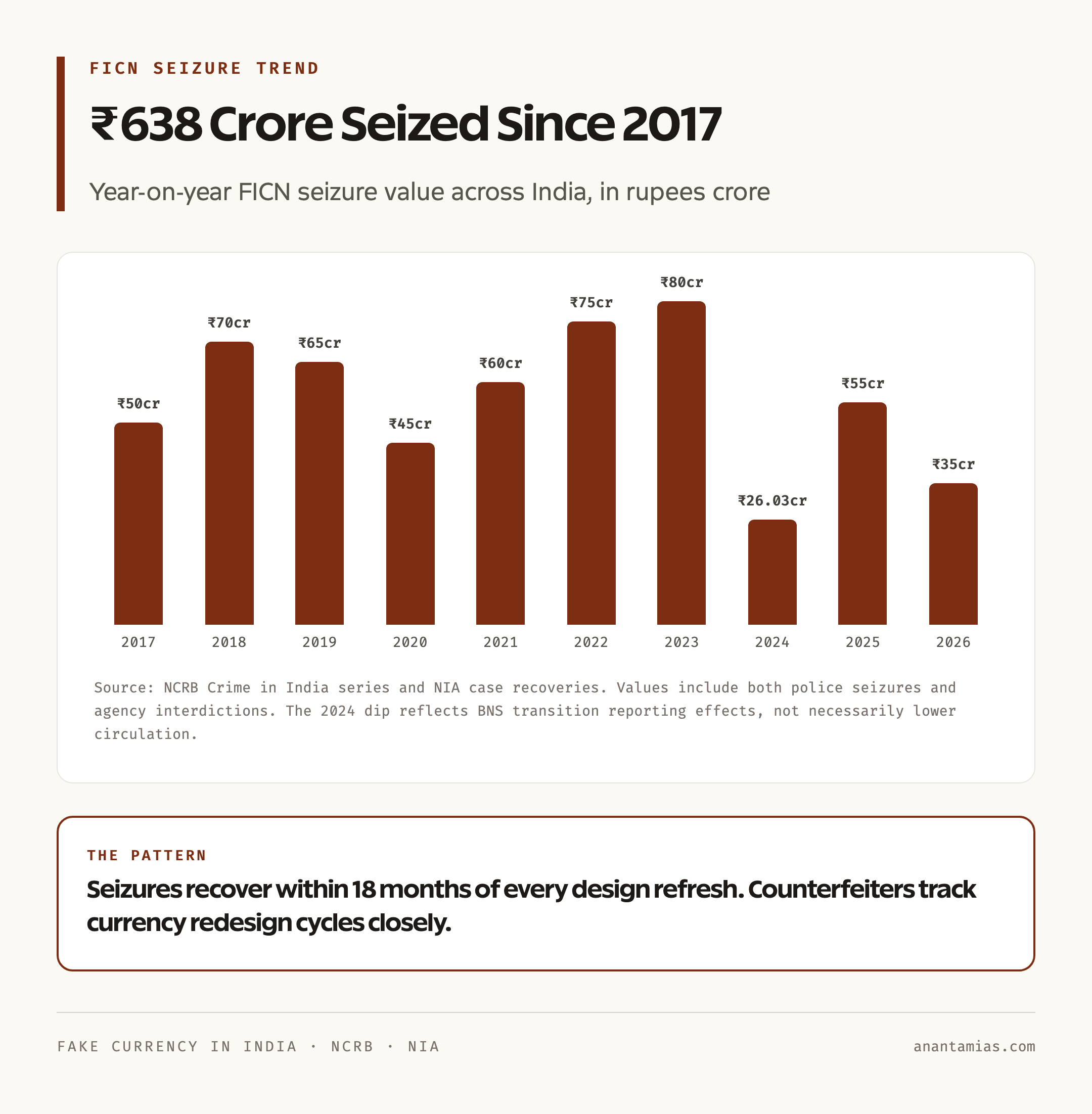
- Total fake currency seized since 2017: roughly ₹638 crore (NCRB and NIA cumulative).
- Gujarat’s share of detections: above 50 percent over the 2017-2026 window.
- 2024 FICN seizure value: ₹26.03 crore (NCRB Crime in India 2024).
- Top denominations counterfeited: ₹500 and ₹200 notes, with rising ₹100 cases.
- Lead investigative agency: National Investigation Agency (NIA), under the NIA Act, 2008.
- Constitutional anchor: counterfeiting falls under Indian Penal Code Sections 489A-489E, now mirrored in the Bharatiya Nyaya Sanhita.
What Just Happened
In early May 2026, the Ministry of Home Affairs tabled fresh state-wise fake currency in India seizure figures before a parliamentary standing committee. The data confirmed three trends that security analysts have been flagging for years: counterfeiting is becoming more concentrated geographically, the quality of fakes is improving, and the supply chain is increasingly transnational.
The NCRB Crime in India 2024 report had already shown that the value of FICN seized in 2024 stood at ₹26.03 crore across 1,135 cases. The cumulative count since 2017 now sits at the ₹638 crore mark when you add NIA case recoveries that do not always show up in police-only statistics. Officials told the committee that the seizure value undercounts circulation, since detection rates for high-grade fakes remain low.
The post-demonetisation period was meant to break the FICN economy. The note ban of November 2016 invalidated 86 percent of currency in circulation overnight. Counterfeiters were left with stacks of useless paper. But the new ₹2,000 note, and later the redesigned ₹500, were copied within months. By 2018, fresh FICN was already in circulation.
Background and Historical Context
Counterfeiting is one of the oldest crimes against the state. In British India, the East India Company faced organised counterfeiting of the rupee from the 1820s onward. After independence, the Reserve Bank of India absorbed currency design and security from the colonial framework and added Indian-language scripts, watermarks, and progressively complex security threads.
The modern fake currency in India problem took its present shape in the 1990s. Investigative reports linked high-quality counterfeits to print houses in Pakistan, with notes routed through Nepal, Bangladesh, and Gulf transit points. The phrase Fake Indian Currency Notes, or FICN, entered policy vocabulary around this time. The Reserve Bank progressively upgraded note design in 1996, 2000, 2005, and 2016 to defeat each new generation of fakes.
The 2016 demonetisation was the most dramatic policy intervention. The government cited three goals: hitting black money, choking terror financing, and ending FICN circulation. The first two outcomes remain contested. On counterfeiting, the demonetisation produced a short-term shock and a longer-term reset. The new notes use updated security features, but counterfeiters adapted within 12 to 18 months.
The NIA was tasked specifically with FICN investigation in 2013, after the Mumbai 26/11 attacks confirmed terror-counterfeit linkages. Since then, the agency has run several long-running FICN networks to ground, including modules tied to Dawood Ibrahim’s organisation and to print shops in Pakistan’s Punjab.
Key Features of India’s Counter-Counterfeiting Framework
The Indian state runs a layered defence against fake currency.
- Legal layer: Sections 489A-489E of the old IPC, now part of the Bharatiya Nyaya Sanhita, criminalise counterfeiting, possession, and circulation of FICN. Punishment goes up to life imprisonment.
- Investigative layer: The NIA leads, with state police, customs, and the Directorate of Revenue Intelligence as partners. The Terror Funding and Fake Currency Cell sits inside the NIA.
- Detection layer: RBI’s currency verification, processing, and shredding system flags suspect notes returned from bank chests. Banks must report FICN within prescribed timelines.
- Design layer: RBI security features include intaglio printing, microletters, color-shifting ink, latent images, and bleed lines for the visually impaired.
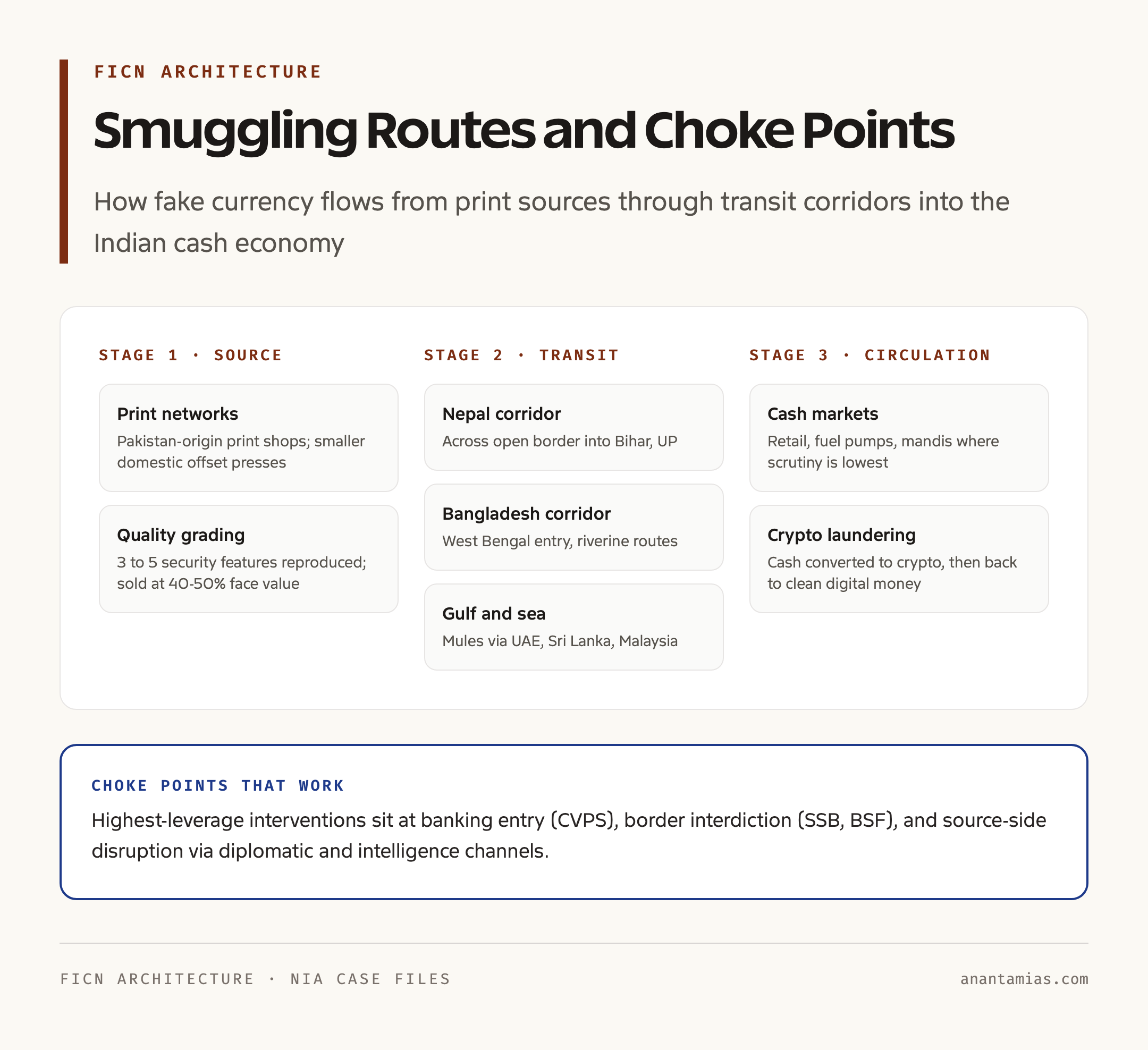
- Cross-border layer: SSB, BSF, and customs handle smuggling interdiction at the Nepal and Bangladesh borders.
This framework looks comprehensive on paper. In practice, the bottleneck sits at detection inside banks and in the informal economy, where most fake notes circulate undetected.
Why Gujarat Tops the Detection Tables
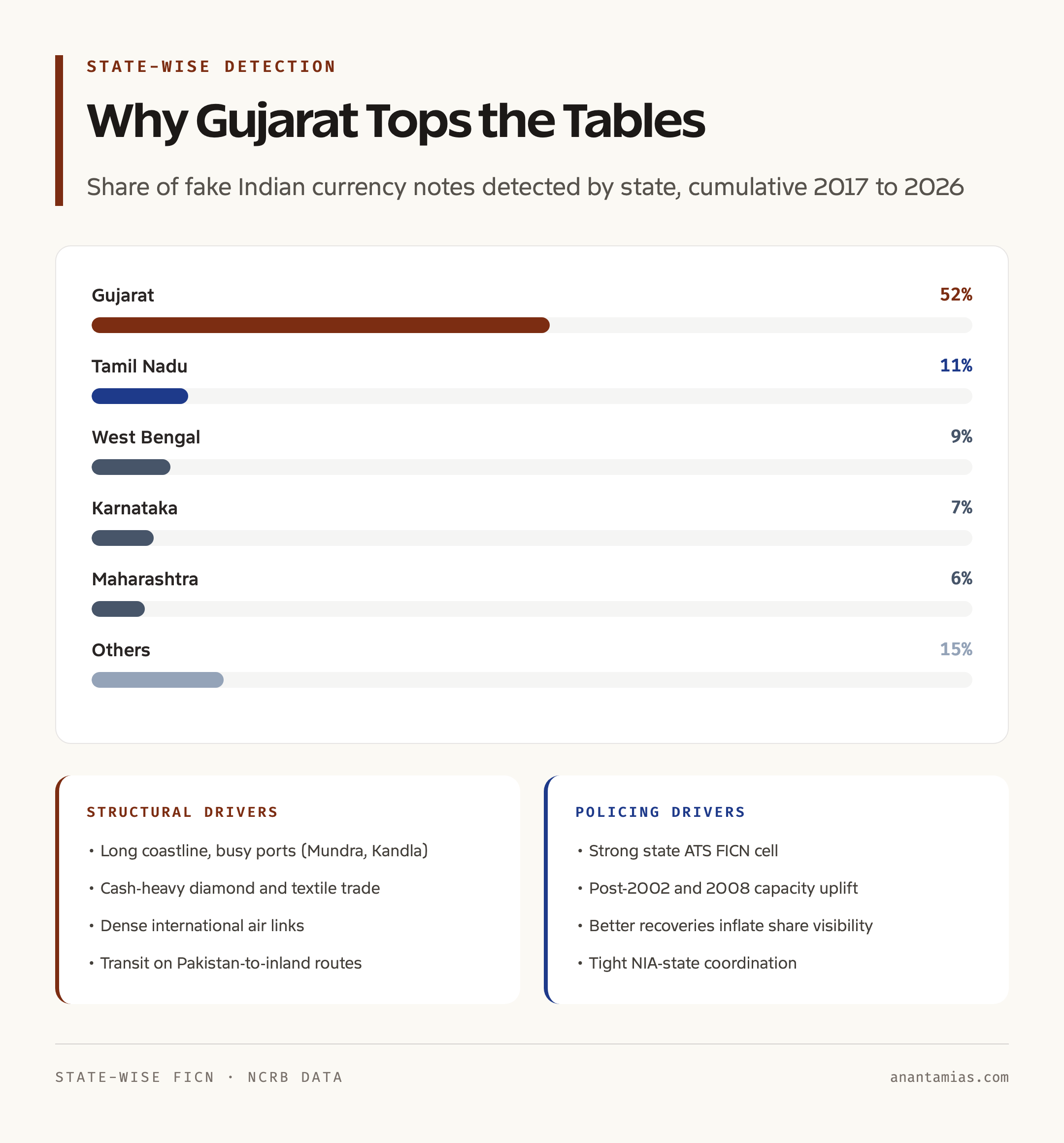
Gujarat’s outsized share of fake currency in India seizures has a structural explanation, not a moral one. The state has long coastlines, busy ports including Mundra and Kandla, dense international air traffic through Ahmedabad and Surat, and a large diamond and textile cash economy. Each of these is a counterfeiter’s friend and an investigator’s lead.
Two factors compound the geography. First, Gujarat’s Anti-Terrorism Squad and state police have invested heavily in FICN detection capacity since the 2002 and 2008 attack experiences. Better policing produces more recoveries, which makes the data look worse, even though the underlying problem may be similar elsewhere. Second, the state sits on transit routes between Pakistan-origin print shops and consumer markets across western and central India.
Other states with high detections include Tamil Nadu, West Bengal, Karnataka, and Maharashtra. Border states like Punjab and West Bengal record large interdictions because cross-border smuggling is more visible there.
Why It Matters
Fake currency in India is not just a financial crime. It hits four state interests at once.
It threatens monetary sovereignty. Only the RBI can issue legal tender. Every counterfeit note is an unauthorised seignorage extraction.
It enables terror financing. Multiple NIA charge sheets, including the 2018 module busted in West Bengal, link FICN earnings to handlers based in Pakistan and to specific terror outfits. The economics work because counterfeiters trade fakes at roughly 40 to 50 percent of face value.
It corrupts the informal economy. Small traders absorb the loss when they unknowingly accept and bank a fake note. The bank confiscates the note and files a complaint, leaving the trader with the financial hit.
It weakens trust in cash, which still anchors over 80 percent of consumer transactions in India by volume despite the UPI revolution.
Detailed Analysis: What the FICN Numbers Hide
Three patterns deserve closer attention.
The quality ladder is climbing. Modern fake currency in India often reproduces three or four of the RBI’s seven main security features. Bank officials report cases where only specialised UV scanners catch the fake. This explains why detection inside the banking chain has improved but field detection by traders remains weak.
Denomination targeting has shifted. The ₹2,000 note, withdrawn from circulation in 2023, was the original prestige target for counterfeiters. Post-withdrawal, the volume has moved to ₹500 and increasingly to ₹200. The lower face value of ₹200 makes detection less likely because people scrutinise smaller notes less carefully.
Geography is fragmenting. Earlier, FICN flowed through three main corridors: Nepal-Bihar, Bangladesh-West Bengal, and Karachi-Gujarat. Investigators now see micro-routes through Sri Lanka, Malaysia, and the Gulf, with cash mules carrying smaller batches more frequently. Internal printing inside India, using domestic offset presses, is also rising in NIA case files.
The connection to organised crime and terrorism has been formalised in case-law and policy. For a deeper look at how the state frames these overlaps, our explainer on organised crime terrorism linkages traces the doctrinal arc.
Comparative Perspective
Compare the Indian framework against three peer cases.
- United States: The US Secret Service has dual mandate over counterfeiting and presidential protection. Detection happens overwhelmingly at the Federal Reserve sorting stage, with field detection through cash-handling staff training. Counterfeit rates are extremely low because the dollar carries the world’s most sophisticated security features.
- European Union: The European Central Bank coordinates with national central banks and Europol. The euro has experienced waves of counterfeiting from Italian and Bulgarian print networks. EU seizure data is published quarterly, more frequently than India’s annual NCRB cycle.
- United Kingdom: The Bank of England moved to polymer notes from 2016 onward. Polymer is far harder to counterfeit than paper because the substrate itself carries security features. Counterfeit rates dropped sharply.
India has experimented with polymer for the ₹10 note in limited pilots. A broader polymer shift would impose printing infrastructure costs but could permanently raise the cost of counterfeiting.
Challenges
The fight against fake currency in India runs into recurring obstacles.
- Detection gap inside banks. Bank staff turnover and training shortfalls mean that fake notes routinely pass through teller counters before catching a back-end check.
- Field-level awareness. Most cash transactions happen without any scanning. Retail traders rely on visual checks alone.
- Cross-border coordination. Source-side action against print shops in Pakistan and Bangladesh requires diplomatic and intelligence cooperation that is uneven at best.
- Conviction rates. NIA conviction rates in FICN cases are high, but state police rates are far lower because evidence chains break.
- Digital-age laundering. Counterfeiters increasingly use FICN to seed cash for crypto purchases, then convert back to clean digital money. The trail is harder to follow than traditional hawala.
- Demonetisation fatigue. Another note withdrawal is politically and economically costly, which limits the policy menu.
Prelims Pointers
- NIA Act, 2008: under the Union Home Ministry, jurisdiction over FICN cases under 2013 amendment.
- BNS provisions on counterfeiting mirror IPC Sections 489A-489E, with up to life imprisonment.
- RBI under the Reserve Bank of India Act, 1934 has the sole right to issue currency.
- Major security features on Indian banknotes: watermark, security thread, latent image, microletters, intaglio print, color-shifting ink, bleed lines.
- Currency Verification and Processing System (CVPS) at RBI handles bulk fake detection.
- Coinage Act, 2011 regulates coin counterfeiting separately.
- SSB guards the India-Nepal and India-Bhutan borders, key FICN transit routes.
- Terror Funding and Fake Currency Cell sits within the NIA.
Mains Questions
- Examine the structural reasons why a single state like Gujarat accounts for over half of fake currency in India detections. (GS Paper III, 250 words)
- Critically evaluate demonetisation’s claim of breaking the FICN economy. Use NCRB and NIA data from the post-2017 period. (GS Paper III, 250 words)
- Counterfeiting is increasingly intertwined with terror financing and organised crime. Discuss India’s institutional response and suggest reforms. (GS Paper III, 250 words)
- Compare India’s anti-counterfeiting framework with the United States and the European Union. What lessons can India draw? (GS Paper II, 150 words)
Way Forward
The next phase of India’s response to fake currency in India needs three shifts.
Move detection earlier in the cash cycle. Mandatory UV scanners at high-throughput retail points, subsidised through MSME schemes, would catch fakes before they recirculate. Bank-staff training cycles need to be shorter and more frequent.
Re-examine the polymer substrate question. A measured transition for lower denominations, beginning with ₹100 and ₹200, would test the operational case before any large rollout.
Strengthen the source-side response. Diplomatic engagement on print-shop networks, supported by financial intelligence sharing through the Financial Action Task Force framework, is more productive than purely interdictive policing.
The link between counterfeiting and India’s broader internal security architecture deserves continued examination. Our piece on terrorism in India sets the wider context, and the explainer on black money and parallel economy shows how FICN intersects with digital laundering channels. For the latest reporting framework that captures these patterns, see our analysis of the NCRB Crime in India 2024 report.
The ₹638 crore figure is what the state has caught. The interesting number is what it has missed. Closing that gap is the work of the next decade.
Frequently Asked Questions
How much fake currency has been seized in India since 2017?
Cumulative seizures of fake Indian currency notes since 2017 stand at roughly ₹638 crore, combining NCRB police data with NIA case recoveries. The 2024 single-year figure alone was ₹26.03 crore across 1,135 cases.
Why does Gujarat account for over half of fake currency detections?
Gujarat’s long coastline, major ports like Mundra and Kandla, busy international airports, and a large cash-heavy diamond and textile economy combine with strong police FICN units. The state sits on natural transit routes between Pakistan-origin print networks and inland markets.
What is FICN and which agency investigates it?
FICN stands for Fake Indian Currency Notes. The National Investigation Agency leads FICN cases under the NIA Act, 2008, after a 2013 amendment formally added FICN to its jurisdiction. State police, customs, and the Directorate of Revenue Intelligence assist.
Did demonetisation in 2016 end fake currency circulation?
No. Demonetisation produced a short-term shock by invalidating existing FICN stocks. Counterfeiters adapted to the new note designs within 12 to 18 months, and fresh FICN was in circulation by 2018. The long-term claim of breaking the counterfeit economy has not held.
Which denominations are counterfeited most often?
₹500 notes lead the seizure tables. ₹200 counterfeits are rising because people scrutinise smaller notes less carefully. The ₹2,000 note, withdrawn in 2023, was the original prestige target during 2016-2023.
What security features protect Indian banknotes?
Key features include the watermark, security thread, latent image, microletters, intaglio print giving raised feel, color-shifting ink on numerals, and bleed lines for visually impaired identification. RBI updates the feature set periodically.
How is fake currency linked to terror financing?
Counterfeiters trade fakes at 40 to 50 percent of face value, which gives terror handlers a margin to fund operations. Multiple NIA charge sheets have documented direct flows from FICN sales to handlers and listed terror outfits.
What punishment do fake currency offences carry in India?
Bharatiya Nyaya Sanhita provisions, mirroring the older IPC Sections 489A to 489E, prescribe up to life imprisonment for counterfeiting, possession, and circulation of fake currency notes.
Should India move to polymer banknotes like the UK?
Polymer notes are far harder to counterfeit because the substrate itself carries security features. India has piloted polymer ₹10 notes. A broader transition would raise printing costs but could permanently raise the counterfeiter’s cost curve.
Where can students read the official data?
The NCRB Crime in India annual report, the NIA annual report, and the RBI Annual Report carry the primary statistics. Parliamentary standing committee reports on home affairs add policy commentary.
Tell Google you want more of this.
Add Anantam IAS as a preferred sourceOne tap, and this site shows up more often in your own Top Stories, AI Overviews and AI Mode. Remove it any time.