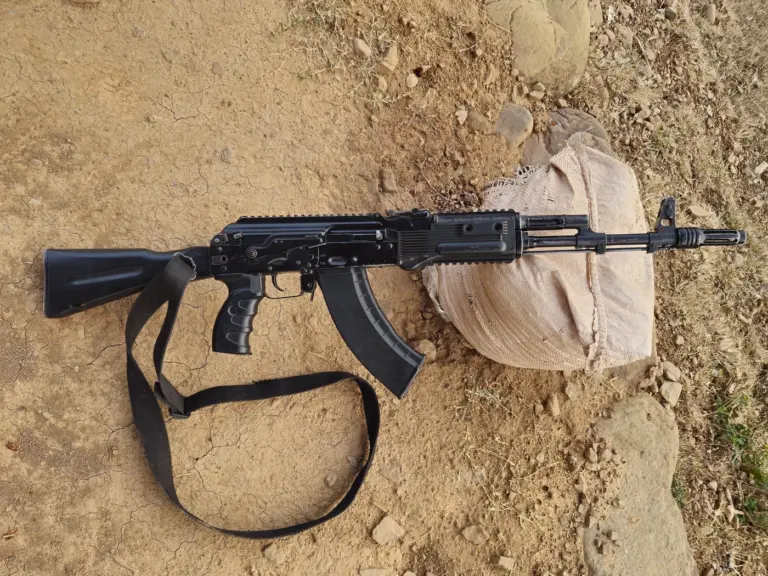
On 22 April 2025, three gunmen walked out of the pine forests above Baisaran meadow near Pahalgam and shot dead 26 civilians, most of them tourists. It was the deadliest attack on Indian civilians since 26/11. Sixteen days later, Indian missiles were striking nine terrorist camps deep inside Pakistan and Pakistan-occupied Kashmir. Between those two dates lies the whole story of terrorism in India: a threat that mutates faster than the institutions built to fight it, and a state that has learned, attack by attack, to respond harder each time.
For UPSC, terrorism is not one topic. It is the connective tissue running through internal security, India’s neighbourhood, federalism, civil liberties, financial regulation, and disaster response. The 2019 Mains GS3 paper asked you to “analyse the multidimensional challenges posed by external state and non-state actors to the internal security of India.” You cannot write a single competent paragraph on that without the framework this guide builds. Treat what follows as a working manual, not a glossary.
Why Terrorism Defies Definition
The United Nations has no universally agreed definition of terrorism. This is not a trivial academic point — it has crippled international cooperation for decades. The phrase “one person’s terrorist is another’s freedom fighter” captures the political deadlock that has stalled the Comprehensive Convention on International Terrorism (CCIT), a treaty India first proposed at the UN in 1996 and still champions today. The sticking points are familiar: should state armed forces be exempt? Should “self-determination” struggles be carved out? Until states agree on who counts as a terrorist, they cannot agree on whom to extradite, sanction, or freeze.
For UPSC purposes, work with this functional definition: terrorism is the premeditated use of violence against civilians and non-combatants to achieve political, ideological, or religious objectives through intimidation and fear. Three elements matter — the target is usually non-combatant, the method is violence designed to terrorise a wider audience, and the goal is political.
Examiners reward candidates who can separate terrorism from its neighbours. Insurgency is an organised armed rebellion seeking to control territory or overthrow a government — it often holds ground and runs parallel administration, as Maoists once did in Bastar. Militancy is a looser term for armed struggle, frequently used for Kashmir. Extremism is an ideological position that may or may not turn violent. Organised crime is profit-driven, though, as the 1993 Mumbai blasts showed, the line between a crime syndicate and a terror network can vanish entirely. Terrorism overlaps with all of these but is defined by its deliberate weaponisation of fear against the innocent.
How Terrorism in India Evolved
India’s experience of terrorism is not a single narrative but five overlapping theatres, each with its own origins, peak, and trajectory. Understanding the chronology is what separates a descriptive answer from an analytical one.
Punjab and Khalistan (1980s–1990s). The first sustained terrorist campaign in independent India was the Khalistan movement, demanding a separate Sikh state. It peaked with Operation Blue Star (1984), the assassination of Prime Minister Indira Gandhi the same year, and the Air India Kanishka bombing (1985) that killed 329 people — still the deadliest aviation terror attack before 9/11. A combination of hard policing under K.P.S. Gill and political reconciliation broke the movement by the mid-1990s. But it has not vanished: a pro-Khalistan diaspora in Canada, the UK, and Australia keeps the separatist idea alive through “referendum” campaigns, and Pakistan’s ISI has revived it operationally using drones to drop weapons and drugs across the Punjab border.
Jammu & Kashmir (1989–present). Cross-border terrorism in the Valley began in earnest in 1989, fuelled by Pakistan’s ISI redirecting Afghan-war mujahideen toward Kashmir. It evolved from indigenous groups like the JKLF to Pakistan-controlled outfits like Lashkar-e-Taiba and Jaish-e-Mohammed, and most recently to “umbrella” proxies such as The Resistance Front (TRF), created to give cross-border terror a local, secular-sounding face. This is the longest-running and most internationalised theatre.
The Northeast (1950s–present). India’s oldest insurgencies predate Kashmir by decades. Nagaland’s separatist movement began in the 1950s; Assam, Manipur, Mizoram, and Tripura followed. These were primarily ethno-nationalist insurgencies over identity, land, and autonomy rather than religious terrorism. Sustained peace accords have largely pacified the region, though Manipur’s 2023 ethnic violence and instability in post-coup Myanmar keep the embers warm.
Left-Wing Extremism (1967–2026). The Naxalbari uprising in West Bengal in 1967 launched a Maoist insurgency that, at its height, the government called India’s “gravest internal security threat.” It controlled a “Red Corridor” stretching across central and eastern India. As we will see, this theatre has now effectively closed.
Urban and jihadi terror (1993–present). The 1993 Bombay serial blasts — organised by the D-Company crime syndicate in retaliation for communal riots — marked the arrival of mass-casualty urban terrorism. It evolved through the Indian Mujahideen’s serial bombings of the 2000s to the contemporary worry: small, self-radicalised ISIS-inspired modules and lone-wolf attackers radicalised online rather than trained in camps.
Types of Terrorism
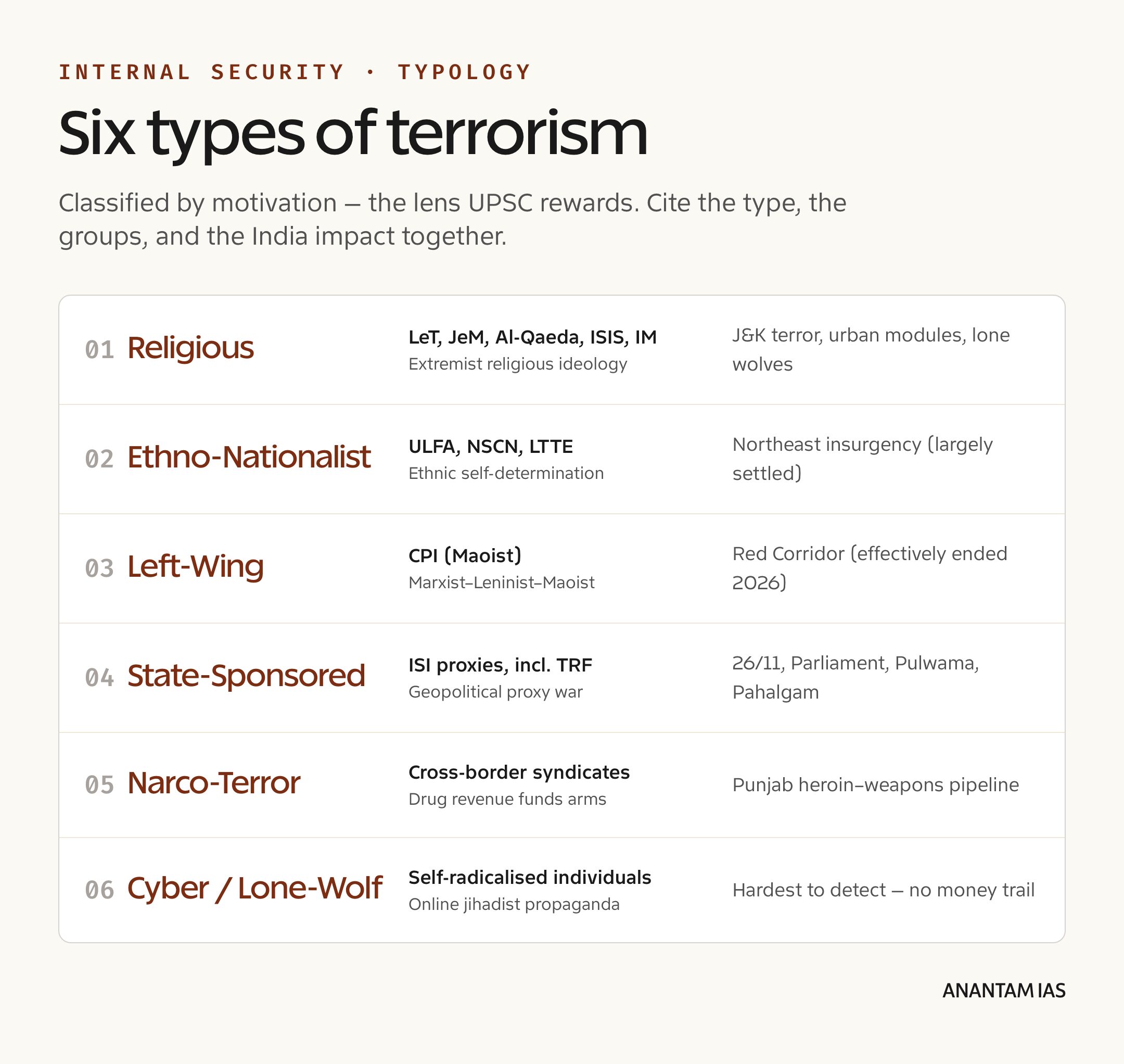
Terrorism is not monolithic. UPSC expects you to distinguish between types, cite examples, and connect each to India’s security challenges. The classification below is by motivation — the most exam-relevant lens.
Religious Terrorism
Violence justified by an extremist reading of religious ideology. Al-Qaeda (founded 1988 by Osama bin Laden) and ISIS/ISIL (which declared a caliphate in 2014 under Abu Bakr al-Baghdadi) are the global archetypes. In India, Lashkar-e-Taiba (LeT) and Jaish-e-Mohammed (JeM) operate on a jihadist ideology while functioning as instruments of Pakistan’s ISI. The distinguishing feature of religious terrorism is its absolutist worldview: because the cause is framed as divine, the violence is open-ended and negotiation is rejected, which is why these groups favour mass-casualty attacks. India’s domestic experience includes the Indian Mujahideen (IM), a home-grown network responsible for a string of serial bombings across Indian cities in the late 2000s before it was largely dismantled, and more recently the diffuse threat of ISIS-inspired self-recruitment, which substitutes online ideology for organisational structure. The shift from large trained organisations to small online-radicalised cells is the single most important change in the religious-terror threat over the past decade.
Ethno-Nationalist Terrorism
Violence in pursuit of political self-determination for an ethnic or national group. The LTTE (Liberation Tigers of Tamil Eelam, Sri Lanka) pioneered the suicide vest as a tactic and assassinated Rajiv Gandhi in 1991. Turkey’s PKK is another classic case. In India’s Northeast, ULFA (United Liberation Front of Assam) and the NSCN (National Socialist Council of Nagaland) pursued ethno-nationalist separatism. Such movements are often more amenable to political settlement than religious terrorism, which is precisely why India’s accord-driven strategy has worked in the Northeast.
Left-Wing Extremism (LWE) / Naxalism
Rooted in Marxist–Leninist–Maoist ideology, the CPI (Maoist) sought to overthrow the Indian state through “protracted people’s war” from the countryside. Naxalism originated in the 1967 Naxalbari uprising and drew its strength from genuine grievances — landlessness, denial of forest rights, displacement by mining, and a governance vacuum in tribal districts. The government’s response combined the SAMADHAN doctrine (2017) — Smart leadership, Aggressive strategy, Motivation and training, Actionable intelligence, Dashboard-based KPIs, Harnessing technology, Action plan per theatre, and No access to financing — with welfare saturation. By 2026, as detailed below, the insurgency had effectively collapsed.
One contested dimension is the so-called “urban Naxal” network — the alleged use of front organisations, sympathetic intellectuals, and legal-aid and rights groups to provide ideological cover, recruitment, and logistical support to the armed movement from the cities. Security agencies argue this above-ground ecosystem was as important to the insurgency’s survival as the guerrillas in the forest. Civil-liberties advocates counter that the label has been stretched to target lawful dissent and activism. For UPSC, the point to register is the analytical one: modern insurgencies sustain themselves through an above-ground support structure as much as an underground armed wing, and dismantling the former is both effective and legally fraught — a genuine dilemma rather than a settled question.
State-Sponsored Terrorism
When a state uses terrorist organisations as deniable instruments of foreign policy. Pakistan’s sponsorship of cross-border terrorism is the textbook case studied worldwide. The ISI has provided training, weapons, financing, and safe havens to LeT and JeM, whose headquarters at Muridke and Bahawalpur operated openly for years. The strategic logic is to bleed India “by a thousand cuts” below the threshold of conventional war, using nuclear weapons as a shield against retaliation. Operation Sindoor in 2025 was India’s deliberate attempt to demolish that shield.
What makes the sponsorship durable is its ecosystem, not any single group. Pakistan’s strategy combines a deep bench of interchangeable proxies (when one is sanctioned, another is spun up under a new name, as TRF was for LeT), a financing web of charities and trade fronts, ideological infrastructure in seminaries and propaganda outfits, and “plausible deniability” maintained by keeping the state’s fingerprints off operations. This is why pressure has to be applied at every layer at once — military, financial, diplomatic, and informational — and why no single strike, designation, or grey-listing is ever decisive. Dismantling an ecosystem is slow, cumulative work.
Narco-Terrorism
The fusion of drug trafficking with terrorism, where narcotics fund weapons and the same routes carry both. India sits between the Golden Crescent (Afghanistan–Pakistan–Iran) and the Golden Triangle (Myanmar–Laos–Thailand). Punjab’s heroin epidemic is directly tied to cross-border smuggling that doubles as a terror-financing and arms pipeline, increasingly delivered by drones.
Cyber-Terrorism and Digital Radicalisation
Two distinct threats sit under this head. The first is cyber-terrorism proper — attacks on critical information infrastructure such as power grids, financial systems, or air-traffic control. The second, more immediate for India, is online radicalisation: encrypted messaging, slick propaganda videos, and algorithmic echo chambers that recruit and instruct without a single physical training camp. The modern terrorist may never cross a border; the border crosses into the phone.
Lone-Wolf and Self-Radicalised Terrorism
Individuals who radicalise online and act alone, with no organisational chain of command for intelligence agencies to intercept. This makes them extraordinarily hard to pre-empt — there is no money trail, no communications network, no co-conspirator to turn informant. India has seen ISIS-inspired lone actors and small “modules” in Kerala, Karnataka, and elsewhere, a pattern that worries the security establishment far more than the dwindling number of trained infiltrators.
CBRN Terrorism
The use of Chemical, Biological, Radiological, or Nuclear materials. While no major CBRN terror attack has occurred in India, the risk of a “dirty bomb” — conventional explosives wrapped around radioactive material — keeps it on the threat matrix, given porous borders and the global black market in fissile material. The National Disaster Management Authority maintains CBRN response protocols precisely for this low-probability, high-consequence scenario.
| Type | Key Groups | Ideology / Driver | India Impact |
|---|---|---|---|
| Religious | LeT, JeM, Al-Qaeda, ISIS | Extremist religious | J&K terror, urban modules, lone wolves |
| Ethno-Nationalist | ULFA, NSCN, LTTE | Ethnic self-determination | Northeast insurgency (now largely settled) |
| Left-Wing Extremism | CPI (Maoist) | Marxist–Leninist–Maoist | Red Corridor (effectively ended 2026) |
| State-Sponsored | ISI-backed proxies (incl. TRF) | Geopolitical / proxy war | 26/11, Parliament, Pulwama, Pahalgam |
| Narco-Terrorism | Cross-border syndicates | Drug revenue + arms | Punjab heroin–weapons pipeline |
| Cyber / Lone-Wolf | Self-radicalised individuals | Online jihadist propaganda | Hard-to-detect, no money trail |
What Drives Terrorism: Root Causes
Examiners increasingly want the “why,” not just the “what.” Terrorism is overdetermined — no single cause explains it — but the drivers cluster into five categories.
- Socio-economic. Poverty alone does not cause terrorism — many recruits are educated and middle-class — but relative deprivation, unemployment, and the sense of a blocked future create a pool of the disaffected. The Maoist insurgency drew its foot soldiers from India’s most marginalised tribal districts, where the state was absent and exploitation was routine.
- Political and governance. Alienation from the political mainstream, denial of identity or autonomy, perceived injustice, weak rule of law, and governance vacuums are powerful enablers. Where the state cannot deliver security and dignity, insurgents offer both.
- Ideological and religious radicalisation. A coherent narrative that frames violence as righteous — whether jihadist, Maoist, or ethno-nationalist — is what converts grievance into organised terror. Ideology supplies the justification and the recruitment pitch.
- External sponsorship. India’s case is distinctive because a hostile neighbour has industrialised terror as statecraft. Pakistan’s ISI converts local grievance into operational capability through money, training, and weapons. Remove the sponsorship and many movements wither, as Khalistan did in the 1990s.
- Psychological and social. Identity-seeking, peer networks, charismatic recruiters, revenge for personal or community trauma, and the search for belonging all feed radicalisation — increasingly mediated by social media rather than physical contact.
India’s profile is distinctive in another way. It faces every major type of terrorism simultaneously — religious, ethno-nationalist, left-wing, and state-sponsored — across a vast, diverse territory with long, porous borders shared with a hostile nuclear neighbour. Few states confront this full spectrum at once. The drivers also interact: external sponsorship exploits internal grievance, narco-money funds separatist revival, and online propaganda amplifies local alienation. This is why single-instrument responses fail and why the security establishment increasingly speaks of a “whole-of-society” approach.
The policy implication is decisive: kinetic operations can suppress terrorism but only address the symptom. Durable success requires draining the reservoir of grievance — which is exactly why India’s counter-LWE strategy paired security operations with the Aspirational Districts Programme, road-building, and welfare saturation. The Naxal collapse is the proof of concept: it was development plus pressure, not pressure alone, that closed the Red Corridor.
Radicalisation and De-radicalisation
Radicalisation is the process by which an individual comes to adopt extremist beliefs and, ultimately, to legitimise violence. It rarely happens overnight and almost never in isolation. Understanding the pathway is the precondition for interrupting it.
Security scholars describe radicalisation as a staged pathway rather than a switch: a phase of pre-radicalisation (an ordinary life with some latent grievance or vulnerability), self-identification (the individual begins to explore an extremist ideology, often triggered by a personal crisis or a galvanising event), indoctrination (the belief hardens, usually within a peer group or under a recruiter’s influence), and finally action (the decision to plan or commit violence). The value of the model is practical: each stage offers a different opening for intervention, and the earlier the better.
Online radicalisation is now the dominant vector. Recruiters use mainstream platforms to identify the vulnerable, then migrate them to encrypted channels where propaganda, ideological instruction, and even operational guidance flow beyond the reach of surveillance. India has dismantled multiple ISIS-inspired modules in Kerala and Karnataka built almost entirely online, where young people self-recruited after consuming foreign propaganda. Prison radicalisation is a second, under-appreciated channel: jails throw petty offenders into contact with hardened ideologues, and overcrowded Indian prisons are fertile ground.
De-radicalisation and Countering Violent Extremism (CVE) form the other half of the equation — and India’s record here is patchier than its kinetic record. The most-cited efforts include Maharashtra’s de-radicalisation programme, which claims to have counselled hundreds of youth away from ISIS influence, and Kerala’s community-engagement model drawing in families, clerics, and educators. In Jammu & Kashmir, the security forces run reintegration and “return to mainstream” initiatives for former militants and their families. Naxal surrender-and-rehabilitation policies — offering money, skills training, and amnesty — drove thousands of cadres to lay down arms in the final years of the insurgency.
The lessons are consistent: de-radicalisation works best when it is community-led rather than police-led, when it offers a credible alternative future, and when counter-narratives come from voices the target audience trusts. India lacks a single national CVE framework, and building one — without it becoming an instrument of surveillance or stigmatising entire communities — is among the hardest balancing acts in counter-terrorism.
It helps to borrow the four-strand logic many states use to organise their CVE effort — prevent (stop people being drawn to extremism), pursue (investigate and disrupt plots), protect (harden likely targets), and prepare (limit the damage of attacks that do occur). India’s strength has overwhelmingly been in “pursue” and “protect”; its weakness is “prevent.” Closing that gap — through education, online counter-messaging, mental-health support, and rapid reintegration of surrendered cadres — is where the next decade’s gains must come from, because a threat that originates in the mind cannot be defeated by force at the border alone.
India’s Threat Landscape Today
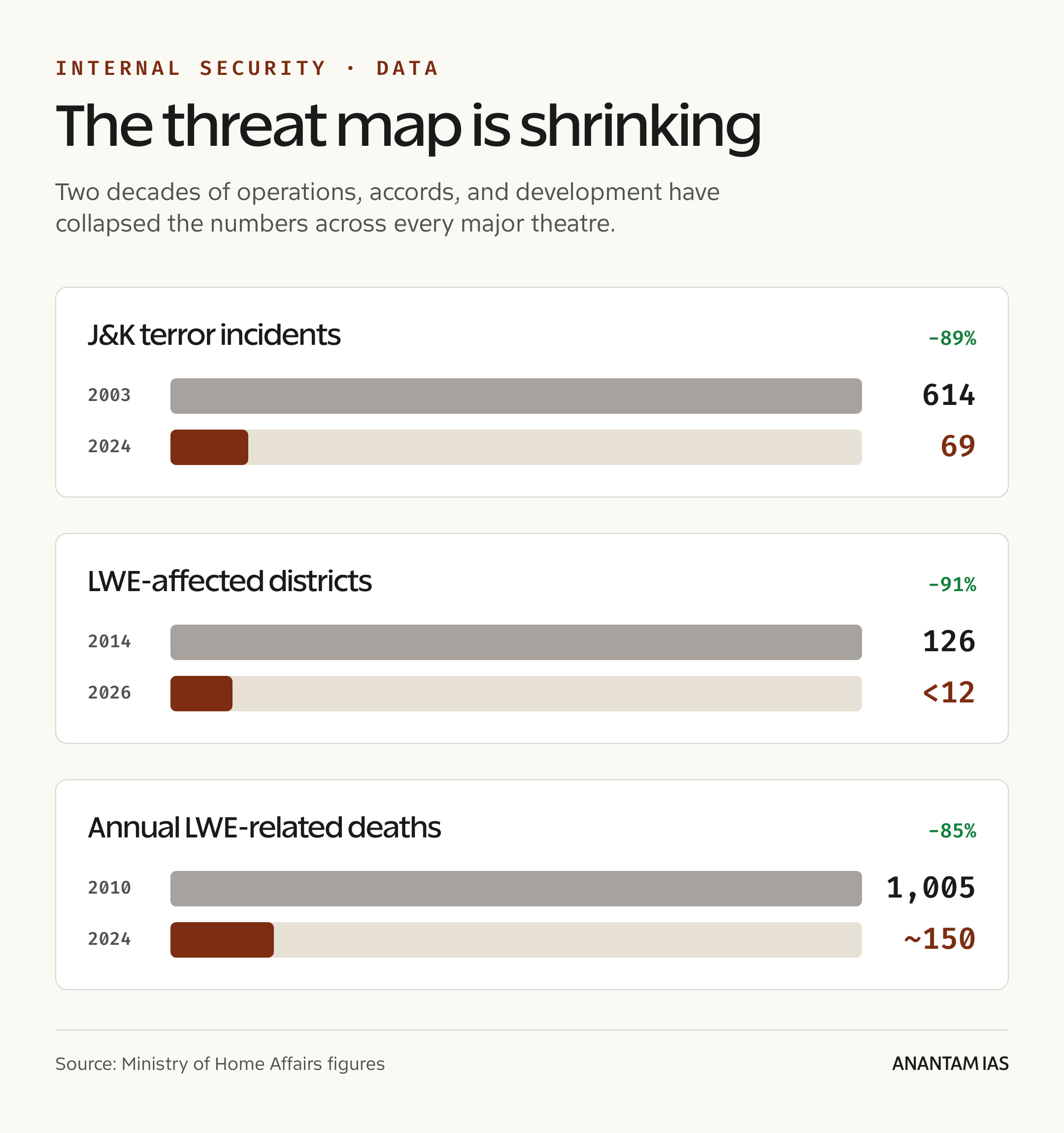
The single most important fact about India’s internal-security map is that it has shrunk dramatically. Two of the three classic theatres are near resolution; the third has been transformed by a new doctrine of retaliation.
Jammu & Kashmir
Cross-border terrorism sponsored by Pakistan has been the dominant challenge since 1989. After the abrogation of Article 370 in August 2019, terror incidents declined sharply — from 614 in 2003 to 69 in 2024. Yet the threat has not disappeared; it has changed shape. The new pattern includes hybrid militants (radicalised locals who carry out a single attack and melt back into civilian life), targeted killings of minorities and migrant workers designed to break communal calm, and weaponised drones dropping arms and narcotics across the international border. The Pahalgam massacre of April 2025 — 26 civilians killed by The Resistance Front, a Lashkar proxy — shattered the narrative of “normalcy returning” and triggered the most significant escalation in decades. The hybrid-militant model is what makes the current threat so hard to police: a radicalised local supported by overground workers (OGWs) who provide shelter, reconnaissance, and logistics leaves almost no signature for intelligence to detect before the attack. Dismantling the OGW network — the civilian support structure — has therefore become as important as neutralising the gunmen themselves.
The Northeast
Insurgency in the Northeast predates Kashmir’s troubles, but a sustained policy of accord-making has transformed it. The Naga Framework Agreement (2015) with NSCN-IM, the Bodo Accord (2020), the Karbi Anglong agreement, and the rollback of the Armed Forces (Special Powers) Act from large swathes of Assam, Nagaland, and Manipur all reflect a region pulled back from the brink. The remaining concerns are the Meitei–Kuki ethnic violence in Manipur that erupted in 2023, and the spillover of instability from post-coup Myanmar, where Indian insurgent groups have historically maintained camps and the porous border now sees refugee and arms flows. The Manipur crisis is a reminder that ethnic conflict and insurgency feed each other: where communities arm themselves and the state’s monopoly on force frays, dormant insurgent networks find recruits, weapons, and a cause. The decision to fence and tighten the long, traditionally free-movement Indo-Myanmar border reflects this anxiety, though it carries its own costs for cross-border kinship ties and local livelihoods.
Left-Wing Extremism: The End of the Red Corridor
This is the great counter-insurgency success story of the decade. The Red Corridor once stretched from Nepal to Karnataka across more than 126 affected districts in 2014. Sustained operations under the SAMADHAN doctrine, relentless development saturation, and the targeting of top leadership shrank that footprint to 18 districts by 2025 and into single digits by early 2026. The decisive blows came in quick succession: the killing of CPI (Maoist) general secretary Nambala Keshav Rao alias Basavaraju in Chhattisgarh’s Narayanpur district in May 2025, followed by senior commander Madvi Hidma and other politburo members in early 2026. Between 2024 and early 2026, security forces killed over 700 cadres, arrested more than 2,200, and secured over 4,800 surrenders. On 30 March 2026, the Union Home Minister told Parliament that the Maoist insurgency had been effectively ended. The caution UPSC rewards: elimination of the armed movement is not elimination of the underlying grievances — land, forest rights, and tribal governance must still be addressed, or the vacuum can refill.
The Revival of Khalistan
Domestically dormant, the Khalistan movement has found new life abroad. A pro-Khalistan diaspora runs “referendum” campaigns in Western capitals, and the killing of separatist figures overseas has strained India’s relations with Canada and the United States. Operationally, the ISI exploits the cause to push drones laden with weapons, RDX, and heroin across the Punjab border, blending narco-terrorism with separatist revival. The NIA has registered multiple cases targeting this nexus.
Major Terror Attacks on India
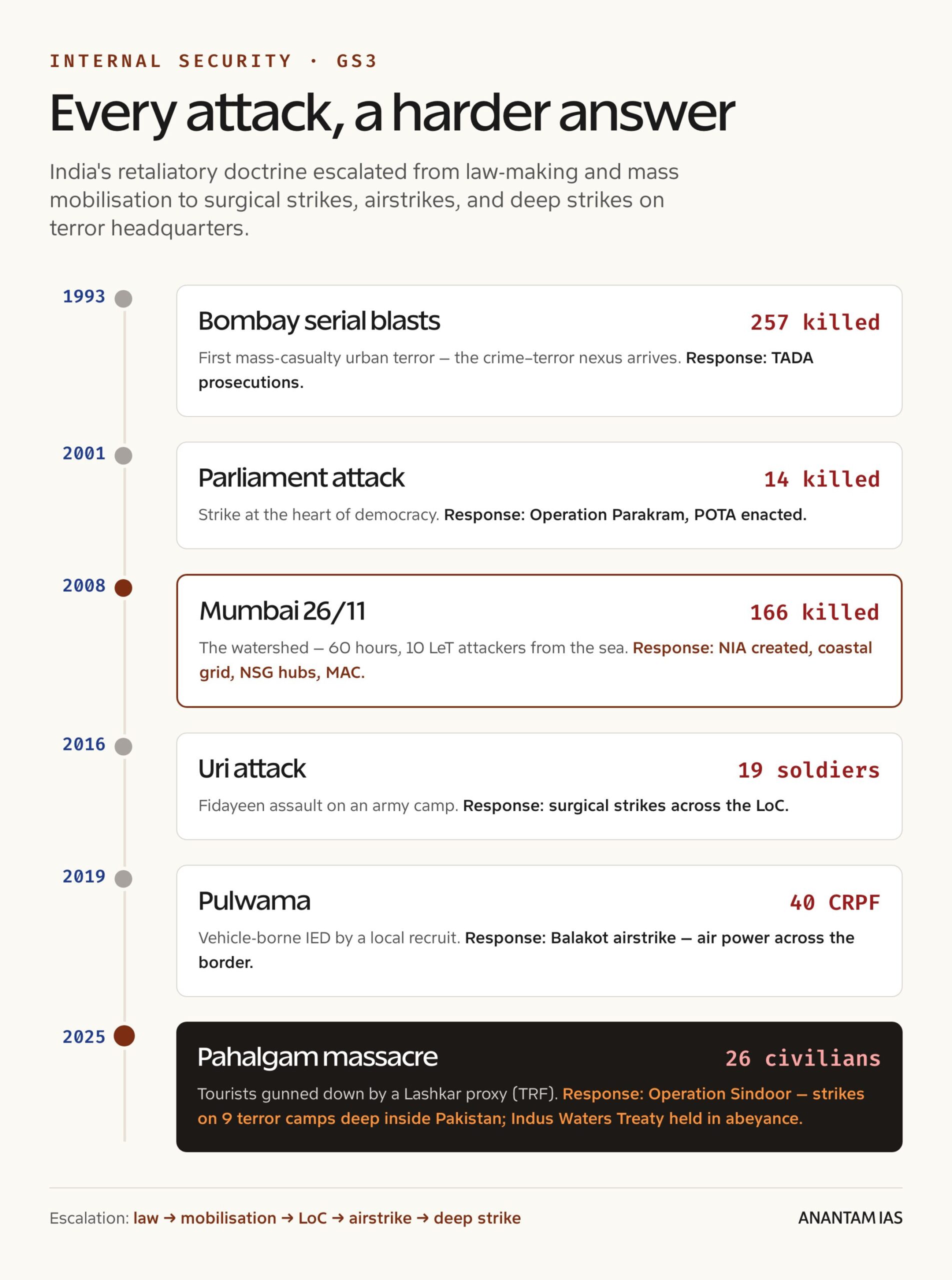
The single most important analytical move in any answer on terrorism is to link each major attack to the institutional reform it triggered. India’s counter-terror architecture was not designed on a whiteboard — it was built reactively, in the smoking aftermath of catastrophe.
| Attack | Date | Perpetrator | Casualties | Policy Response |
|---|---|---|---|---|
| Bombay serial blasts | 12 Mar 1993 | D-Company (Dawood Ibrahim) | 257 killed | First mass-casualty urban terror; TADA prosecutions |
| Parliament attack | 13 Dec 2001 | LeT + JeM | 14 killed (incl. 5 terrorists) | Operation Parakram; POTA enacted (2002) |
| Akshardham temple | 24 Sep 2002 | Religious terrorists | 33 killed | NSG deployment; intelligence review |
| Mumbai train blasts | 11 Jul 2006 | LeT / SIMI (alleged) | 209 killed | Railway security push; intelligence reform |
| Mumbai 26/11 | 26 Nov 2008 | LeT (10 Pakistani nationals) | 166 killed, 300+ injured | NIA created (2009); coastal security overhaul; NSG hubs; MAC strengthened |
| Pathankot airbase | 2 Jan 2016 | JeM | 7 personnel killed | Perimeter security review; defence reforms |
| Uri attack | 18 Sep 2016 | JeM | 19 soldiers killed | Surgical strikes across LoC (29 Sep 2016) |
| Pulwama | 14 Feb 2019 | JeM (Adil Ahmad Dar) | 40 CRPF personnel killed | Balakot airstrike (26 Feb 2019) |
| Pahalgam | 22 Apr 2025 | TRF (LeT proxy) | 26 civilians killed | Operation Sindoor (7 May 2025); Indus Waters Treaty held in abeyance |
1993 and the Crime–Terror Nexus
The 1993 Bombay serial blasts — thirteen coordinated explosions that killed 257 people in retaliation for the post-Babri communal riots — were planned and executed by the D-Company crime syndicate under Dawood Ibrahim, with logistical support traced to Pakistan. They are the foundational case study in the crime–terror nexus: the same networks that smuggle gold and counterfeit currency can smuggle RDX and operatives. The investigation also exposed how organised crime, communal polarisation, and external sponsorship can fuse into a single mass-casualty event — a pattern examiners love because it cuts across society, security, and the economy.
The Parliament Attack and Coercive Diplomacy
The 13 December 2001 attack on Parliament by LeT and JeM fidayeen struck at the symbolic heart of Indian democracy. India’s response was Operation Parakram — the largest military mobilisation since 1971, with hundreds of thousands of troops massed on the border for nearly ten months. It is studied as a case of coercive diplomacy: a show of force short of war meant to compel Pakistan to act against terror groups. Its ambiguous results — high cost, limited concessions — fed the later conclusion that calibrated, deniable, or precise strikes might achieve more than mass mobilisation, a line of thinking that culminated in the surgical strikes and Operation Sindoor.
26/11: The Watershed
The 26/11 Mumbai attacks remain the defining trauma. Ten LeT terrorists, trained in Pakistan and dispatched by sea from Karachi, struck the Taj and Trident hotels, the Chhatrapati Shivaji Terminus, a hospital, and a Jewish centre over roughly 60 hours. Ajmal Kasab, the lone attacker captured alive, was a Pakistani national whose confession established Pakistani state complicity beyond doubt. The attack exposed catastrophic failures: an unguarded coastline, no central counter-terror investigation agency, NSG commandos who had to be flown in from Delhi hours after the assault began, and intelligence that was collected but never fused. Almost every pillar of India’s modern counter-terror architecture — the NIA, the four new NSG hubs, the coastal security grid, and the strengthened Multi-Agency Centre — is a direct answer to 26/11.
From Surgical Strikes to Operation Sindoor
The most important evolution is in how India retaliates. After Uri (2016) — where a pre-dawn fidayeen assault on an army camp killed 19 soldiers — India conducted ground surgical strikes across the Line of Control, publicly acknowledged for the first time, hitting launch pads used by infiltrators. After Pulwama (2019), where a local recruit, Adil Ahmad Dar, rammed an explosives-laden vehicle into a CRPF convoy and killed 40 personnel, India crossed the international border with the Balakot airstrike — the first use of air power against Pakistan since 1971, targeting a JeM training facility. After Pahalgam (2025), it went further still with Operation Sindoor, striking nine terror camps — including the JeM headquarters at Bahawalpur and the LeT headquarters at Muridke — deep inside Pakistan and PoK, followed by a four-day military exchange.
The trajectory is unmistakable: LoC → international border → deep strikes on headquarters. Each cycle widened the geography of retaliation, raised the cost imposed on the sponsor, and lowered India’s threshold for using force. Pulwama is also instructive as a tactical shift — a locally recruited suicide bomber using a vehicle-borne IED, signalling the move from foreign infiltrators to radicalised locals that defines the current J&K threat. We examine the doctrine all this established in the next section.
Common student mistake: describing attacks as a list of dates and body counts. The marks lie in the linkage — attack to institutional reform, and the steady escalation of India’s retaliatory doctrine over time.
Operation Sindoor and India’s New Doctrine
If 26/11 is the watershed in how India organises its counter-terror institutions, Operation Sindoor (May 2025) is the watershed in how India responds across the border. It deserves separate treatment because it crystallised a doctrine that had been forming since 2016 — and because it will frame internal-security questions for years.
After the Pahalgam massacre, India did not confine its response to the military domain. It suspended the Indus Waters Treaty — the 1960 agreement long treated as untouchable even through previous wars — closed the Attari–Wagah border, expelled Pakistani nationals, and downgraded diplomatic ties. Then, in the early hours of 7 May 2025, it struck nine terror infrastructure targets across Pakistan and Pakistan-occupied Kashmir, including the Jaish-e-Mohammed headquarters complex at Bahawalpur and the Lashkar-e-Taiba nerve centre at Muridke — sites that had functioned openly for decades. A four-day exchange of strikes and counter-strikes followed before a cessation of hostilities on 10 May.
The strategic significance lies in the “new normal” that the Prime Minister articulated afterwards, which can be reduced to three propositions UPSC candidates should be able to state cleanly:
- Any terror attack will be treated as an act of war, answered with assured and proportionate military retaliation rather than diplomatic protest alone.
- India will not be deterred by nuclear blackmail. The operation deliberately called Pakistan’s nuclear bluff, demonstrating that conventional retaliation against terror infrastructure is possible below the nuclear threshold.
- No distinction will be made between terrorists and the state that shelters them. The sponsor’s territory is no longer a sanctuary.
Analysts cautioned about the risks: the danger of escalation between two nuclear states, the limits of coercion against a determined sponsor, and the reality that cross-border strikes degrade infrastructure but do not end the proxy strategy. The balanced UPSC view holds both truths — Operation Sindoor raised the cost of sponsoring terror and reshaped deterrence, but military action is necessary, not sufficient. The proxy war ends only when the sponsorship calculus inside Pakistan changes, which is a long diplomatic and economic project, not a single night’s strikes.
The Legal Framework Against Terror
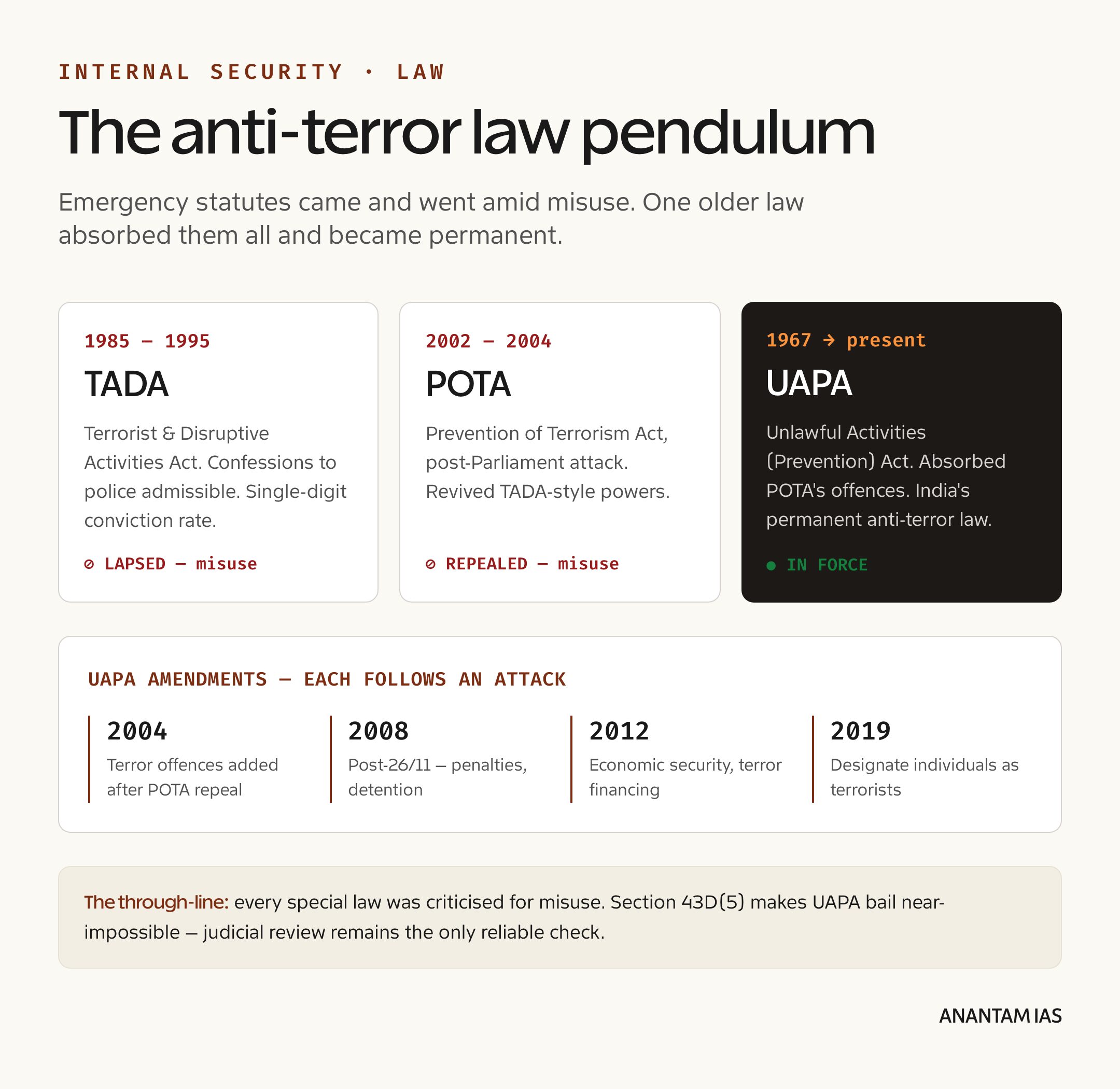
India’s anti-terror law has swung repeatedly between two poles — the security imperative to detain and convict, and the constitutional imperative to protect liberty. The history is a pendulum.
TADA → POTA → UAPA
The Terrorist and Disruptive Activities (Prevention) Act, TADA (1985), was India’s first dedicated anti-terror law, enacted during the Punjab insurgency. It allowed confessions to police officers as admissible evidence and prolonged detention — and was so widely misused, with conviction rates in the low single digits, that it was allowed to lapse in 1995. The Prevention of Terrorism Act, POTA (2002), enacted after the Parliament attack, revived many of TADA’s provisions and met the same fate — allegations of political and communal misuse led to its repeal in 2004.
When POTA was repealed, its substantive terror offences were folded into the older Unlawful Activities (Prevention) Act, UAPA (1967), which has since become India’s permanent anti-terror statute. Its key amendments map directly onto the attack chronology: 2004 (added terror offences after POTA’s repeal), 2008 (post-26/11, enhanced penalties and detention), 2012 (expanded the definition to cover economic security and terror financing), and 2019 (empowered the government to designate individuals — not just organisations — as terrorists, and let the NIA investigate without state permission).
Critics argue that UAPA’s broad definition of a “terrorist act,” its long pre-charge detention, and the near-impossibility of bail under Section 43D(5) invert the presumption of innocence. The Supreme Court’s NIA v. Zahoor Ahmad Shah Watali (2019) judgment set an exceptionally high threshold for bail, effectively making the process itself the punishment when trials drag on for years. Other relevant laws include the National Security Act, 1980 (preventive detention) and the contested Armed Forces (Special Powers) Act, 1958 (AFSPA), which grants the army sweeping powers in “disturbed areas” and remains a live civil-liberties flashpoint, though its footprint has shrunk as the Northeast has stabilised.
The enduring UPSC tension to articulate: extraordinary laws may be necessary against an extraordinary threat, but every such law in India’s history has been misused, and judicial oversight has been the only reliable check. A balanced answer acknowledges both the security rationale and the liberty cost.
The Constitutional Balance
Counter-terror law lives in permanent tension with fundamental rights — Article 21’s guarantee of life and personal liberty, Article 22’s safeguards against arbitrary arrest, and the due-process standards the Supreme Court has read into them. The judiciary has tried to hold the line: in People’s Union for Civil Liberties (PUCL) v. Union of India, the Court upheld POTA’s validity but laid down safeguards against misuse, insisting that the threat of terrorism cannot become a licence to abandon constitutional discipline. The deeper principle examiners reward is this — security and liberty are not opposites to be traded off, but conditions for each other. A state that loses public trust, especially among minority and border communities, loses the human intelligence and cooperation on which counter-terrorism ultimately depends. Heavy-handed enforcement that alienates a population can manufacture the very radicalisation it aims to prevent.
India’s Counter-Terror Architecture
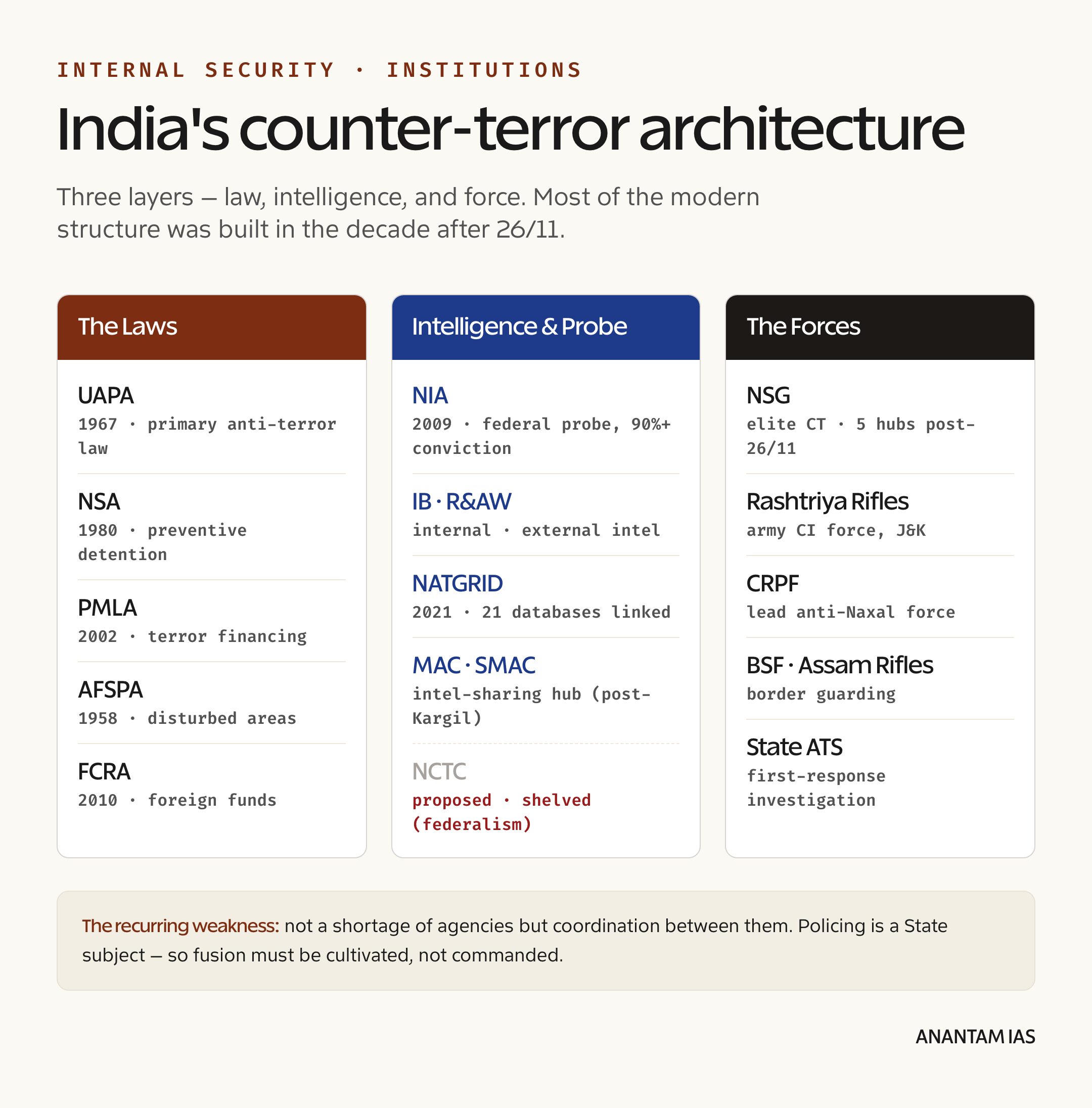
Beyond the law sits a web of investigative agencies, intelligence bodies, and armed forces. The recurring weakness — and the recurring exam theme — is coordination.
Investigation: The NIA
Created by the NIA Act, 2008 and operational from 2009, the National Investigation Agency is India’s federal counter-terrorism investigation body. After the 2019 amendment it can take over any scheduled terror case from state police suo motu and even investigate offences committed against Indians abroad. It prosecutes under the UAPA, the Explosive Substances Act, and related laws, and has maintained a conviction rate above 90% in completed cases — a deliberate contrast to the abysmal conviction record of the TADA/POTA era, when laws were strong on paper but collapsed in court. Alongside the NIA, most states run their own Anti-Terrorism Squads (ATS) and Special Task Forces, which handle the bulk of first-response investigation; Maharashtra’s and Gujarat’s ATS units, among others, have cracked significant cases. The federal–state division of labour works only when investigation is seamless across the handover, which is the practical argument for stronger coordination machinery.
Intelligence and Coordination
- IB (Intelligence Bureau): India’s internal intelligence agency, the front line of domestic counter-terror intelligence.
- R&AW (Research and Analysis Wing): the external intelligence agency, responsible for tracking cross-border terror infrastructure.
- NATGRID (National Intelligence Grid): links 21 databases — immigration, banking, telecom, tax — for pattern detection. Operational since 2021 after a decade of delay.
- MAC (Multi-Agency Centre): the real-time intelligence-sharing hub under the IB, created on the recommendation of the Kargil Review Committee, with state-level Subsidiary MACs (SMAC).
- NTRO (National Technical Research Organisation): technical and signals intelligence.
The NCTC That Never Was
Proposed after 26/11 on the model of the US National Counterterrorism Center, the National Counter Terrorism Centre (NCTC) was meant to fuse intelligence and coordinate operations nationally. It was shelved due to state opposition: states argued that giving the Centre power to conduct operations and arrests on state territory — with the body housed under the IB — violated the federal scheme, since “police” and “public order” are State subjects. The NCTC debate is a textbook cooperative and competitive federalism case study and the clearest illustration of how India’s federal structure shapes — and constrains — its security architecture.
The Armed Response
Operationally, counter-terror is executed by the NSG (National Security Guard) — India’s elite hostage-rescue and counter-terror force, with hubs added in Mumbai, Chennai, Hyderabad, and Kolkata after 26/11 — alongside the Rashtriya Rifles (the army’s dedicated counter-insurgency force in J&K), CRPF (the lead anti-Naxal force), BSF and Assam Rifles (border guarding), and state police Special Operations Groups. The lesson of 26/11 — that the country’s premier commando force sat hours away from its likeliest target — drove the geographic dispersal of this capability.
Coastal and Border Security
Post-26/11 reforms hardened the seaward approach: the Coastal Security Scheme (Phases I and II), regular Sagar Kavach exercises, mandatory registration and AIS transponders for fishing boats, and the National Committee for Strengthening Maritime and Coastal Security under the Cabinet Secretary. On land, smart-fencing, the Comprehensive Integrated Border Management System, and counter-drone systems address the newest vector — the weaponised drone.
The Coordination Problem
The recurring flaw, rediscovered after almost every attack, is not a shortage of agencies but a surplus of them that do not talk to each other. Intelligence was often collected but not fused; warnings sat in one silo while the agency that needed them sat in another. The MAC and NATGRID were built precisely to dissolve these silos, and tools like the Crime and Criminal Tracking Network and Systems (CCTNS) aim to digitise and link police records nationally. Yet the federal structure — with policing devolved to the states — means coordination cannot be commanded; it must be cultivated. This is the unglamorous core of effective counter-terrorism and the reason the NCTC debate matters far beyond any single institution.
Terror Financing: Following the Money
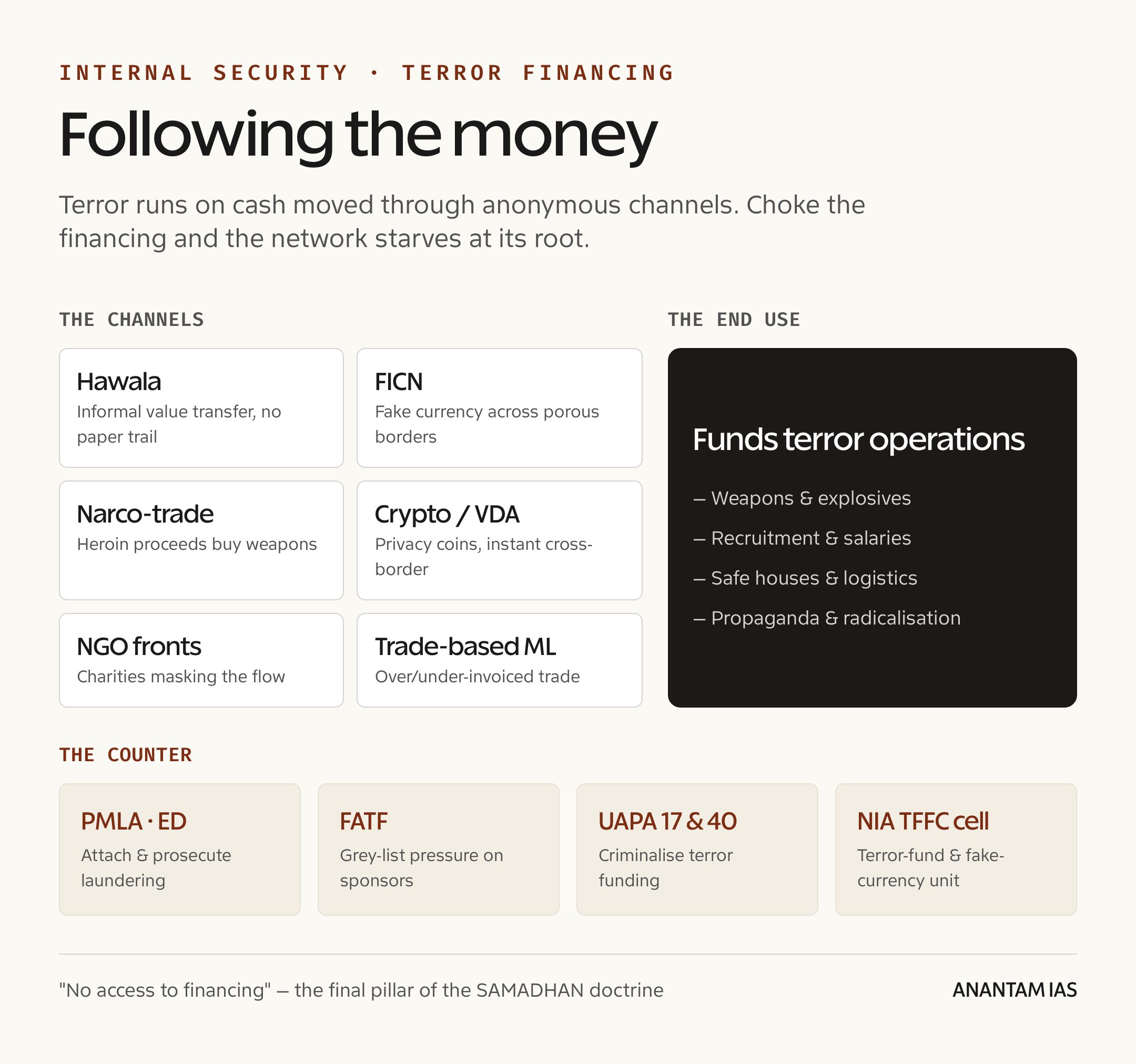
Terrorism runs on money. Disrupting the financing networks is often more effective — and more durable — than chasing individual operatives, because money leaves a trail and starves the organisation at its root. This is why “No access to financing” is the final pillar of the SAMADHAN doctrine.
The Channels
- Hawala: an informal value-transfer system operating outside banks, settling cross-border payments through trust networks with no paper trail. Its anonymity and speed make it the backbone of terror financing in South Asia.
- Counterfeiting (FICN): Fake Indian Currency Notes, pushed across the India–Nepal and India–Bangladesh borders to both fund operations and sabotage the economy. The 2016 demonetisation cited FICN as one target.
- Narco-trafficking: the Golden Crescent supplies heroin whose proceeds buy weapons; the drug routes and the arms routes are the same routes, increasingly flown by drone.
- Cryptocurrency and virtual assets: the fastest-growing concern — dark-web transactions, privacy coins, and crypto wallets that move value across borders instantly. The 2019 UAPA amendment and PMLA provisions now extend to virtual digital assets.
- NGO and charity fronts: organisations posing as charitable trusts to channel funds. Amendments to the Foreign Contribution (Regulation) Act, FCRA, target this conduit.
- Trade-based money laundering: over- and under-invoicing of legitimate trade to move value while disguising its origin.
The Legal and Institutional Counter
The Prevention of Money Laundering Act (PMLA), 2002, enforced by the Enforcement Directorate, is the financial spearhead; the Supreme Court upheld most of its provisions in Vijay Madanlal Choudhary v. Union of India (2022). The UAPA itself criminalises terror financing under Sections 17 and 40, and the NIA runs a dedicated Terror Funding and Fake Currency Cell.
Globally, the Financial Action Task Force (FATF), established in 1989, sets the standards for combating money laundering and terror financing through its 40 Recommendations. It maintains two lists: the “black list” (high-risk jurisdictions calling for counter-measures — historically Iran and North Korea) and the “grey list” (jurisdictions under “increased monitoring” that have committed to an action plan). Grey-listing is a powerful economic lever because it raises the perceived risk of doing business with a country, deters foreign investment, and complicates access to loans from the IMF and World Bank.
Pakistan sat on the grey list from 2018 to October 2022, and the resulting scrutiny visibly squeezed its already fragile economy and forced at least cosmetic action against UN-designated terrorists. It was removed after the FATF judged it had substantially completed its action plans, though it remained only partially compliant on mutual legal assistance. After the Pahalgam attack, India launched a renewed diplomatic campaign to have Pakistan re-listed, building a dossier on its continued failure to act against terror financiers and arguing that international lending was indirectly subsidising a state sponsor of terror. India itself, by contrast, received a strong rating in its FATF mutual evaluation, strengthening its hand to make this case. India also hosted the third No Money For Terror (NMFT) ministerial conference in New Delhi in 2022, pressing the global agenda on choking terror funds.
Emerging and Future Threats
The threat is migrating from the camp to the cloud, and from the rifle to the remote control. Four frontiers define the next decade.
- Weaponised drones. The June 2021 attack on the Jammu Air Force station — the first use of drones to bomb an Indian military installation — announced a new era. Along the Punjab and J&K borders, drones now routinely drop weapons, RDX, and narcotics. Cheap, hard to detect, and deniable, they are the perfect proxy tool, and counter-drone systems are racing to catch up.
- Cyber-terrorism. Attacks on critical infrastructure — power grids, financial systems, ports, hospitals — could inflict mass disruption without a single gunshot. India’s growing digital dependence widens this attack surface every year.
- AI and deepfakes. Generative AI lowers the cost of propaganda, enables convincing disinformation and impersonation, and could automate radicalisation and recruitment at scale.
- Maritime and CBRN. The 26/11 sea route remains a vulnerability, and the low-probability, high-consequence risk of a radiological “dirty bomb” keeps CBRN preparedness on the agenda.
India has begun to institutionalise responses: the National Critical Information Infrastructure Protection Centre (NCIIPC) guards designated critical sectors, CERT-In coordinates cyber-incident response, and the armed forces have stood up counter-drone and electronic-warfare capabilities. But the defining feature of these threats is asymmetry — a hostile actor needs only one success, while the defender must be right every time, and the attack surface keeps expanding as India digitises. The same technologies also cut the other way: the state now deploys drones, satellite surveillance, facial recognition, big-data analytics, and AI-driven pattern detection for its own counter-terror operations, turning the technology contest into a permanent race between offence and defence.
The Economic Cost of Terrorism
Terrorism’s price is not counted only in lives. It distorts entire regional economies and diverts national resources from development. Tourism — a lifeline for Jammu & Kashmir — collapses after every major attack; the Pahalgam massacre, which deliberately targeted tourists, was calculated precisely to wreck the Valley’s hard-won economic revival. Investor confidence and FDI shrink in regions perceived as unstable, perpetuating the very underdevelopment that breeds grievance. The opportunity cost of security spending is enormous: every rupee spent on counter-insurgency in the Red Corridor or on border fencing is a rupee not spent on schools or hospitals. And the Maoist insurgency’s deepest legacy is the arrested development of central India’s mineral-rich tribal belt, where decades of conflict kept roads, banks, and industry out of some of the country’s poorest districts. Security and development are not a trade-off here — they are the same project.
Global studies of the economic impact of terrorism consistently find that its costs ripple far beyond the immediate destruction — through higher insurance and security overheads, lost productivity, capital flight, and the long shadow it casts over trade and travel. For a developing economy like India’s, every diversion of scarce capital from human development to security is a compounding loss. This reframes counter-terrorism not as a purely military expense but as an investment in the conditions for growth — which is exactly how a strong GS3 answer should position it.
Challenges in India’s Counter-Terror Response
- Federalism friction. “Police” and “public order” are State subjects, so the Centre cannot impose a unified operational structure — the reason the NCTC was shelved. Genuine cooperative federalism, not central diktat, is the only workable path.
- Intelligence silos. Multiple agencies still hoard rather than share; the MAC was meant to fix this, but fusion remains imperfect. Every post-attack inquiry rediscovers the same lesson.
- Liberty versus security. Each strong anti-terror law — TADA, POTA, UAPA — has been misused, eroding public trust and, in minority-majority regions, the very legitimacy on which counter-terror depends.
- Justice delays. Terror trials drag on for years; with bail near-impossible under UAPA, the process itself becomes the punishment, and acquittals after long incarceration corrode faith in the system.
- Online radicalisation. Encrypted, borderless, and individual, it defeats the surveillance model built for organised networks.
- Porous borders. Long, difficult terrain on the Pakistan, Nepal, Bangladesh, and Myanmar frontiers remains exploitable despite smart-fencing.
- Capacity gaps. State police forces — the genuine first responders — are under-staffed, under-trained, and under-equipped, the unglamorous weak link that police reforms have long sought to fix.
International Cooperation
No country defeats transnational terrorism alone. The global threat itself has shifted — away from large, hierarchical organisations holding territory and towards decentralised, online-driven, lone-actor violence, even as state sponsorship persists in regions like South Asia. This makes intelligence-sharing, financial cooperation, and common legal standards more important than ever, because a threat that lives on borderless platforms cannot be policed within borders. India’s diplomacy works on several tracks at once.
- CCIT: India’s flagship proposal, pending since 1996, to give the world a single legal definition of terrorism. Its non-adoption is the central gap in the global framework.
- UN mechanisms: UNSC Resolution 1373 (2001) obliges all states to criminalise terror financing and freeze assets, while the 1267 Sanctions Committee designates individuals and entities. India’s sustained campaign finally got JeM chief Masood Azhar designated by the UN in 2019, after years of Chinese vetoes.
- FATF: the financial-standards body whose grey-listing of Pakistan proved one of the most effective levers India has wielded.
- Regional and plurilateral: the SCO’s Regional Anti-Terrorist Structure (RATS), BIMSTEC counter-terror cooperation, the Quad‘s counter-terrorism working group, and the Global Counter-Terrorism Forum (GCTF).
- Bilateral: deep intelligence-sharing with the US (a joint working group since 2000), France, and increasingly the Gulf states, whose cooperation on extradition and terror financing has grown markedly.
- Diplomatic mobilisation: after Pahalgam and Operation Sindoor, India dispatched multi-party parliamentary delegations to dozens of world capitals to make the case against cross-border terrorism — a model of using diplomacy to build a coalition around a kinetic response.
The persistent obstacle is the safe-haven and extradition problem. Fugitives like Dawood Ibrahim and Hafiz Saeed have lived for years under the protection of a hostile state, and India has struggled to secure the extradition even of those who have fled to friendlier jurisdictions, given slow legal processes and the political sensitivities around terrorism designations. This is the practical reason the CCIT matters so much: without an agreed definition, one country’s terrorist remains another’s political refugee, and the global net stays full of holes. India’s strategy has therefore been to combine relentless legal documentation, multilateral designations through the 1267 Committee, and economic pressure through the FATF — recognising that no single lever is decisive on its own.
The Way Forward
A durable counter-terror posture rests on more than firepower. The clearest template is the Naxal model: the Red Corridor did not collapse because of force alone but because force was fused with roads, banks, mobile towers, welfare saturation, and an attractive surrender-and-rehabilitation offer — pressure on the armed core while the surrounding population was given a stake in the mainstream. The same integrated logic, adapted to each theatre, is what the priorities below try to capture:
- A whole-of-government approach that fuses intelligence, policing, finance, diplomacy, and development rather than running them in separate lanes.
- Revisit the NCTC in a federally acceptable form — built through consensus with the states rather than imposed — to close the coordination gap 26/11 exposed.
- Invest in de-radicalisation and CVE at scale, community-led and rights-respecting, so that the online recruitment pipeline is met by a credible counter-narrative.
- Strengthen financial intelligence to keep pace with crypto and trade-based laundering, and sustain the diplomatic pressure on terror financiers through FATF.
- Modernise border management with counter-drone systems, sensors, and surveillance, while building genuine police capacity at the state level.
- Address root causes — the Red Corridor’s collapse must be cemented with land, forest, and governance reforms so the vacuum does not refill, and the same logic must guide policy in J&K and the Northeast.
- Push the CCIT diplomatically while deepening bilateral and plurilateral cooperation, since terror financing and safe havens are inherently transnational. Probity matters too: probity in governance closes the corruption gaps that terror networks exploit.
Conclusion: Using This in the Exam
The arc of terrorism in India over the past decade is one of contraction and consolidation: the Red Corridor declared effectively ended, the Northeast pacified by accords, and a new retaliatory doctrine — articulated through the surgical strikes, Balakot, and Operation Sindoor — that treats a terror attack as an act of war and refuses to be deterred by nuclear blackmail. But the threat has not died; it has migrated to the phone, the drone, and the lone self-radicalised individual, where the old playbook does not work.
For GS3, deploy this material analytically, never as a list. When asked about internal security, structure your answer around the threat → response → gap → way forward logic. Always link an attack to the reform it produced. Always balance the security imperative against the civil-liberties cost. And always close with a forward-looking, root-cause-aware solution. A few framings worth internalising: that India faces the full spectrum of terrorism simultaneously; that its retaliatory doctrine has escalated from coercive diplomacy to deep cross-border strikes; that security and development are complements, not trade-offs; and that the hardest contemporary threats — online radicalisation, lone wolves, drones — defeat the network-era playbook and demand a “prevent”-heavy, whole-of-society response.
Representative questions to practise against include the 2019 GS3 prompt on external state and non-state actors, recurring questions on the role of external sponsorship in fuelling internal security challenges, the linkages between terrorism, money laundering, and organised crime, and prompts on the federal challenges of counter-terror coordination. To go deeper, read the linked guides on internal security, money laundering, and police reforms in India, and connect the federalism dimension to cooperative and competitive federalism. Used well, terrorism is not a standalone topic — it is a lens through which an examiner tests whether you can hold security, rights, federalism, and development in a single coherent argument.
Watch on YouTube
Related video from the Anantam IAS YouTube channel.
Why Defining Terrorism Is Difficult

Tell Google you want more of this.
Add Anantam IAS as a preferred sourceOne tap, and this site shows up more often in your own Top Stories, AI Overviews and AI Mode. Remove it any time.