Why in News?
The Ministry of Health and Family Welfare released the latest National Health Accounts (NHA) Estimates for 2023-24, highlighting a significant increase in government health expenditure and a decline in out-of-pocket expenditure (OOPE) by households over the past decade.
The findings indicate progress towards Universal Health Coverage (UHC) and improved financial protection.
| UPSC Relevance: GS-2 Social Justice: Health; Welfare Schemes Prelims: National Health Accounts Mains: Health Sector in India: Key Trends |
Key Findings of the National Health Accounts (2013-14 to 2023-24):
| Indicator | 2013-14 | 2023-24 |
| Union Government health expenditure | ₹1.30 lakh crore | ₹4.14 lakh crore |
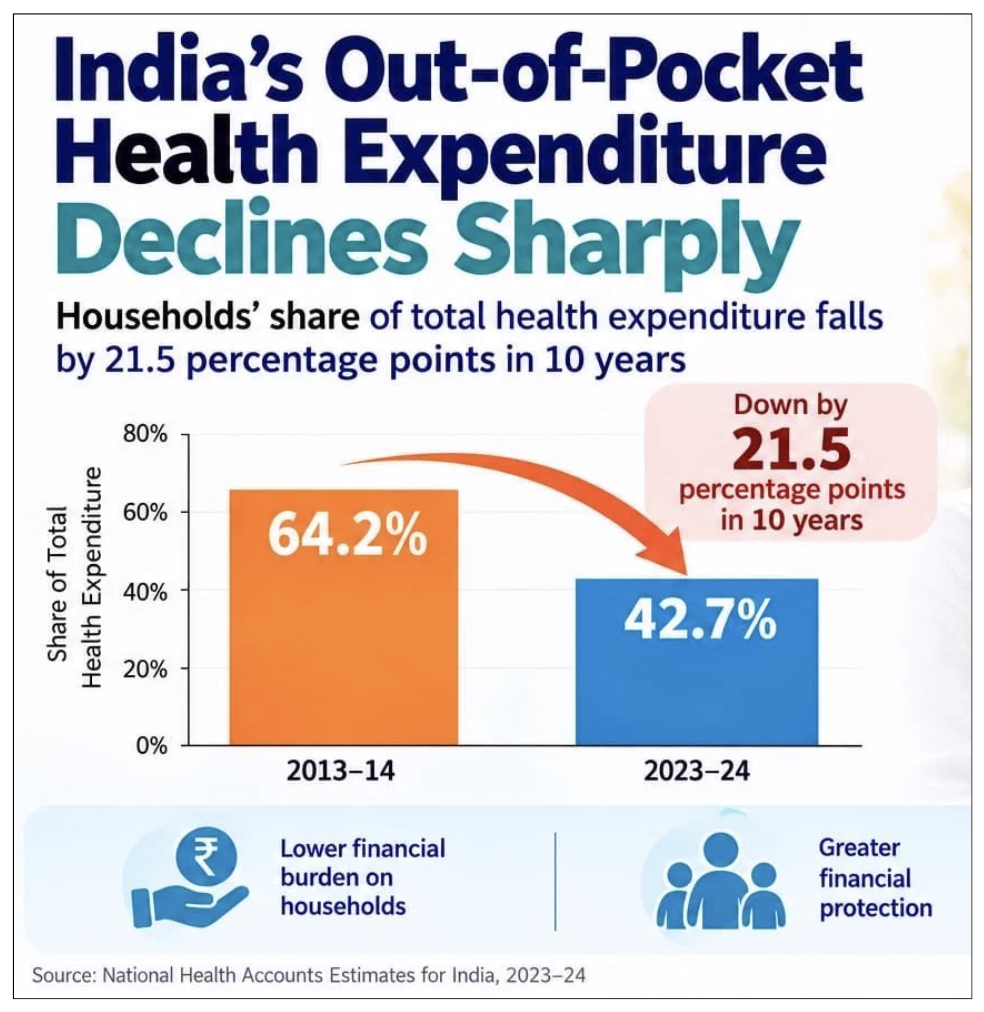
| Out-of-pocket expenditure (OOPE) as % of total health expenditure | 64.2% | 42.7% |
| Social security expenditure as % of total health expenditure | 6% | 11% |
| Private health insurance expenditure as % of total health expenditure | 3.4% | 10.2% |
| Per capita government health expenditure | ₹1,042 | ₹2,959 |
- Rising public expenditure: The government’s health expenditure (Centre + States) has more than tripled over the decade, from ₹1.30 lakh crore in FY14 to ₹4.14 lakh crore in FY24.
- Declining household burden: OOPE declined by 21.5 percentage points, indicating reduced dependence on direct household payments for healthcare.
- Increasing government contribution: The government’s share in total health expenditure increased by 14.9 percentage points.
- Expansion of social security: The share of social security expenditure rose from 6% to 11%, reflecting greater coverage through publicly funded health insurance and medical benefits for government employees.
- Growth of private insurance: Its share increased from 3.4% to 10.2%, indicating a growing role for private health insurance in healthcare financing.
Positive Impacts and Significance of the Findings:
- Progress towards Universal Health Coverage (UHC): Increased public financing improves healthcare access for economically vulnerable sections. This directly supports India’s commitment to Sustainable Development Goal (SDG) 3.8, which targets Universal Health Coverage.
- Improved Financial Risk Protection: A lower OOPE share (42.7%) reduces catastrophic health expenditure and prevents families from falling into the medical poverty trap. Publicly funded schemes like Ayushman Bharat-PMJAY have strengthened this safety net for poor households.
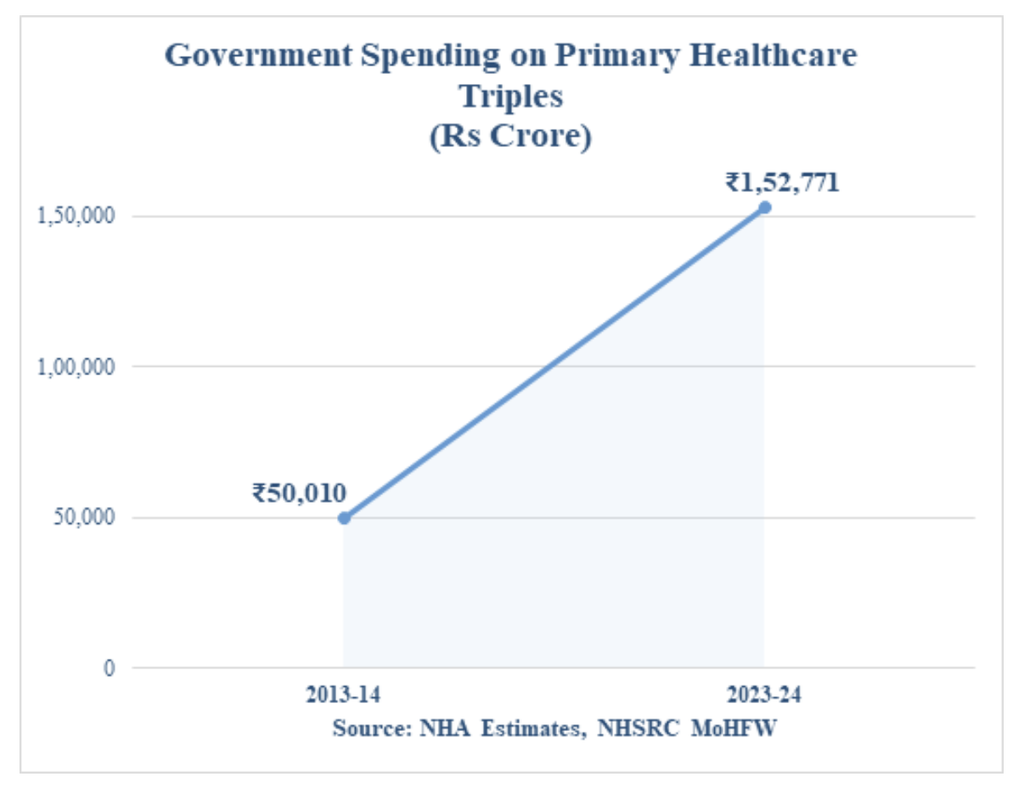
- Strengthening Primary Healthcare: Public spending on primary care touched ₹1.53 lakh crore in 2023-24. Flagship initiatives like Ayushman Arogya Mandirs, the National Health Mission (NHM), and free drugs and diagnostics have boosted preventive, promotive, and grassroots care.
- Institutional Expansion & Utilisation: Programs like Jan Aushadhi Kendras and the Pradhan Mantri National Dialysis Programme have lowered treatment costs and increased public healthcare utilisation.
- Diversification & Risk-Pooling: The doubling of social security expenditure (11%) and growth in private health insurance (10.2%) show a shift toward formal, insurance-based financing. This reduces direct financial dependence on household savings.
Challenges and Concerns:
Despite the improvement in healthcare financing indicators, several structural challenges remain:
- Inadequate public health expenditure: Government health expenditure stood at only 1.43% of GDP in 2023-24, below the National Health Policy (2017) target of 2.5% of GDP by 2025.
- Persistent household burden: Despite the decline, OOPE still accounted for 42.7% of total health expenditure, amounting to approximately ₹4.06 lakh crore in 2023-24.
- High medicine and diagnostic costs: Expenditure on medicines, diagnostics and outpatient care continues to impose a substantial burden, particularly on low-income households.
- Uneven healthcare infrastructure: Rural and remote areas continue to face shortages of doctors, specialists, diagnostic facilities and adequately equipped public health institutions.
- Inter-State Disparities: Health financing gains are uneven across the country. Empowered Action Group (EAG) states and rural areas continue to lag in medical infrastructure and workforce availability.
- Insurance coverage gaps: Insurance-based protection does not necessarily guarantee affordable and accessible treatment. Exclusions, inadequate coverage and high treatment costs can continue to expose households to financial hardship.
- Focus on curative care: Greater emphasis on hospitalisation and insurance coverage must be complemented by investments in preventive and primary healthcare.
Way Forward:
- Increase public health investment: Gradually scale up combined Union and State health spending to achieve the National Health Policy target of 2.5%.
- Prioritise primary healthcare: Strengthen Ayushman Arogya Mandirs, sub-centres and Primary Health Centres, with greater emphasis on preventive and promotive healthcare.
- Reduce medicine-related expenditure: Expand access to generic medicines through Pradhan Mantri Bhartiya Janaushadhi Pariyojana and strengthen free drugs and diagnostics programmes.
- Strengthen public health infrastructure: Address shortages of healthcare professionals, improve rural health facilities and strengthen district-level hospitals.
- Improve health insurance coverage: Strengthen PM-JAY implementation, improve portability and ensure timely reimbursement and access to empanelled hospitals.
About National Health Accounts (NHA):
- NHA provides comprehensive estimates of healthcare expenditure and the flow of funds within India’s healthcare system.
- It is prepared by the National Health Systems Resource Centre (NHSRC) under the Ministry of Health and Family Welfare.
- It follows the internationally recognised System of Health Accounts (SHA), 2011 framework, facilitating international comparisons.
- It tracks expenditure by financing sources, financing schemes, healthcare providers and healthcare functions.
Mains Practice Question:
Q. “Rising public expenditure on healthcare and declining out-of-pocket expenditure indicate progress towards Universal Health Coverage in India. However, significant structural challenges remain.” Discuss.
Tell Google you want more of this.
Add Anantam IAS as a preferred sourceOne tap, and this site shows up more often in your own Top Stories, AI Overviews and AI Mode. Remove it any time.