Why in News?
The Government of India has approved the revision of the Wholesale Price Index (WPI) base year from 2011-12 to 2022-23. Introduction of a comprehensive Producer Price Index (PPI) framework. Gradual replacement of WPI by PPI over the next five years.
The revised WPI and the new PPI series are scheduled for release by the Office of the Economic Adviser (OEA), Department for Promotion of Industry and Internal Trade (DPIIT). WPI will continue to be published alongside PPI for five years before being phased out.
| UPSC Relevance: GS-3 Economy: Economic Development, National Income Accounting Prelims: WPI, PPI, CPI, Purchaser’s Price, DPIIT |
What is the Wholesale Price Index (WPI)?
- WPI is a key economic indicator that tracks the average change in price of goods and commodities at the bulk/producer level before they reach the retail or consumer market.
- It reflects price movements of a basket of goods, including primary articles (food, oilseeds, minerals), fuel and power (petrol, diesel, LPG, electricity), and manufactured products (chemicals, textiles, metals and machinery).
- Published monthly by: Office of the Economic Adviser (DPIIT)
- Current base year: 2011-12 (being revised to 2022-23).
- WPI does not include services. WPI is used to monitor supply-side inflation and is a critical input for industry pricing, taxation and policy-making.
Current WPI Basket:
The revised WPI series expands coverage from:
- 2011-12 Series: 697 items
- 2022-23 Series: 957 items
This provides a broader representation of India’s evolving economy.
What is the Producer Price Index (PPI)?
- The Producer Price Index measures changes in prices received and paid by producers during the production process.
- Unlike WPI, PPI tracks inflation across the entire production chain, including:
- Output PPI: prices received by producers for goods and services sold.
- Input PPI: prices paid by producers for raw materials, fuel, services and other inputs.
Thus, PPI captures inflationary pressures before they reach consumers.
Plan for Release of Services PPI:
- It will be released on a quarterly basis. The release schedule is being finalised in consultation with the Ministry of Statistics and Programme Implementation.
- Initial services PPI will include seven services: Banking, Securities Transaction, Insurance, Management of Pension Funds, Railways, Air (Passenger) and Telecom.
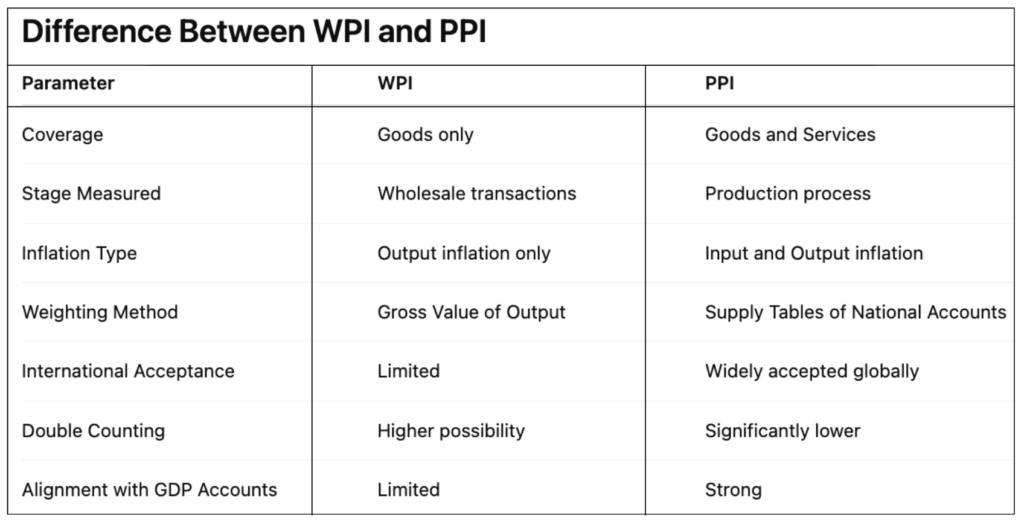
Difference between WPI and PPI:
Why is India moving from WPI to PPI?
- Better reflection of the economy: India’s economy has become increasingly service-oriented. Services contribute nearly 55% of India’s Gross Value Added (GVA). WPI excludes services entirely. PPI incorporates both goods and services. Therefore, PPI provides a more comprehensive picture of producer-level inflation.
- Alignment with International Best Practices: Most advanced economies use PPI rather than WPI. Countries such as the United States, the United Kingdom, Canada, and Australia have long adopted PPI frameworks. The transition also aligns with recommendations of the International Monetary Fund (IMF) and international statistical standards.
- Consistency with National Accounts: PPI is closely linked with the Supply and Use Tables (SUTs) and the National Accounts framework. This improves GDP estimation, Sectoral price analysis, Productivity measurement, and input-output modelling. Thus, policymakers obtain more reliable macroeconomic information.
- Captures Cost-Push Inflation Better: One major limitation of WPI is that it mainly records output prices. PPI captures both Input Inflation (Raw materials, Energy, Transport costs, Intermediate goods) & Output Inflation (prices received by producers). This helps identify whether rising production costs are being passed on to consumers.
- Eliminates Double Counting: Under WPI, the same product may appear multiple times at different stages of production. For example: Iron Ore → Steel → Automobile. Inflation may be counted repeatedly at each stage. PPI’s supply-chain-based methodology significantly reduces such double-counting, leading to more accurate inflation estimates.
- Better Policy Formulation: PPI provides early warning signals about inflationary pressures. It helps:
- RBI monitor cost-push inflation
- Government assess industrial competitiveness
- Businesses forecast pricing trends
- Policymakers understand sector-specific stress.
By aligning India’s statistical framework with global standards and modern economic realities, the PPI is expected to provide a more accurate, comprehensive, and policy-relevant measure of inflationary trends.
Tell Google you want more of this.
Add Anantam IAS as a preferred sourceOne tap, and this site shows up more often in your own Top Stories, AI Overviews and AI Mode. Remove it any time.