Why in News?
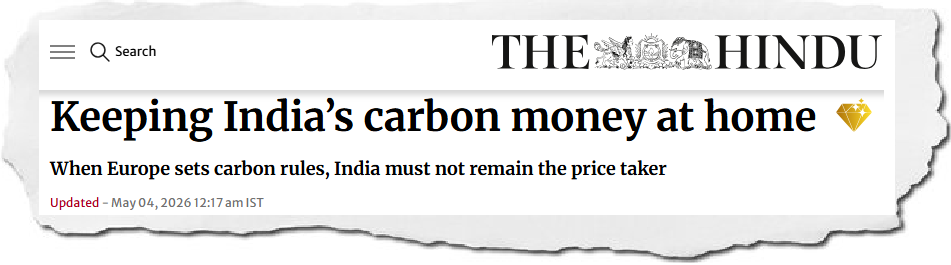
The European Union’s Carbon Border Adjustment Mechanism (CBAM) came fully into force on January 1, 2026. Simultaneously, India and the European Union concluded negotiations for a Free Trade Agreement (FTA) on January 27, 2026. The debate has intensified over whether CBAM unfairly burdens Indian exports and whether India should evolve its own carbon pricing and border adjustment mechanisms.
UPSC Relevance
GS-II: India-EU Relations, International Institutions, Global Governance
GS-III: Climate Change, Environmental Conservation, Economy, Energy Security, International Trade
Understanding the Carbon Border Adjustment Mechanism (CBAM)
The Carbon Border Adjustment Mechanism is a climate-related trade policy introduced by the European Union to impose a carbon price on imports entering the EU market.
The EU argues that domestic industries already pay carbon costs under the EU Emissions Trading System (ETS), and imported products should bear similar costs to ensure a “level playing field”.
Initially, CBAM covers carbon-intensive sectors such as:
- Steel
- Aluminium
- Cement
- Fertilisers
- Electricity
- Hydrogen
Under this mechanism, importers into the EU must pay charges corresponding to the embedded carbon emissions in imported products.
Objectives Behind CBAM
Preventing Carbon Leakage
Carbon leakage refers to industries relocating production to countries with weaker environmental standards to avoid stringent climate regulations.
CBAM seeks to prevent this by ensuring imports face comparable carbon costs.
Supporting EU Climate Goals
The mechanism is linked to the EU’s ambition of achieving climate neutrality by 2050 under the European Green Deal.
Protecting Domestic Industries
Critics argue that beyond climate concerns, CBAM also acts as a protective trade instrument shielding European industries from cheaper imports.
Why CBAM Concerns India?
Competitive Disadvantage for Indian Exports
Indian steel, cement and aluminium producers generally operate with higher carbon intensity compared to many European firms due to:
- Dependence on coal-based energy
- Older industrial technologies
- Limited access to green finance
- High transition costs
As a result, Indian exports may become costlier in European markets.
Unequal Playing Field
A major criticism is that European industries continue to enjoy:
- Free emission allowances under the EU ETS
- Subsidised public finance
- Large-scale decarbonisation support
These protections reduce their effective carbon costs even while CBAM is imposed on external exporters.
Indian producers, however, face the full burden without equivalent state support.
WTO and Trade Justice Concerns
The debate over CBAM has important implications for the global trading system.
Possible Conflict with GATT Principles
Under the World Trade Organization framework, Article III of the General Agreement on Tariffs and Trade (GATT) discourages the use of internal taxes and regulations to unfairly protect domestic industries.
Developing countries argue that CBAM indirectly functions as:
- A trade barrier
- A green protectionist tool
- A mechanism transferring adjustment burdens onto poorer countries
Climate Justice Dimension
The principle of “Common But Differentiated Responsibilities” (CBDR) under global climate governance recognises that developed nations historically contributed more to climate change and therefore should shoulder greater responsibility.
Critics argue that CBAM ignores developmental asymmetries between developed and developing economies.
India-EU Free Trade Agreement and CBAM
The India-EU FTA did not provide India any exemption from CBAM.
However, the agreement contains an important provision through Annex 14-A, which establishes:
- Technical dialogue on carbon border measures
- Recognition of effective carbon pricing paid in India
- Most-Favoured-Nation (MFN) treatment if flexibility is granted to others
This creates a limited but significant diplomatic and legal opening for India.
India’s Carbon Credit Trading Scheme (CCTS)
India notified the Carbon Credit Trading Scheme in 2023.
The scheme establishes a domestic carbon market through tradable carbon certificates.
Key features include:
- Sectoral coverage of major industries
- Market-based carbon pricing
- Compliance obligations for installations
- Gradual expansion across sectors
The scheme is intended to help India transition toward lower-carbon industrial production while maintaining economic growth.
Article 9 of CBAM and India’s Opportunity
CBAM Regulation Article 9 allows deductions for carbon prices already paid in the country of origin.
This means that if Indian exporters already pay carbon costs under India’s domestic system, these costs can potentially be adjusted against EU CBAM liabilities.
This provision becomes strategically important because:
- It prevents double carbon taxation
- It gives legitimacy to India’s domestic carbon market
- It strengthens India’s negotiating position
India Border Adjustment Mechanism (IBAM)
Concept
Experts have proposed that India create its own India Border Adjustment Mechanism (IBAM).
Under this model:
- India itself would collect carbon-related charges on exports
- These charges would be recognised under CBAM Article 9
- Indian exporters would not pay additional net carbon costs in Europe
The crucial difference is that the revenues would remain within India instead of flowing into European treasuries.
Potential Benefits of IBAM
Retaining Carbon Revenues
Instead of Europe retaining adjustment revenues, India could use these funds domestically.
Financing Green Transition
The revenues can support:
- Green steel production
- Hydrogen-based technologies
- Renewable energy expansion
- Energy-efficient industrial upgrades
- Worker transition and reskilling
Strengthening Climate Sovereignty
IBAM would allow India to shape its own climate transition rather than merely complying with external regulatory frameworks.
What are the Challenges Before India?
Industrial Readiness
Many Indian industries still rely heavily on fossil fuels and may struggle with transition costs.
Monitoring and Verification
A credible carbon pricing system requires:
- Accurate emissions accounting
- Strong monitoring mechanisms
- Transparent reporting systems
- Independent audits
Trade Retaliation Risks
Aggressive border adjustment measures could trigger trade disputes or retaliatory measures.
Balancing Development and Decarbonisation
India must simultaneously:
- Reduce emissions
- Ensure industrial growth
- Protect employment
- Maintain export competitiveness
This creates a difficult policy balancing act.
Broader Geopolitical Significance
CBAM reflects the increasing intersection of:
- Climate policy
- Trade policy
- Industrial strategy
- Geopolitics
Climate regulations are gradually becoming instruments of economic power and global influence.
For developing countries like India, the challenge is not only environmental adaptation but also ensuring policy autonomy within an evolving green global order.
Way Forward
India’s response must combine diplomacy, industrial policy and climate strategy.
Strengthening India’s Domestic Carbon Market
India must accelerate the implementation of the Carbon Credit Trading Scheme (CCTS) by gradually expanding sectoral coverage, improving emissions accounting standards, and ensuring transparent monitoring, reporting and verification (MRV) systems. A credible and compliance-grade domestic carbon market will strengthen India’s position in negotiations with the European Union regarding recognition under CBAM Article 9.
A robust domestic carbon pricing system would also reduce the risk of double carbon taxation on Indian exports.
Negotiating Mutual Recognition Under CBAM Article 9
India should utilise the institutional mechanisms available under the India-EU Free Trade Agreement, especially Annex 14-A, to secure formal recognition of carbon prices paid domestically.
The focus should be on:
- Recognition of India’s carbon credits as valid offsets
- Transparent methodologies for carbon accounting
- Exchange-rate conversion mechanisms
- Avoidance of double adjustment burdens
This would ensure that Indian exporters are not unfairly penalised.
Developing a Carefully Designed India Border Adjustment Mechanism (IBAM)
India may gradually evolve its own India Border Adjustment Mechanism (IBAM), but this must be designed cautiously and in consultation with trading partners.
An effective IBAM should:
- Be WTO-compatible
- Avoid retaliatory trade conflicts
- Align with domestic carbon pricing systems
- Ensure transparency and predictability
Most importantly, revenues generated through such mechanisms should remain within India and be utilised for domestic decarbonisation efforts.
Using Carbon Revenues for Green Industrial Transition
Carbon-related revenues should be ring-fenced into a dedicated climate transition fund.
These resources can support:
Industrial Modernisation
- Green steel production
- Low-carbon cement technologies
- Energy-efficient manufacturing systems
- Electrification of industrial processes
Renewable Energy Expansion
India must accelerate investments in:
- Solar energy
- Wind energy
- Green hydrogen
- Energy storage systems
Reducing fossil fuel dependence will lower export carbon intensity over time.
Worker Protection and Just Transition
Decarbonisation must not disproportionately burden workers and vulnerable communities.
Dedicated transition support is necessary through:
- Reskilling programmes
- Social protection measures
- Green employment generation
- Regional economic diversification
Enhancing Technological Capacity
Indian industries require access to affordable clean technologies.
India should therefore:
- Encourage domestic green technology innovation
- Expand research and development support
- Promote technology transfer partnerships
- Increase public-private collaboration
The transition to low-carbon manufacturing cannot succeed without technological upgrading.
Climate Finance and International Equity
India should continue demanding greater climate finance commitments from developed countries based on the principle of Common But Differentiated Responsibilities (CBDR).
Developed countries historically contributed more to global emissions and therefore carry greater obligations in supporting developing economies through:
- Green finance
- Technology transfer
- Capacity building
- Adaptation assistance
Climate measures should not become disguised forms of green protectionism.
Building Coalitions with Developing Countries
India should work closely with:
- BASIC countries
- BRICS nations
- G77 groupings
- Other developing economies affected by CBAM
Collective bargaining can strengthen the Global South’s negotiating position in global trade and climate forums.
A coordinated approach is essential to ensure that climate governance remains equitable and inclusive.
Ensuring WTO-Compatible Climate Policies
India’s response must remain consistent with the rules of the World Trade Organization.
This requires:
- Non-discriminatory climate measures
- Transparent carbon accounting
- Predictable trade regulations
- Scientific justification for adjustments
A rules-based approach will reduce the risk of prolonged trade disputes.
Strengthening Domestic Institutional Capacity
Effective climate-trade governance requires strong institutional coordination among:
- Ministry of Commerce
- Ministry of Environment, Forest and Climate Change
- Ministry of Finance
- Bureau of Energy Efficiency
- Industry regulators
India must develop specialised expertise in carbon accounting, climate diplomacy and green industrial policy.
Promoting Sustainable Consumption and Circular Economy
India should also reduce industrial emissions through circular economy strategies such as:
- Recycling and reuse
- Scrap-based steelmaking
- Resource efficiency
- Waste minimisation
This can simultaneously improve competitiveness and reduce environmental pressures.
Integrating Development with Decarbonisation
India’s climate strategy must reflect its developmental realities.
Unlike developed economies, India continues to face challenges relating to:
- Poverty reduction
- Energy access
- Industrialisation
- Employment generation
Therefore, India’s transition pathway must balance environmental sustainability with developmental priorities and energy security.
Conclusion
The debate over CBAM is not merely about environmental regulation; it represents a larger struggle over who controls the economics of decarbonisation in the 21st century.
For India, the challenge lies in ensuring that climate action does not become a new form of trade asymmetry. Mechanisms such as the Carbon Credit Trading Scheme and a carefully designed India Border Adjustment Mechanism could help India retain both policy autonomy and carbon revenues while participating constructively in global climate governance.
Prelims Practice Questions
1. Consider the following statements regarding the Carbon Border Adjustment Mechanism (CBAM):
- It has been introduced by the European Union.
- It aims to prevent carbon leakage.
- It currently applies only to agricultural products.
Which of the statements given above are correct?
(a) 1 and 2 only
(b) 2 and 3 only
(c) 1 only
(d) 1, 2 and 3
Answer: (a)
2. Which of the following sectors are covered under the European Union’s CBAM?
- Steel
- Cement
- Aluminium
- Hydrogen
Select the correct answer using the code below:
(a) 1 and 2 only
(b) 1, 2 and 3 only
(c) 2, 3 and 4 only
(d) 1, 2, 3 and 4
Answer: (d)
3. The principle of “Common But Differentiated Responsibilities” (CBDR) is associated with:
(a) World Trade Organization
(b) United Nations Framework Convention on Climate Change
(c) International Monetary Fund
(d) Basel Convention
Answer: (b)
Mains Practice Questions
1. “Climate-related trade measures are increasingly becoming instruments of economic power.” Examine in the context of the European Union’s Carbon Border Adjustment Mechanism (CBAM).
2. Discuss the implications of the European Union’s CBAM for India’s industrial competitiveness, climate policy and trade sovereignty.
3. Critically analyse whether carbon border taxes violate the principles of climate justice and equitable global trade.
Tell Google you want more of this.
Add Anantam IAS as a preferred sourceOne tap, and this site shows up more often in your own Top Stories, AI Overviews and AI Mode. Remove it any time.